Nail Salon POS Systems: Commission Tracking, Walk-In Flow, and the Technology Gap Nobody Talks About
Published March 2026 · 11 min read
The nail salon industry in the United States is a $10 billion market, and Vietnamese-Americans own an estimated 40-50% of those salons. This isn't a footnote — it shapes everything about how nail salons operate, from staffing models to communication patterns to the technology requirements that generic POS companies completely overlook.
I'm going to be direct about what most POS companies won't say: the nail salon has operational needs that are fundamentally different from restaurants, and most "salon POS" solutions are restaurant software with an appointment plugin bolted on. This article covers the real technology requirements of running a nail salon profitably, with specific attention to commission tracking, walk-in management, multi-language operations, and the metrics that actually matter for this industry.
Commission Tracking: The Single Most Important Feature
In most nail salons, technicians work on commission. The standard structure varies — typically 40-60% of the service price goes to the technician, with the salon keeping the remainder for rent, supplies, insurance, and profit. But that simple percentage gets complex fast.
Consider a real scenario: Technician Mai performs a full set of acrylics ($55, at 50% commission = $27.50), adds nail art on four nails ($5/nail = $20, at 60% commission because art is a specialty skill = $12), then the client adds a pedicure ($40, at 45% commission because pedicures use more supplies = $18). Mai's total commission for this one client: $57.50. Now multiply that across 8-12 clients per day, across 6-10 technicians, across 6 days a week.
Calculating this manually — as many nail salons still do, often in a paper ledger or a spreadsheet that the owner updates nightly — is error-prone, time-consuming, and a constant source of disputes. A technician believes she did 10 clients on Tuesday, the owner's records show 9. The difference might be $55, but the trust erosion is worth far more than the money.
Diva Nail Beauty, a four-location nail salon chain, switched to KwickOS and reported a 90% increase in operational efficiency. The primary driver was automated commission tracking. Every service performed by every technician is logged at the point of sale with the technician's identity verified. Commission calculations happen in real time — the technician can see their running daily total on the system. End-of-week payroll that used to take the owner 3-4 hours of spreadsheet work now takes 15 minutes: print the report, verify, pay.
The tiered commission structures that many nail salons use — where the commission percentage increases once a technician exceeds a revenue threshold — are handled automatically. Mai earns 45% on her first $2,000/week in services and 55% on everything above that threshold. The system tracks the running total and applies the higher rate when the threshold is crossed. No manual monitoring, no end-of-week adjustments, no disputes about when the threshold was actually reached.
Walk-In Management: The Nail Salon's Bread and Butter
Unlike hair salons where 70-80% of clients book appointments, nail salons typically derive 40-60% of their revenue from walk-in traffic. This creates a unique operational challenge: you need to manage a queue of waiting clients, assign them to available technicians based on skill and availability, and keep wait times reasonable so walk-ins don't leave for the salon across the street.
The walk-in flow in KwickOS works as a queue management system. When a walk-in client arrives, the receptionist adds them to the queue with their requested service. The system shows which technicians are currently available, which ones are finishing within the next 10-15 minutes, and which ones have the skills for the requested service (not every technician does nail art or specializes in acrylics).
The client sees an estimated wait time — derived from actual service durations in the system, not the receptionist's guess. "Your wait for a full set will be approximately 20 minutes" is based on the current technician's average completion time for that service, accounting for where they are in their current client's appointment. This accuracy manages expectations and reduces walkouts.
For salons that serve both walk-ins and appointments, the system prevents the classic conflict: a walk-in arrives at 2:15 PM, the receptionist assigns them to a technician, and then realizes that technician has a 2:30 PM appointment. The system blocks this by showing the technician's upcoming schedule alongside their current availability. Walk-ins are only assigned to technicians with enough open time before their next commitment.
Service Timing: Where Efficiency Meets Revenue
Time is the primary constraint in a nail salon. A technician who averages 45 minutes per manicure serves 10-11 clients in a 9-hour shift. A technician who averages 55 minutes serves 9. Over a week, that's 6-12 fewer clients — at $30 average per service, that's $180-360 in lost revenue per technician per week. Across 8 technicians, the annual impact is $75,000-150,000.
KwickOS tracks service duration from clock-in to checkout for every appointment. This data surfaces patterns that are invisible without measurement. Technician Linh consistently completes pedicures in 35 minutes. Technician Trang takes 50 minutes for the same service. Is Trang being more thorough (which clients appreciate and tip better for)? Or is Trang spending time on her phone between steps? The data doesn't answer "why" — but it identifies "where" so you can investigate.
Average service times also inform your pricing. If your gel manicure is priced at $40 and averages 50 minutes, your revenue per technician-hour is $48. If your spa pedicure is priced at $55 and averages 75 minutes, the revenue per technician-hour is $44. The pedicure feels like a bigger ticket but actually generates less hourly revenue. This analysis — simple once you have the data, impossible without it — shapes your pricing strategy and your menu design.
Inventory: Polishes, Acrylics, and the Supply Cost That Creeps
Nail salon supply costs are significant and frequently under-tracked. Acrylic powder, gel polish, monomer liquid, dipping powders, nail tips, cuticle oil, disposable files, buffer blocks, acetone, cotton — the list runs to hundreds of SKUs, each with different consumption rates and replacement cycles.
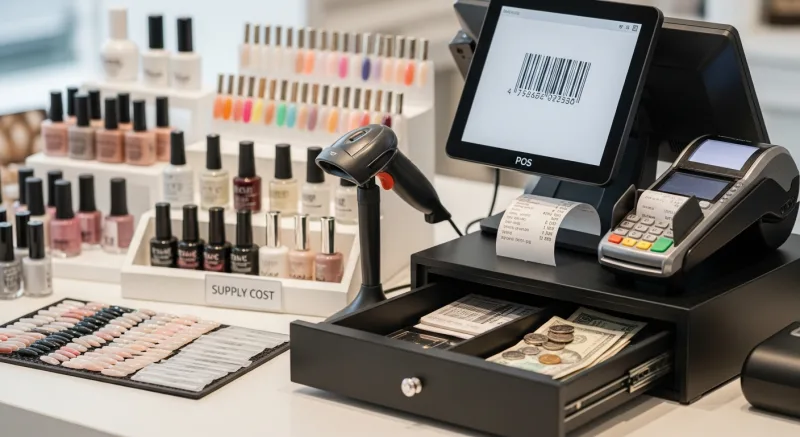
The invisible cost killer is waste and theft. A bottle of OPI gel polish costs $12-15 wholesale and should provide 15-20 applications. If your usage data (tracked through KwickOS inventory) shows a bottle lasting only 8-10 applications, you have a problem: over-application, spillage, or product walking out the door. At 50 bottles/month consumption, the difference between 15 applications/bottle and 10 applications/bottle is an extra 25 bottles — $300-375/month in excess product cost.
KwickOS tracks product usage against services performed. When a technician completes a gel manicure, the system deducts the estimated product from inventory. Over time, the system builds consumption profiles per product, per technician, per service. Variances become visible. Par levels trigger reorder alerts before you run out. The owner sees a weekly supply cost report that shows trends, not just totals.
For retail products — hand creams, cuticle oils, nail care kits, polish for home use — the inventory and sales tracking works identically to any retail POS. But because it's integrated with the service POS, you can see which services generate the most retail follow-through. Clients who get dipping powder manicures buy cuticle oil at twice the rate of clients who get regular polish. That's a cross-selling opportunity your technicians should know about.
Multi-Language: Not a Feature, a Requirement
In a Vietnamese-American owned nail salon — which describes roughly half the salons in this country — the owner and many technicians communicate primarily in Vietnamese. Clients communicate in English. Some salons also employ technicians who speak Spanish or Chinese.
A POS system that only operates in English forces the entire team to work in their second language for every transaction. This slows operations, increases errors, and creates a daily friction that most POS vendors have never considered because they've never actually worked in a multilingual salon environment.
KwickOS supports English, Chinese, and Spanish natively, with the interface language switchable per user. A Vietnamese-speaking technician will find the Chinese interface more accessible than English in many cases, given the shared character familiarity. The key point: each staff member works in their most comfortable language while the system maintains consistent data across all languages. A service entered in Chinese by one user appears correctly in English for another user pulling up the same client record.
Client-facing elements — the kiosk interface for self-check-in, the digital signage showing services and prices, the online booking page — operate in English (or whichever language you configure for your client demographic). The back-of-house and technician-facing elements operate in whatever language serves your team best. One system, multiple languages, no compromise.
The Walk-Out Problem and Digital Payments
Nail salons have a higher cash transaction percentage than most retail businesses. While cash is declining industry-wide, some nail salon clients still prefer cash, and some salon owners prefer cash for their own reasons. But the industry trend is clear: card and mobile payment adoption is accelerating, and salons that can't process digital payments smoothly are losing clients.
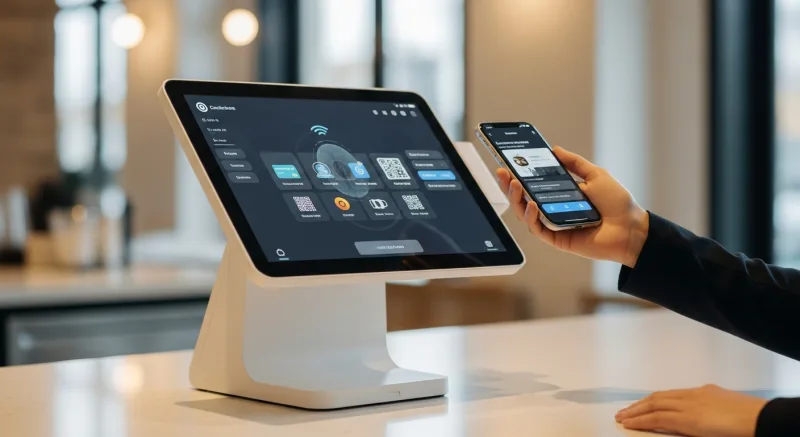
The payment processing question is especially important at nail salon volumes. A busy salon doing $50,000-70,000/month in card transactions pays significant processing fees. On Square's locked rate of 2.6% + $0.10, that's $1,370-1,870/month. On a negotiated rate through KwickOS's processor-agnostic model — say 2.15% + $0.08 — the same volume costs $1,131-1,561/month. The monthly savings of $239-309 adds up to $2,868-3,708/year. For a nail salon with typical 12-18% net margins, that processing savings is equivalent to $16,000-31,000 in additional revenue.
Tip processing matters here too. Many nail salon clients tip in cash even when paying for the service by card. The POS needs to handle split tender (card for service, cash for tip) as smoothly as full card transactions. KwickOS handles all tip scenarios: full card (tip on card), split tender, cash-only, and pre-calculated tip suggestions on the terminal screen that gently guide clients toward appropriate tip amounts.
Security and Time Tracking
Nail salons often operate with a mix of full-time technicians, part-time technicians, and booth renters. Tracking hours accurately for each category is essential for payroll compliance, commission calculations, and understanding your true labor cost per service.
KwickOS fingerprint verification eliminates the buddy-punch problem that plagues hourly workplaces. Each technician clocks in with their fingerprint — no PINs to share, no swipe cards to pass around. The system supports 1:N identification (fingerprint alone identifies the person) and 1:1 verification (enter your ID, then verify with fingerprint). This is especially relevant in salons where technicians start at different times based on their appointment schedules rather than a uniform shift start.
The fingerprint system also controls access to POS functions. A technician can process payments and view their own commission data. A manager can access all commission data, void transactions, and run reports. The owner can access financial summaries, system configuration, and multi-location comparisons. Role-based access ensures that sensitive information stays appropriately restricted.
Multi-Location: Scaling the Nail Salon Business
Successful nail salon owners frequently expand to multiple locations. Diva Nail Beauty's four-location operation is typical of the growth pattern: prove the model at one location, expand to nearby markets, and manage the portfolio centrally.
Multi-location management in KwickOS provides consolidated reporting across all stores from a single dashboard. The owner sees which location is outperforming, which technicians generate the most revenue, which services are trending up or down, and where supply costs are out of line. This visibility is impossible when each location runs a separate, disconnected POS system.
Client data also carries across locations. A regular client at your Katy location who visits your Sugarland store for convenience has their complete service history available. The technician at Sugarland sees the client's preferences, past services, and notes. The loyalty points the client earned at Katy are redeemable at Sugarland. The experience feels seamless because the technology is actually seamless — one platform, multiple locations.
The Real Cost Comparison
A nail salon running separate tools typically pays:
- POS system: $50-80/month
- Payment processing (locked rate on $50K): $1,350-1,500/month
- Scheduling/booking tool: $25-80/month
- Commission tracking (manual labor): 3-4 hours/week owner time
- Client management CRM: $30-60/month
- Digital signage: $30-50/month per screen
Total software cost: $1,485-1,770/month, plus 12-16 hours/month of owner time on commission calculations. At a conservative $30/hour value for the owner's time, that's another $360-480/month in labor.
KwickOS consolidates all of these functions into one platform with processor-agnostic payment processing. The software subscriptions collapse into a single platform fee. The commission calculations happen automatically, reclaiming 12-16 hours/month of the owner's time. The processing savings alone — moving from a locked 2.6% to a negotiated 2.15% on $50K/month — saves $225+/month.
Conservative total monthly savings: $400-700 in direct costs plus $360-480 in recovered owner time. That's $9,120-14,160/year for a single location. For Diva Nail Beauty's four locations, the annualized impact approaches $40,000-56,000 — real money that funds expansion, renovations, or simply makes the business more sustainable.
What Diva Nail Beauty Actually Experienced
The numbers above are estimates. Here's what we know from the real deployment: Diva Nail Beauty operates 4 stores with 4 KwickOS terminals. Their reported outcome was a 90% increase in operational efficiency. That efficiency gain came from three primary sources: automated commission tracking that eliminated manual calculations, integrated walk-in queue management that reduced client wait times and walkouts, and consolidated multi-location reporting that gave the owner visibility across all four stores without visiting each one daily.
The 90% efficiency figure isn't about processing transactions faster — any modern POS handles that adequately. It's about eliminating the administrative overhead that consumed hours of management time daily. Hours that now go toward growing the business, training technicians, and being present in the salons rather than hunched over spreadsheets in a back office.
Choosing Technology That Respects Your Business
The nail salon industry deserves technology built with its actual needs in mind. Commission tracking that works. Walk-in management that flows. Multi-language support that recognizes the workforce reality. Inventory tracking granular enough for polishes and acrylics. Service timing data that drives efficiency. Multi-location management for growing businesses.
If your current POS makes you work around its limitations rather than working with your operations, the system is wrong for your business. You shouldn't have to adapt your salon to fit your software. The software should fit your salon.
Join Diva Nail Beauty and 5,000+ businesses on KwickOS. Call (888) 355-6996 or visit kwickos.com.
The Revenue Features Most "All-in-One" Systems Charge Extra For
When POS companies say "all-in-one," they rarely mean gift cards and loyalty are included. Toast charges $75/month for their loyalty add-on. Square Loyalty starts at $45/month. Clover requires third-party apps. KwickOS includes all of these natively — zero extra cost.
Physical & Electronic Gift Cards
Sell branded physical cards at the register. Send e-gift cards via text or email. Track balances across every location in real time. Gift card holders spend 20-40% more than face value — this is not a nice-to-have, it is a revenue multiplier.
Points-Based Loyalty System
Every transaction earns points. Customers see their balance on receipts and can redeem at checkout. Configurable earn ratios, tiered VIP levels, and automatic birthday rewards. No separate app required — it runs inside the POS your cashier already knows.
Membership & Subscription Management
Run coffee clubs, wine memberships, or VIP dining programs. Recurring billing, exclusive member pricing, and member-only items — managed from the same dashboard as your daily operations. Your customers feel special. Your revenue becomes predictable.
Real impact: businesses using KwickOS loyalty features see repeat visit rates increase by up to 35%. Gift card programs generate an average of 15% additional revenue during holiday seasons.

Tom Jin
Founder & CIO of KwickOS · 30 Years IT · 20 Years Restaurant Industry
Tom built KwickOS after decades running restaurants and IT companies. Today KwickOS serves 5,000+ businesses across 50 states.