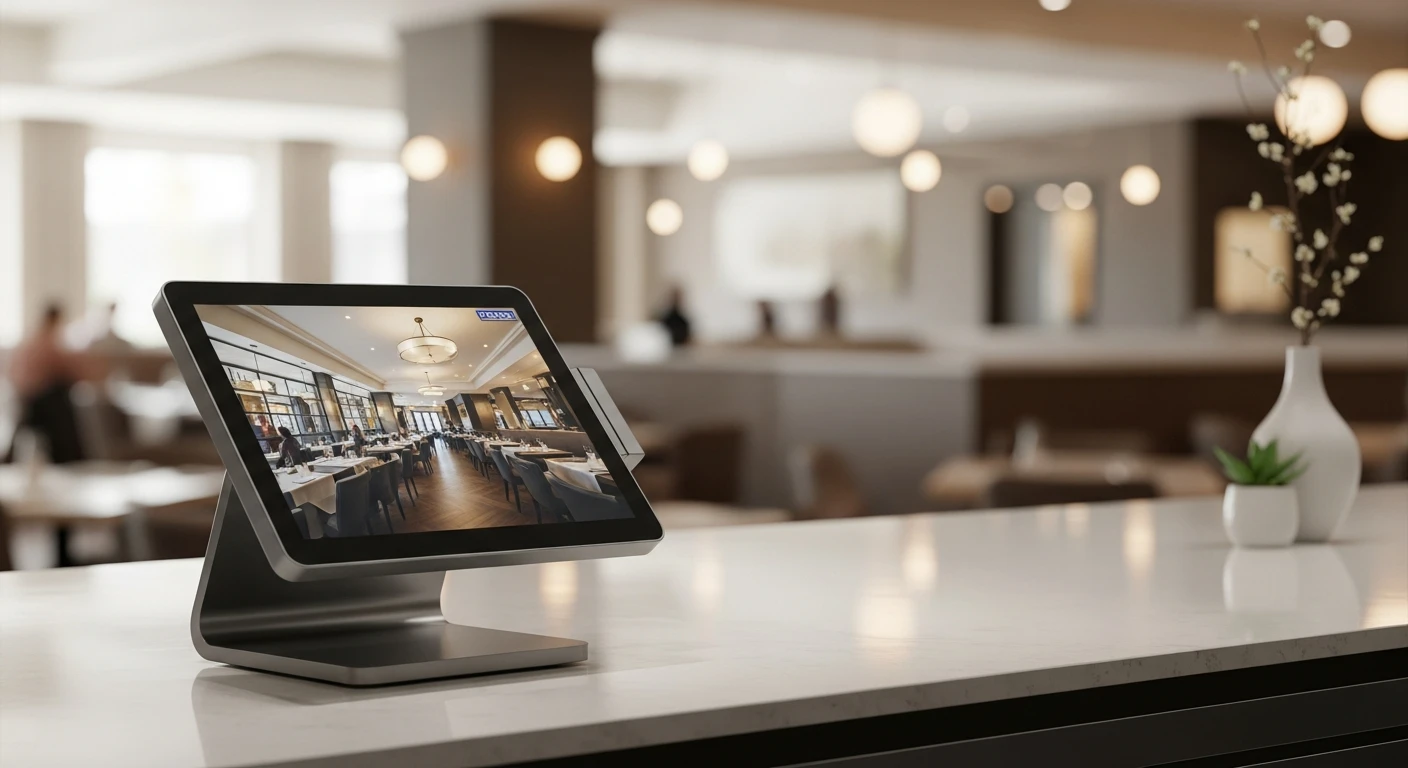
Running a restaurant without the right pos is like driving without a dashboard. I have watched this scenario play out dozens of times. A restaurateur opens a second location and manages through sheer effort — driving between stores, calling managers, manually comparing spreadsheets. It works, barely, because they are personally involved enough to catch problems. Then they open a third location and suddenly they cannot be at all three stores. The problems they masked with personal presence become systemic failures.
The third location is the truth test for your POS system. Every weakness — fragmented reporting, disconnected loyalty, manual menu updates, per-location processing chaos — becomes an expensive, time-consuming problem that no amount of personal effort can overcome.
The Full-Service Complexity Multiplier
Full-service restaurants are the most operationally complex food service format. Each location runs a kitchen with multiple stations (grill, sauté, fry, salad, dessert), a front-of-house with hosts, servers, bussers, and runners, a bar program with its own inventory and staffing, and a management layer coordinating all of it. The POS is not just a cash register — it is the nervous system connecting every department.
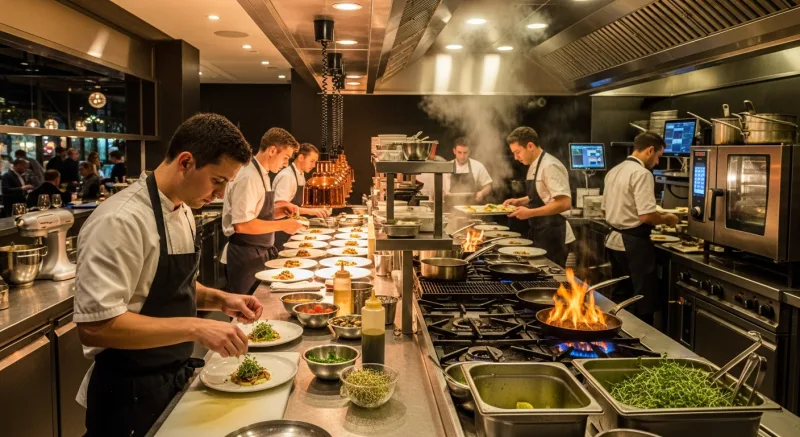
At a single location, the POS handles table assignments, order routing to kitchen stations via KDS, bar ticket management, check splitting, tipping, and end-of-night reporting. That is already a complex workflow. At three locations, every one of those workflows needs to function independently at each store while feeding data into a centralized management layer that gives ownership visibility across the entire group.
Most POS systems were built for single-location full-service restaurants. They handle the kitchen routing and table management well enough, but the multi-location management layer is either absent or bolted on as an afterthought. The result: three independent POS installations that happen to run the same software but do not share data, customers, or operational intelligence.
Centralized Reporting: The Owner's Sanity Check
A full-service restaurant group owner needs to answer a specific set of questions every morning: How did each location perform last night? Which servers drove the highest average check? What was the food cost percentage at each location? How did the bar program perform relative to food? Were there any unusual void or discount patterns that suggest a problem?
On fragmented POS systems, answering these questions requires logging into three separate back offices, pulling three separate reports, exporting to spreadsheets, and manually combining data. For a full-service restaurant with complex reporting needs (server performance, food vs. bar revenue split, course timing, table turn rates), this takes 60-90 minutes per day. That is 7.5-11 hours per week — more than a full workday — spent on data aggregation rather than data analysis.
KwickOS puts all three locations on one dashboard. One login, one screen, side-by-side comparison. Location A's average check was $52 last night; Location B's was $44; Location C's was $58. Location B's bar revenue was 18% of total (below the 25% target); time to talk to the bar manager about cocktail promotion. Location C had 4 voids over $30 (unusual); review the details. All of this in 5 minutes, from your phone, while drinking coffee at home.
T. Jin China Diner runs 15 locations and 75 terminals on this dashboard. The owner monitors every store in real time — sales, labor, inventory, exceptions. For a 3-5 location FSR group, the dashboard transforms morning reporting from a 90-minute data collection exercise into a 5-minute strategic review.
Menu Management: The Seasonal Overhaul Problem
Full-service restaurants change menus more extensively than QSRs. A seasonal menu rotation might involve removing 8 dishes, adding 10 new ones, adjusting 15 prices, updating modifiers (new sides, new sauces, dietary flags), and reorganizing the POS layout to match the new printed menu. At one location, this is an afternoon project. At three locations with separate POS installations, it is a multi-day coordination effort.
The danger is not just the time — it is the errors. When a manager at Location B manually enters the new menu, they might set the filet mignon at $42 instead of $44. The error goes unnoticed for a week because nobody compares pricing across locations until the month-end review. At 5 filet orders per night, that $2 error costs $70/week or $3,640/year at one location.
KwickOS one-click menu sync pushes the entire seasonal update to all locations simultaneously. Build the new menu at headquarters — every item, every price, every modifier, every KDS routing instruction — and push it with one click. All terminals at all locations update. No manual entry. No pricing errors. No multi-day rollout.
Crafty Crab Seafood uses this across 19 locations and 152 terminals. Their menu includes seafood boils with complex modifier trees (sauce type, spice level, protein add-ons, side selections). When headquarters adds a new seasonal sauce, all 152 terminals at 19 locations receive it in a single sync. A full-service restaurant group with 3-5 locations can push a complete seasonal menu overhaul in minutes, not days.
Cross-Location Gift Cards and Special Occasions
Full-service restaurants sell higher-value gift cards than fast-casual or QSR — typically $50-200 per card. These are gifts for birthdays, anniversaries, holidays, and corporate client appreciation. The per-card revenue is significant, and the customer experience of redeeming that gift card is a high-stakes moment. If the recipient walks into Location B with a card purchased at Location A and it does not work, the damage is disproportionate. This is not a $5 coffee card — it is a $100 dinner gift that someone chose specifically because they like your restaurant.
KwickOS gift cards sync across all locations in real time. A $150 gift card purchased at Location A is immediately usable at Location B and C. The recipient walks in, the host checks the reservation, the server takes the order, and at the end of the meal, the gift card covers $120 of the $140 check. The remaining $30 balance is available at any location for the next visit. Seamless, dignified, brand-appropriate.
For FSR groups, gift card programs can generate $200,000-500,000 in annual sales. With 10-15% breakage (unredeemed balances), that is $20,000-75,000 in pure margin. Fragmented gift cards that only work at one location suppress both the purchase volume (fewer people buy them when they know there is a restriction) and the breakage rate (frustrated recipients push harder to fully redeem). Cross-location gift cards maximize both.
Loyalty and VIP Recognition
Full-service restaurant loyalty is fundamentally about recognition. The guest who spends $400/month across your restaurant group should be recognized at every location — their favorite table, their wine preference, their birthday month. On fragmented systems, that guest's history is split across three databases. No location has the full picture. The server at Location B has no idea that the couple requesting a table is one of the group's top 50 spenders.
KwickOS unified loyalty creates one guest profile across all locations. Spend tracked everywhere. Preferences noted once, visible everywhere. Membership tiers — Silver, Gold, Platinum — earned on total cross-location spend and recognized at every front desk. When a Platinum member makes a reservation at Location C, the host sees their tier, their total lifetime spend, their dining history, and any notes from previous visits at any location.
Haidilao, with 600+ locations worldwide, built their entire brand on consistent VIP recognition across every store. A customer who has earned VIP status at one Haidilao restaurant receives VIP treatment at any Haidilao worldwide. That consistency of recognition is what drives their legendary customer loyalty. Your FSR group can implement the same principle from day one on KwickOS — it does not take 600 locations to matter. It matters at 3.
Kitchen Display Systems Across Multiple Kitchens
Full-service restaurant kitchens are orchestras. The grill station, sauté station, fry station, and expo station need to coordinate so that all items for a table arrive simultaneously. The KDS is the conductor. If Table 12 orders a steak (grill, 12 minutes), pasta (sauté, 8 minutes), and fried calamari (fry, 5 minutes), the KDS needs to stagger start times so everything arrives at expo at the same moment.
At multiple locations, KDS configuration needs to be consistent but adaptable. The routing logic (which items go to which station) should be identical across locations so a cook transferring from Location A to Location B sees familiar workflows. But station capacity and staffing may differ — Location C might have a combined grill/sauté station during slow shifts.
KwickOS KDS configuration is part of the centralized menu management. When headquarters updates an item's routing (moving a new entrée to the grill station), the routing updates at all locations. Per-location overrides are supported for stations with different configurations, but the default is consistency. Shogun Japanese Hibachi uses customized KDS displays for their hibachi station — and new staff reach proficiency in under 5 minutes because the interface is consistent and intuitive.
Payment Processing: The Multi-Location FSR Math
Full-service restaurants process higher average tickets ($35-65 per check) with fewer transactions per day compared to QSRs. The economics favor a percentage-based analysis rather than per-transaction focus.
A 3-location FSR group processing $150,000/month per location ($450,000/month total) has significant negotiating leverage. On Toast at 2.99% + $0.15 per transaction (average 150 transactions/day per location at $55 average check), processing costs approximately $13,920/month across all three locations. At a negotiated rate through an independent processor (2.15% + $0.10), the same volume costs $10,125/month.
Annual savings: $45,540.
That savings funds a general manager salary at a single location. Or a complete kitchen equipment upgrade. Or a marketing campaign that drives $200,000 in incremental revenue. The point is that processor lock-in is not a minor inconvenience for FSR groups — it is a strategic constraint that limits investment capacity.
KwickOS is processor-agnostic. One processor, one negotiated rate, all locations. The aggregate volume gives you the leverage that no single-location negotiation can match.
Staff Management and Cross-Training
FSR groups routinely share staff between locations. A server might pick up shifts at a different location when their home store is slow. A sous chef might help open a new location for two weeks before returning. A bartender might float between the cocktail-focused location and the sports-bar-focused location based on event schedules.
KwickOS fingerprint authentication (1:N matching — just touch the sensor, no ID required) works at every location. An employee clocking in at Location C on Tuesday uses the same fingerprint they use at Location A on Monday. One employee record, one timecard, one payroll integration. Permissions follow the employee — a server authorized at both locations has server-level access at both, while a manager authorized at all three has manager-level access everywhere.
This eliminates duplicate employee accounts, prevents unauthorized access (a server cannot suddenly gain manager access at a different location), and simplifies payroll for cross-location workers.
The Multi-Location FSR Readiness Checklist
- Can you see all locations' sales, labor, food cost, and exceptions on one dashboard in real time?
- Can you push a complete seasonal menu update to all locations with one click?
- Do gift cards purchased at any location work at every location instantly?
- Does the loyalty program create one guest profile with cross-location history?
- Can you use one payment processor at one rate for all locations?
- Do employees use the same authentication (fingerprint) at every location?
- Does KDS routing update automatically when the menu syncs?
- If one location loses internet during dinner service, does it continue operating at full capability?
KwickOS answers yes to all eight. Hybrid local+cloud architecture means each location runs independently at 1ms local speed with full offline capability while connecting to centralized management for reporting, menu sync, loyalty, and gift cards.
Growing Your Restaurant Group?
Schedule a demo and we will configure the multi-location dashboard, one-click menu sync, cross-location gift cards and loyalty, and KDS management for your specific restaurant group.
Get Your Free DemoOr call us directly: (888) 355-6996
Turn One-Time Diners into Regulars: Built-In Gift Cards & Loyalty
Most POS companies treat gift cards and loyalty as afterthoughts — expensive add-ons that cost $50-100/month extra. KwickOS includes them at no additional charge because we believe they are essential revenue tools, not luxury features.
Gift Cards That Actually Drive Revenue
Here is what most restaurant owners do not realize: gift card buyers spend an average of 20-40% more than the card's face value. A $50 gift card typically generates $60-70 in actual spending. KwickOS supports both physical gift cards and electronic gift cards that customers can purchase, send, and redeem through their phones.
- Physical gift cards — branded plastic cards that sit on your counter and sell themselves during holidays
- E-gift cards — customers buy and send digitally via text or email, perfect for last-minute gifts
- Balance tracking — real-time balance across all your locations, no manual reconciliation
- Reload capability — customers top up their balance, creating a built-in prepayment habit
Loyalty Points That Keep Them Coming Back
KwickOS loyalty is not a punch card from 2005. It is a digital points system that tracks every dollar spent and automatically rewards your best customers:
- Earn points on every purchase — configurable ratio (e.g., $1 = 1 point, or $1 = 10 points)
- Tiered rewards — silver, gold, platinum levels to incentivize higher spending
- Birthday rewards — automated birthday offers that bring customers back during their special month
- Points-for-payment — customers redeem points directly at checkout, seamless for your staff
Membership Programs
For restaurants running VIP programs or subscription models (like monthly coffee clubs), KwickOS membership management handles recurring billing, exclusive pricing tiers, and member-only menu items — all within the same system your cashier already uses.
The bottom line: Toast charges $75/month extra for loyalty. Square's loyalty starts at $45/month. KwickOS includes gift cards, e-gift cards, loyalty points, and membership management in every plan. That is $540-900/year you keep in your pocket.