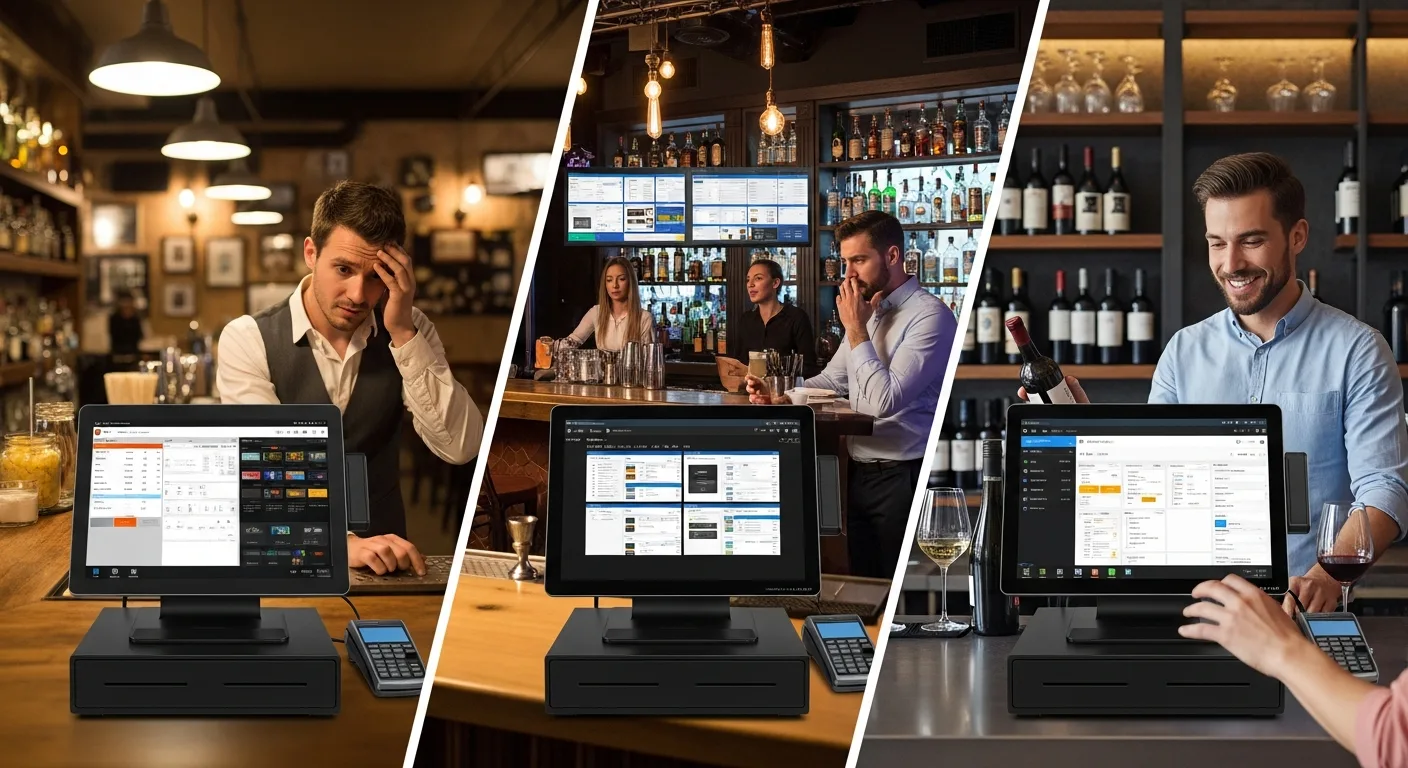
The best 3 Bars, 3 POS Systems, 3 Headaches handles everything from checkout to closing — without extra apps or workarounds. You own a cocktail bar downtown. A sports bar in the suburbs. A rooftop lounge by the waterfront. Three venues, three vibes, three menus — but one brand and one ownership group. Your customers cross-pollinate. The couple that discovers your cocktail bar on date night visits the sports bar for Sunday football. The rooftop lounge regulars buy gift cards that should work at any of your venues.
But your POS systems do not know each other. Three separate installations. Three separate inventory databases. Three separate loyalty programs. Three separate end-of-night reports that someone has to manually combine into one picture of how your bar group actually performed.
This fragmentation costs multi-venue bar operators between $25,000 and $60,000 per year — a number that sounds high until you calculate the individual line items.
The Liquor Inventory Crisis Across Multiple Bars
Liquor inventory is the single most expensive management challenge for multi-location bar operators. Unlike food inventory, which has some forgiveness in portioning, every extra half-ounce of spirits poured is pure margin erosion. Industry studies consistently show that bars lose 15-25% of their liquor inventory to overpouring, theft, and accounting errors. At a single location, this is a manageable problem. At three locations, it compounds into a crisis.
The math is stark. A bar doing $80,000/month in liquor sales with a 20% pour cost has $16,000 in liquor inventory flowing through the system monthly. A 20% loss rate means $3,200/month in unaccounted liquor — per location. Across three locations, that is $9,600/month or $115,200/year disappearing without clear explanation.
Most POS systems track liquor sales but not liquor consumption at the pour level. They know you sold 45 margaritas. They do not know whether those 45 margaritas consumed the correct amount of tequila or 30% more than the recipe calls for. Without pour-level tracking connected to your POS, the gap between what you sold and what you consumed remains invisible.
KwickOS connects sales data to recipe-based inventory. Every cocktail sold decrements the specific spirits, mixers, and garnishes from that location's inventory based on the standardized recipe. When the recipe calls for 2 oz of vodka and the bottle weighs 4 oz less than it should after 30 drinks, the system flags the discrepancy. The bar manager investigates one location's variance, not blindly auditing three venues hoping to find the problem.
The centralized dashboard shows liquor consumption across all venues simultaneously. You can compare pour accuracy at the downtown cocktail bar versus the sports bar — if the sports bar consistently shows higher variance, you know where to focus training and oversight.
Tab Management: The Friday Night Stress Test
Bars live and die by tab management. On a busy Friday night, a single location might have 60-100 open tabs simultaneously. Bartenders need to add items quickly, split tabs, transfer tabs between bar stations, and close tabs accurately — all while maintaining speed and customer satisfaction.
At multiple locations, tab management introduces additional complexity. Customers who start at your happy hour bar sometimes want to move to your nightclub venue next door. Staff who work at multiple venues need login credentials that work at each location. Managers who oversee two venues need to see open tabs at both simultaneously to assess staffing needs.
KwickOS handles multi-location tab scenarios that other systems cannot. Employee fingerprint authentication — KwickOS's 1:N fingerprint matching — means a bartender who works at both the cocktail bar and the sports bar does not need separate login credentials. They touch the sensor at whichever venue they are working, and their permissions, clock-in data, and tip tracking activate instantly. No password sharing, no duplicate accounts, no security gaps.
For managers overseeing multiple venues, the unified dashboard shows open tabs, average tab value, and close rate across all locations in real time. If the sports bar has 85 open tabs and the cocktail bar has 30, the manager can see whether the sports bar needs another bartender before the rush peaks rather than after customers start leaving due to slow service.
Gift Cards: Your Bar Group's Secret Revenue Multiplier
Bar gift cards are impulse purchases driven by celebration. Birthday dinners, holiday parties, bachelor and bachelorette weekends, corporate client gifts. The average bar gift card value is $40-75, and the breakage rate (unredeemed balance) for bars runs higher than restaurants at 12-18% because recipients often redeem partially and forget the remaining balance.
For a three-venue bar group, gift card sales can reach $60,000-100,000 annually. That is significant revenue that includes a 12-18% pure profit component from breakage. But this only works if the gift cards function across all venues. If a customer receives a gift card from someone who bought it at your cocktail bar but the recipient only visits your sports bar, and the card does not work there, you have just frustrated a customer and suppressed future gift card purchases.
KwickOS gift cards — physical and digital — work at every location in your group from the moment of purchase. No activation delays, no manual reconciliation, no "sorry, that card is for our other location." The balance syncs in real time. A $75 gift card used for $35 in cocktails downtown shows a $40 remaining balance instantly at every other venue.
Unified Loyalty for Cross-Venue Regulars
Bar loyalty programs face a unique challenge: the reward needs to match the occasion. A free appetizer works for a casual sports bar visit. A complimentary craft cocktail works for a cocktail bar visit. A VIP table upgrade works for a nightclub visit. But the points should accumulate regardless of which venue the customer visits.
On fragmented POS systems, each venue runs its own loyalty program. A customer who visits your cocktail bar twice a week and your sports bar once a week has two separate loyalty accounts earning at different rates. Neither account reflects their true spend across your brand. They are your most valuable customer type — a multi-venue regular — but your system treats them as two separate moderate customers.
KwickOS loyalty unifies across all locations. Points earned at any venue accumulate in one account. The customer hits VIP tier status based on total spend across your bar group, not per-venue spend. When they reach reward thresholds, they can choose which venue to redeem at — and the reward can be customized per venue. The cocktail bar offers a complimentary premium cocktail. The sports bar offers a free appetizer platter. Same program, venue-appropriate rewards, one customer profile.
Membership management from headquarters means you can create tiered programs — Silver, Gold, Platinum — with benefits that scale. Platinum members at Haidilao's 600+ locations receive consistent VIP treatment everywhere they visit. The same principle works for bar groups: your top 5% of customers, identified by unified cross-venue spend data, receive recognition and benefits that make them feel valued at every one of your venues.
Centralized Reporting: Tuesday Morning Instead of Tuesday Afternoon
Without a unified dashboard, Monday morning for a multi-venue bar operator looks like this: log into Venue A's back office, pull Saturday night numbers, export to spreadsheet. Log into Venue B. Repeat. Log into Venue C. Repeat. Manually combine. Calculate cover counts, average spend, bar vs. food split, tip percentages, labor cost ratios. By the time you have a complete picture, it is Tuesday afternoon and the insights are two days stale.
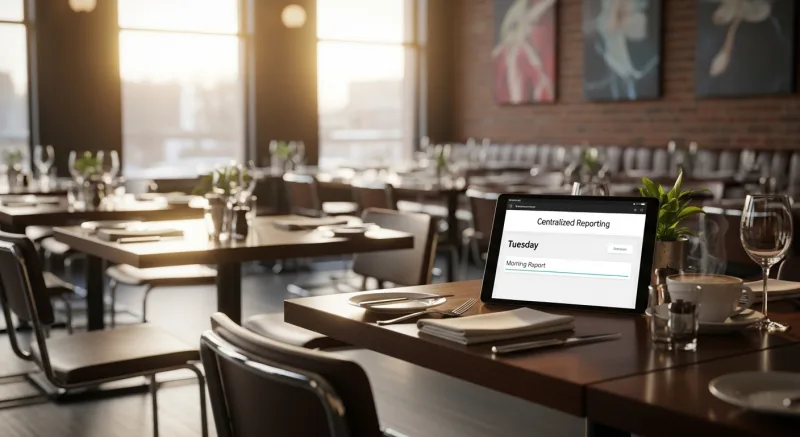
KwickOS shows all venues on one screen in real time. Saturday night at 11 PM, you can see that the cocktail bar is running at 95% capacity with $48 average spend, the sports bar peaked at 9 PM and is declining, and the rooftop lounge is ramping up. This real-time cross-venue visibility lets you make decisions while they still matter — redirect a bartender from the declining venue to the ramping one, authorize a DJ extension at the rooftop, or make a last call decision at the sports bar based on current tab data rather than gut feeling.
T. Jin China Diner uses this same dashboard model across 15 locations and 75 terminals. The real-time monitoring allows the owner to see performance across every store simultaneously. For bar groups, where revenue concentration in a few peak hours makes real-time data even more critical, the dashboard is not a luxury — it is a necessity.
Processing Freedom Across Multiple Venues
Bar groups often end up with different payment processors at different venues because each venue was set up at a different time, sometimes with different equipment vendors who bundled their preferred processor. The result: three processor relationships, three rate structures, three settlement schedules, and zero aggregate volume leverage.
A bar group processing $250,000/month across three venues has significant negotiating power — if they negotiate as one entity with one processor. Split across three processors, each venue is a $83,000/month account negotiating independently. The rate difference between a $250K/month aggregate account and an $83K/month individual account can be 0.15-0.25%, which translates to $4,500-$7,500/year in unnecessary processing fees.
Toast eliminates your negotiating power entirely — they set the rate and you pay it. Their standard 2.99% + $0.15 per transaction on bar volume (where average ticket sizes of $12-20 mean high transaction counts relative to revenue) costs significantly more than a negotiated rate. A bar processing $80,000/month through Toast pays approximately $2,520/month in processing. The same volume at a negotiated 2.2% + $0.08 costs $1,840/month. That is $680/month per venue, or $24,480/year across three venues, in processing savings alone.
KwickOS is processor-agnostic. One processor, one rate, all venues. Negotiate once, save everywhere.
Staff Scheduling and Cross-Venue Deployment
Bar groups frequently share staff between venues. A bartender might work the cocktail bar Monday through Wednesday and the sports bar Thursday through Saturday. A barback might cover wherever demand is highest on a given night. Security staff might float between venues based on event schedules.
On separate POS systems, cross-venue employees need separate accounts at each location. Their hours get tracked in two systems. Their tip pools are calculated separately. Their labor cost appears on two separate P&Ls. Payroll reconciliation becomes a manual exercise of combining time records from multiple systems.
KwickOS fingerprint authentication (1:N matching — no employee ID needed, just a finger on the sensor) works at every location. An employee clocks in at whatever venue they are working that shift. Their hours, tips, and labor cost are tracked centrally. The owner sees total labor cost across all venues and can identify whether cross-venue scheduling is actually efficient or whether the transportation time between venues is creating hidden labor waste.
Why Most Bar POS Systems Fail at Multi-Location
Toast, Square, and Clover were built for single-location operations and retrofitted for multi-location as an afterthought. The evidence is in the details:
- Toast charges per-location subscription fees. A 3-venue bar group on Toast's Growth plan pays $165+/month per location ($495+/month total) plus locked processing rates. No processor choice. No aggregate rate negotiation.
- Square allows multiple locations under one account but does not provide true unified inventory, truly cross-location loyalty, or seamless gift card operation across venues.
- Clover requires separate merchant accounts per location. Each venue is essentially a standalone business in Clover's system — separate processor relationship, separate everything.
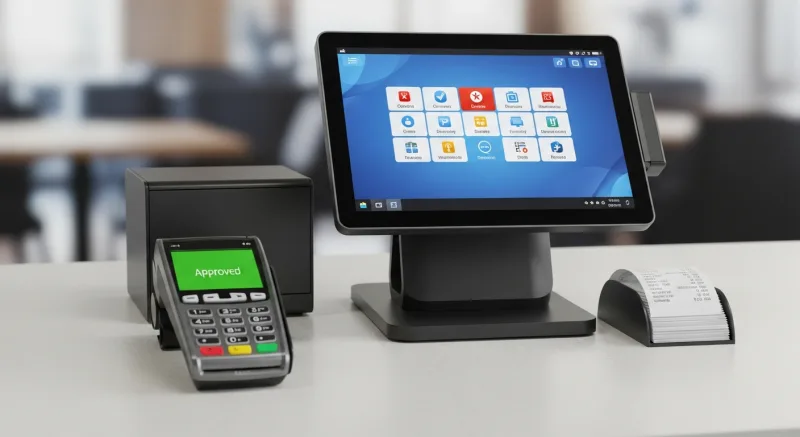
KwickOS was built for the multi-location scenario from the beginning. One dashboard, one loyalty program, one gift card system, one menu management tool, one employee database with biometric authentication, one processor relationship with aggregate volume leverage. The hybrid local+cloud architecture means each venue runs independently (1ms local processing, full offline capability) while connecting to centralized management.
The Multi-Venue Readiness Checklist
Before opening your next venue, confirm your POS handles these bar-specific multi-location requirements:
- Can employees use the same authentication (fingerprint or login) across all venues?
- Do gift cards purchased at any venue work at every other venue in real time?
- Is loyalty unified — points earned at one venue count toward rewards redeemable at any venue?
- Can you see open tabs, average spend, and capacity across all venues on one screen?
- Can you use one payment processor with one negotiated rate for all venues?
- Does liquor inventory track by recipe across all locations with centralized variance reporting?
- Can you push menu changes (seasonal cocktails, price updates) to all venues with one click?
- If one venue loses internet on a Saturday night, does it keep processing tabs and payments?
KwickOS answers yes to all eight.
Running Multiple Bar Venues?
Schedule a demo and we will show you unified tab management, cross-venue gift cards and loyalty, real-time multi-venue dashboard, and processor-agnostic savings across your bar group.
Get Your Free DemoOr call us directly: (888) 355-6996