Houston Has 11,000 Restaurants and 80 Languages. Your POS Should Speak at Least Three.
Updated March 2026 · By Tom Jin
Houston is the most ethnically diverse city in the United States, and its restaurant scene reflects this diversity with a scope that staggers comprehension. Over 11,000 restaurants serve a metropolitan area where more than 80 languages are spoken at home. The city’s Chinatown is the largest in the South. Its Vietnamese community in Midtown and the Bellaire corridor supports hundreds of pho and banh mi shops. Hillcroft Avenue has been nicknamed the “International District” for its Pakistani, Indian, and Middle Eastern restaurants. And the Tex-Mex tradition that Houston helped invent remains a culinary backbone that generates billions in annual revenue.
No other American city asks this much of restaurant technology. The POS system serving a Bellaire Chinese seafood restaurant needs to display kitchen orders in Chinese characters. The same platform serving a Hillcroft biryani house needs to handle complex combo builds with twenty possible sides. And the Tex-Mex institution in the Heights needs Spanish-language KDS for a kitchen crew that has been making fajitas the same way for thirty years. Houston does not need a POS system. It needs a POS operating system — one that adapts to every cuisine, every language, and every neighborhood in the most diverse dining city on earth.
Hurricane Harvey and the Infrastructure Lesson
Hurricane Harvey in 2017 dropped 60 inches of rain on Houston over four days. The flooding displaced 30,000 people and damaged 204,000 homes. Restaurants that survived the physical damage faced weeks of infrastructure disruption: power outages, internet service loss, supply chain interruption, and staff displacement. The restaurants that recovered fastest were those whose operations could function independently of external infrastructure.
This is not ancient history. The 2024 derecho knocked out power to over a million Houston residents in May, and Tropical Storm Beryl caused widespread outages in July of the same year. Houston faces infrastructure-disrupting weather events multiple times per year. A POS system that requires internet connectivity to process a transaction is a system that fails during precisely the moments when the community needs functioning restaurants most — in the days after a storm, when grocery stores are closed and people need a hot meal.
KwickOS processes every transaction locally. When the Comcast node flooding takes out internet service to your block in Montrose, your POS keeps running. When CenterPoint Energy’s grid goes down and you switch to generator power, KwickOS runs on the same minimal power that charges a tablet. The hybrid architecture stores all data locally and syncs to the cloud when connectivity is available, not when connectivity is required. Houston restaurants have learned through repeated experience that “always-on cloud” means nothing when the cloud’s connection to your restaurant runs through flooded infrastructure.
Bellaire Chinatown: Scale, Speed, and Chinese Characters
Houston’s Chinatown along Bellaire Boulevard is not a single district. It is a sprawling, multi-mile corridor of Chinese, Vietnamese, and Taiwanese restaurants operating at a scale that dwarfs most cities’ entire Asian food scenes. Dim sum palaces seating 500 operate alongside tiny Sichuan noodle shops. Taiwanese bubble tea chains with sophisticated ingredient customization share strip malls with Cantonese roast duck houses.
The operational commonality across this diversity is language. Kitchen staff in Bellaire read Chinese. Menu items have names that are meaningful in Chinese and approximate in English. A dim sum order for “har gow” tells the cook one thing; the Chinese characters tell them exactly how to prepare it, including the specific wrapper thickness and shrimp size that the English transliteration cannot convey.
KwickOS renders Chinese characters natively on every kitchen display, terminal, and kiosk. Tiger Sugar, a KwickOS customer with international dessert locations, built its entire ordering workflow around minimal-step personalization — customers customize drinks through a streamlined interface that matches the speed of bubble tea production rather than slowing it down with unnecessary screen taps. Electronic receipts with loyalty integration complete each transaction while building a retention database that converts first-time visitors into regulars.
The Tex-Mex Processing Tax
Houston’s Tex-Mex restaurants are high-volume, moderate-ticket operations where processing fees eat directly into already-thin margins. A busy Tex-Mex restaurant on Washington Avenue might process $90,000 monthly in card transactions with average tickets of $22-$28. Toast’s locked-in 2.99% plus $0.15 on this volume costs $2,836 per month — $34,032 per year.
The same restaurant running KwickOS with a negotiated processor at 2.1% plus $0.08 pays $1,970 per month — $23,640 per year. Annual savings: $10,392. Over five years, that is $51,960 — enough to renovate a patio, buy a walk-in cooler, or fund three months of payroll during a slow season.
Houston’s restaurant market rewards volume. The operators who thrive process enormous transaction counts at moderate ticket averages. At these volumes, the processing rate is not a minor accounting line. It is one of the largest variable costs in the business. KwickOS’s processor-agnostic architecture lets Houston operators shop rates, negotiate from a position of volume-based leverage, and switch processors when better rates become available — all without changing their POS system.
The Hillcroft International District
Hillcroft Avenue between US-59 and Bissonnet concentrates Pakistani, Indian, Bangladeshi, Afghan, and Middle Eastern restaurants in a corridor that serves Houston’s South Asian community and attracts adventurous diners from across the metro area. These restaurants feature menu structures that challenge Western POS assumptions: combination plates with multiple protein, starch, and sauce selections; family-style sharing platters that blur the line between appetizer and entrée; and dessert and beverage programs with customization depth that rivals any cocktail bar.
KwickOS modifier trees handle this complexity cleanly. A biryani combination plate with choice of protein (chicken, lamb, goat, vegetable), rice style (plain, saffron, mixed), bread selection (naan, paratha, roti), and three accompaniments from a list of twelve generates a KDS ticket that the kitchen reads as a structured build rather than a paragraph of text. Each component displays on its own line with visual distinction. The cook scans the ticket and begins production without interpretation delays.
For Hillcroft restaurants where the front counter operates in English and the kitchen in Urdu or Hindi, KwickOS’s terminal-independent language settings allow each station to run in whatever language serves the person using it. The order enters in English and displays in the kitchen in whatever format the cook needs.
T. Jin’s Houston Blueprint for Multi-Location Growth
T. Jin China Diner operates 15 locations with 75 terminals, with significant presence in the Houston metro area. Their expansion model demonstrates how a Houston restaurant group uses technology to scale without losing operational control. Each location operates with its own menu adaptations based on the neighborhood it serves — the Chinatown location emphasizes different items than the suburban location in Sugar Land — while corporate maintains real-time oversight of all locations simultaneously.
Houston’s geography makes this multi-location challenge particularly acute. The metro area spans over 10,000 square miles. A restaurant group operating in Bellaire, the Heights, and Katy manages three locations that are physically 30 miles apart, serving different demographics with different dining habits. KwickOS’s centralized dashboard with per-location customization means the owner sees all three locations’ performance on a single screen while each location runs the configuration that fits its market.
This is the growth pattern that successful Houston restaurants follow: start in one neighborhood, prove the concept, and expand outward into the sprawling suburbs where new residential development creates constant demand for dining options. A POS system that works for one location but requires a technology overhaul at three locations constrains this natural Houston growth trajectory.
The Medical Center Lunch Economy
The Texas Medical Center is the largest medical complex in the world, employing over 106,000 people across 60+ institutions. The lunch economy surrounding the Medical Center represents one of the most concentrated, time-sensitive dining markets in Houston. Doctors, nurses, technicians, and administrators have 30-45 minute lunch breaks and zero tolerance for wait times. A restaurant that cannot serve a doctor in under ten minutes loses that customer permanently to the cafeteria.
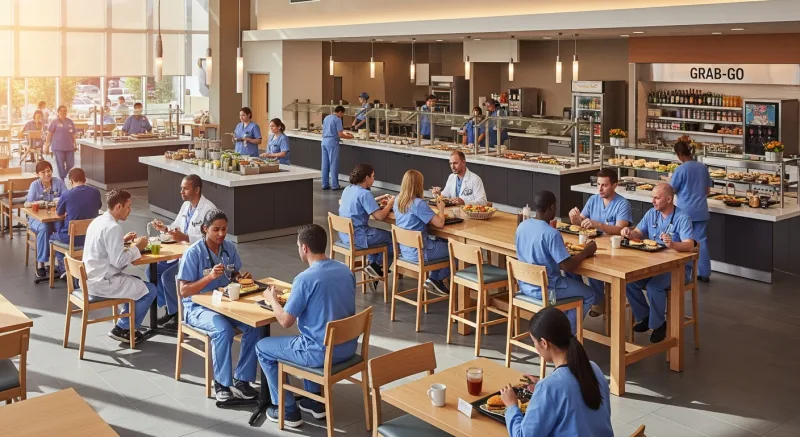
KwickOS online pre-ordering through KwickMenu transforms Medical Center lunch service. A surgeon who orders at 11:45 from the operating room locker area walks into the restaurant at 12:00 and picks up a prepared meal. The order entered the KDS at 11:45, production began immediately, and the food is bagged and waiting when the customer arrives. This integration eliminates the in-restaurant wait that Medical Center workers cannot afford.
Self-ordering kiosks further accelerate the walk-in experience. A nurse on a 30-minute break orders at a kiosk in 60 seconds, receives a pager, and sits down. The kitchen produces the order while the nurse checks messages. Total elapsed time from entry to food: four minutes. For restaurants competing for Medical Center lunch dollars against institutional cafeterias, this speed is the value proposition.
Delivery Across Houston’s Infinite Sprawl
Houston’s lack of zoning and limitless horizontal expansion create delivery distances that would be unusual in any other major city. A delivery from a Montrose restaurant to a customer in Memorial — a perfectly normal delivery radius — covers 10 miles. DoorDash charges the same 25% commission on this delivery as it does on a two-mile delivery downtown, even though the restaurant’s cost of fulfillment is dramatically higher for the longer trip.
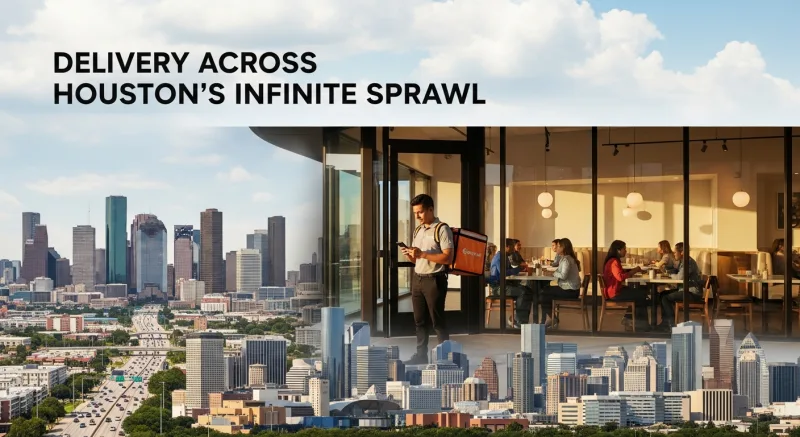
KwickDriver’s distance-based pricing ($2 per delivery plus $6.99 per five miles) creates transparent delivery economics that let Houston restaurants define profitable delivery zones. A restaurant can price its delivery service area based on actual fulfillment costs rather than a flat percentage that ignores geography. For Houston’s sprawl, this geographic pricing awareness is the difference between a profitable delivery program and one that loses money on every order outside a three-mile radius.
Fingerprint Security in Houston’s Vast Labor Market
Houston’s restaurant labor force is enormous and mobile. Workers move between establishments frequently, driven by better wages, shorter commutes, or scheduling conflicts. This mobility creates persistent security gaps in PIN-based POS systems: a departed employee’s PIN remains active because no manager remembered to deactivate it; a current employee shares their PIN with a friend who picks up a single shift; a supervisor’s PIN is known by half the staff because they typed it in front of the line one too many times.
KwickOS fingerprint 1:N eliminates every one of these vulnerabilities. A fingerprint cannot be shared. A departed employee’s fingerprint deactivates with one click. A supervisor’s biometric cannot be observed and replicated. Every void, every discount, every cash drawer open, and every time clock punch is linked to a specific human being through a credential that is physically impossible to transfer. For Houston restaurants operating with dozens of employees across multiple shifts, this self-enforcing security replaces the administrative burden that PIN management creates.
Houston’s POS Priorities
Houston asks more of restaurant technology than any other American city because Houston asks more of its restaurants than any other American city. Eighty languages, 11,000 restaurants, 10,000 square miles, and hurricane-caliber weather events create operating conditions that expose every weakness in every system.
- Hurricane-grade offline processing — Annual storms guarantee infrastructure disruption; plan for weeks, not hours
- Native Chinese language — Bellaire Chinatown kitchens require character-level display accuracy
- Native Spanish language — Tex-Mex kitchens across the city operate in Spanish
- Processor independence — Houston volumes demand negotiated rates that locked systems cannot provide
- Complex modifier architecture — Hillcroft’s combination plates and Bellaire’s dim sum need deep customization
- Multi-location scalability — Houston’s sprawl-driven expansion pattern demands technology that scales to 15+ locations
- Distance-aware delivery pricing — 10,000 square miles of metro needs geography-based delivery economics
- Medical Center speed — Pre-ordering and kiosks serve the world’s largest medical campus lunch economy
Houston does not settle for adequate. The city’s restaurants are among the best in America precisely because they refuse to compromise. Their technology should demonstrate the same standard.
Houston restaurant owners: Call (888) 355-6996 or visit KwickOS.com — headquartered right here in Spring, TX — to discuss what POS technology designed for Houston’s conditions actually looks like.
Turn One-Time Diners into Regulars: Built-In Gift Cards & Loyalty
Most POS companies treat gift cards and loyalty as afterthoughts — expensive add-ons that cost $50-100/month extra. KwickOS includes them at no additional charge because we believe they are essential revenue tools, not luxury features.
Gift Cards That Actually Drive Revenue
Here is what most restaurant owners do not realize: gift card buyers spend an average of 20-40% more than the card's face value. A $50 gift card typically generates $60-70 in actual spending. KwickOS supports both physical gift cards and electronic gift cards that customers can purchase, send, and redeem through their phones.
- Physical gift cards — branded plastic cards that sit on your counter and sell themselves during holidays
- E-gift cards — customers buy and send digitally via text or email, perfect for last-minute gifts
- Balance tracking — real-time balance across all your locations, no manual reconciliation
- Reload capability — customers top up their balance, creating a built-in prepayment habit
Loyalty Points That Keep Them Coming Back
KwickOS loyalty is not a punch card from 2005. It is a digital points system that tracks every dollar spent and automatically rewards your best customers:
- Earn points on every purchase — configurable ratio (e.g., $1 = 1 point, or $1 = 10 points)
- Tiered rewards — silver, gold, platinum levels to incentivize higher spending
- Birthday rewards — automated birthday offers that bring customers back during their special month
- Points-for-payment — customers redeem points directly at checkout, seamless for your staff
Membership Programs
For restaurants running VIP programs or subscription models (like monthly coffee clubs), KwickOS membership management handles recurring billing, exclusive pricing tiers, and member-only menu items — all within the same system your cashier already uses.
The bottom line: Toast charges $75/month extra for loyalty. Square's loyalty starts at $45/month. KwickOS includes gift cards, e-gift cards, loyalty points, and membership management in every plan. That is $540-900/year you keep in your pocket.

Founder & CIO of KwickOS · 30 Years IT · 20 Years Restaurant Industry
Tom built KwickOS after running restaurants and IT companies for decades. Headquartered in Spring, TX, KwickOS serves 5,000+ businesses across all 50 states, processing over $2M in daily sales.