Detroit’s Comeback Kitchen: The Motor City’s Restaurants Are Rebuilding on Better Technology
Updated March 2026 · By Tom Jin
A decade ago, articles about Detroit restaurants started with bankruptcy. Today they start with James Beard nominations. The city that defined American manufacturing has spent the last ten years defining something equally ambitious: a restaurant renaissance built from the ground up by operators who could not afford to make expensive mistakes. Detroit’s restaurant revival did not happen with unlimited capital. It happened with converted storefronts, shoestring budgets, and a determination to build something real in neighborhoods that the rest of the country had written off.
This bootstrapped reality has a direct consequence for technology choices. A Detroit restaurant owner who invested their savings into a Corktown space cannot absorb a $44,000 annual processing fee that a locked-in POS system extracts from a $120,000 monthly volume. They cannot afford technology that fails during Lake Michigan winter storms when delivery demand spikes. And they cannot justify paying for software add-ons — loyalty programs, gift cards, online ordering — that should be fundamental capabilities, not premium upsells.
Corktown to Midtown: The Revival Corridor
Detroit’s restaurant density concentrates along a corridor running from Corktown through downtown to Midtown, following the trajectory of the city’s broader economic recovery. Corktown’s Victorian houses now harbor some of the most celebrated restaurants in the Midwest. Midtown, anchored by Wayne State University and the Detroit Institute of Arts, supports a mix of student-friendly spots and upscale dining. Downtown’s revitalization around Woodward Avenue has filled formerly vacant storefronts with restaurants that now serve the growing residential population and the corporate workers returning to office buildings.
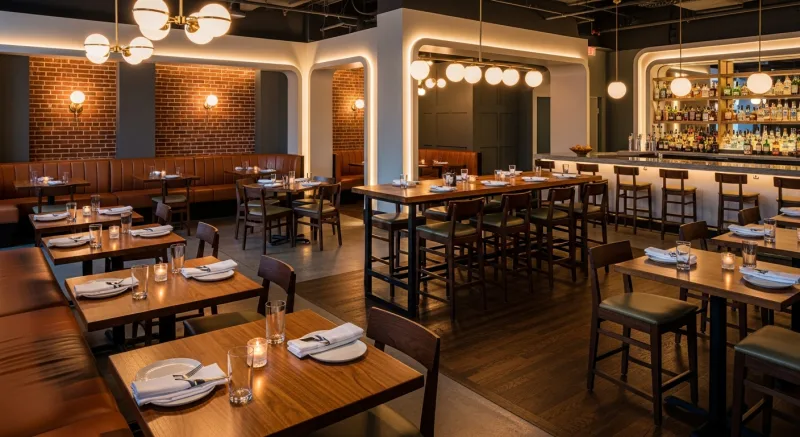
These neighborhoods share a characteristic: buildings that were never designed for restaurant use. A Corktown restaurant in a converted house has residential-grade electrical wiring. A Midtown spot in a former retail space has plumbing that was designed for a clothing store, not a dishwasher running sixteen hours a day. And the Wi-Fi infrastructure in these repurposed spaces is often an afterthought — a consumer-grade router from Best Buy serving thirty connected devices during dinner rush.
KwickOS thrives in these conditions because it does not depend on connectivity for the transaction itself. A converted Corktown house with spotty Wi-Fi runs KwickOS on local processing — 1-millisecond transaction speed regardless of signal strength. The cloud syncs when it can. The payment processes regardless. For Detroit restaurants operating in buildings that were never designed for their current purpose, this architectural independence is the difference between a system that works in the demo and one that works on a Saturday night.
Dearborn: The Arab American Restaurant Capital
Dearborn has the highest concentration of Arab Americans in the United States, and its restaurant scene reflects this community’s culinary traditions with extraordinary depth and authenticity. Lebanese, Iraqi, Yemeni, and Syrian restaurants line Michigan Avenue and Warren Avenue, serving a clientele that is knowledgeable about the cuisine, particular about authenticity, and loyal to the establishments that get it right.
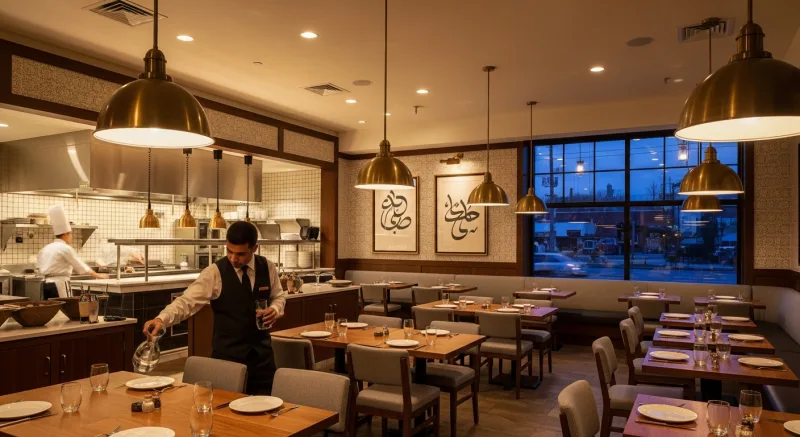
These restaurants operate with kitchen staff who work most efficiently in Arabic, menus that feature items with names that do not translate directly into English, and preparation methods that involve custom builds — shawarma plates with specific protein, sauce, and side combinations that create modifier complexity rivaling any Tex-Mex operation. KwickOS’s configurable modifier trees handle these builds cleanly, displaying the complete customer selection on the KDS in a format that the kitchen reads without interpretation.
Processing economics matter intensely in Dearborn’s competitive restaurant market. A shawarma restaurant doing $50,000 monthly in card transactions pays Toast $1,645 per month in locked-in processing. Through KwickOS with a negotiated processor at 2.1% plus $0.08, the cost drops to $1,130. The $515 monthly savings — $6,180 annually — is a consequential number for a restaurant where the owner works the grill alongside their staff.
Greektown and the Casino District
Greektown sits adjacent to Detroit’s three casinos — MGM Grand Detroit, MotorCity Casino Hotel, and Hollywood Casino at Greektown — creating a dining district that serves both the neighborhood’s Greek community and the casino visitor traffic that flows through the area late into the night. The casino-adjacent dynamic creates extended operating hours, with some restaurants serving until 2 AM to capture the post-gaming crowd.
Late-night operations require POS systems that run reliably through 18-hour shifts without degradation. KwickOS runs on Linux, which does not require the periodic restarts that Windows-based systems need to clear memory and maintain performance. A KwickOS terminal that starts at 8 AM runs with identical performance at 1:30 AM. For Greektown restaurants where the midnight-to-2-AM window represents 15-20% of daily revenue, system reliability during those final hours is not negotiable.
Casino visitors are also disproportionately likely to purchase gift cards — either for themselves as future visit motivation or for friends and family. KwickOS gift card integration captures this impulse purchasing through the same terminal that processes the dinner check. A server mentioning a gift card promotion while presenting the bill converts a table’s departure into a future visit guarantee.
Mexicantown and Southwest Detroit
Southwest Detroit’s Mexicantown corridor is one of the oldest and most authentic Mexican restaurant concentrations in the Midwest. Restaurants here are predominantly family-owned, multi-generational, and staffed by kitchen crews who speak Spanish as their first (and often only) language. The food is serious. The margins are thin. And the technology needs are specific: Spanish-language kitchen displays, affordable processing rates, and reliability that does not require an IT department to maintain.
KwickOS’s native Spanish interface runs across the entire system. Menu items, modifiers, kitchen display orders, and management reports all display in Spanish. For a Mexicantown restaurant where the owner, the cooks, and the prep staff all work in Spanish, this means operating the POS in their language rather than navigating an English system and hoping translations are accurate.
Online ordering through KwickMenu brings Mexicantown’s food to customers across the metro area who might not drive to Southwest Detroit but will order delivery. Combined with KwickDriver’s flat $2 per delivery fee, a Mexicantown restaurant can offer delivery across a 10-mile radius profitably — reaching Dearborn, downtown, and the near suburbs without the 25% commission that would make a $15 enchilada delivery a money-losing transaction.
Eastern Market: Saturday Morning and the Food Hall Model
Eastern Market is the largest open-air produce market in the country, drawing 45,000 visitors on a typical Saturday morning. The market’s surrounding blocks have evolved into a food hall and restaurant cluster that captures market-goer traffic. Operating in this environment requires POS technology optimized for high-volume, fast-transaction counter service where customers are standing, holding bags of produce, and making quick purchase decisions.
KwickOS self-ordering kiosks in Eastern Market food stalls process transactions without a staffed counter. A customer approaches, orders, pays, and receives a pickup number in under 90 seconds. The kitchen sees the order on the KDS immediately. For food stall operators who cannot afford two counter staff on a Saturday morning — one to take orders and one to prepare food — a kiosk provides the order-taking capacity while the operator focuses entirely on production.
Digital signage through KwickSign gives Eastern Market stalls the visual merchandising that drives impulse purchases. A bright, rotating display showing the day’s specials, ingredient sourcing stories, and customer reviews catches eyes in a way that a handwritten menu board does not. In a market environment where 45,000 potential customers walk past your stall, the digital display is the first point of engagement.
The Winter Delivery Lifeline
Michigan winters hit Detroit harder than they hit most cities because Detroit’s infrastructure challenges compound the weather’s impact. Snow removal is inconsistent in some neighborhoods. Power outages are more frequent than in surrounding suburbs. And when temperatures drop below zero, Detroiters stay home and order delivery in volumes that can make or break a restaurant’s monthly numbers.
KwickDriver at $2 per delivery transforms winter delivery from a margin-eroding obligation into a profit center. A restaurant processing 40 deliveries per night during a January cold snap keeps $40 more per night through KwickDriver versus DoorDash on $30 average orders. Over 90 winter delivery nights, that is $3,600 in additional retained revenue — money that bridges the gap between winter expenses and spring recovery.
KwickOS’s offline processing ensures that when a winter storm knocks out internet in a neighborhood with aging infrastructure, the restaurant keeps taking orders, processing payments, and running its kitchen. The delivery platform may temporarily lose cloud features, but the core transaction processing continues on local hardware. For Detroit restaurants where infrastructure reliability cannot be taken for granted, this local-first architecture is not a premium feature. It is a survival requirement.
The Auto Industry Lunch Economy
Detroit’s remaining auto industry operations — along with their supplier networks, engineering centers, and corporate offices — create a weekday lunch economy in suburbs like Dearborn (Ford), Auburn Hills (Stellantis), and Warren (General Motors). These are high-volume, compressed-window lunch operations serving thousands of workers in 90-minute windows. The restaurants that serve them need speed above all else.
KwickOS integrates online pre-ordering through KwickMenu so that factory and office workers order before their lunch break starts. The order enters the KDS, production begins, and the food is ready for pickup when the worker arrives. This eliminates the lunch-line wait that causes workers to choose a faster competitor. A restaurant offering 5-minute guaranteed pickup through pre-ordering captures the auto-industry lunch crowd that a 15-minute wait-time restaurant loses.
Fingerprint Accountability in High-Turnover Detroit
Detroit’s restaurant labor market reflects the city’s broader economic challenges: high turnover, inconsistent availability, and a workforce that moves between establishments frequently. Traditional POS security based on PIN codes fails in this environment because PINs are shared on day one, former employees’ codes remain active weeks after departure, and no manager has time to audit PIN usage when they are also cooking, serving, and managing.
KwickOS fingerprint 1:N identification solves this systemically. Each employee registers a fingerprint. Every action they take on the POS is biometrically verified and logged. When they leave, access ends instantly. No PIN to revoke. No access card to retrieve. The security model requires zero ongoing administrative effort while providing complete accountability. For Detroit restaurants where the owner is also the manager, the cook, and the IT department, this self-managing security is essential.
Detroit’s POS Requirements for a City in Motion
Detroit is not what it was. The restaurants being built here are ambitious, scrappy, and cost-conscious in a way that translates directly into technology decisions. Every dollar of processing cost, every hour of system downtime, and every missing feature that requires a third-party add-on is a dollar, an hour, or a fee that a Detroit restaurant operator feels personally.
- Processor independence — Every basis point saved in processing costs goes directly to survival and growth
- Infrastructure resilience — Converted buildings and aging networks demand local transaction processing
- Spanish and multilingual support — Mexicantown and Dearborn kitchens operate in their communities’ languages
- All-inclusive features — Loyalty, gift cards, and online ordering must be included, not upsold
- Self-ordering kiosks — Eastern Market and counter-service operations need automated throughput
- Flat-rate delivery — Winter delivery is a lifeline, not a luxury; protect the margin
- Fingerprint security — High turnover needs biometric accountability, not administrative PIN management
- Digital signage — Market environments and foot-traffic locations need dynamic visual merchandising
Detroit builds things. It always has. The restaurants being built here deserve technology that builds alongside them rather than extracting from them.
Detroit restaurant owners: Call (888) 355-6996 or visit KwickOS.com to see what POS technology designed for real-world conditions delivers in a city that knows something about reinvention.
Turn One-Time Diners into Regulars: Built-In Gift Cards & Loyalty
Most POS companies treat gift cards and loyalty as afterthoughts — expensive add-ons that cost $50-100/month extra. KwickOS includes them at no additional charge because we believe they are essential revenue tools, not luxury features.
Gift Cards That Actually Drive Revenue
Here is what most restaurant owners do not realize: gift card buyers spend an average of 20-40% more than the card's face value. A $50 gift card typically generates $60-70 in actual spending. KwickOS supports both physical gift cards and electronic gift cards that customers can purchase, send, and redeem through their phones.
- Physical gift cards — branded plastic cards that sit on your counter and sell themselves during holidays
- E-gift cards — customers buy and send digitally via text or email, perfect for last-minute gifts
- Balance tracking — real-time balance across all your locations, no manual reconciliation
- Reload capability — customers top up their balance, creating a built-in prepayment habit
Loyalty Points That Keep Them Coming Back
KwickOS loyalty is not a punch card from 2005. It is a digital points system that tracks every dollar spent and automatically rewards your best customers:
- Earn points on every purchase — configurable ratio (e.g., $1 = 1 point, or $1 = 10 points)
- Tiered rewards — silver, gold, platinum levels to incentivize higher spending
- Birthday rewards — automated birthday offers that bring customers back during their special month
- Points-for-payment — customers redeem points directly at checkout, seamless for your staff
Membership Programs
For restaurants running VIP programs or subscription models (like monthly coffee clubs), KwickOS membership management handles recurring billing, exclusive pricing tiers, and member-only menu items — all within the same system your cashier already uses.
The bottom line: Toast charges $75/month extra for loyalty. Square's loyalty starts at $45/month. KwickOS includes gift cards, e-gift cards, loyalty points, and membership management in every plan. That is $540-900/year you keep in your pocket.

Founder & CIO of KwickOS · 30 Years IT · 20 Years Restaurant Industry
Tom built KwickOS after running restaurants and IT companies for decades. He relocated the company to a 10,000 sq ft office in 2023 and now serves 5,000+ businesses across all 50 states, processing over $2M in daily sales.