Thirty Below Zero and Your POS Just Crashed: A Minneapolis Restaurant Technology Reality Check
Updated March 2026 · By Tom Jin
Minneapolis holds an uncomfortable distinction: it is the coldest major city in the contiguous United States. Average January temperatures of 13 degrees Fahrenheit, with wind chills routinely reaching minus 30, create an operating environment for restaurants that is unique in American dining. Five months of genuine winter transform every aspect of restaurant operations — from delivery logistics to dining patterns to the fundamental question of whether your technology works when the temperature outside would freeze exposed skin in ten minutes.
The Twin Cities support approximately 3,800 restaurants serving a metro population of 3.7 million people with one of the highest per-capita dining rates in the Midwest. The food scene has evolved far beyond hotdish and lutefisk stereotypes. Minneapolis now hosts a nationally recognized culinary ecosystem anchored by the North Loop warehouse district, the Eat Street international corridor, and neighborhood gems scattered from Northeast to Uptown to Saint Paul’s Grand Avenue.
The Skyway Lunch Economy
Minneapolis operates the world’s longest continuous skyway system — 11 miles of enclosed, climate-controlled walkways connecting 80 city blocks of downtown. From November through March, this indoor city-above-the-streets is where downtown lunch happens. Office workers move between buildings, shopping, and restaurants without ever stepping outside. The skyway lunch economy operates by its own rules: speed is paramount (workers have 30-45 minute breaks), the customer base is captive (nobody walks outside to find alternatives), and loyalty is driven by convenience more than cuisine.
KwickOS online pre-ordering through KwickMenu captures the skyway lunch market by letting office workers order from their desk and pick up on the skyway level. The order enters the KDS at 11:50 AM, production begins, and the food is ready at 12:05 when the worker arrives via skyway. No waiting in line. No cold weather between office and restaurant. This integration between digital ordering and physical pickup is the essential workflow for any restaurant competing for skyway lunch dollars.
Self-ordering kiosks at skyway-level restaurants handle the noon crush without doubling counter staff for a 90-minute window. A kiosk processes orders in 60 seconds, diverting customer traffic from the staffed line and increasing total throughput by 40-50%. For skyway restaurants where 60% of daily revenue concentrates between 11:30 and 1:00, this automated capacity is the difference between capturing demand and losing it to the restaurant with the shorter line.
Winter Delivery: The Revenue Lifeline
When wind chill hits minus 25, Minneapolis residents do not walk to restaurants. They do not drive to restaurants if the roads are icy. They order delivery. The winter delivery spike in the Twin Cities exceeds even Chicago’s because Minneapolis winters are longer, colder, and produce more extreme conditions more frequently. A neighborhood restaurant that sees 20 deliveries on a July evening may process 60 on a January evening.
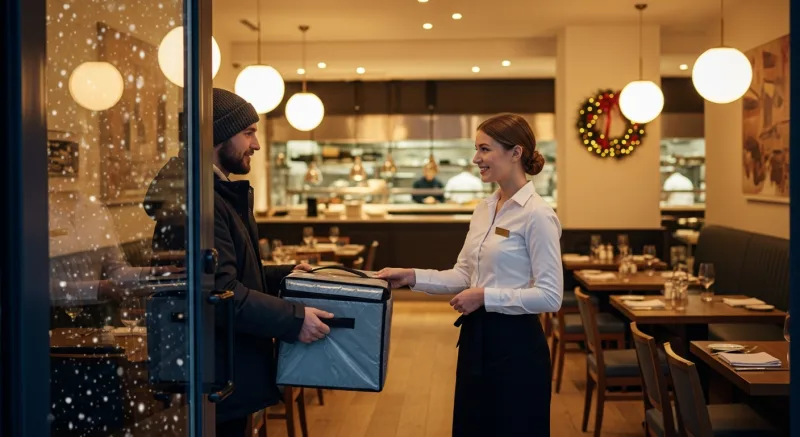
DoorDash’s 25% commission on each of those 60 winter deliveries extracts $7.50 from a $30 order — $450 nightly. KwickDriver at $2 per delivery takes $120. The nightly savings of $330, sustained across 120 winter delivery nights, totals $39,600 in annual processing savings. That is not an estimate based on hypothetical adoption. It is arithmetic based on the delivery patterns that every Minneapolis restaurant operator already knows.
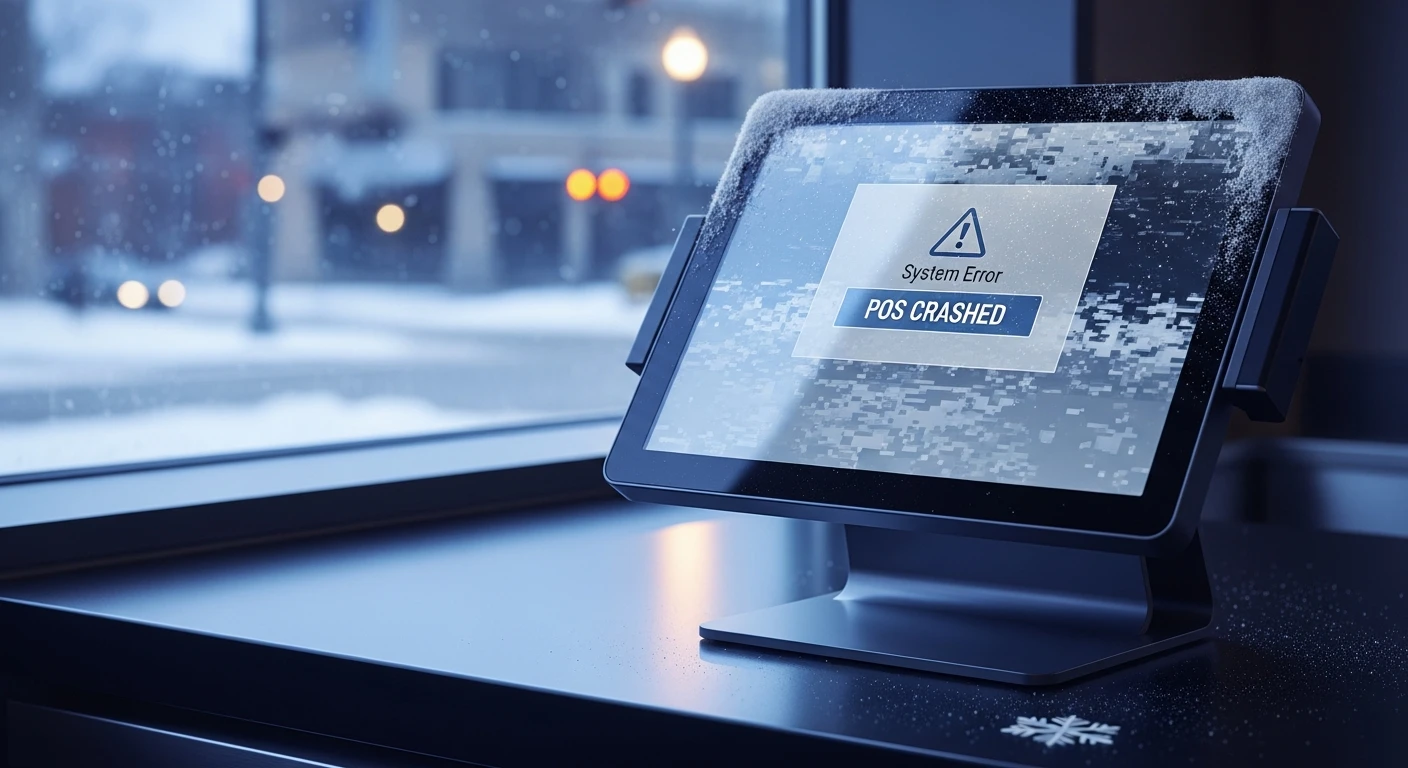
KwickOS offline processing ensures that winter storms do not shut down the delivery operation. When a blizzard takes out internet service, KwickOS processes transactions locally. The delivery orders may temporarily pause online intake, but every in-house and phone order processes normally. When connectivity returns, the cloud syncs. The restaurant never stops making money because the weather outside stopped the internet.
Eat Street: Minneapolis’s International Food Corridor
Nicollet Avenue between 14th and 29th Streets — known as Eat Street — concentrates Mexican, Vietnamese, Chinese, Ethiopian, Somali, and Mediterranean restaurants in a walkable corridor that represents the Twin Cities’ culinary diversity in microcosm. The corridor demonstrates what Minneapolis dining has become: global, affordable, and staffed by immigrant communities who operate most efficiently in their native languages.
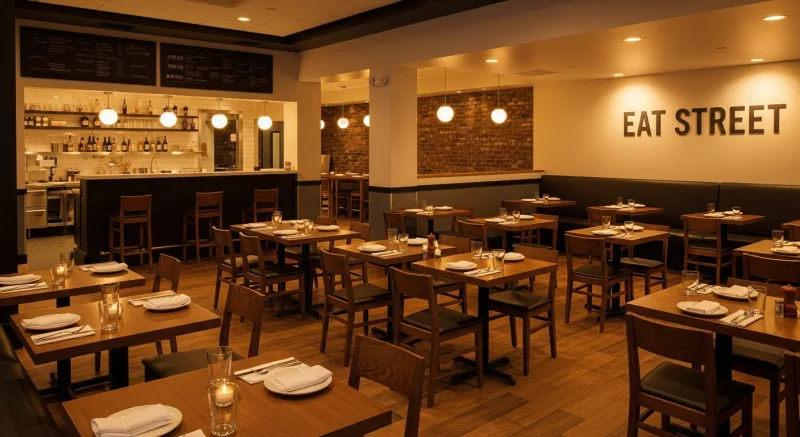
KwickOS Spanish-language support serves Eat Street’s Mexican restaurants. Chinese-language KDS support serves the Chinese restaurants. The Vietnamese and Ethiopian establishments benefit from the visual, icon-based kitchen display formatting that communicates across language barriers. Each restaurant on Eat Street can configure KwickOS for its specific linguistic requirements while running the same underlying platform that provides reporting, inventory, and financial management in whatever language the owner prefers.
The Hmong and Somali Food Revolution
Minneapolis has the largest Somali population in North America and one of the largest Hmong populations in the United States. Both communities have developed restaurant cultures that are now attracting customers from far beyond their ethnic enclaves. Somali restaurants along Lake Street and in the Cedar-Riverside neighborhood serve sambusa, bariis, and hilib ari to a growing audience. Hmong restaurants in North Minneapolis and Brooklyn Park offer papaya salad, larb, and egg rolls that trace to Laotian traditions.
These restaurants face a common technology challenge: menu items that do not fit standard POS categories, preparation methods that involve customer-chosen component combinations, and operational workflows that differ from the American server-kitchen-table model. KwickOS’s flexible modifier architecture accommodates non-standard menu structures. A Somali combination plate where the customer selects a protein, a starch, a vegetable, and a sauce creates a ticket that displays as a structured build on the KDS rather than an unformatted paragraph.
KwickOS’s low learning curve matters for operators who may be first-generation business owners. The system follows logical kitchen workflow rather than POS-industry conventions, allowing operators to achieve proficiency rapidly and spend their time cooking rather than troubleshooting software.
The North Loop Brewery-Restaurant Hybrid
The North Loop warehouse district has become Minneapolis’s premium dining and brewery corridor. Former grain elevators and flour mills now house restaurants with exposed brick, timber beams, and craft beer programs with 20+ rotating taps. The brewery-restaurant hybrid model operating in these converted industrial spaces creates specific POS requirements: rotating beverage menus, tasting flight configurations, and food programs that complement rather than lead the dining experience.
KwickSign digital signage synchronizes with KwickOS menu management so that tap list changes on the POS automatically update on the display board. When a North Loop taproom taps a new barrel-aged stout at 4 PM on Friday, the KwickSign board shows it immediately with name, ABV, tasting notes, and pricing. No chalkboard to rewrite. No chalk dust. No handwriting that customers cannot read from ten feet away.
The integrated menu-signage system is particularly valuable for breweries where the tap list may change three times per week. Manual signage updates in a 24-tap operation become a significant recurring labor cost. Automated signage through KwickSign eliminates this labor while providing a more consistent, professional visual presentation.
Processing at Midwest Margins
Minneapolis restaurant margins are compressed by a combination of Midwest pricing expectations, a $15.57 state minimum wage (Minneapolis city rate), and seasonal revenue volatility that concentrates the majority of patio and walk-in traffic into five warm-weather months. A restaurant that does $100,000 monthly in card transactions during summer may drop to $65,000 in January. The POS processing cost should adjust with volume; the locked-in fees from proprietary systems do not.
Toast’s 2.99% plus $0.15 on $80,000 average monthly volume costs $2,552 monthly. KwickOS with a competitive processor at 2.15% plus $0.08 costs $1,800. Monthly savings of $752 total $9,024 annually. At Minneapolis margins of 4-7% for full-service restaurants, this processing savings represents the equivalent profit from an additional $128,000-$225,000 in annual revenue that the restaurant does not need to generate.
The Patio Season Scramble
Minneapolis patio season runs from approximately May through September — five months that can account for 35-45% of annual revenue for restaurants with significant outdoor seating. The scramble to maximize patio revenue during these months requires portable POS capability: tablets for tableside ordering on the patio, mobile payment processing, and kitchen display integration that treats patio orders identically to indoor orders.
KwickOS tablets serve as mobile POS stations that servers carry to the patio. Orders entered tableside route immediately to the kitchen display. Payment processes at the table without the server returning inside. For Minneapolis restaurants where the patio generates a disproportionate share of annual profit, this operational speed during patio season compounds into thousands of additional transactions over five months.
Gift card promotions during patio season capture warm-weather enthusiasm and convert it into cold-weather revenue. A customer enjoying dinner on the patio in July who buys a gift card becomes a guaranteed return visit in February when the restaurant needs every customer it can get. KwickOS gift card integration enables this seasonal revenue-bridging strategy through the same terminal that processes the patio dinner.
Fingerprint Security for Twin Cities Staffing
The Twin Cities restaurant labor market is competitive, with unemployment in food service consistently below 5%. High demand for experienced kitchen and service staff means workers move between restaurants frequently, creating the PIN-sharing and departed-employee security gaps that plague every high-turnover labor market.
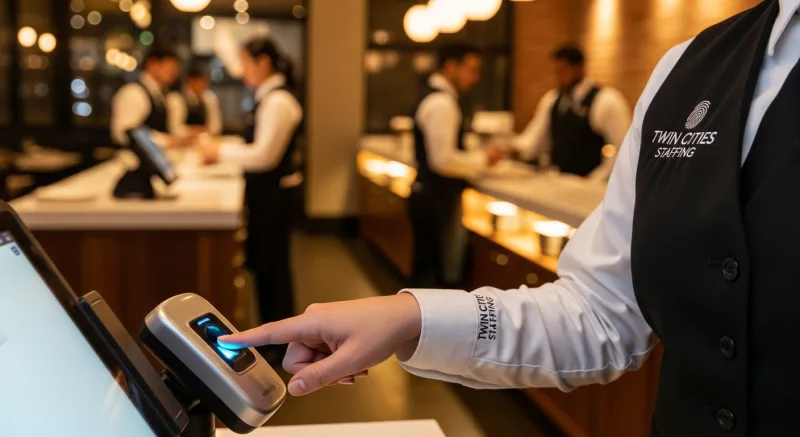
KwickOS fingerprint 1:N identification provides biometric accountability that does not depend on administrative diligence. Each employee’s fingerprint is their credential. It deactivates when they leave. It cannot be shared while they are employed. For Minneapolis restaurants where a cook might work at three different establishments per year, the fingerprint system ensures that access at your restaurant is revoked the moment the employee relationship ends — automatically, without a manager remembering to delete a PIN.
Minneapolis POS Selection Criteria
The Twin Cities restaurant market operates under conditions that most POS companies design for in theory and fail to deliver in practice. Five months of extreme cold, concentrated summer revenue, a diverse food culture, and Midwest financial discipline create a set of requirements that generic POS solutions cannot satisfy.
- Offline winter processing — Blizzards guarantee internet outages; local processing keeps revenue flowing
- Flat-rate winter delivery — 120 nights of high-volume delivery cannot sustain 25% commissions
- Pre-ordering for skyway lunch — Downtown’s indoor economy requires digital ordering integration
- Self-ordering kiosks — 90-minute lunch rushes need automated throughput
- Multilingual support — Eat Street, Somali, and Hmong restaurants need flexible language configurations
- Digital signage for breweries — North Loop tap lists need real-time automated display updates
- Processor independence — Midwest margins demand negotiated rates
- Patio-season portability — Five months of outdoor revenue need tablet-based tableside service
Minneapolis endures winters that would close restaurants in other cities. The technology running these restaurants should be equally resilient.
Minneapolis restaurant owners: Call (888) 355-6996 or visit KwickOS.com to see POS technology that performs at thirty below.
Turn One-Time Diners into Regulars: Built-In Gift Cards & Loyalty
Most POS companies treat gift cards and loyalty as afterthoughts — expensive add-ons that cost $50-100/month extra. KwickOS includes them at no additional charge because we believe they are essential revenue tools, not luxury features.
Gift Cards That Actually Drive Revenue
Here is what most restaurant owners do not realize: gift card buyers spend an average of 20-40% more than the card's face value. A $50 gift card typically generates $60-70 in actual spending. KwickOS supports both physical gift cards and electronic gift cards that customers can purchase, send, and redeem through their phones.
- Physical gift cards — branded plastic cards that sit on your counter and sell themselves during holidays
- E-gift cards — customers buy and send digitally via text or email, perfect for last-minute gifts
- Balance tracking — real-time balance across all your locations, no manual reconciliation
- Reload capability — customers top up their balance, creating a built-in prepayment habit
Loyalty Points That Keep Them Coming Back
KwickOS loyalty is not a punch card from 2005. It is a digital points system that tracks every dollar spent and automatically rewards your best customers:
- Earn points on every purchase — configurable ratio (e.g., $1 = 1 point, or $1 = 10 points)
- Tiered rewards — silver, gold, platinum levels to incentivize higher spending
- Birthday rewards — automated birthday offers that bring customers back during their special month
- Points-for-payment — customers redeem points directly at checkout, seamless for your staff
Membership Programs
For restaurants running VIP programs or subscription models (like monthly coffee clubs), KwickOS membership management handles recurring billing, exclusive pricing tiers, and member-only menu items — all within the same system your cashier already uses.
The bottom line: Toast charges $75/month extra for loyalty. Square's loyalty starts at $45/month. KwickOS includes gift cards, e-gift cards, loyalty points, and membership management in every plan. That is $540-900/year you keep in your pocket.

Founder & CIO of KwickOS · 30 Years IT · 20 Years Restaurant Industry
Tom built KwickOS after running restaurants and IT companies for decades. He relocated the company to a 10,000 sq ft office in 2023 and now serves 5,000+ businesses across all 50 states, processing over $2M in daily sales.