America’s Test Market Eats: Why Columbus Restaurants Need a POS That Can Experiment
Updated March 2026 · By Tom Jin
Marketing executives have called Columbus “America’s test market” for decades because the city’s demographics mirror the nation’s median with uncanny accuracy. Fast-food chains test new menu items in Columbus before rolling them out nationally. Wendy’s was born here. White Castle started here. But beneath the test-market reputation lies a sophisticated, chef-driven restaurant scene that has exploded along High Street, in the Short North, across German Village, and throughout Grandview Heights — a scene that experiments not because national brands tell it to, but because Columbus diners reward creativity.
Columbus now supports over 3,000 restaurants serving a metro area of 2.1 million people. The city’s rapid growth — driven by Ohio State University, a booming tech sector, and corporate headquarters including Nationwide, Cardinal Health, and L Brands — has created a restaurant market where concepts that would struggle in smaller Midwest cities thrive because Columbus has the population density, the disposable income, and the appetite to support them.
Game Day in the Horseshoe: 105,000 Hungry Fans
Ohio Stadium seats 102,780. On seven or eight Saturdays every fall, the population of a mid-sized city descends on the campus area, and every restaurant within a two-mile radius of the stadium operates at maximum capacity from 9 AM until midnight. A restaurant on High Street near campus that normally serves 180 covers on Saturday serves 500 on game day. A bar that pours 400 drinks serves 1,200.
This is not a gradual increase. It happens at a specific moment — roughly three hours before kickoff — and sustains at peak intensity for eight to ten hours. POS systems that perform adequately under normal conditions reveal their architectural limitations under this sustained load. Cloud-based systems queue transactions when server response slows under volume. Kitchen display systems lag when every ticket arrives simultaneously. Payment terminals time out when the cellular network serving the area is saturated by 100,000 smartphones.
KwickOS processes locally. Each transaction completes in 1 millisecond regardless of how many other devices on the network are competing for bandwidth. The kitchen display updates from the local server, not a remote one. When the entire High Street corridor is processing at maximum throughput during the third quarter of an Ohio State night game, KwickOS does not slow down because there is no remote dependency to create a bottleneck.
Short North: From Art Galleries to Restaurant Row
The Short North Arts District has transformed into Columbus’s most concentrated restaurant corridor. Between Goodale Park and the Convention Center, over 100 restaurants compete for a clientele that skews young, design-conscious, and willing to spend on memorable experiences. First Friday gallery hops bring thousands of additional visitors into the district monthly, and restaurants that align their operations with this cultural calendar capture significant walk-in traffic.
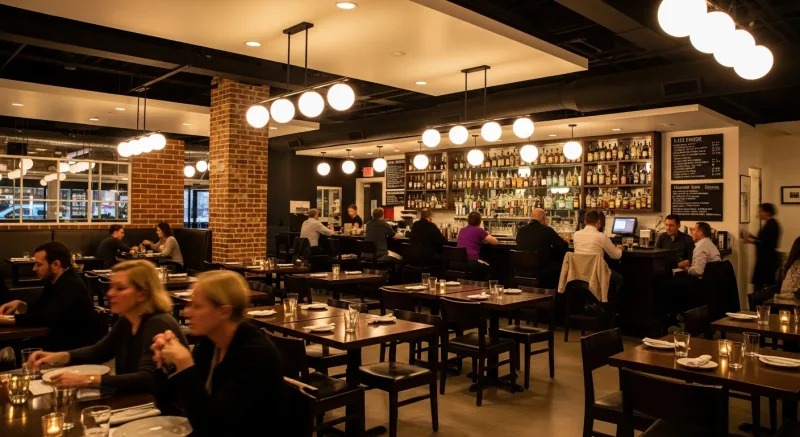
Digital signage through KwickSign matters in the Short North because foot traffic is the primary customer acquisition channel. A restaurant with a dynamic, visually compelling menu display facing High Street captures walk-in customers that a printed menu in the window does not. When First Friday brings gallery hoppers past your door at 8 PM, a KwickSign display promoting your late-night small plates menu and cocktail specials is the digital equivalent of a sidewalk hawker — except it costs nothing per customer interaction and updates instantly.
The Short North also demands aesthetic consistency that technology can either support or undermine. A beautifully designed restaurant with a clunky POS terminal bolted to the bar disrupts the visual experience. KwickOS runs on sleek tablets that blend with the design environment. The hardware is a tool, not an eyesore.
German Village Tradition Meets Modern Efficiency
German Village is one of the largest privately funded historic districts in the United States, and its brick-street charm attracts both tourists and locals to restaurants housed in buildings that predate the Civil War. The physical constraints of these historic structures — low ceilings, narrow doorways, limited electrical capacity, thick brick walls that attenuate Wi-Fi signals — create technology challenges that modern POS systems designed for new construction handle poorly.
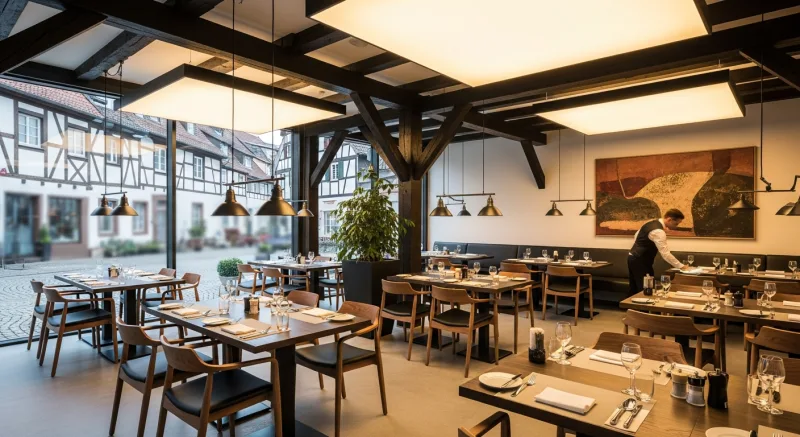
Wi-Fi signal attenuation through 160-year-old brick walls is a real engineering problem. A Toast terminal in the front dining room of a German Village restaurant may have strong Wi-Fi, but the terminal in the back garden separated by two brick walls may have intermittent connectivity. Cloud-dependent systems degrade or fail entirely in dead zones. KwickOS connects through the local network, and even if Wi-Fi is spotty, transactions process locally on the device itself. The cloud sync happens when connectivity is stable, but the immediate transaction never depends on it.
German Village restaurants also tend toward the full-service, multiple-course dining format that demands kitchen timing coordination. KwickOS’s course-based firing system manages the progression from appetizer to entrée to dessert with server-controlled firing. The kitchen sees what is coming next and when the server wants it, enabling the paced dining experience that German Village guests expect without the shouting-across-the-kitchen timing coordination that leads to errors during busy service.
The Ohio State University Supply Chain
Ohio State’s campus and surrounding neighborhoods support a parallel restaurant economy driven by 60,000 students, 40,000 employees, and a steady stream of visiting parents, prospective students, and conference attendees. This customer base is mobile-first, price-conscious, and expects immediate gratification. A campus-area restaurant without online ordering is invisible to half its potential customers.
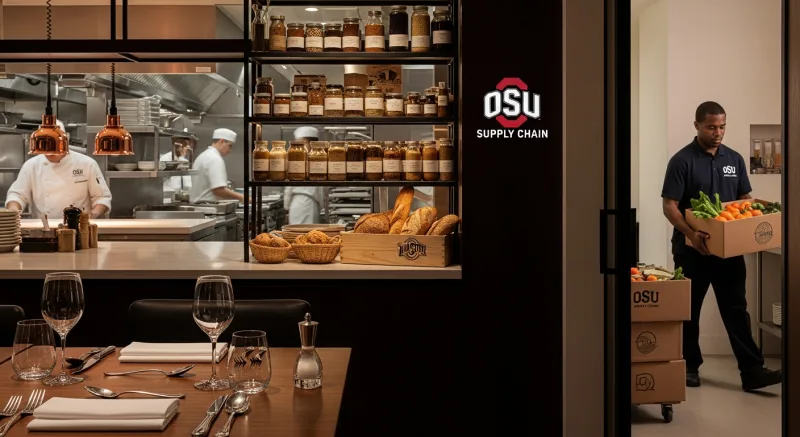
KwickMenu online ordering integrates directly with KwickOS, routing orders from the restaurant’s website to the kitchen display without third-party intermediaries. A student in Morrill Tower who orders lunch at 11:45 AM wants the food ready when they arrive at 12:00. The order enters the KDS immediately, the kitchen begins production, and the food is ready for pickup precisely when the student walks through the door. This integration eliminates the manual order re-entry that third-party platforms often require, saving time and preventing the transcription errors that produce wrong orders.
KwickDriver’s flat $2 delivery fee makes campus delivery economically viable for restaurants where the average ticket is $12-$15. DoorDash’s 25% commission on a $12 order takes $3 — a quarter of the revenue — rendering thin-margin campus restaurants unprofitable on delivery. KwickDriver takes $2 regardless of order size. The difference becomes substantial when a campus restaurant delivers 80 orders per day during finals week.
Easton and Polaris: Suburban Dining at Mall Scale
Columbus’s suburban dining is concentrated around massive retail developments like Easton Town Center and Polaris Fashion Place. These are not mall food courts. They are open-air shopping districts with full-service restaurants that compete directly with Short North establishments for customer spending. A restaurant at Easton might process $250,000 monthly in card transactions during the holiday season.
At that volume, processor independence is not a luxury. It is basic financial management. Toast’s 2.99% on $250,000 costs $7,625 monthly. A competitive processor through KwickOS at 2.15% costs $5,575. The $2,050 monthly difference — $24,600 annually — is the equivalent of a full-time host or a year’s worth of linen service. Restaurants that accept locked-in processing rates at these volumes are making a choice they may not realize they are making.
Easton and Polaris restaurants also benefit from KwickOS gift card integration during the holiday shopping season. A restaurant located within a shopping destination captures gift card purchases from shoppers who are already in spending mode. KwickOS processes physical and digital gift cards through the same POS — no separate vendor, no additional fees, no reconciliation headache between the gift card system and the daily sales report.
The Somali and East African Food Movement
Columbus has one of the largest Somali communities in North America, concentrated primarily along Cleveland Avenue and Morse Road. The Somali restaurant scene has grown from a handful of community-oriented establishments to a visible dining presence that attracts customers from across the city. These restaurants face unique operational challenges: menu items that do not map to Western restaurant categories, service styles that blend cafeteria and table service, and a customer base that includes both the Somali community and adventurous diners discovering the cuisine.
KwickOS’s flexible menu configuration accommodates the non-standard menu structures that East African restaurants use. Items that combine a protein, a starch, and a sauce in customer-chosen combinations require modifier trees that most POS systems oversimplify. When a customer orders a combination plate and selects goat, rice, and suqaar with a specific sauce, the KDS displays the complete build exactly as the kitchen needs to see it. The system adapts to the cuisine rather than forcing the cuisine to adapt to the system.
Loyalty Programs in a College Town Economy
Columbus’s restaurant economy faces a structural loyalty challenge: the student population turns over by 25% every year as classes graduate and new students arrive. A restaurant that builds a loyal student following in September watches that following graduate in May and must rebuild from scratch every fall. This constant churn makes systematic loyalty capture essential rather than optional.
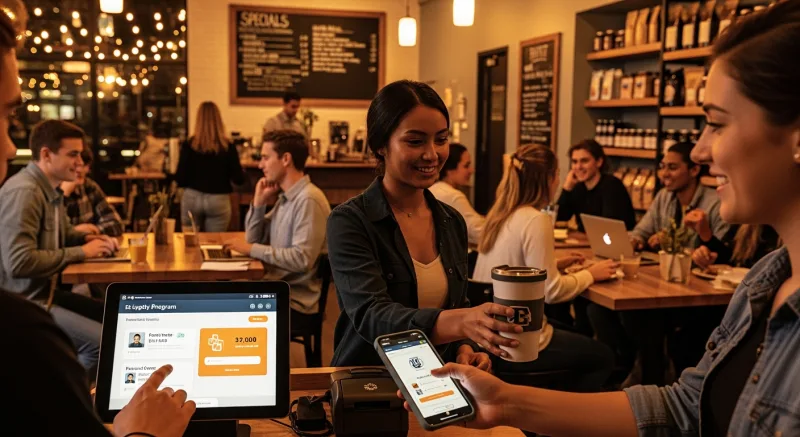
KwickOS loyalty points accumulate automatically with every transaction. A first-year student who discovers a Short North restaurant during orientation and eats there weekly for four years generates significant lifetime value — but only if the restaurant captures that customer in a loyalty system from their first visit. KwickOS integrates the loyalty enrollment into the payment flow: earn points, receive a digital loyalty card, and start accumulating rewards without a separate registration step that most customers skip.
Membership tiers allow Columbus restaurants to create VIP programs for their most valuable customers. A restaurant offering a $50/month membership with priority seating and a free entrée converts its most loyal diners into guaranteed recurring revenue. The membership management runs through KwickOS — enrollment, billing, benefit tracking, and redemption all happen within the same system that processes daily transactions.
Fingerprint Security for Columbus’s Part-Time Workforce
Ohio State’s student body provides a massive part-time restaurant workforce. These are employees who work 15-20 hours per week around class schedules, frequently swap shifts with classmates, and move between restaurants as their schedules change semester to semester. Traditional POS security based on PIN codes breaks down entirely in this environment. Students share PINs casually, departed employees’ PINs remain active long after their last shift, and the constant turnover makes PIN management an administrative burden that most managers abandon.
KwickOS fingerprint 1:N identification replaces this chaos with biometric certainty. Each employee’s fingerprint is their credential. It cannot be shared, cannot be forgotten, and cannot be used by someone else. When a student employee quits mid-semester, their fingerprint is deactivated instantly. No PIN to remember to revoke. No card to retrieve. The security model is inherently self-managing in a way that PIN-based systems in high-turnover environments never achieve.
Columbus POS Selection Guide
Columbus has outgrown its test-market reputation. The city’s restaurant scene is nationally recognized and locally demanding. POS technology for Columbus restaurants should match the creativity and ambition of the operators who build them.
- Game-day processing power — 105,000 fans create sustained volume that cloud systems cannot reliably handle
- Processor independence — Easton and Polaris volumes justify negotiated rates saving five figures annually
- Digital signage — Short North foot traffic converts through visual, dynamic menu displays
- Historic building compatibility — German Village brick walls demand local processing, not Wi-Fi-dependent clouds
- Campus delivery economics — $12 average tickets cannot absorb 25% platform commissions
- Flexible menu architecture — Diverse cuisines need configurable modifiers, not rigid templates
- Automated loyalty — Student turnover demands systematic retention from the first transaction
- Fingerprint security — Part-time student workers and constant turnover make PIN systems worthless
Columbus tests everything. Test your POS assumptions. The results might surprise you.
Columbus restaurant owners: Call (888) 355-6996 or visit KwickOS.com to see what a processor-agnostic, offline-capable system delivers in a city that takes food seriously.

Founder & CIO of KwickOS · 30 Years IT · 20 Years Restaurant Industry
Tom built KwickOS after running restaurants and IT companies for decades. He relocated the company to a 10,000 sq ft office in 2023 and now serves 5,000+ businesses across all 50 states, processing over $2M in daily sales.