A Mile Above Sea Level, A Mile Ahead on POS: Denver’s Restaurant Technology Gap
Updated March 2026 · By Tom Jin
Denver sits at 5,280 feet above sea level, and the altitude affects everything — including the restaurant business. Water boils at 202 degrees instead of 212, which changes cooking times for pasta, rice, and baked goods. Alcohol hits faster at altitude, affecting pour control and liability calculations. Dehydration-prone tourists from sea level drink more water and less alcohol than expected, skewing beverage revenue assumptions. Even the POS hardware heats differently at altitude, with thinner air providing less natural cooling for electronics running in a hot kitchen.
These are not the concerns that POS salespeople discuss during demos. They are the realities that Denver restaurant operators live with every day, in a city that has transformed from a cowboy-steak-and-potatoes town into one of America’s most innovative dining markets. Denver now hosts over 4,000 restaurants, more than 400 breweries in the metro area, and a farm-to-table movement that draws on Colorado’s agricultural heritage with more sincerity than most cities can muster.
RiNo: Where Industrial Kitchens Meet Artisan Ambition
River North Art District has become Denver’s hottest restaurant neighborhood by converting warehouses, auto shops, and industrial spaces into dining destinations. The adaptive reuse aesthetic is central to RiNo’s identity — exposed brick, steel beams, concrete floors — but the industrial origins of these buildings create practical technology challenges. Metal structures interfere with Wi-Fi propagation. Concrete floors and steel framing create electrical grounding issues. Open-plan layouts with 20-foot ceilings and hard surfaces produce noise levels that make verbal kitchen communication impossible during peak service.
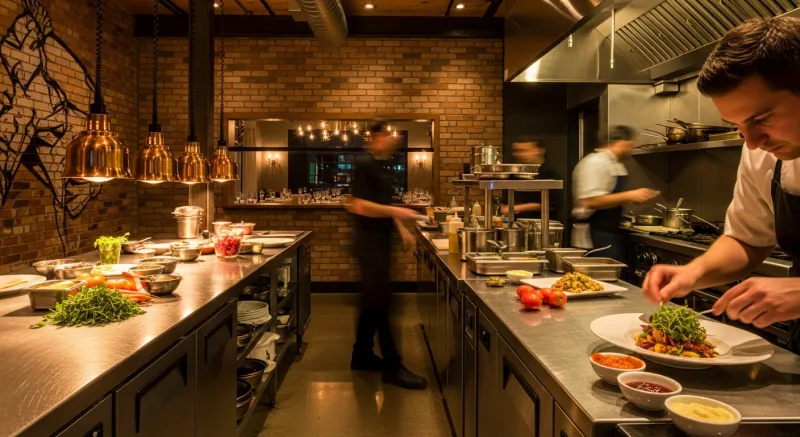
In this environment, kitchen display systems are not a convenience upgrade from paper tickets. They are a necessity. When the ambient noise level exceeds 85 decibels during a Friday night service, a cook cannot hear the expeditor calling out modifications. A KwickOS KDS screen mounted at each station displays orders with visual clarity that cuts through the noise. Modifications highlight in color. Rush orders flash. Allergen flags appear prominently. The entire communication system shifts from auditory to visual, matching the acoustic reality of a converted warehouse kitchen.
KwickOS’s local processing architecture also addresses the metal-structure Wi-Fi problem. Transactions process on the device itself, not through a cloud server that requires consistent internet connectivity. In a RiNo building where the Wi-Fi signal drops to one bar in the back kitchen, the POS keeps processing without interruption. Cloud sync happens when the signal is strong. Transaction processing never waits for it.
The Craft Brewery POS Problem
Denver’s 400+ breweries have created a beverage program complexity that most restaurant POS systems cannot handle efficiently. A taproom with 24 rotating taps, seasonal releases, collaboration brews, and guest taps needs a menu system that changes multiple times per week. When a keg blows at 8 PM on a Saturday, the item needs to disappear from the menu, the digital signage, and the online ordering system simultaneously — not three separate updates across three different platforms.
KwickOS integrates menu management, digital signage through KwickSign, and online ordering through KwickMenu into a single system. When a keg kicks, the bartender marks it empty on the POS. Instantly, KwickSign boards update to remove the beer. KwickMenu stops accepting online orders for that beer. The replacement keg’s beer populates across all systems the moment the bartender adds it. Zero delay, zero inconsistency, zero customer ordering a beer that ran out twenty minutes ago.
Pour sizes and pricing in craft beer are nonstandard. A 4-ounce taster, 10-ounce half pour, 16-ounce full pour, 32-ounce crowler, and 64-ounce growler all need different pricing for each beer, and high-ABV beers may have mandatory smaller pour sizes under Colorado liquor regulations. KwickOS modifier trees handle this matrix of beer-by-size-by-price without the clunky workaround of creating a separate menu item for every combination.
Ski Season: When Denver Becomes a Gateway City
From November through April, Denver functions as the gateway to Colorado’s $5 billion ski industry. Millions of visitors pass through Denver International Airport, stay in downtown hotels, and dine in Denver restaurants on their first and last nights. This tourism-driven seasonal surge increases downtown restaurant volume by 25-40% during peak ski weekends — visitors who are spending on vacation, tipping generously, and expecting technology that matches the sophistication of the resorts they are headed to.
Gift card sales spike during ski season as visitors buy them for friends or for their own future returns. KwickOS physical and digital gift cards integrate directly into the POS transaction — no separate vendor, no additional fees. A tourist who buys a $50 gift card at a LoDo restaurant on Friday night becomes a guaranteed return customer when they pass back through Denver on Sunday. The gift card is also a marketing channel: every person who receives one as a gift learns about the restaurant without the restaurant spending a dollar on advertising.
Loyalty program enrollment during ski season converts one-time visitors into recurring digital customers. A visitor who joins a restaurant’s loyalty program through KwickOS receives targeted promotions for future trips. When they return next season, the system recognizes them, their preferences are logged, and the experience feels personalized rather than transactional. This is customer relationship management built into the POS rather than bolted on as a separate monthly subscription.
Federal Boulevard: Denver’s International Food Highway
Federal Boulevard from West Colfax to Alameda is Denver’s most culinarily diverse corridor. Vietnamese pho houses, Ethiopian injera restaurants, Mexican taquerias, Korean barbecue joints, and Salvadoran pupuserias line both sides of the street in strip malls that look modest from the outside and produce extraordinary food inside. These are predominantly immigrant-owned, family-operated restaurants where the kitchen speaks a different language than the front counter.
KwickOS’s multilingual support addresses Federal Boulevard’s linguistic reality. Spanish-language interface for Tex-Mex and Salvadoran kitchens. Chinese-language display for Chinese and Vietnamese restaurants with Chinese-reading kitchen staff. English for front-of-house customer interactions. Each terminal runs independently in whatever language serves the person operating it. A restaurant where the owner speaks Vietnamese, the kitchen staff reads Chinese, and the counter staff speaks English runs all three configurations simultaneously on KwickOS.
Processing economics matter particularly for Federal Boulevard restaurants, where average tickets are lower ($10-$18) and margins are thinner than downtown establishments. Toast’s 2.99% plus $0.15 on a $12 pho order takes $0.51 — over 4% of the transaction. KwickOS with a competitive processor at 2.0% plus $0.08 takes $0.32. The difference seems small per transaction but compounds across 300 daily transactions to $57 per day — $20,805 per year. For a family restaurant, that is a meaningful percentage of annual profit.
Coors Field and the LoDo Pre-Game Economy
Lower Downtown’s restaurant scene orbits Coors Field, where 81 Rockies home games per year create a predictable dining surge from April through September. The pre-game economy starts at 4 PM for 6:40 PM starts, with restaurants along Blake Street, Larimer Square, and Market Street processing at 150-200% of normal volume for roughly three hours.
KwickOS self-ordering kiosks in LoDo restaurants handle the pre-game rush by removing the ordering bottleneck from the server-to-kitchen pipeline. Customers entering a packed restaurant 90 minutes before first pitch can order at a kiosk, pay, and receive a table pager in under two minutes. The kitchen receives the order instantly through the KDS, and production begins before the customer has found their seat. For restaurants that lose walkout customers during game-day waits, kiosks convert that lost revenue into processed orders.
KwickOS fingerprint identification protects LoDo restaurants during the game-day staffing surge. Temporary bartenders and servers hired for the baseball season register fingerprints on day one. Every transaction, every void, every discount traces to a specific individual. When September ends and seasonal staff departs, their biometric access deactivates instantly. The accountability persists even after the employee relationship ends.
Cannabis-Adjacent Dining: Denver’s Unique Challenge
Denver’s legalized cannabis market has created a dining ecosystem that exists nowhere else in America at this scale. Restaurants near dispensary clusters on Broadway, Colfax, and in RiNo see customer behavior patterns influenced by cannabis consumption: larger appetites, longer dwell times, higher snack-food ordering, and lower alcohol purchases. This is not a moral observation. It is a data pattern that affects menu engineering, kitchen production timing, and revenue forecasting.
KwickOS analytics provide the data to identify and respond to these patterns. When sales data shows that a RiNo restaurant’s snack and appetizer category spikes 40% after 9 PM on weekends while alcohol sales plateau, the operator adjusts menu promotion accordingly. Digital signage through KwickSign can promote late-night appetizer specials during the hours when customer behavior data indicates highest demand. This is data-driven menu management that responds to Denver’s specific market dynamics rather than national dining assumptions.
The Blizzard Window and Delivery Dependency
Denver’s weather swings rapidly. A 70-degree March afternoon can become a 6-inch snowfall by the next morning. When blizzards hit, Denver restaurants experience the same delivery surge that Chicago sees in winter — customers who were planning to dine out switch to delivery, concentrating enormous demand on restaurants that offer it. Third-party delivery commissions during these surges are pure extraction: 25% of every order during the period when demand is highest and restaurants could charge full price.
KwickDriver at $2 per delivery plus $6.99 per five miles keeps the blizzard-surge revenue in the restaurant. A $35 delivery order yields $33 to the restaurant through KwickDriver versus $24.50-$28 through DoorDash. On a heavy snow day with 60 deliveries, the daily savings exceed $300. These weather-driven delivery spikes happen ten to fifteen times per Denver winter — cumulative savings of $3,000-$4,500 on snow days alone.
What Denver Restaurants Should Prioritize in a POS
Denver’s restaurant market is younger and faster-evolving than cities of similar size. The operators tend toward innovation, the customers reward creativity, and the competitive landscape punishes complacency. POS technology for Denver restaurants should match this energy with capabilities that actually serve the Mile High City’s unique conditions.
- Local processing in metal buildings — RiNo’s converted warehouses kill Wi-Fi; transactions must process locally
- Integrated menu and signage — 400+ breweries with rotating taps need real-time synchronization
- Processor independence — Volume-based rate negotiation saves five figures annually at Denver volumes
- Multilingual capability — Federal Boulevard kitchens require Spanish and Chinese interfaces
- Gift card and loyalty integration — Ski-season tourism converts to repeat visits through systematic retention
- Self-ordering kiosks — Game-day surges at Coors Field demand automated ordering throughput
- Data-driven analytics — Denver’s unique market dynamics require sales pattern visibility
- Flat-rate delivery — Blizzard delivery surges create revenue that percentage fees would destroy
Denver’s elevation is permanent. Its restaurant technology decisions do not have to be. Choose a POS system that performs as high as the city sits.
Denver restaurant owners: Call (888) 355-6996 or visit KwickOS.com to see how a system built for real-world conditions performs at 5,280 feet.
Turn One-Time Diners into Regulars: Built-In Gift Cards & Loyalty
Most POS companies treat gift cards and loyalty as afterthoughts — expensive add-ons that cost $50-100/month extra. KwickOS includes them at no additional charge because we believe they are essential revenue tools, not luxury features.
Gift Cards That Actually Drive Revenue
Here is what most restaurant owners do not realize: gift card buyers spend an average of 20-40% more than the card's face value. A $50 gift card typically generates $60-70 in actual spending. KwickOS supports both physical gift cards and electronic gift cards that customers can purchase, send, and redeem through their phones.
- Physical gift cards — branded plastic cards that sit on your counter and sell themselves during holidays
- E-gift cards — customers buy and send digitally via text or email, perfect for last-minute gifts
- Balance tracking — real-time balance across all your locations, no manual reconciliation
- Reload capability — customers top up their balance, creating a built-in prepayment habit
Loyalty Points That Keep Them Coming Back
KwickOS loyalty is not a punch card from 2005. It is a digital points system that tracks every dollar spent and automatically rewards your best customers:
- Earn points on every purchase — configurable ratio (e.g., $1 = 1 point, or $1 = 10 points)
- Tiered rewards — silver, gold, platinum levels to incentivize higher spending
- Birthday rewards — automated birthday offers that bring customers back during their special month
- Points-for-payment — customers redeem points directly at checkout, seamless for your staff
Membership Programs
For restaurants running VIP programs or subscription models (like monthly coffee clubs), KwickOS membership management handles recurring billing, exclusive pricing tiers, and member-only menu items — all within the same system your cashier already uses.
The bottom line: Toast charges $75/month extra for loyalty. Square's loyalty starts at $45/month. KwickOS includes gift cards, e-gift cards, loyalty points, and membership management in every plan. That is $540-900/year you keep in your pocket.

Founder & CIO of KwickOS · 30 Years IT · 20 Years Restaurant Industry
Tom built KwickOS after running restaurants and IT companies for decades. He relocated the company to a 10,000 sq ft office in 2023 and now serves 5,000+ businesses across all 50 states, processing over $2M in daily sales.