When Your Kitchen Hits 150 Degrees, Your POS Better Not Melt
Updated March 2026 · By Tom Jin
Phoenix set a record in 2024: 113 consecutive days above 100 degrees Fahrenheit. The city experienced 55 days above 110. For four months, the ambient temperature outside was hotter than a kitchen’s target holding temperature for cooked food. Inside Phoenix restaurant kitchens, where flat-top grills, deep fryers, and pizza ovens compound the outdoor heat, temperatures near cooking stations exceed 140-150 degrees during summer dinner service.
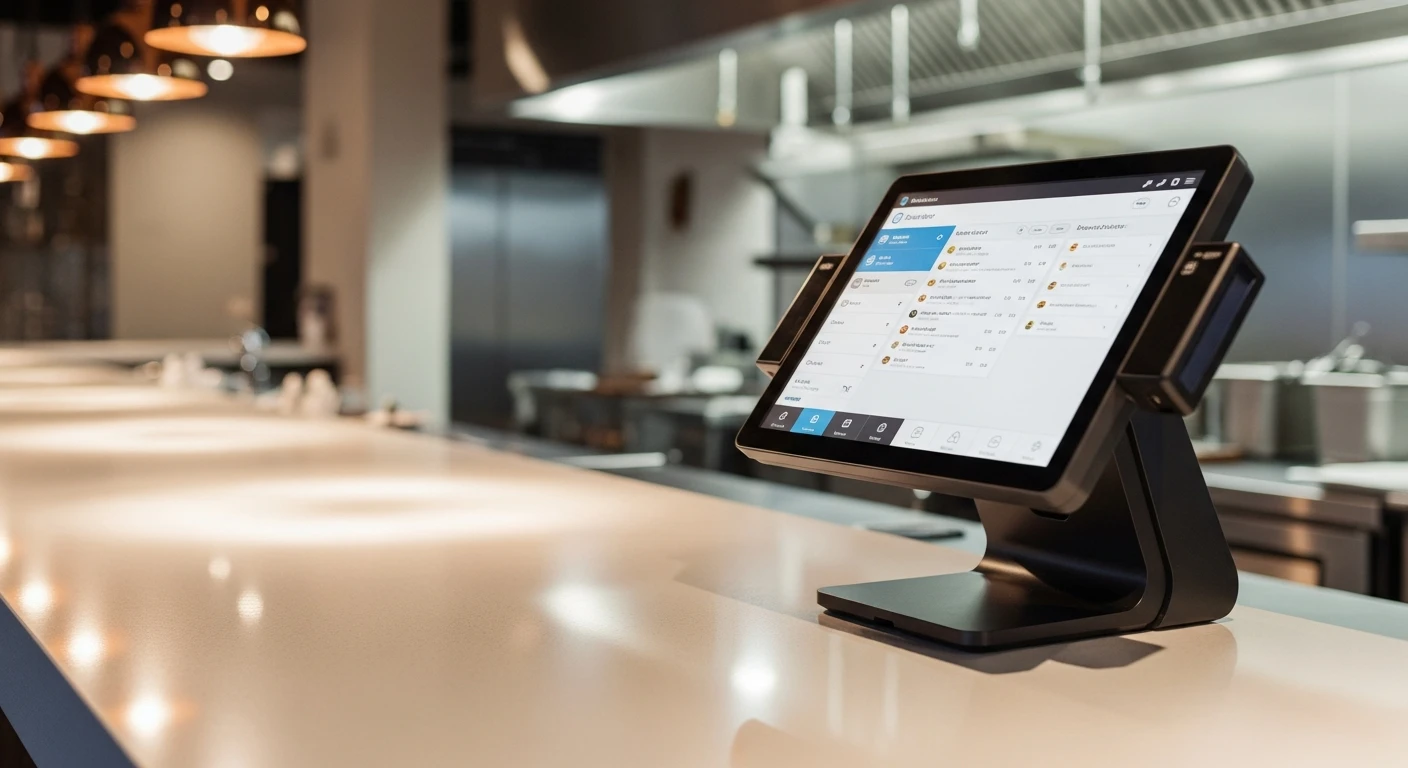
This is the environment in which your POS hardware must function. Most POS terminals are rated for operation up to 104 degrees Fahrenheit (40 Celsius). Phoenix kitchens exceed that rating for five months of the year. The result: proprietary POS hardware from Toast, Square, and Clover overheats, throttles performance, and eventually fails prematurely. Replacement requires ordering from the vendor, waiting for shipping, and paying a premium for hardware that was not designed for the climate in which it operates.
Hardware Darwinism in the Desert
KwickOS runs on any touchscreen hardware, including commercial-grade tablets rated for higher operating temperatures. When a Phoenix restaurant operator chooses a tablet with a 122-degree operating range and positions it in the coolest available kitchen location, they have matched the hardware to the environment rather than accepting whatever a POS company ships from its Boston warehouse. If the hardware eventually fails to heat — and in Phoenix, all electronics eventually lose that fight — replacement is a $250-$400 commercial tablet from Amazon, not an $800-$1,200 proprietary terminal on a six-week backorder.
Kitchen display screens face the same thermal challenge. KwickOS KDS runs on commercial displays rated for high-temperature environments. A restaurant that loses a kitchen display to a 145-degree July day replaces it with an off-the-shelf commercial monitor in 24 hours. The KwickOS software configures on the new hardware in minutes. Toast’s proprietary kitchen displays require vendor-specific replacement, vendor-scheduled installation, and vendor-determined timelines. In a Phoenix July, a week without a KDS in the kitchen is a week of shouting orders across a superheated room.
The Sonoran Menu and Desert Flavor Profiles
Phoenix’s Mexican food is not Tex-Mex. It is Sonoran Mexican — a distinct regional cuisine characterized by flour tortillas (not corn), machaca (shredded dried beef), green chile, and the chimichanga (which Phoenix may or may not have invented, depending on who tells the story). Sonoran restaurants operate with menu structures and modifier patterns specific to this cuisine that differ from the Tex-Mex configurations that POS systems designed in the Northeast assume.
KwickOS modifier trees accommodate Sonoran menu complexity: chimichanga builds with protein selection (machaca, chicken, bean and cheese), sauce options (green chile, red chile, sour cream), and a sides matrix that includes Sonoran-specific items like elote and charro beans alongside standard rice and beans. The KDS displays the complete build in a format that the Sonoran kitchen crew reads instantly — in Spanish, because KwickOS runs natively in Spanish on every kitchen display.
For Phoenix’s large Spanish-speaking restaurant workforce, the native Spanish interface is not an accommodation. It is operational accuracy. A kitchen that operates in Spanish should run a POS in Spanish. KwickOS makes this a configuration setting, not a feature request.
Snowbird Season: The Valley’s Revenue Swing
From October through April, Phoenix’s population increases by an estimated 300,000-500,000 seasonal residents — snowbirds from the Midwest and Northeast who winter in Scottsdale, Paradise Valley, and Sun City. This seasonal influx increases restaurant revenue by 25-40% during the cool months and creates a corresponding decline in summer when the snowbirds leave and temperatures exceed human tolerance for outdoor activity.
KwickOS analytics track seasonal patterns over multiple years, allowing Phoenix operators to forecast staffing, inventory, and marketing with data rather than intuition. When the system shows that the third week of February consistently produces 35% higher revenue than the third week of July, the operator schedules accordingly and manages inventory to prevent the summer overstock that turns into waste.
Gift card promotions during snowbird season capture winter visitors and convert them into summer-absence revenue. A snowbird who buys a $100 gift card in February for a friend who visits Phoenix in April extends the restaurant’s revenue reach beyond the seasonal window. Digital gift cards through KwickOS travel with the snowbird back to Minnesota and generate word-of-mouth marketing in a demographic that returns annually.
Scottsdale’s Premium Dining and Processing Economics
Scottsdale’s Old Town and Fashion Square districts concentrate Arizona’s most expensive restaurants. Average dinner tickets of $80-$150 per person, driven by resort tourism and affluent retirees, create processing volumes where rate differences translate to enormous absolute savings. A Scottsdale restaurant processing $250,000 monthly at Toast’s 2.99% pays $7,625 monthly. KwickOS with a competitive processor at 2.05% costs $5,325. Annual savings: $27,600 — the salary of a full-time host.
The Monsoon Season Wildcard
Phoenix monsoon season from June through September produces violent thunderstorms with high winds, dust storms (haboobs), and flash flooding that can knock out power and internet with sudden intensity. A haboob that reduces visibility to zero for 30 minutes may also take out the cellular tower serving your neighborhood. A flash flood that blocks a major intersection can disrupt utility service for hours.
KwickOS processes transactions locally without internet dependency. When a monsoon knocks out Cox internet and the T-Mobile tower simultaneously, the POS keeps processing on local hardware at 1-millisecond speed. Cloud sync resumes when infrastructure returns. The restaurant never stops serving because the weather outside interrupted the connection between your register and a server in Virginia.
Mesa, Chandler, and the East Valley Expansion
Phoenix-area restaurant growth has concentrated in the East Valley suburbs — Mesa, Chandler, Gilbert, and Queen Creek — where new residential development creates instant customer bases. A restaurant group that succeeds in central Phoenix inevitably expands eastward into these growing communities. KwickOS centralized management with per-location customization supports this expansion pattern, allowing each location to run a market-appropriate configuration while corporate monitors all locations from a unified dashboard.
T. Jin China Diner’s 15-location, 75-terminal deployment demonstrates this multi-location capability at scale. Phoenix restaurant groups following the same city-to-suburb expansion model need technology that scales from one location to fifteen without replacement, without migration, and without the operational disruption of switching POS systems during their most critical growth phase.
The Food Truck Desert
Phoenix food trucks face unique challenges: summer heat that makes customer lines unbearable, generator costs amplified by running HVAC alongside cooking equipment, and city regulations that vary between Phoenix, Scottsdale, Tempe, and Mesa. KwickOS runs on tablets that draw minimal power — critical for food trucks where every watt of generator capacity is contested between the AC, the fryer, and the POS.
KwickMenu online pre-ordering eliminates the outdoor line entirely. A customer pre-orders from their air-conditioned car, drives to the truck’s location, and picks up the food without standing in 115-degree heat. This pre-ordering capability transforms the summer food truck business from marginal to viable by removing the customer’s physical discomfort from the transaction.
Fingerprint Security in Phoenix’s Transient Market
Phoenix’s rapid growth creates a restaurant labor market characterized by constant movement. Workers cycle between establishments as new restaurants open and wage competition intensifies. KwickOS fingerprint 1:N identification provides biometric security that adapts automatically to this turnover. Each employee’s fingerprint deactivates when they leave. No PINs to revoke. No access cards to collect. The security model maintains itself without administrative overhead.
Phoenix POS Essentials
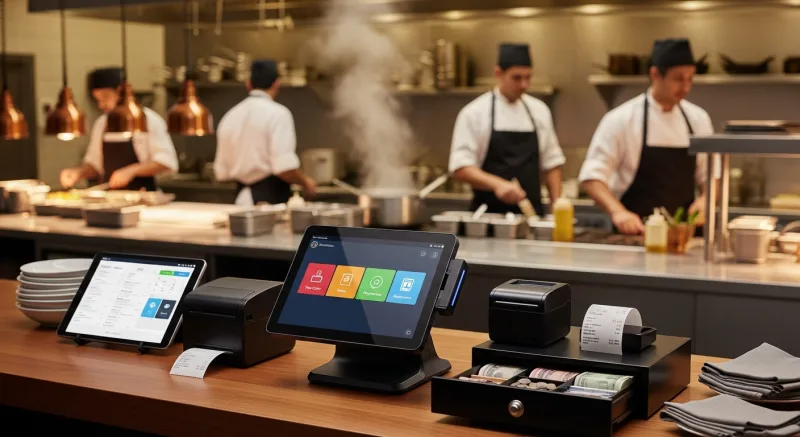
- Heat-resistant hardware flexibility — 150-degree kitchens destroy proprietary terminals; replaceable tablets survive
- Native Spanish interface — Sonoran kitchens operate in Spanish; the POS should too
- Monsoon offline processing — Desert storms guarantee periodic infrastructure disruption
- Processor independence — Scottsdale premium volumes save five figures annually with negotiated rates
- Snowbird season analytics — Seasonal revenue swings need data-driven forecasting
- Gift cards for seasonal conversion — Snowbird visitors become year-round revenue through gift cards
- Multi-location scalability — Central Phoenix to East Valley expansion needs unified management
- Pre-ordering for food trucks — Summer heat eliminates outdoor lines; digital ordering replaces them
Phoenix restaurants operate in conditions that would shut down restaurants in cooler climates. The technology should be equally heat-hardened.
Phoenix restaurant owners: Call (888) 355-6996 or visit KwickOS.com to see POS technology that works in the desert.
Turn One-Time Diners into Regulars: Built-In Gift Cards & Loyalty
Most POS companies treat gift cards and loyalty as afterthoughts — expensive add-ons that cost $50-100/month extra. KwickOS includes them at no additional charge because we believe they are essential revenue tools, not luxury features.
Gift Cards That Actually Drive Revenue
Here is what most restaurant owners do not realize: gift card buyers spend an average of 20-40% more than the card's face value. A $50 gift card typically generates $60-70 in actual spending. KwickOS supports both physical gift cards and electronic gift cards that customers can purchase, send, and redeem through their phones.
- Physical gift cards — branded plastic cards that sit on your counter and sell themselves during holidays
- E-gift cards — customers buy and send digitally via text or email, perfect for last-minute gifts
- Balance tracking — real-time balance across all your locations, no manual reconciliation
- Reload capability — customers top up their balance, creating a built-in prepayment habit
Loyalty Points That Keep Them Coming Back
KwickOS loyalty is not a punch card from 2005. It is a digital points system that tracks every dollar spent and automatically rewards your best customers:
- Earn points on every purchase — configurable ratio (e.g., $1 = 1 point, or $1 = 10 points)
- Tiered rewards — silver, gold, platinum levels to incentivize higher spending
- Birthday rewards — automated birthday offers that bring customers back during their special month
- Points-for-payment — customers redeem points directly at checkout, seamless for your staff
Membership Programs
For restaurants running VIP programs or subscription models (like monthly coffee clubs), KwickOS membership management handles recurring billing, exclusive pricing tiers, and member-only menu items — all within the same system your cashier already uses.
The bottom line: Toast charges $75/month extra for loyalty. Square's loyalty starts at $45/month. KwickOS includes gift cards, e-gift cards, loyalty points, and membership management in every plan. That is $540-900/year you keep in your pocket.

Founder & CIO of KwickOS · 30 Years IT · 20 Years Restaurant Industry
Tom built KwickOS after running restaurants and IT companies for decades. He relocated the company to a 10,000 sq ft office in 2023 and now serves 5,000+ businesses across all 50 states, processing over $2M in daily sales.