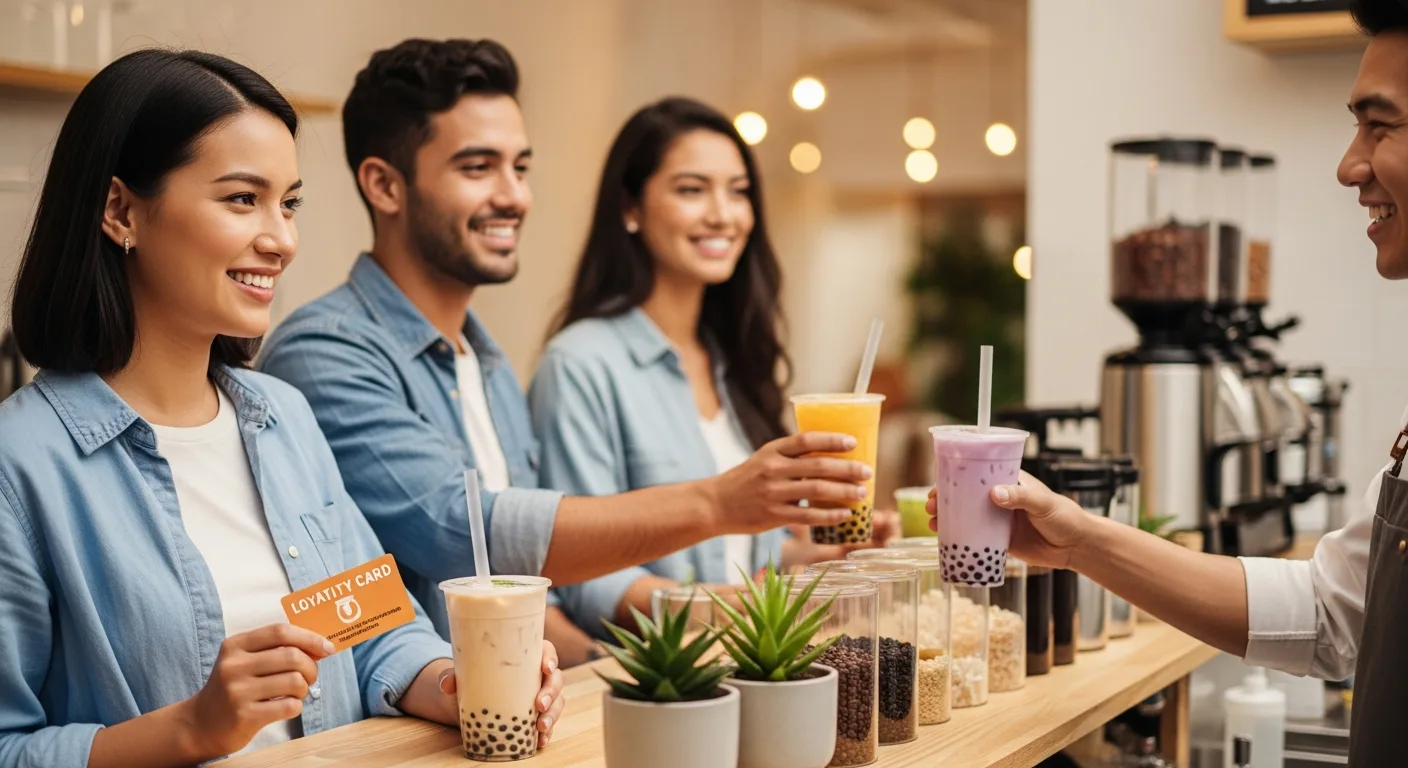
Bubble tea has the highest repeat purchase frequency of any beverage category. The average boba customer visits 2.8 times per week — more than coffee drinkers (2.1x/week) and far more than juice bar customers (0.8x/week). That frequency creates an enormous loyalty opportunity, but only if your program understands how boba customers think. They do not just buy drinks. They build drinks. Sugar level, ice level, toppings, milk type — every order is a personal creation. Your loyalty program must reward that behavior.
Tiger Sugar International Dessert, which operates two locations with KwickOS-powered kiosks, discovered this firsthand. Their minimal-step personalization flow combined with electronic receipts and loyalty enrollment captures customer preferences from the first visit. When that customer returns, the system remembers their exact customization — 50% sugar, less ice, extra boba, oat milk — and offers it as a one-tap reorder. That personalization-plus-loyalty combination drives a 42% repeat visit rate among enrolled members versus 19% among non-enrolled customers.
Why Generic Loyalty Software Fails Bubble Tea Shops
Restaurant and coffee shop loyalty programs are built around simple transactions: order food, earn points, redeem reward. Bubble tea transactions are fundamentally different:
Heavy customization. A single boba drink can have 15+ modification options: base tea type, sugar level (0/25/50/75/100%), ice level (no ice/less/regular/extra), topping choices (boba, jelly, pudding, cheese foam, crystal boba), milk options (regular/oat/almond/coconut), and size. Generic POS systems treat customizations as modifiers. Bubble tea POS systems need to treat them as core product attributes that the loyalty system tracks and remembers.
Low average ticket, extremely high frequency. The average boba transaction is $6-8. With 2.8 visits per week, a loyal customer spends $900-1,100/year. Points systems designed for $30 restaurant tickets make boba customers wait too long for rewards. The math needs recalibration.
Young, tech-savvy demographic. The core boba demographic (18-35) expects digital-native loyalty. They want to see their points on their phone, get push notifications about bonus events, and share their loyalty status on social media. Paper punch cards are not just inefficient — they signal that your shop is behind the times.
Topping upsell opportunity. Toppings are where boba shops make their real margin. A base tea costs the shop $0.40-0.60 to make. Each topping add-on ($0.50-1.00 retail) costs $0.05-0.15. Your loyalty program should specifically incentivize topping additions.
The 7 Loyalty Models That Drive Boba Revenue
1. Stamp Card (Digital, Drink-Based)
The classic boba loyalty model: buy 9 drinks, get the 10th free. But digital, not paper. A digital stamp card tracked in the POS eliminates the 70% loss rate of physical cards and provides actual purchasing data.
Optimization: make stamps category-aware. A regular-size drink earns 1 stamp. A large earns 1.5 stamps. Adding premium toppings earns a bonus 0.5 stamp. This subtly encourages upsizing and add-ons while still feeling like a straightforward "buy X, get 1 free" program.
2. Points-Per-Dollar With Topping Multipliers
Award 10 points per dollar on every purchase, with 2x points on any premium topping addition. A customer buying a $6.50 drink with $1.50 in toppings earns 65 base points plus 30 bonus points (2x on the $1.50 topping) = 95 points.
Redemption tiers:
- 300 points = free topping on any drink
- 500 points = free regular-size drink (any base)
- 800 points = free large drink with one topping
- 1,500 points = free "build your dream drink" (any size, any toppings, unlimited)
At 95 points per visit, a 3x/week customer earns a free topping in one week, a free drink in less than two weeks, and the dream drink reward in about 5 weeks. That pace matches boba customer expectations perfectly.
3. Customization Memory + Loyalty Integration
This is what sets great boba loyalty apart from good boba loyalty. When a loyalty member orders, the POS should display their last 3-5 orders and offer one-tap reorder. This serves dual purposes: speed (critical during afternoon rush) and psychological ownership ("my usual"). Customers who have a "usual" at a boba shop are 3x less likely to switch to a competitor.
KwickOS stores customization preferences per customer profile. When the loyalty member's phone number is entered at checkout — or when they order through the self-service kiosk — their favorites appear instantly. No searching, no re-explaining their exact sugar-ice-topping combination to a new staff member.
4. Birthday Boba Program
Birthday rewards have a 35% redemption rate in boba shops — significantly higher than the 20-25% rate in restaurants. The reason is simple: boba is an easy, low-commitment birthday treat. People celebrate at boba shops.
Best configuration: send the birthday reward 5 days before the birthday. Offer a free large drink with unlimited toppings (retail value $9-11, cost to shop $1.50). The birthday customer almost always brings friends — the average birthday redemption visit generates $28 in total group sales.
5. Limited-Edition and Seasonal Bonus Events
Boba shops rotate seasonal flavors constantly — taro in fall, strawberry in spring, mango in summer. Tie loyalty multipliers to seasonal launches: 3x points on any seasonal drink during launch week. This drives trial of new items and creates urgency ("I need to try the new flavor this week while triple points are active").
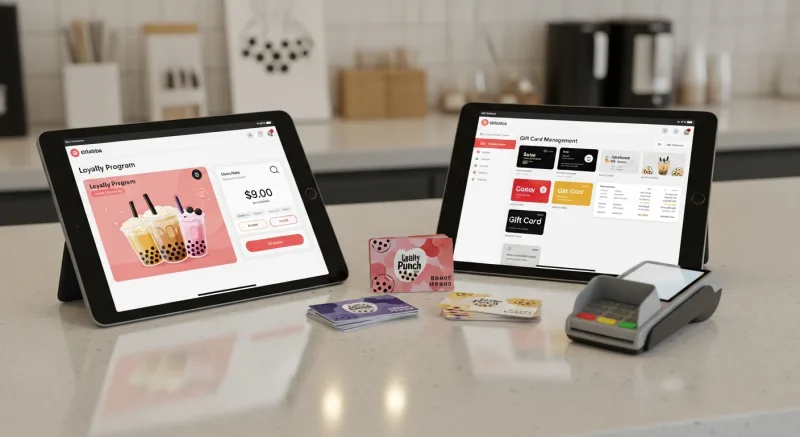
6. Gift Cards for the Boba Demographic
Gift cards are perfect for the boba demographic. They are a popular gift among teens and young adults, easy to give digitally, and the overspend rate is remarkable: boba gift card holders spend 30-40% beyond the card value because they always add toppings or upsize.
Digital e-gift cards are essential for boba shops. The target demographic lives on their phones and expects to send a gift card via text or social media in under 30 seconds. Physical cards are nice for in-store display but account for only 30% of boba gift card sales — 70% are digital.
7. Subscription Model (Daily Boba Club)
The subscription model is exploding in boba: $39/month for one drink per day (any regular size, one free topping). The retail value of 30 drinks is $180+. The shop's actual cost at $0.60/drink is $18/month. Even assuming the subscriber visits 25 out of 30 days, the margin is extraordinary — and every visit generates topping upsells, food add-ons, and drinks for the friends they bring along.
Software Comparison for Boba Shops
| Platform | Loyalty Cost | Customization Memory | Kiosk Support |
|---|---|---|---|
| Toast | $75/month | No | Limited |
| Square | $45/month | No | Basic |
| Clover | $39-99/month | Third-party | No |
| KwickOS | $0 (built-in) | Native | Full kiosk mode |
Tiger Sugar runs KwickOS with self-service kiosks that integrate loyalty enrollment directly into the ordering flow. Customers enter their phone number, see their customization history, and earn points — all without staff interaction. The result: 78% loyalty enrollment rate, compared to the industry average of 35% for staff-driven enrollment.
Points Configuration for Boba (Exact Settings)
Earning rate: 10 points per dollar spent. A $7 drink = 70 points.
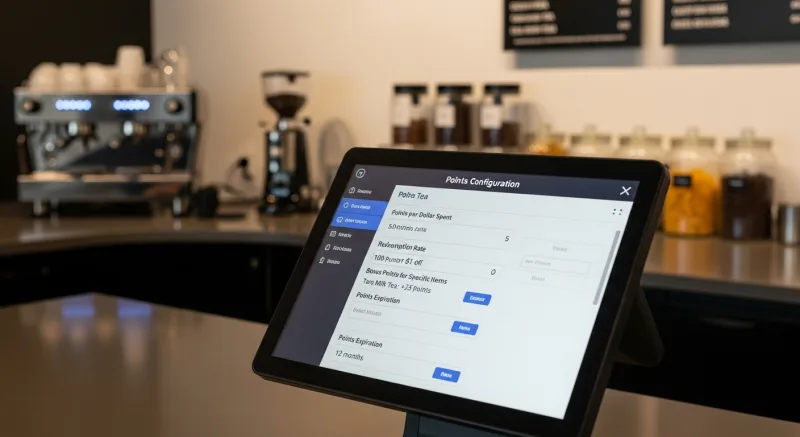
Topping bonus: 2x points on all topping additions. $1.50 in toppings = 30 bonus points.
Upsize bonus: 25 bonus points for ordering large instead of regular.
New item trial bonus: 50 bonus points for first purchase of any new seasonal item.
Redemption schedule:
- 300 points = free topping add-on (any single topping)
- 500 points = free regular drink (base tea, standard customizations)
- 800 points = free large drink with 1 premium topping
- 1,500 points = "Ultimate Boba" — any drink, any size, unlimited toppings
Reward cost analysis: Free topping costs $0.10. Free regular drink costs $0.55. Free large with topping costs $0.85. Ultimate Boba costs $1.50 max. At earning rates of 80-100 points per visit, the reward cost is under 5% of loyalty-driven revenue — well within healthy margins for a beverage business with 75-80% gross margins.
Launch Plan: 4 Weeks to Full Boba Loyalty
Week 1: Configure points, tiers, and customization tracking in KwickOS. Train staff on the enrollment pitch: "Want to earn free boba? Phone number is all I need." For kiosk locations, add the loyalty prompt to the kiosk ordering flow.
Week 2: Soft launch. Enroll customers organically. Test the customization memory feature with regulars — ask if their "usual" appears correctly. Adjust any points math that feels off.
Week 3: Full launch. Counter signage, social media posts, and the first bonus point event (3x points on your new seasonal drink). Target: 100 enrollments per week.
Week 4: Launch birthday rewards. Begin digital gift card promotion. Set up the "we miss you" automated message for members who have not visited in 10 days.
By month 3, a typical boba shop should have 800-1,200 loyalty members, with enrolled customers visiting 40% more frequently and spending 15% more per visit than non-members.
Why Kiosk + Loyalty Is the Boba Sweet Spot
Self-ordering kiosks and loyalty programs create a powerful feedback loop in boba shops. The kiosk captures the customer's phone number at the start of the order. The loyalty system immediately displays their favorites and points balance. The customer orders their "usual" with one tap, adds an extra topping because they are close to a reward, and completes checkout — all without any staff interaction during the ordering process.
This combination reduces order time by 40%, increases average ticket by 18% (through topping upsell prompts), and drives loyalty enrollment rates above 70%. It is the model that Tiger Sugar uses, and it is why their two-location operation achieves per-store revenue that outperforms the national average by a significant margin.
KwickOS is one of the few platforms that integrates kiosk ordering, loyalty points, customization memory, and gift cards into a single system. No third-party integrations to maintain, no sync delays between the kiosk and the loyalty database, no separate admin panel for loyalty management.
Build a Boba Loyalty Empire
KwickOS includes loyalty, kiosk ordering, customization memory, gift cards, and CRM — all built in, no extra monthly cost. See how Tiger Sugar grew repeat visits 42%.
Book Your Free Demo