ISO Agent POS Residual Income: The Complete 2026 Guide to Selling POS Systems
You're already selling payment processing. Adding POS to your portfolio doesn't just increase revenue—it makes your merchants nearly impossible to lose. Here's exactly how the math works.
If you're an ISO agent or independent sales organization selling payment processing, you already know the grind: find a merchant, pitch a lower rate, get the deal, and earn a residual on their processing volume. It works. But it has a fundamental weakness.
Processing-only merchants leave. They leave because another agent walks in with a rate 5 basis points lower. They leave because their bank offers a bundled deal. They leave because switching processors is easy—it takes one phone call and a new terminal.
Now imagine that same merchant is running your POS system. Their entire operation—menu, inventory, employee schedules, sales history, customer database, online ordering, kitchen displays—runs on software you placed. Switching their POS means retraining their entire staff, rebuilding their menu, losing their historical data, and disrupting their operation for days.
That merchant isn't leaving over 5 basis points. That merchant is yours for years.
Why ISO Agents Need POS in Their Portfolio
The payment processing industry is mature. Margins are compressed. The race to the bottom on rates means your residual per merchant shrinks every year. Here's what POS changes:
1. Higher Revenue Per Merchant
A processing-only merchant generates residual income from one source: the spread on their card transactions. A POS merchant generates residual income from three sources: processing spread, software subscription, and hardware/equipment. The total residual per merchant can be 2–4x higher with POS included.
2. Dramatically Lower Attrition
Industry data shows processing-only merchant attrition runs 15–25% annually. POS merchants have attrition rates of 3–7%. That's not a small difference—it's the difference between running to stand still and building a growing portfolio.
3. More Valuable Conversations
When you're selling processing, you're having a commodity conversation about rates and fees. When you're selling POS, you're having a business conversation about efficiency, labor costs, online ordering revenue, and growth. The second conversation is more interesting, more valuable, and more likely to lead to a referral.
4. Referral Acceleration
A merchant who saves 10 basis points on processing tells nobody. A merchant whose new POS system saved them 2 hours of daily labor, increased their online orders by 30%, and eliminated their paper ticket chaos? They tell every restaurant owner they know.
The Residual Math: Processing + Software + Hardware (The Triple Stack)
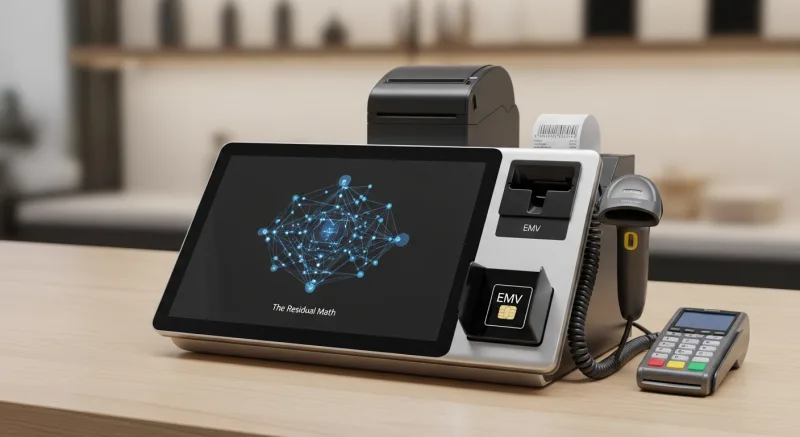
Here's how POS residual income actually works. Most agents think of it as a single number, but it's actually three stacked revenue streams:
| Revenue Stream | Per Merchant / Month | Notes |
|---|---|---|
| Payment processing residual | $75–$150 | Spread on card transactions. Varies by volume. |
| Software subscription revenue share | $50–$100 | Monthly POS software fee. Recurring as long as merchant is active. |
| Hardware margin / lease | $25–$75 | Upfront hardware sale or monthly lease income on terminals, printers, etc. |
Combined monthly residual per merchant: $150–$325
Compare to processing-only: $75–$150/month. POS doubles your per-merchant income while cutting your attrition rate by 70%.
The software subscription is the most important revenue stream, even though it may not be the largest. Here's why: processing residuals fluctuate with the merchant's volume (slow month = lower residual). Software subscriptions are fixed. Whether the merchant does $20,000 or $80,000 in sales, your software residual stays the same. It's predictable, stable income that smooths out the variability in your processing portfolio.
The Processor-Agnostic Advantage: Why This Changes Everything for Agents
This is the single most important section of this article. Read it twice.
Most POS companies (Toast, Square, Clover) require merchants to use their proprietary payment processing. When you sell Toast, the merchant must process through Toast Payments. When you sell Square, the merchant must process through Square.
That means you lose your processing relationship.
Think about what that means: you spend years building a processing portfolio, and the moment you place a Toast POS, your processing residual on that merchant goes to zero. Toast takes the processing. You might get a referral fee or a small residual on the Toast software, but your core business—payment processing—just lost a merchant.
KwickOS is processor-agnostic. The merchant can use any payment processor they want. Your processor. Your relationship. Your residual.
| Scenario | Your Processing Residual | Your Software Residual | Total |
|---|---|---|---|
| You sell processing only | $100/mo | $0 | $100/mo |
| You sell Toast POS | $0 (Toast takes it) | $25–$50/mo | $25–$50/mo |
| You sell KwickOS + your processing | $100/mo (you keep it) | $50–$100/mo | $150–$200/mo |
Selling Toast literally cuts your income in half on that merchant. Selling KwickOS doubles it. This isn't a marginal difference—it's a 4x swing in your per-merchant economics.
Merchant Stickiness: Why POS Merchants Don't Leave
A processing-only merchant has nothing tying them to you except rates. A POS merchant has:
- Their entire menu configured in the system (dozens of hours of setup)
- Employee records, schedules, and payroll data
- Historical sales data (months or years of reporting and analytics)
- Online ordering integrated with their website and Google listing
- Customer loyalty data and CRM profiles
- Kitchen display configurations and station routing
- Staff training investment (every employee knows this system)
- Integrations with accounting software, delivery services, and third-party apps
The switching cost isn't just financial. It's operational disruption. A restaurant switching POS systems typically experiences 3–5 days of degraded operations during the transition. Staff makes more errors. Speed drops. Customer experience suffers. No restaurant owner wants to go through that voluntarily.
This is why POS attrition runs 3–7% annually compared to 15–25% for processing-only. Your portfolio compounds instead of churning.
Portfolio math: An agent adding 5 merchants/month with 20% annual attrition needs 12 months to reach 46 net merchants. The same agent with 5% attrition reaches 57 net merchants. After 3 years: 98 vs. 149. The stickiness difference is worth more than the software residual itself.
The KwickOS Partner Program: How It Works
KwickOS was built for the agent channel. The entire support and installation infrastructure exists so that you, the agent, can focus on what you do best: finding and closing merchants. Here's what KwickOS handles:
What KwickOS Does (So You Don't Have To)
- Installation: KwickOS handles hardware setup and software configuration. Purchase to installation: 7–10 days. On-site install time: 1–3 hours.
- Menu programming: The KwickOS team builds the merchant's menu, including categories, modifiers, pricing, and photos.
- Staff training: 1–2 hours of on-site or remote training for the merchant's team. Most staff achieve proficiency in a single session.
- 24/7 technical support: Multilingual (English, Chinese, Spanish) US-based support handles all technical issues. When a merchant calls with a problem at 2 AM, KwickOS answers—not you.
- Ongoing updates: Software updates deploy automatically. Linux-based system means no Windows update interruptions, no forced restarts during business hours.
What You Do
- Find merchants who need a POS upgrade (or a first POS)
- Demo KwickOS (browser-based, so you can demo from your phone or laptop)
- Close the deal with processing + POS bundled
- Collect residuals on processing, software, and hardware
- Get referrals from happy merchants
You are the sales relationship. KwickOS is the fulfillment and support infrastructure. This is the model that scales: your time goes into revenue-generating sales activity, not into troubleshooting a printer at 10 PM on a Friday.
Partner Tiers
| Tier | Model | Best For |
|---|---|---|
| Referral Partner | Send leads, earn referral bonuses. No active selling required. | Accountants, consultants, restaurant suppliers who encounter merchants needing POS |
| Reseller | Actively sell and demo KwickOS. Earn processing + software + hardware residuals. | ISO agents, independent sales reps, merchant service providers |
| Full Partner | White-label capabilities, territory protection, highest residual tiers, co-marketing support. | Established ISOs with sales teams, regional POS dealers |
The core principle across all tiers: we do the work, you make the money. KwickOS handles installation, training, and support. You handle the relationship and the sale.
100 Merchants: What Your Residual Portfolio Looks Like
Let's model a realistic agent portfolio at the 100-merchant mark:
| Revenue Stream | Per Merchant | x 100 Merchants | Monthly Total |
|---|---|---|---|
| Processing residual | $100 | 100 | $10,000 |
| Software subscription share | $75 | 100 | $7,500 |
| Hardware residual/lease | $50 | 100 | $5,000 |
| Total monthly residual | $22,500/mo | ||
| Annualized | $270,000/yr |
At the higher end of the range (higher-volume merchants, multi-location deals, premium hardware packages), 100 merchants can generate $25,000+/month or $300,000+ annually.
The key metric: with 5% annual attrition, you lose only 5 merchants per year. If you're adding 3–5 per month, your portfolio grows relentlessly. In year 3, you're approaching 150+ merchants with $30,000–$40,000/month in residual income.
Compare to Processing-Only
100 processing-only merchants at $100/month average = $10,000/month. But with 20% annual attrition, you're losing 20 merchants per year. You need to add nearly 2 per month just to maintain your current level. Growth is a treadmill.
The POS agent earns 2x per merchant and retains 3x as many. After three years, the gap is not 2x—it's 5x or more, because the compounding effect of lower attrition accelerates every year.
KwickOS Partner vs Toast Sales Rep vs Clover Agent

| Factor | KwickOS Partner | Toast Sales Rep | Clover Agent |
|---|---|---|---|
| You keep processing relationship | Yes (processor-agnostic) | No (Toast takes processing) | Depends on ISO agreement |
| Software residual | $50–$100/mo | $25–$50/mo | $10–$30/mo |
| Total per-merchant income | $150–$325/mo | $25–$50/mo | $85–$130/mo |
| Installation handled by | KwickOS team | Toast team | Often the agent |
| 24/7 support provided by | KwickOS (multilingual) | Toast | Varies (often the agent) |
| Hardware flexibility | Any hardware (browser-based) | Toast hardware only | Clover hardware only |
| Industries served | Restaurant, retail, beauty/spa | Restaurant only | General (not specialized) |
| Offline capability | Full (hybrid local+cloud) | Limited | Limited |
The Toast comparison is the critical one for ISO agents. When you sell Toast, you're essentially giving away your most valuable asset—the processing relationship—in exchange for a modest software commission. You're trading a $100/month processing residual for a $25–$50/month Toast referral. That's not a partnership; that's a pay cut.
KwickOS lets you stack income: keep your processing residual and add software and hardware income on top. The merchant gets a better system (processor-agnostic means they're never locked into one processor's rates), and you earn more.
Getting Started: Your First POS Sale This Month
Step 1: Identify Your Best Prospects
Look at your existing processing portfolio first. Which merchants are running outdated POS systems, cash registers, or no POS at all? Those are your warmest leads—you already have the relationship.
Best prospects for a POS upgrade:
- Restaurants using a register or basic POS older than 5 years
- Multi-location operators still managing each store independently
- Merchants who have asked about online ordering (KwickOS includes it)
- Beauty/spa businesses tracking appointments and commissions manually (like Diva Nail, which saw a 90% efficiency increase after switching to KwickOS for automated commission tracking across 4 stores)
- Any merchant complaining about their current POS vendor's support, fees, or limitations
Step 2: Demo KwickOS
Because KwickOS is browser-based, you can demo it on any device. Pull it up on your phone during a merchant visit. Show them the POS interface, the online ordering page, the KDS display, the management dashboard. No special demo hardware required.
Focus on the problems they've told you about. If they hate their current system's reporting, show the real-time dashboard. If they're losing money on third-party delivery fees, show KwickDriver ($2 flat fee + $6.99/5mi vs. 15–25% commission to DoorDash/UberEats). If they have labor problems, show the fingerprint clock-in and scheduling module.
Step 3: Bundle the Deal
The strongest pitch is a bundled package: processing + POS + online ordering + KDS, all in one relationship. The merchant gets one point of contact (you), one support number (KwickOS 24/7 support), and one integrated system instead of 4–5 separate vendors.
Step 4: KwickOS Handles Fulfillment
Once the merchant signs, hand it off to the KwickOS installation team. They handle hardware procurement, on-site installation (1–3 hours), menu programming, and staff training (1–2 hours). The typical timeline from signed deal to live system is 7–10 days.
You don't need to become a POS technician. You don't need to learn Linux administration. You don't need to be on-call for support issues. KwickOS has 24/7 multilingual US-based support that handles everything post-installation.
Building a POS Portfolio: The Long Game
The agents who build the most valuable portfolios think in 3-year terms, not 3-month terms. Here's the trajectory:
Year 1: Foundation (40–60 merchants)
Focus on your existing processing portfolio. Convert 3–5 merchants per month to POS + processing bundles. Build case studies from early wins. Monthly residual: $6,000–$15,000.
Year 2: Growth (80–120 merchants)
Referrals from Year 1 merchants start compounding. Add cold outreach to new merchants. Multi-location deals increase average deal size. Monthly residual: $15,000–$25,000.
Year 3: Scale (130–180 merchants)
With 5% attrition, compounding is now working hard. Consider hiring a junior sales rep funded by your residuals. Target multi-location chains for 5–15 terminal deals. Monthly residual: $25,000–$40,000+.
This is how ISO agents build businesses worth acquiring. A portfolio of 150 POS merchants with 5% attrition and $30,000/month residual has a real market value. Processing-only portfolios are commodities. POS portfolios are assets.
The question isn't whether to add POS to your portfolio. The question is how many months of compounding growth you're willing to leave on the table before you start.
Become a KwickOS partner
Keep your processing relationship. Add software and hardware residuals. We handle installation, training, and 24/7 support. You focus on sales.
Apply to Partner Program (888) 355-6996