 Kelly Ho
You just rang up a $47 lunch check. The customer pays with a credit card. Your processor takes $1.38. The card network takes its cut. By the time the dust settles, you're left with about $45.20.
Now picture the same transaction, but the customer pays from a prepaid balance they loaded last week. Your processing cost on that swipe? Zero. The card was charged once when they loaded $100. That's one transaction fee instead of three or four spread across multiple visits.
But it gets worse for the business that doesn't offer stored value. That $47 customer could just as easily have walked into the restaurant next door. Nothing ties them to you. No commitment. No reason to come back.
A stored value card changes the equation entirely. When a customer has $53 still sitting on their account, you become their default choice. Every meal decision starts with "I already have money there." And industry research suggests those customers spend 23% to 35% more per visit than cash or credit customers — because the money feels already spent.
Here's the thing: stored value programs aren't just for Starbucks anymore. They're one of the most underused revenue tools available to independent restaurants, retail shops, and beauty businesses. And with the right POS-integrated gift card and loyalty system, setting one up takes less than a day.
What Stored Value Cards Actually Are (and Why They're Not Just Gift Cards)
Let's clear up the confusion first, because most business owners use "gift card" and "stored value card" interchangeably. They're not the same thing.
A gift card is a one-time loaded instrument. Someone buys a $50 card, gives it to their friend, the friend spends it, and the card is done. It's a gifting mechanism — the buyer and the user are usually different people.
A stored value card is a reloadable prepaid account linked to a specific customer. Think of it as a house account that the customer funds themselves. They load $100 today, spend $34 tomorrow, reload $50 next week. The balance persists. The relationship persists. The revenue persists.
The critical difference is behavioral. Gift card holders are transactional — they show up, drain the balance, and may never return. Stored value card holders are relational — they've made a commitment to your business, and every reload deepens that commitment.
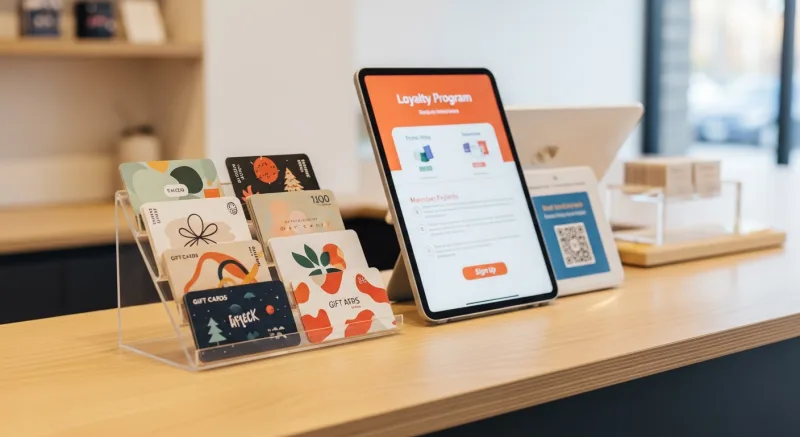
And that's not all: stored value cards can integrate directly with your loyalty and points program. Every dollar loaded earns points. Every purchase earns points. The two systems feed each other, creating a flywheel that accelerates customer retention.
The Psychology of Prepaid Spending: Why Customers Spend More
You're losing money every time a customer pays with a credit card at checkout — not just in processing fees, but in restrained spending. Here's why prepaid balances change behavior.
The "sunk cost" effect. When a customer loads $100 onto a stored value card, they mentally categorize that money as "spent." It's no longer sitting in their bank account competing with rent, groceries, and car payments. It's been allocated to your business. This means when they're deciding between a $12 lunch salad and a $19 steak sandwich, the steak wins — because the $19 doesn't feel like real money anymore.
The "house money" effect. This is the same psychology that makes casino chips feel less valuable than cash. Prepaid balances feel like bonus money, even though the customer loaded it themselves. The result is larger orders, more add-ons, and less price sensitivity at the POS checkout.
Here's a real-world example. Tiger Sugar runs two locations with two self-ordering kiosks. When customers order with a stored value account at the kiosk, the average ticket includes more customization — extra toppings, size upgrades, premium milk alternatives. The minimal-step personalization flow on the kiosk makes it effortless to add extras, and the prepaid balance removes the last psychological barrier to spending.
The "balance anxiety" effect. Nobody likes seeing $3.47 left on a card. It feels incomplete, wasteful. So customers do one of two things: they reload to a round number (generating new revenue), or they spend $15 on a $3.47 balance and pay the difference (generating bonus revenue above the stored value). Either way, you win.
5 Revenue Streams Hidden Inside a Stored Value Program
Most businesses think of stored value cards as simply "prepaid spending." But there are at least five distinct revenue mechanisms baked into a well-designed program.
1. Float Revenue: Their Money, Your Bank Account
When a customer loads $200 onto a stored value card, that $200 lands in your bank account immediately. The customer might take 6 weeks to spend it. During those 6 weeks, you're holding their cash. For a business with 200 active stored value accounts averaging $75 in loaded balances, that's $15,000 in float sitting in your account, improving cash flow and earning interest.
For multi-location operators like T. Jin China Diner — with 15 stores and 75 terminals — the float across hundreds of prepaid accounts becomes a meaningful working capital advantage. And because KwickOS syncs balances across all locations in real time via its hybrid local+cloud architecture, a customer who loads at one store can spend at any of the 15 locations without friction.
2. Breakage Revenue: The Balance They Never Spend
Industry research suggests that 10% to 15% of stored value balances are never fully redeemed. This is called breakage, and it's recognized as revenue under specific accounting rules. A stored value program processing $100,000 in annual loads could generate $10,000 to $15,000 in breakage revenue — money that was paid to you but never exchanged for goods or services.
Important note: breakage is subject to state escheatment laws. Some states require you to remit dormant balances after 3 to 5 years. Your POS system needs to track dormancy periods automatically — KwickOS does this natively, flagging accounts approaching escheatment thresholds so you can run re-engagement campaigns before the clock runs out.
3. Processing Fee Elimination
Every time a customer pays from a stored value balance, you avoid a credit card processing fee on that transaction. The only processing fee you paid was when they originally loaded the card.
Let's do the math. A customer loads $100 in one transaction. Processing fee at 2.5%: $2.50. That $100 gets spent across four visits averaging $25 each. If those four visits were paid with a credit card individually, you'd pay $2.50 in processing fees — four separate swipes at $0.625 each.
The savings seem small on one customer. But scale it to 300 active stored value accounts spending an average of $150/month, and you're looking at $900 to $1,350 per month in avoided processing fees. That's $10,800 to $16,200 per year. And if you're on a processor-agnostic system like KwickOS where you've already negotiated competitive interchange-plus rates, the stored value layer stacks savings on top of savings.
Compare that to businesses locked into Toast's 2.99% + $0.15 per swipe — they're paying the maximum on every single transaction with no escape hatch. A stored value program on a processor-agnostic platform is a double win.
4. Auto-Reload: The Subscription Revenue You Didn't Know You Had
Here's the feature that separates good stored value programs from great ones. Auto-reload lets customers set their card to automatically replenish when the balance drops below a threshold.
Customer sets: "Reload $50 when balance drops below $10."
What this creates is functionally a subscription to your business. The customer never runs out of balance. They never have a reason to pay with cash or credit. They never have a reason to go somewhere else — because they've already paid you.
According to restaurant industry data, auto-reload customers visit 40% more frequently than non-auto-reload stored value customers. And they spend more per visit, because they never experience the friction of "Should I reload?" at checkout.
At the POS, the checkout flow is seamless — tap the card, balance deducts, receipt prints. If auto-reload triggers, the customer gets a notification. No staff intervention needed. KwickOS handles the charge, balance update, and loyalty points accrual in a single 1ms local transaction.
5. Data and Personalization
Every stored value transaction is linked to a customer profile. Unlike anonymous cash or generic credit card transactions, you know exactly who spent what, when, and how often. This data powers:
- Targeted promotions: "You haven't visited in 2 weeks — here's a $5 bonus when you reload $25."
- Menu recommendations: "Your usual order is ready to reorder with one tap."
- VIP identification: Staff knows a high-value customer walked in before they even order.
- E-gift card upsells: "Send a digital gift card to a friend and earn 2x loyalty points."
This is the same CRM intelligence that Diva Nail Beauty uses across its 4 stores to track client preferences and automate commission calculations — resulting in a 90% efficiency increase. When your stored value program feeds into your CRM and loyalty engine, every customer interaction gets smarter.
How to Launch a Stored Value Program (Step by Step)
You don't need a six-month rollout plan. Here's how businesses on KwickOS typically launch a stored value program in under a week.
Step 1: Configure Your Account Structure
Decide on the basics. Minimum load amount (we recommend $25 — low enough to reduce friction, high enough to create meaningful commitment). Maximum balance ($500 is standard for restaurants, $1,000 for retail). Auto-reload thresholds and increment options.
Step 2: Design Your Incentive Tiers
The single most important factor in stored value adoption is the bonus structure. Customers need a financial reason to prepay. Here's what works:
| Load Amount | Bonus | Effective Discount | Your Cost |
|---|---|---|---|
| $25 | +$2 bonus | 7.4% | $2 (food cost ~$0.70) |
| $50 | +$5 bonus | 9.1% | $5 (food cost ~$1.75) |
| $100 | +$15 bonus | 13.0% | $15 (food cost ~$5.25) |
| $200 | +$35 bonus | 14.9% | $35 (food cost ~$12.25) |
The "effective discount" looks generous, but your actual cost is the food cost of the bonus — roughly 35% of face value for restaurants. A $15 bonus costs you about $5.25 in food cost, but secures $100 in guaranteed revenue plus the 23% spending uplift. The math overwhelmingly favors the business.
Step 3: Integrate with Your Loyalty Program
This is where stored value programs become truly powerful. Link stored value loads and spending to your existing loyalty points program. Options include:
- 2x points on stored value loads (incentivizes loading over pay-per-visit)
- Bonus points for auto-reload activation
- Tier upgrades based on stored value balance (e.g., "Gold member" status for maintaining $100+ balance)
- Birthday auto-credits to stored value accounts
Step 4: Train Your Staff on the 15-Second Pitch
Your cashiers and servers need exactly one line: "Would you like to load $50 onto a house account? You'll get an extra $5 free, and it works at all our locations."
That's it. No hard sell. No lengthy explanation. The bonus does the selling. At checkout on KwickOS, staff can create a new stored value account in three taps — customer name, phone number, initial load amount. The system generates a physical card number or links to the customer's digital wallet automatically.
Shogun Japanese Hibachi proved this works with new technology: their staff got proficient on custom station displays in under 5 minutes. A stored value enrollment is even simpler.
Step 5: Launch Digital and Physical Simultaneously
Offer both physical stored value cards (for customers who want something tangible at checkout) and digital accounts accessible via phone number or e-gift card link. Rockin' Rolls runs 49 iPad self-ordering stations across 3 locations — customers can load stored value directly from the kiosk screen without involving staff at all.
For digital-first customers, an e-gift card to themselves functions as a stored value initial load. They get a link, they bookmark it, and they use it on every visit. This is especially effective for younger demographics who expect mobile-first everything.
Stored Value Cards at Scale: Multi-Location Considerations
Single-location businesses get the core benefits. Multi-location operators get multiplied returns — but only if the technology supports it.
The critical requirement is real-time balance sync across all locations. A customer who loads $100 at Store A and walks into Store B five minutes later needs to see that $100 balance immediately. Any delay — even a few minutes — creates checkout confusion and erodes trust in the program.
This is where architecture matters. Cloud-only POS systems depend on internet connectivity for every balance check. If the connection drops, the stored value system goes down. KwickOS uses a hybrid local+cloud architecture: balances sync to every terminal locally (1ms response time) and update to the cloud for cross-location sync. Even if the internet drops at one location, stored value transactions continue processing locally and sync when connectivity returns.
Crafty Crab Seafood — 19 stores, 152 terminals — uses this exact architecture for menu sync and pricing across locations. The same infrastructure handles stored value balances, loyalty points, and e-gift card redemptions simultaneously. One dashboard, one customer database, 19 locations operating in perfect sync.
Stored Value vs. Membership Programs: When to Use Each
Some businesses ask: should I run a stored value program or a membership program? The answer is usually both — but they serve different purposes.
| Feature | Stored Value Card | Membership Program |
|---|---|---|
| Revenue type | Prepaid (lump sum) | Recurring (monthly/annual) |
| Customer commitment | Medium (balance-based) | High (subscription-based) |
| Best for | Restaurants, retail, quick-service | Spas, salons, fitness, wine clubs |
| Churn risk | Low (money already paid) | Medium (can cancel anytime) |
| Upsell mechanism | Bonus credits on loads | Member-only pricing/perks |
The power move: offer stored value cards as a membership perk. "Gold members get 20% bonus on every stored value load." Now your membership program drives stored value adoption, and stored value drives visit frequency. Two retention engines working together.
Accounting and Compliance: What You Need to Know
Stored value card revenue has specific accounting requirements that differ from regular sales.
Revenue recognition. When a customer loads $100 onto a stored value card, you do not recognize $100 in revenue immediately. That $100 is a liability — you owe the customer $100 worth of goods or services. Revenue is recognized when the customer redeems the balance. This is standard deferred revenue accounting (ASC 606 for US businesses).
Breakage recognition. The portion of balances you estimate will never be redeemed can be recognized as revenue proportionally as redemptions occur. Your POS system needs to track redemption patterns to support these estimates.
State escheatment. Unclaimed balances must be reported and potentially remitted to the state after a dormancy period. Requirements vary — California has no escheatment for gift cards over $10, while other states require remittance after 3 years. Your POS system should flag dormant accounts automatically.
The CARD Act. Federal law prohibits expiration dates within 5 years of last load and limits inactivity fees. These rules apply to stored value cards just as they apply to traditional gift cards.
Here's the thing: if your POS can't track these compliance requirements automatically, you're creating a manual bookkeeping nightmare. KwickOS tracks load dates, last activity, dormancy periods, and escheatment deadlines natively — and it supports multilingual receipts in English, Chinese, and Spanish, so your diverse customer base always gets clear terms.
Marketing Your Stored Value Program
Launching the program is half the battle. Getting customers to adopt it is the other half. Here are the channels that work:
At the register. Train staff to mention stored value on every transaction over $30. "You spent $34 today — if you'd loaded $50, you would have gotten $5 free. Want to start a house account for next time?" This approach works because the customer just demonstrated willingness to spend at your price point.
On your self-ordering kiosks. Add a "Start a House Account" option to the payment screen. Baked Cravings uses self-serve kiosks at Lego Land — a stored value enrollment prompt on the kiosk screen converts impulse buyers into repeat customers without any staff interaction.
Through e-gift cards. Run a "Gift Yourself" campaign. "Load $100, get $15 free — send an e-gift card to yourself." This converts the e-gift card mechanism into a stored value enrollment funnel. The customer gets a digital card they can reload anytime.
Via your delivery platform. If you're using KwickDriver for in-house delivery ($2 + $6.99 per order vs. 25% commission on DoorDash), offer stored value as a payment option. Customers who prepay for delivery orders are locked into ordering from you instead of browsing competitor listings on third-party apps.
Partner referrals. If you work with a POS reseller or ISO agent, they can introduce stored value programs to their merchant portfolio as a value-add. It's a retention tool for the reseller and a revenue tool for the merchant — everyone wins.
The ROI Math: What a Stored Value Program Is Actually Worth
Let's run the numbers for a mid-size restaurant processing $50,000/month in sales.
Assumptions: 200 active stored value accounts, average loaded balance of $75, average monthly spend of $120 per account from stored value (vs. $97 without — the 23% uplift).
| Revenue Source | Monthly | Annual |
|---|---|---|
| Spending uplift (23% on 200 accounts) | $4,600 | $55,200 |
| Processing fee savings | $600 | $7,200 |
| Breakage (12% of $15,000 loaded) | $150 | $1,800 |
| Float benefit (interest on $15,000) | $62 | $750 |
| Total incremental value | $5,412 | $64,950 |
Cost: Bonus credits given (approximately $2,400/year at 35% food cost = $840 actual cost) plus staff training time (one hour).
The ROI is not close. For every dollar you give away in bonuses, you get back over $27 in incremental revenue and savings. And that doesn't account for the lifetime value increase from higher retention rates.
For businesses processing $2M+ daily across 5,000+ locations — like the KwickOS merchant network — stored value programs represent one of the highest-leverage revenue tools available.
Launch Your Stored Value Program Today
KwickOS supports stored value cards, e-gift cards, loyalty points, and auto-reload natively — across every location, every terminal, every language. See it in action.
Get a Demo