March 13, 2026 · 12 min read
The Complete Guide to Restaurant Gift Card Programs in 2026
Gift cards are the most underused profit tool in the restaurant industry. Here is how to build a program that generates year-round revenue, brings in new customers, and keeps cash flowing even when seats are empty.
Key takeaway: The average gift card recipient spends 20–40% more than the card’s face value per visit. A restaurant selling 200 gift cards at $50 during the holidays generates $10,000 in immediate cash flow—plus an estimated $2,500 in additional spend when recipients redeem. And roughly 6–10% of gift card balances are never redeemed at all.
Why Gift Cards Are a Restaurant’s Secret Revenue Engine
Most restaurant owners think of gift cards as a nice-to-have. A stack of plastic cards sitting by the register, maybe a small display near the door. That mindset is leaving serious money on the table.
According to the National Restaurant Association, restaurant gift cards are the most requested gift card category in North America, outpacing retail, entertainment, and e-commerce cards. In 2025, the U.S. gift card market exceeded $220 billion in total value, with restaurants capturing roughly 35% of that spend.
But the real power of gift cards is not the initial sale. It is what happens after:
- Overspend: Gift card holders spend an average of 20–40% above the card balance per visit. A $50 card typically generates $60–$70 in total spending.
- Breakage: Between 6% and 10% of gift card value is never redeemed. That is pure profit.
- New customers: Over 60% of gift cards are purchased for someone else. Each card sold is a potential first-time visit from someone who might never have found your restaurant.
- Cash flow timing: You receive the money when the card is sold, not when it is redeemed. During holiday seasons, this creates a significant cash cushion for traditionally slow January and February months.
- No discount required: Unlike coupons or promotions, gift cards generate revenue at full menu price.
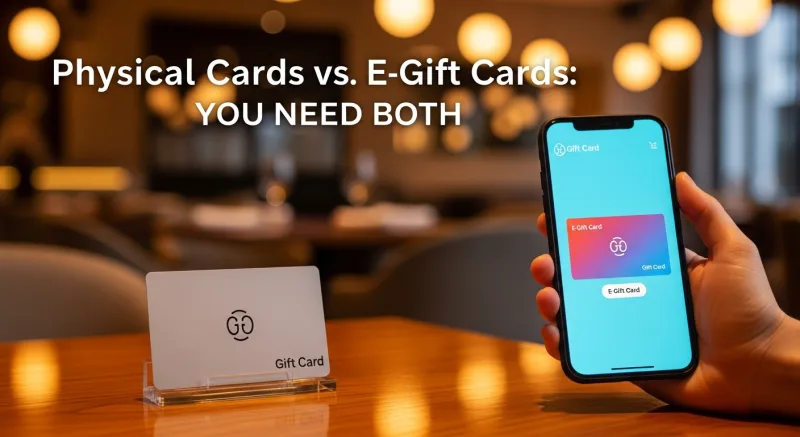
Physical Cards vs. E-Gift Cards: You Need Both
The gift card landscape has split into two distinct channels, and restaurants that only offer one are missing half the opportunity.
Physical Gift Cards
Physical cards still dominate in-store purchases and remain the top choice for holiday gifting. There is a psychological weight to handing someone a physical card—it feels like a real gift in a way that a forwarded email does not.
For physical cards, you need:
- Custom-branded cards with your restaurant’s logo and color scheme
- A visible display near the register and entrance
- Multiple denominations ($25, $50, $75, $100) plus custom-amount options
- Seasonal packaging or sleeves for holidays
- Staff trained to suggest gift cards during checkout
The production cost for physical gift cards typically runs $0.50–$1.50 per card depending on volume and quality. On a $50 card, that is a 1–3% cost of goods—far better margins than any menu item.
E-Gift Cards (Digital)
E-gift cards are the fastest-growing segment, now representing over 40% of all gift card sales. They are essential for capturing last-minute buyers, social media promotions, and online audiences.
E-gift cards offer advantages that physical cards cannot match:
- Instant delivery: A customer can purchase and send a gift card at 11:55 PM on Christmas Eve
- Social sharing: Recipients share e-gift cards on social media, creating free brand exposure
- Zero production cost: No card stock, no shipping, no inventory management
- Trackable: You know exactly who bought, who received, and when they redeemed
- Upsell integration: Send reminders when balances are running low, or suggest reload options
Physical vs. E-Gift Card Comparison
| Factor | Physical Cards | E-Gift Cards |
|---|---|---|
| Production cost | $0.50–$1.50/card | $0 per card |
| Purchase timing | Planned purchases, in-store | Impulse and last-minute buys |
| Average value | $40–$50 | $25–$35 |
| Breakage rate | 8–10% (cards get lost) | 4–6% (always in phone) |
| New customer reach | Local / personal gifting | National / social media reach |
| Best season | Nov–Dec holidays | Year-round (birthdays, thank-yous) |
The Holiday Gift Card Playbook: A Revenue Plan That Works
The period between Thanksgiving and Christmas accounts for nearly 50% of annual gift card sales. If you do not have a holiday strategy, you are effectively giving up half your gift card revenue.
Here is a proven timeline:
October: Preparation
- Order physical card stock (allow 3–4 weeks for custom printing)
- Set up e-gift card purchasing on your website and social media
- Train staff on gift card suggestive selling: “Would you like to pick up a gift card while you are here? They make great stocking stuffers.”
- Create a gift card display near the entrance and register
November: Early Promotion
- Launch “Buy $50, Get $10 Bonus” promotion for Black Friday through Cyber Monday
- Post e-gift card purchase links on all social channels
- Email your customer list about gift card availability
- Add gift card messaging to receipts and table tents
December: Peak Sales Push
- Increase bonus card promotions as Christmas approaches
- Emphasize e-gift cards for last-minute shoppers after December 20
- Staff should mention gift cards to every table during checkout
- Run “12 Days of Gift Cards” social media countdown
January–February: Redemption Season
- This is when gift cards get redeemed. Prepare for increased traffic
- Use redemption visits to enroll new loyalty program members
- Upsell: gift card holders who overspend become repeat customers
ROI Calculator: The Real Math Behind Gift Card Revenue
Holiday Gift Card ROI Example
Assume a single-location restaurant sells 200 gift cards during the holiday season at an average of $50 each:
Initial Revenue
$10,000
200 cards × $50 average
Overspend Revenue
$2,500
25% average overspend on redemption
Breakage Profit
$800
~8% of value never redeemed
Total Impact
$13,300
From a $300–$500 investment in cards
That is a 26×–44× return on the cost of producing the physical cards. No marketing channel comes close to this ROI.
Bonus Card Strategy: Why “Buy $50, Get $10 Free” Works So Well
The bonus card promotion is the single most effective gift card marketing tactic. Here is why it works from both sides of the transaction:
For the buyer: They perceive a 20% bonus value. A $50 purchase feels like $60. This is more compelling than a 20% discount on a meal because the gift card already solves the “what do I get them?” problem.
For your restaurant: The $10 bonus card brings the recipient back for a second visit. That second visit averages $35–$45 in spending, of which only $10 is subsidized. You are paying $10 to generate a $35+ ticket. That is a customer acquisition cost of $10—far below the $25–$50 cost of acquiring a new customer through digital advertising.
The key is structuring bonus cards correctly:
- Bonus cards should have a delayed activation (not valid until January 1) to drive traffic during slow months
- Set an expiration on the bonus card (90 days works well) to create urgency
- Make the bonus card a separate card from the purchased gift card so the buyer keeps it for themselves
- Track bonus card redemption rates to optimize future promotions
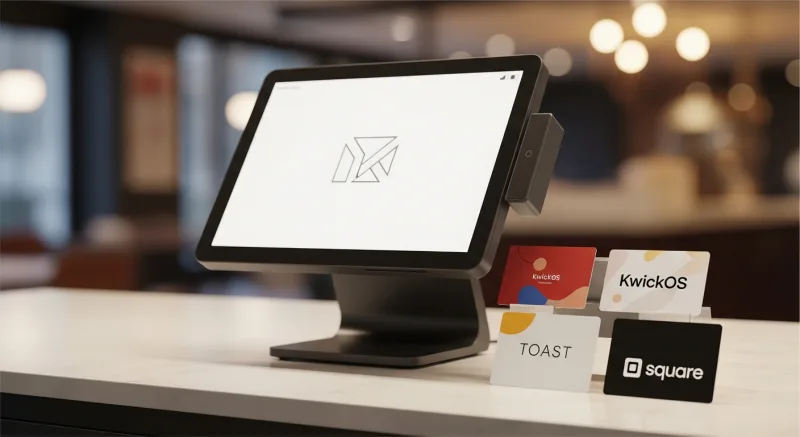
Gift Card Program Costs: KwickOS vs. Toast vs. Square
What you pay for gift card functionality varies enormously depending on your POS provider. Some include it free. Others treat it as a premium add-on that can cost more than the cards themselves.
| Feature | KwickOS | Toast | Square |
|---|---|---|---|
| Gift card module | Included free | $75/month add-on | Free (basic) |
| E-gift card support | Yes, built-in | Yes (with add-on) | Yes |
| Physical card support | Yes | Yes | Yes |
| Bonus card promotions | Yes, built-in | Yes (with add-on) | No |
| Multi-location balance | Yes | Yes | Yes |
| Loyalty integration | Yes, unified | Separate $75/mo module | Separate module |
| Annual cost (gift cards only) | $0 | $900/year | $0 (limited features) |
| Annual cost (gift + loyalty) | $0 | $1,800/year | $540/year |
Over three years, a Toast user paying for both gift card and loyalty modules spends $5,400 on features that KwickOS includes at no extra cost. For a multi-location operator like Crafty Crab (19 locations) or T. Jin China Diner (15 locations), those costs multiply. Crafty Crab would pay over $34,000 in three years just for Toast gift card and loyalty access across all locations.
E-Gift Cards for Social Media and Online Sales
E-gift cards open up a sales channel that physical cards simply cannot reach. When someone cannot visit your restaurant in person—whether they live in another city or just found you through Instagram—an e-gift card lets them engage immediately.
Social Media Integration
The most effective e-gift card strategies tie into social media:
- Instagram Stories: Add a “Send a Gift Card” swipe-up link (or link sticker) to food photos and reels
- Facebook Shops: List e-gift cards as products in your Facebook shop
- Birthday targeting: Run Facebook ads targeting users with upcoming birthdays in your area, promoting e-gift cards as the perfect gift
- User-generated content: When customers tag your restaurant, reply with a link to your e-gift card page
- Influencer partnerships: Give local food influencers gift cards to review; include purchase links in their content
Website Integration
Your website should make e-gift card purchases frictionless:
- Prominent “Gift Cards” link in your main navigation
- One-page checkout (no account creation required)
- Scheduled delivery for birthdays and special occasions
- Custom message option so the sender can personalize
- Mobile-optimized design (over 70% of e-gift card purchases happen on phones)
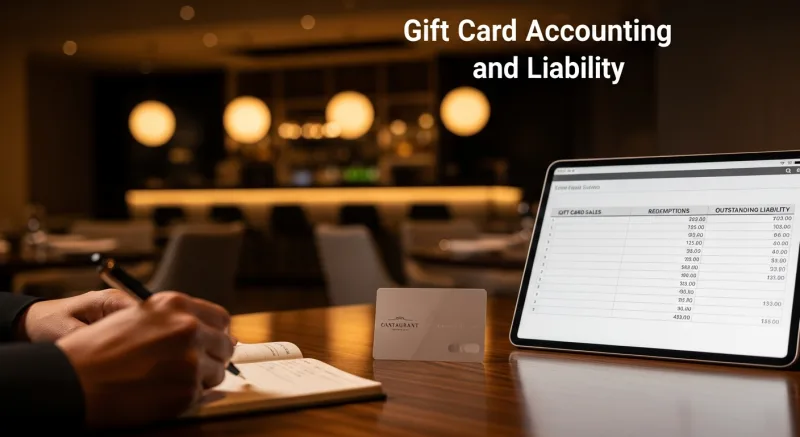
Gift Card Accounting and Liability: What You Need to Know
Gift cards create a deferred revenue liability on your books. When you sell a $50 gift card, you have not earned that revenue yet—you have an obligation to provide $50 worth of food or service. The revenue is recognized when the card is redeemed.
Key accounting considerations:
- Breakage recognition: Unredeemed balances can be recognized as revenue over time, but state laws vary. Some states require you to escheat unused balances to the state after a certain period (typically 3–5 years).
- Expiration rules: Federal law (the CARD Act) prevents gift card expiration within five years of purchase. Many states have stricter rules or prohibit expiration entirely.
- Fee restrictions: Inactivity fees are permitted only after 12 months of no activity in most jurisdictions, but many states ban them outright.
- Bonus card treatment: Promotional bonus cards (the “free $10”) can have different expiration rules since they were not purchased. Consult your accountant.
Your POS system should track all of this automatically. KwickOS maintains a real-time gift card liability ledger that your accountant can pull at any time, breaking down sold versus redeemed versus outstanding balances by month.
Seven Tactics to Sell More Gift Cards Year-Round
Holiday sales are important, but the restaurants that maximize gift card revenue sell them consistently throughout the year. Here are seven proven tactics:
1. Server Incentive Program
Pay servers $1–$2 for every gift card they sell. A server who sells just two gift cards per shift generates an extra $100–$200/week in gift card revenue for a cost of $2–$4 per shift. The ROI is extraordinary.
2. Gift Card as Change
When a customer pays cash and the change is under $5, offer to put it on a gift card instead. “Would you like your $3.47 change on a gift card you can use next time?” This is a low-friction way to drive return visits.
3. Corporate Gift Card Programs
Approach local businesses about bulk gift card purchases for employee rewards, client gifts, and holiday bonuses. Offer a 5–10% discount on bulk orders of $1,000 or more. Corporate accounts can become your largest single gift card revenue source.
4. Birthday and Anniversary Promotions
If you collect customer birthdays through your loyalty program, send an email one week before: “Celebrate [Name]’s birthday! Send them a gift card.” Target the customer’s contacts, not just the customer.
5. Catering Tie-In
Include a bonus gift card with every catering order over $200. This brings the catering client into your restaurant as a dine-in customer. A $10 bonus card on a $500 catering order is a 2% marketing cost that can generate hundreds in future dine-in revenue.
6. Checkout Counter Placement
Physical gift card displays should be at eye level at the register, not tucked behind the counter. Studies show that visible gift card displays increase unprompted gift card purchases by 25–35%.
7. E-Gift Card Retargeting
Use Facebook and Google retargeting pixels to show e-gift card ads to people who have visited your website but did not place an order. They already showed interest—a gift card is a low-commitment entry point.
Multi-Location Gift Card Management
For restaurant groups, gift card management becomes exponentially more complex. Customers expect to buy a gift card at one location and redeem it at another. Your POS must handle this seamlessly.
KwickOS uses a centralized gift card ledger that syncs across all locations in real time. When T. Jin China Diner sells a gift card at their downtown location, it is immediately redeemable at all 15 stores. The system tracks which location sold the card, which location redeemed it, and allocates revenue accordingly.
This is where cloud-only POS systems struggle during network outages. If your internet drops and a customer tries to redeem a gift card, a purely cloud-based system cannot verify the balance. KwickOS stores gift card data both locally and in the cloud, so redemption works even when the internet is down. The balance syncs across locations once connectivity is restored.
Common Gift Card Program Mistakes
After working with 5,000+ businesses, we see the same mistakes repeatedly:
- No promotion: Simply having gift cards available is not a strategy. You need active promotion, staff training, and seasonal campaigns.
- Physical-only: Skipping e-gift cards means missing 40%+ of potential sales and all online revenue.
- No bonus card program: Bonus cards are the single highest-ROI promotion in the restaurant industry. Not offering them is leaving money on the table.
- Poor tracking: If you cannot tell how many gift cards you sold last month, what the outstanding liability is, or what your breakage rate is, you are flying blind.
- Ignoring corporate sales: One corporate account buying $5,000 in gift cards equals 100 individual $50 sales. Pursue corporate accounts aggressively.
- Not integrating with loyalty: Gift card redemption should automatically enroll the customer in your loyalty program. Every gift card redeemer is a potential regular.
Getting Started: Launch Your Gift Card Program This Month
A gift card program does not require months of planning. Here is a practical launch checklist:
Week 1: Setup
- Enable gift card module in your POS (free with KwickOS)
- Order physical card stock (500 cards minimum for a single location)
- Set up e-gift card purchasing on your website
- Configure denominations: $25, $50, $75, $100, and custom amount
Week 2: Staff Training
- Train all front-of-house staff on how to sell and redeem gift cards
- Establish suggestive selling scripts
- Set up server incentive program ($1–$2 per card sold)
- Role-play common scenarios: selling, redeeming, checking balances
Week 3: Promotion
- Install physical card displays at register and entrance
- Post e-gift card links on all social media profiles
- Send email announcement to existing customer list
- Add gift card mention to receipts and table tents
Week 4: Measure and Optimize
- Review first month of sales data
- Identify top-selling denominations and adjust inventory
- Recognize top-selling servers
- Plan your first bonus card promotion
The Bottom Line
Gift cards are not a side feature. They are a revenue strategy. A well-executed gift card program generates immediate cash flow, attracts new customers, drives repeat visits, and creates measurable ROI that outperforms nearly every other marketing channel.
The restaurant owners who treat gift cards as a core part of their business—not an afterthought—consistently see stronger holiday revenue, better January traffic, and higher customer lifetime value.
If your POS charges extra for gift card functionality, you are paying for something that should be included. KwickOS includes gift cards, e-gift cards, bonus card promotions, and full multi-location support at no additional cost—because we believe every business should have access to these tools without being nickel-and-dimed.
Ready to launch your gift card program? Call us at (888) 355-6996 or request a free demo to see how KwickOS makes gift card management effortless.