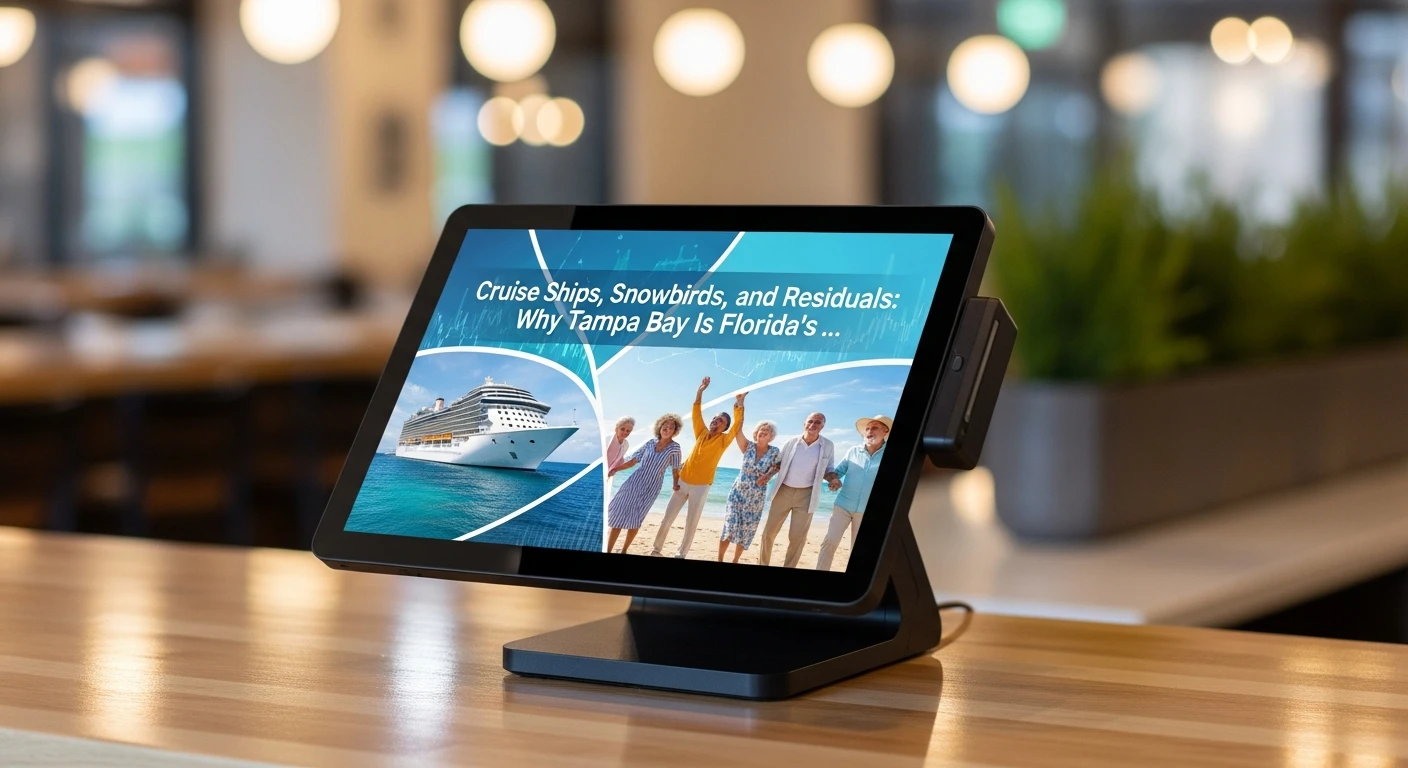
Cruise Ships, Snowbirds, and Residuals requires understanding the local market, regulations, and customer expectations in Tampa. Tampa Bay — encompassing Tampa, St. Petersburg, Clearwater, and the surrounding Hillsborough and Pinellas counties — has approximately 5,500 restaurants serving a metro population of 3.3 million. That population has grown 15% since 2020, making Tampa the second-fastest-growing large metro in the United States. Every one of those new residents needs to eat, and the restaurant industry has responded with an unprecedented building boom. New restaurant openings in Tampa Bay have outpaced Miami since 2023.
For a POS reseller, Tampa Bay's growth trajectory creates a rare window. New restaurants making first-time POS decisions are the easiest placements in the industry — there is no incumbent system to displace, no contract to break, no operator loyalty to overcome. You are simply the first person to walk in with the right solution at the right time. In Tampa Bay, that window is wide open.
The Three Economies That Power Tampa Bay Restaurants
Most restaurant markets run on one or two economic engines. Tampa Bay runs on three distinct economies that overlap and reinforce each other, creating a uniquely resilient and high-volume restaurant market.
Economy One: The Cruise Port
The Port of Tampa Bay is the largest cruise port on the Gulf Coast, handling 1.2 million cruise passengers annually. Those passengers arrive a day early. They stay a day late. They eat dinner before boarding. They eat lunch after disembarking. The Channelside and Ybor City restaurant districts serve this cruise traffic directly, and the volume patterns are remarkably predictable — you can look at the cruise ship schedule and forecast which restaurants will spike on which days.
Cruise-adjacent restaurants process $50,000-$90,000/month in card volume during peak season (October through April). The predictability of the cruise schedule means these restaurants staff and supply accordingly, and their POS systems need to handle the swing from a quiet Tuesday to a 400-cover Friday when three ships are in port simultaneously.
Economy Two: The Snowbird Season
From November through April, Tampa Bay's population swells by an estimated 300,000 seasonal residents — retirees and part-year residents from the Northeast and Midwest who escape winter. These snowbirds dine out at extraordinary rates. Industry data shows snowbird-season restaurant spending in the Tampa Bay area is 35-40% above summer baseline. Your processing residuals from a diversified Tampa Bay portfolio will show a clear seasonal lift during these six months.
The snowbird effect is concentrated along the Gulf beaches — Clearwater Beach, Indian Rocks Beach, Treasure Island, and St. Pete Beach — where seasonal restaurants process $60,000-$100,000/month during peak season. Some beach restaurants close entirely during hurricane season, which means your residual income from these merchants has a seasonal pattern. Smart resellers offset this with year-round placements in Tampa proper.
Economy Three: Permanent Growth
The third economy is the one that makes Tampa Bay strategically important for a POS reseller: permanent population growth. Tampa Bay has added over 400,000 permanent residents since 2020, driven by corporate relocations (including major financial services and tech companies), remote workers fleeing high-cost metros, and Florida's zero state income tax. This permanent growth creates permanent restaurant demand — not seasonal, not tourist-dependent, but year-round baseline volume that compounds your residual income annually.
The areas seeing the most restaurant growth — Wesley Chapel, Riverview, Brandon, and the Gateway corridor — are suburban communities where new retail centers are adding restaurants monthly. These greenfield placements are the lowest-friction sales in the POS industry.
Tampa Bay's Restaurant Neighborhoods
Ybor City
Tampa's historic Latin Quarter was built by Cuban, Spanish, and Italian cigar workers in the 1880s. Today, Seventh Avenue (La Septima) is a dining and entertainment corridor with 80+ restaurants and bars. The neighborhood's Latin heritage means Spanish-language POS capability matters here. Card volumes of $40,000-$70,000/month, with significant spikes on weekend nights and during events at nearby Amalie Arena (home of the Tampa Bay Lightning).
Ybor City's operators tend to be independent and community-oriented. The processor-agnostic pitch — freedom from corporate POS vendor lock-in — resonates with Ybor's independent spirit. KwickOS's native Spanish support provides competitive advantage in a neighborhood where many operators and staff are bilingual.
South Howard (SoHo)
Tampa's trendiest dining neighborhood along Howard Avenue features upscale restaurants, craft cocktail bars, and brunch destinations. SoHo restaurants process $45,000-$75,000/month in card volume. The operators here are younger, tech-aware, and responsive to the architecture pitch — they understand why local processing is faster than cloud-dependent and why processor independence saves money over time.
Seminole Heights
Tampa's culinary renaissance neighborhood has transformed from working-class residential to the city's most exciting independent restaurant district. James Beard-nominated chefs have opened here. The restaurants are chef-driven, independently owned, and allergic to corporate platforms. Monthly card volumes of $35,000-$55,000. These operators chose Seminole Heights specifically because it is not a chain restaurant corridor — they will choose POS on the same principle.
St. Petersburg: The Surprise
St. Petersburg has undergone one of the most dramatic urban transformations in America over the past decade. Downtown St. Pete now has 200+ restaurants within walking distance of the waterfront, fueled by a thriving arts scene, the Dali Museum tourism draw, and an influx of young professionals. Card volumes of $40,000-$65,000/month. St. Pete's restaurant density rivals neighborhoods in much larger cities, and the concentration makes it efficient for door-to-door reselling — you can visit 15 restaurants in a single afternoon on foot along Central Avenue and Beach Drive.
Clearwater and the Beaches
Clearwater Beach has been ranked America's best beach multiple times. The beach tourism economy drives restaurant volumes that spike dramatically during snowbird season and spring break. Clearwater Beach restaurants process $55,000-$100,000/month during peak season. The tourist-heavy payment mix is almost entirely card-based, maximizing your processing residuals.
International Corridors
Tampa Bay has several underserved international restaurant corridors. Busch Boulevard features a growing Asian restaurant scene. Dale Mabry Highway and West Hillsborough Avenue have Vietnamese and Chinese restaurants that need multilingual POS. The Westchase and Carrollwood areas have added Filipino, Thai, and Korean restaurants serving Tampa's diversifying population. KwickOS's Chinese and English language support provides competitive advantage in these corridors.
The Hurricane Factor
Tampa Bay had not taken a direct hurricane hit in over a century — until Hurricane Milton in 2024 reminded everyone that Florida's Gulf Coast is hurricane territory. The restaurant community's response was immediate: operators who had relied on cloud-only POS systems found themselves unable to process orders during extended internet outages. Power came back before internet service in many areas, and restaurants with generator power but no internet connectivity were stuck.
KwickOS's hybrid local+cloud architecture processes transactions locally at 1ms latency and syncs to the cloud when connectivity is available. During a hurricane-related internet outage, KwickOS terminals continue processing orders using local data. This is not a theoretical advantage in Tampa Bay — it is an operational necessity that restaurant operators now understand viscerally.
The hurricane conversation has become a closing tool for KwickOS resellers throughout Florida. When you ask a Tampa Bay restaurant owner "what happened to your POS during Milton?" you get a story about lost revenue. When you show them hybrid local+cloud architecture, you solve a problem they experienced personally.
Revenue Projections
- Average monthly card volume: $43,000
- Per-merchant monthly residual: $64.50
- Year 1 (10 placements/month): ~$45,000
- Year 2 annual run-rate: $132,000+
Tampa Bay's seasonal pattern creates an interesting residual income dynamic. Your beach and cruise-adjacent merchants will generate higher residuals during the November-April peak season, creating a natural income boost during the winter months. Your year-round Tampa and St. Pete placements provide stable baseline income. The combination is more resilient than either pattern alone.

Why Tampa Bay Is Underserved
The POS vendor landscape in Tampa Bay is surprisingly thin for a market of 5,500 restaurants. Toast has presence but has concentrated its Florida sales team in Miami and Orlando. Square targets the food truck and fast-casual segment but has limited penetration in full-service restaurants. Clover is present through bank partnerships but lacks dedicated sales coverage. The result is a market where many restaurants are running outdated systems, paying excessive processing fees, and receiving minimal support from their POS providers.
This underservice creates the optimal reseller environment: frustrated operators with expired contracts who are actively looking for alternatives but have not been shown one. A KwickOS reseller who commits to Tampa Bay faces less competition than in any other major Florida market.
Three-Tier Partnership
Referral Partner: Tampa Bay's real estate community, restaurant supply companies, and hospitality associations create natural referral channels. Every new restaurant buildout needs a POS recommendation. KwickOS handles the 7-10 day implementation and all support.
Active Reseller: Own the Tampa Bay metro. The geography is manageable — Tampa to St. Pete is 25 miles across the Howard Frankland Bridge. KwickOS handles 1-3 hour installation, 1-2 hour training, 24/7 support.
Full Partner: Cover Tampa Bay and extend to Sarasota, Bradenton, and Lakeland. The I-4 corridor to Orlando creates a natural expansion path. Combined territory: 9,000+ restaurants.
Case Studies
Baked Cravings: Theme Park Adjacent
Tampa Bay's proximity to Orlando's theme park economy makes Baked Cravings' self-serve kiosk deployment at Lego Land directly relevant. The PaxA35 terminal running 24-hour retail demonstrates KwickOS capability for Tampa Bay's high-traffic tourist locations.
Crafty Crab: Seafood Multi-Location
Tampa Bay's seafood restaurant culture — grouper sandwiches, stone crab, and Cajun-style boils — mirrors the Crafty Crab model. 19 locations with customized KDS for complex seafood orders and one-click menu sync across locations.
T. Jin: Cross-Bay Monitoring
For operators managing restaurants on both sides of Tampa Bay — Tampa and St. Pete connected by bridges that can add 45 minutes to a commute during rush hour — T. Jin's real-time remote monitoring across 15 stores eliminates the drive.
The Cigar City Strategy: A Launch Plan
Month 1: Start in Ybor City and Seminole Heights. Ybor's Spanish-language advantage creates immediate differentiation. Seminole Heights' independent operators are the most receptive to processor-agnostic messaging. These two neighborhoods are adjacent — you can cover both on foot in a single day.
Month 2: Cross the bridge to downtown St. Petersburg and Central Avenue. The restaurant density allows high-volume prospecting. Add SoHo for premium Tampa placements.
Month 3: Target Clearwater Beach and the Gulf beaches for high-volume seasonal placements. Begin prospecting in the suburban growth corridors — Wesley Chapel, Brandon, and Riverview — for greenfield new restaurant placements.
Month 4+: Extend south to Sarasota and north along the Suncoast Parkway. Begin targeting the international restaurant corridors along Busch Boulevard and West Hillsborough.
The Timing Advantage
Tampa Bay's restaurant market is in a growth phase that will not last forever. The population boom is driving new restaurant openings at a rate that creates a temporary abundance of first-time POS buyers. As the market matures and growth normalizes, these easy greenfield placements will become displacement sales — harder, slower, and more competitive. The reseller who establishes a Tampa Bay portfolio now, during the growth phase, builds a residual income stream that compounds long after the market matures.
Every POS vendor is looking at Miami. The smart money is looking at Tampa Bay.
Explore the KwickOS Partner Program or call (888) 355-6996.
Your Secret Selling Weapon: Gift Cards, Loyalty & Points — Included Free
Here is what closes deals for KwickOS resellers: when a merchant asks "what about gift cards?" or "do you have a loyalty program?" — you say "It is included. No extra monthly fee." Watch their face when they realize Toast charges $75/month and Square charges $45/month for the same thing.
Why This Matters for Your Sales Pitch
Gift cards and loyalty programs are the features merchants ask about but competitors charge extra for. This is your competitive advantage in every demo:
- Gift card program — physical cards + e-gift cards, multi-location balance sync. Sell it as "your own Starbucks card" for their business
- Points system — automatic point earning on every transaction. Customers come back more often, spend more each visit
- Membership tiers — VIP programs, subscription models, exclusive pricing. Perfect upsell for restaurants, salons, and coffee shops
- CRM integration — customer purchase history, preferences, birthday tracking, SMS/email marketing all from one screen
The Math That Closes Deals
Toast loyalty add-on: $75/month = $900/year. Square loyalty: $45/month = $540/year. KwickOS: $0 extra. Over a 3-year contract, that is $1,620-2,700 your merchant saves — just on loyalty and gift cards. Add payment processing freedom savings ($6,000+/year) and you are showing $8,000+ in annual savings. That is an easy yes.