24-Hour Restaurants, 24-Hour POS: Why Vegas Needs a System That Never Sleeps
Updated March 2026 · By Tom Jin
Las Vegas does not close. At 3 AM on a Tuesday, there are restaurants serving full dinner menus to people who just finished a show, lost at blackjack, or arrived on a red-eye from New York. The concept of “closing time” that governs every other American restaurant market does not exist here. And this 24-hour reality creates technology requirements that POS systems designed for normal operating hours fail to meet in ways that Vegas restaurant operators discover the hard way.
A POS system that needs to restart for updates at 3 AM works fine in Nashville. In Vegas, 3 AM is a dinner rush. A system that runs daily batch processing and slows down during the procedure works fine in Phoenix. In Vegas, there is no guaranteed slow period during which batch processing will not affect service. The technology running a Las Vegas restaurant must operate continuously, at full speed, for weeks at a time without degradation. Most POS systems were not designed for this. KwickOS, running on Linux, was.
The Strip-Adjacent Gold Mine
The Las Vegas Strip generates over $8 billion in annual restaurant revenue. But the most interesting technology stories are not inside the casino resorts with their unlimited budgets. They are in the independently owned restaurants within walking distance of the Strip — along Spring Mountain Road, on East Flamingo, in the Chinatown district — where operators compete for the same tourist dollars without the casino’s advantage of having captured guests already inside a building.
Spring Mountain Road’s Chinatown is not a tourist Chinatown. It is a seven-mile stretch of strip malls containing the most diverse Asian restaurant concentration west of the San Gabriel Valley. Chinese, Korean, Japanese, Vietnamese, Thai, and Filipino restaurants operate at volumes driven partly by the local community and partly by tourists who have discovered that the best food in Vegas is a $12 Uber ride from the Bellagio.
KwickOS’s Chinese language support serves this corridor’s Chinese restaurant operators with native character display on kitchen screens. A dim sum house on Spring Mountain processing 400 covers on a Saturday needs kitchen tickets in Chinese characters — not romanized names that create interpretation delays during the rush. The KDS displays each item in the language the cook reads, and the front-of-house terminal displays in English for the server interacting with tourists who cannot read the Chinese menu.
Convention Volume: CES, MAGIC, and the Revenue Tsunami
The Las Vegas Convention Center, Mandalay Bay, and the Venetian Expo collectively host conventions that bring hundreds of thousands of additional visitors to the city. CES alone attracts 130,000 attendees. MAGIC Show brings 70,000. NAB, CONEXPO, and the World of Concrete each add tens of thousands more. During major convention weeks, off-Strip restaurant volume increases 40-80% above baseline.
These surges arrive with 48 hours’ notice (the convention has been scheduled for a year, but the dining impact is felt from the moment attendees start arriving) and sustain for three to five days. Restaurants cannot hire and train staff in 48 hours. They need technology that multiplies the productivity of existing staff.
KwickOS self-ordering kiosks transform convention-week capacity. A restaurant that can process 120 orders per hour with a three-person counter team can process 200 per hour by adding two kiosks. The kiosks handle the ordering and payment while kitchen staff focus exclusively on production. During CES week, when the line stretches down the sidewalk and every minute of waiting costs potential customers, this automated throughput is the difference between capturing and losing revenue.
Desert Heat and Hardware Survival
Las Vegas summer temperatures exceed 115 degrees. Interior temperatures in restaurants without adequate HVAC — or in kitchens where the HVAC fights a losing battle against industrial ovens and flat-top grills — can exceed 130 degrees near cooking stations. POS hardware positioned near the kitchen pass or in non-air-conditioned patio service areas operates under thermal stress that shortens the lifespan of Windows-based systems requiring active cooling.
KwickOS runs on Linux, which requires fewer system resources and generates less heat than Windows-based alternatives. The software runs on standard tablets rather than purpose-built POS terminals with proprietary hardware. A tablet that overheats in a 130-degree kitchen is a $300 replacement. A proprietary Toast terminal that overheats is a $800-$1,200 replacement plus a service call from the vendor. In Las Vegas, where every restaurant kitchen exceeds the thermal specifications of most POS hardware for four months of the year, this hardware flexibility and replaceability is practical financial planning.
The 24-Hour Shift Change Problem
A restaurant operating 24 hours runs three shifts of staff per day. At each shift change, the outgoing team transfers operational control to the incoming team. In traditional POS systems, this transition involves logging out, logging in, transferring open checks, and reconciling the outgoing shift’s sales. With PIN-based authentication, this transition also creates a security window: outgoing staff may share PINs with incoming staff to avoid the login process, or PINs from departed employees may remain active across shifts.
KwickOS fingerprint 1:N identification eliminates every shift-transition vulnerability. Each employee touches the scanner and is immediately identified — no PIN to share, no card to hand off, no login process to shortcut. Open checks transfer biometrically: the outgoing server’s fingerprint closes their access and the incoming server’s fingerprint opens theirs. At 3 AM, when the graveyard shift takes over and supervision is minimal, the biometric audit trail provides accountability that no PIN-based system achieves.
For 24-hour operations, the fingerprint system also prevents ghost employees — a common fraud where a manager clocks in fictitious employees and pockets their wages. Every clock-in requires a physical fingerprint from a registered individual. You cannot clock in a person who does not physically touch the scanner.
Rockin’ Rolls and the Self-Ordering Revolution
Rockin’ Rolls Sushi Express operates 3 locations with 49 iPad self-ordering stations, demonstrating how self-ordering technology transforms high-volume restaurant operations. Instead of a server visiting each table to take an order, customers browse the menu on their table’s iPad, select items, and submit directly to the kitchen. The KDS receives orders instantly. Serving time dropped dramatically because the bottleneck — waiting for a server to visit, take the order, walk to a terminal, and enter it — was eliminated entirely.
This model is ideal for Las Vegas’s casual dining segment, where tourist customers want food quickly and do not want to compete for a busy server’s attention. A table of four browsing self-ordering tablets generates a larger average ticket than the same table ordering through a server, because the customer sees the full menu with photos and suggestions rather than the abbreviated verbal description a rushed server provides. Upselling happens through the interface — “Add avocado?” “Make it a combo?” — without relying on server training or initiative.
Processing at Vegas Volume
Las Vegas restaurant volumes are among the highest per-location in the country. A Strip-adjacent restaurant processing $200,000 monthly in card transactions is not unusual. A popular Spring Mountain Road establishment might do $150,000. At these volumes, the processing rate difference between locked-in and negotiated rates represents serious money.
On $200,000 monthly volume: Toast at 2.99% plus $0.15 costs $6,280 monthly — $75,360 annually. KwickOS with a negotiated processor at 2.1% plus $0.08 costs $4,360 monthly — $52,320 annually. Annual savings: $23,040. Over five years, that is $115,200 — a number large enough to fund a restaurant renovation, a second location deposit, or a year of marketing that actually drives new customer acquisition.
Clover’s processing rates are often presented as competitive, but Clover locks you into Fiserv processing with limited negotiation flexibility. Square’s flat rate is simple but expensive at volume. Only a processor-agnostic system like KwickOS gives the Vegas operator the leverage that their transaction volume earns them.
The Entertainment District Delivery Paradox
Las Vegas has an unusual delivery dynamic: tourists in hotels frequently prefer delivery to their rooms over venturing out for another meal. After a full day at a convention or a night on the Strip, the appeal of food arriving at your hotel room is powerful. But hotel delivery is logistically complex — navigating casino floors, finding guest elevators, and reaching room doors adds time and confusion that standard delivery apps handle poorly.
KwickDriver’s flat $2 delivery fee makes hotel delivery economically viable for off-Strip restaurants that would otherwise lose the tourist delivery market to room service or casino restaurants. A tourist ordering a $45 dinner delivery to the Bellagio pays the restaurant $43 through KwickDriver versus $31.50-$36 through DoorDash. The restaurant captures the high-ticket tourist order without surrendering a quarter of the revenue to a platform.
KwickMenu online ordering ensures the tourist finds the restaurant through its own web presence rather than a DoorDash search that shows 200 alternatives. A Spring Mountain Road restaurant with a well-optimized KwickMenu page captures the Googling tourist who searches “best Chinese food delivery Vegas” and converts them into a direct customer rather than a platform-intermediated one.
Digital Signage in a City Built on Visual Spectacle
Las Vegas is the most visually competitive restaurant environment in America. Every restaurant competes with the billion-dollar signage of the Strip, the digital spectacles of Fremont Street, and the visual overload that is the Vegas norm. In this environment, a restaurant with a static paper menu in the window is invisible.
KwickSign digital signage gives Vegas restaurants dynamic visual presence. Rotating menu items, vivid food photography, promotional countdown timers, and real-time pricing (happy hour transitions, late-night specials) create the visual dynamism that captures attention in a city where attention is the most scarce resource. A Spring Mountain Road restaurant with a street-facing KwickSign display showing steaming bowls of pho at midnight captures the post-club crowd walking past in a way that a printed menu never could.
Vegas POS Non-Negotiables
Las Vegas restaurants operate under conditions that would be considered extreme in any other market but are simply normal here. The technology supporting these operations must match the intensity of the environment.
- 24/7 reliability on Linux — No restarts, no batch-processing slowdowns, no degradation over weeks of continuous operation
- Processor independence — Vegas volumes save six figures over five years with negotiated rates
- Chinese language support — Spring Mountain Road Chinatown is one of the largest Asian food corridors in America
- Self-ordering at scale — Convention surges and tourist volume demand automated ordering throughput
- Heat-resilient hardware flexibility — 115-degree summers and 130-degree kitchens destroy proprietary terminals
- Fingerprint 24-hour security — Three daily shift changes and graveyard shifts need biometric accountability
- Flat-rate hotel delivery — Tourist room-delivery economics need flat fees, not percentage commissions
- Dynamic digital signage — Visual competition with the Strip demands digital presence, not paper menus
What happens in Vegas might stay in Vegas. But your POS processing fees follow you home on every monthly statement. Choose accordingly.
Las Vegas restaurant owners: Call (888) 355-6996 or visit KwickOS.com to demo a system that never takes a break — just like your restaurant.
Turn One-Time Diners into Regulars: Built-In Gift Cards & Loyalty
Most POS companies treat gift cards and loyalty as afterthoughts — expensive add-ons that cost $50-100/month extra. KwickOS includes them at no additional charge because we believe they are essential revenue tools, not luxury features.
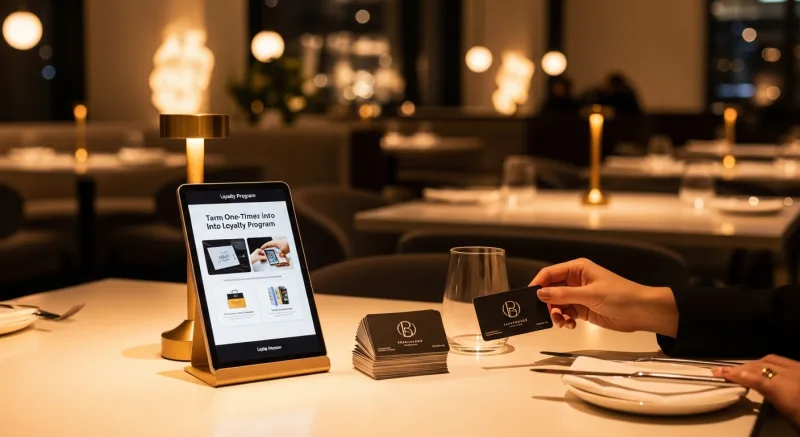
Gift Cards That Actually Drive Revenue
Here is what most restaurant owners do not realize: gift card buyers spend an average of 20-40% more than the card's face value. A $50 gift card typically generates $60-70 in actual spending. KwickOS supports both physical gift cards and electronic gift cards that customers can purchase, send, and redeem through their phones.
- Physical gift cards — branded plastic cards that sit on your counter and sell themselves during holidays
- E-gift cards — customers buy and send digitally via text or email, perfect for last-minute gifts
- Balance tracking — real-time balance across all your locations, no manual reconciliation
- Reload capability — customers top up their balance, creating a built-in prepayment habit
Loyalty Points That Keep Them Coming Back
KwickOS loyalty is not a punch card from 2005. It is a digital points system that tracks every dollar spent and automatically rewards your best customers:
- Earn points on every purchase — configurable ratio (e.g., $1 = 1 point, or $1 = 10 points)
- Tiered rewards — silver, gold, platinum levels to incentivize higher spending
- Birthday rewards — automated birthday offers that bring customers back during their special month
- Points-for-payment — customers redeem points directly at checkout, seamless for your staff
Membership Programs
For restaurants running VIP programs or subscription models (like monthly coffee clubs), KwickOS membership management handles recurring billing, exclusive pricing tiers, and member-only menu items — all within the same system your cashier already uses.
The bottom line: Toast charges $75/month extra for loyalty. Square's loyalty starts at $45/month. KwickOS includes gift cards, e-gift cards, loyalty points, and membership management in every plan. That is $540-900/year you keep in your pocket.

Founder & CIO of KwickOS · 30 Years IT · 20 Years Restaurant Industry
Tom built KwickOS after running restaurants and IT companies for decades. He relocated the company to a 10,000 sq ft office in 2023 and now serves 5,000+ businesses across all 50 states, processing over $2M in daily sales.