March 13, 2026 · 14 min read
LA's 31,000 Restaurants Are Handing $117 Million/Year to POS Companies That Lock Their Processing
For Los Angeles business owners searching for LA's 31,000 Restaurants Are Handing $117 Million/Year to POS Compan..., here's what the top operators already know. Los Angeles County has more restaurants than any county in the United States. From Koreatown bibimbap joints to Beverly Hills steakhouses, Silver Lake vegan cafes to San Gabriel Valley dim sum palaces, the diversity of LA's food scene is unmatched. What every one of these restaurants shares: a POS system that processes card payments. And for thousands of them, that POS is skimming extra profit through payment lock-in.
The LA math: 31,000+ restaurants × $3,780 average annual lock-in cost = $117.2 million/year extracted from LA's restaurant economy. Per restaurant over three years: $11,340. That money could fund LA's minimum wage increases that restaurant owners struggle to absorb.
California's Surcharging Rules: What LA Businesses Need to Know
California lifted its ban on credit card surcharging in 2013 following the class-action settlement in Expressions Hair Design v. Schneiderman. As of 2026, LA businesses can legally add a credit card surcharge up to 4% on Visa and Mastercard transactions. Surcharges on debit cards remain prohibited.
California imposes specific disclosure requirements: signage at the entrance, notification at the point of sale before the transaction is completed, and the surcharge amount printed on the receipt as a separate line item. Many LA restaurants avoid surcharging because the city's competitive dining environment and health-conscious, digitally native customer base reacts negatively to additional fees.
The alternative is a cash discount program, which frames the same economics differently: the posted price reflects a small discount for cash, with card transactions at the "standard" price. California law permits this structure as long as the cash price is advertised as a discount rather than the card price presented as a surcharge.
Whether surcharging or cash discounting, you need transparent processing costs to set the right rate. Locked POS processors obscure your actual cost. KwickOS with an independent processor gives you crystal-clear cost visibility.
LA's Neighborhood Restaurant Economics
Beverly Hills, West Hollywood, Santa Monica: Premium dining with $70-120 average checks. These neighborhoods process the highest per-transaction volumes in LA. The lock-in penalty on high-ticket transactions is pure percentage loss — $0.40 per $100 check × 200 daily covers = $80/day or $29,200/year. With processor freedom, a West Hollywood restaurant saves enough annually to fund an entire patio build-out.
San Gabriel Valley (SGV): The largest Chinese food corridor in the United States. Hundreds of restaurants in Alhambra, Monterey Park, San Gabriel, and Arcadia process transactions for a community that bridges Chinese and American dining culture. KwickOS's native Chinese language support is uniquely valuable here, and processor choice means working with processors experienced in SGV's payment patterns: large banquet tables with split checks, WeChat Pay and Alipay for Chinese tourists, and high-volume dim sum transactions at $15-25 per person.
Koreatown: Dense restaurant concentration with late-night dining culture. Korean BBQ restaurants process heavy weekend volume with $40-65 average checks and table-side tablet ordering. The processing speed during K-Town's 10 PM-2 AM dinner rush determines whether you serve four turns or three. KwickOS's local 1ms processing keeps tables turning without cloud latency.
East LA, Boyle Heights, South LA: Taco shops, pupuserias, and family restaurants with $8-15 average tickets and high transaction counts. These micro-transaction businesses get crushed by per-swipe fees exactly like coffee shops and bubble tea operations. KwickOS's Spanish language support serves these communities directly.
LA's Car Culture and Drive-Through Processing
Los Angeles is built around cars, and drive-through processing volume reflects it. QSR and fast-casual restaurants with drive-through windows in LA process 30-50% more drive-through transactions than comparable businesses in walkable cities like New York or San Francisco. That additional drive-through volume amplifies the per-swipe lock-in penalty.
A LA QSR doing 600 drive-through transactions/day at a locked $0.15/swipe pays $90/day or $32,400/year in flat fees alone. Negotiating the per-swipe fee down to $0.08 saves $25,200/year — nearly enough to hire another full-time worker at California's $16/hour minimum wage.
The Entertainment Industry Connection
LA's entertainment industry drives a unique gift card and catering market. Studios, production companies, talent agencies, and post-production houses order catering and buy restaurant gift cards for wrap parties, client gifts, and employee appreciation. A restaurant positioned to capture this corporate gifting market can sell $150,000-300,000/year in gift cards and catering.
KwickOS gift cards work with any processor, ensuring that $200,000 in outstanding corporate gift card balances remains redeemable regardless of any POS or processor change. For a restaurant that counts entertainment industry clients among its revenue streams, this portability is business-critical.
California Labor Costs and the Processing Squeeze
California's $16/hour minimum wage (and LA's local minimum that is even higher for large employers) already squeezes restaurant margins. When you layer inflated processing fees on top of the highest state labor costs in the continental U.S., the margin pressure becomes critical.
A typical LA restaurant spending $35,000/month on labor and $2,500/month in processing fees has little room for the $300/month in unnecessary processing markup that lock-in creates. That $300/month is two shifts of counter labor at minimum wage. Over a year, it is the cost of 7,200 hours of employee time that your POS vendor takes from you for nothing.
LA Processor Options
Los Angeles has a vibrant payment processing industry with dozens of processors and ISOs competing for restaurant business:
- West Coast processors: Companies headquartered in Southern California with deep knowledge of the LA restaurant market, including multilingual support for the city's diverse communities.
- Ethnic market specialists: Processors serving Chinese, Korean, Mexican, and other immigrant-owned restaurant communities with culturally appropriate service and competitive rates.
- Entertainment industry processors: Companies experienced in high-value corporate transactions, catering deposits, and event processing common to LA's entertainment economy.
The Three-Year Cost for a LA Restaurant
LA restaurant: $945K/year in card sales:
Locked processor: ~$30,255/year
Negotiated processor via KwickOS: ~$26,475/year
Annual savings: $3,780
Three-year savings: $11,340
In a city where rents are among the highest in the country and labor costs keep climbing, $11,340 in processing savings over three years is not pocket change. It is the difference between absorbing the next minimum wage increase and cutting a position. It is the marketing budget that puts you on the map.
LA's restaurants deserve better than locked processing. The technology exists. The savings are real. The only barrier is the inertia your POS vendor counts on.
LA restaurants: take back your processing revenue. Call (888) 355-6996 or visit kwickos.com for a free demo.
KwickOS · 6405 Cypresswood Dr #250, Spring TX 77379
Turn One-Time Diners into Regulars: Built-In Gift Cards & Loyalty
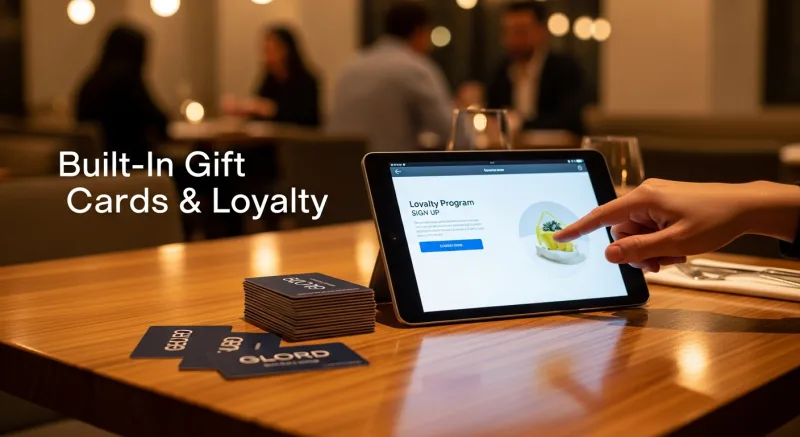
Most POS companies treat gift cards and loyalty as afterthoughts — expensive add-ons that cost $50-100/month extra. KwickOS includes them at no additional charge because we believe they are essential revenue tools, not luxury features.
Gift Cards That Actually Drive Revenue
Here is what most restaurant owners do not realize: gift card buyers spend an average of 20-40% more than the card's face value. A $50 gift card typically generates $60-70 in actual spending. KwickOS supports both physical gift cards and electronic gift cards that customers can purchase, send, and redeem through their phones.
- Physical gift cards — branded plastic cards that sit on your counter and sell themselves during holidays
- E-gift cards — customers buy and send digitally via text or email, perfect for last-minute gifts
- Balance tracking — real-time balance across all your locations, no manual reconciliation
- Reload capability — customers top up their balance, creating a built-in prepayment habit
Loyalty Points That Keep Them Coming Back
KwickOS loyalty is not a punch card from 2005. It is a digital points system that tracks every dollar spent and automatically rewards your best customers:
- Earn points on every purchase — configurable ratio (e.g., $1 = 1 point, or $1 = 10 points)
- Tiered rewards — silver, gold, platinum levels to incentivize higher spending
- Birthday rewards — automated birthday offers that bring customers back during their special month
- Points-for-payment — customers redeem points directly at checkout, seamless for your staff
Membership Programs
For restaurants running VIP programs or subscription models (like monthly coffee clubs), KwickOS membership management handles recurring billing, exclusive pricing tiers, and member-only menu items — all within the same system your cashier already uses.
The bottom line: Toast charges $75/month extra for loyalty. Square's loyalty starts at $45/month. KwickOS includes gift cards, e-gift cards, loyalty points, and membership management in every plan. That is $540-900/year you keep in your pocket.

Tom Jin
Founder & CIO of KwickOS · 30 Years IT · 20 Years Restaurant Industry
Tom's 5,000+ business network spans all 50 states, with particular strength in California's diverse restaurant market. KwickOS's multilingual platform serves LA's communities in their preferred languages.