March 13, 2026 · 14 min read
Your Full-Service Restaurant Processes $1M in Cards. You Are Losing $4,800 of It to Your POS Company.
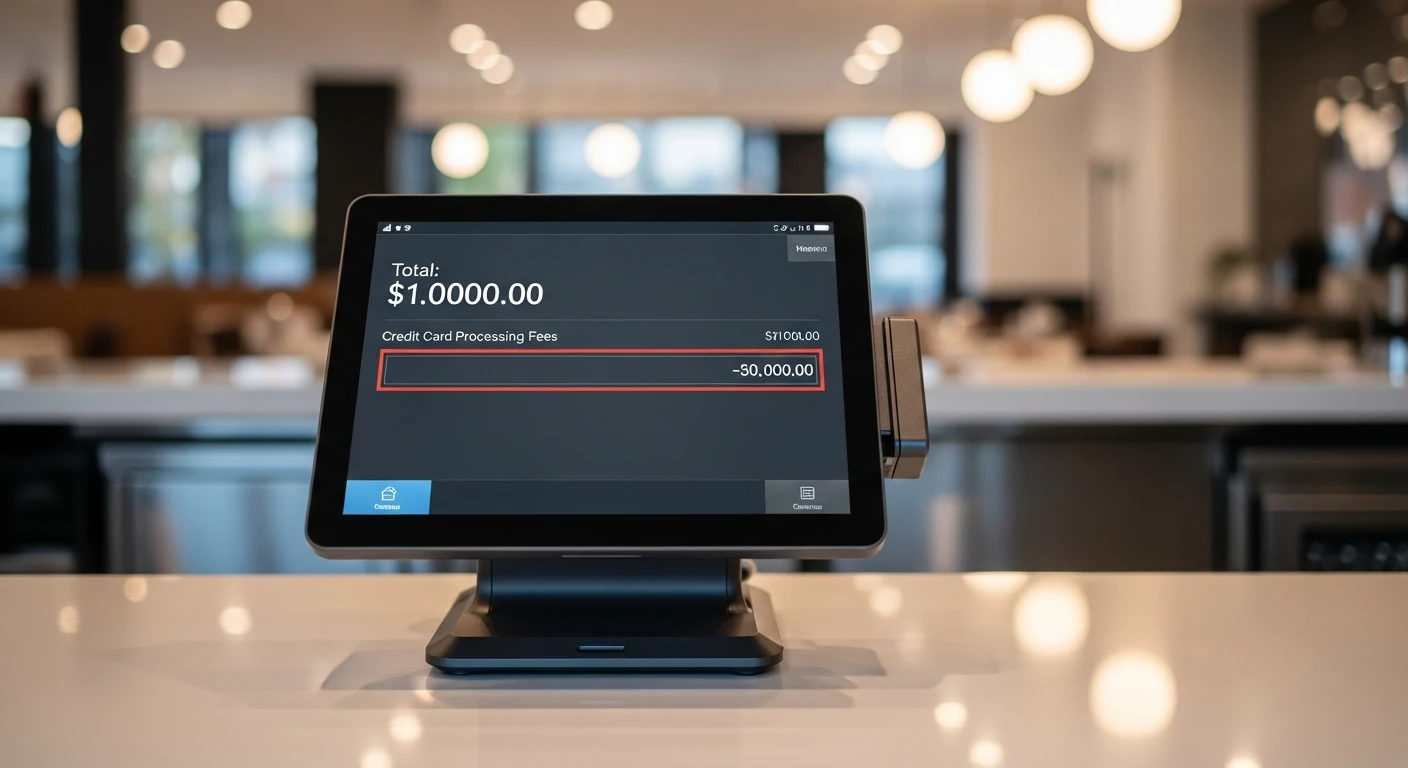
Full-service restaurants run the most complex operations in food service. Multiple revenue streams — dine-in, private events, catering, takeout, delivery, bar sales. Each stream generates card transactions. And every single card transaction carries an inflated processing fee because your POS vendor locked you into their processor.
The FSR math: A full-service restaurant doing $1.2M/year in card sales pays 0.40% more than necessary through a locked processor. That is $4,800/year. Over a typical three-year POS contract: $14,400 lost. Enough to renovate your patio, upgrade your HVAC, or fund three months of marketing.
The Full-Service Revenue Stack: Why FSR Lock-In Costs More
A quick-service restaurant has one revenue stream: counter sales. A full-service restaurant has five or six: dine-in table service, bar tabs, takeout, delivery, catering, and private dining events. Each stream processes cards differently, and the lock-in penalty applies to all of them.
Dine-in table service averages $45-65 per check in a mid-range FSR. At 150 covers per night, you process $6,750-9,750 in cards every evening. The per-table processing overhead: $0.15 per transaction × 80 tables = $12/night in flat fees alone, plus the percentage.
Bar sales generate their own tab-and-close pattern with pre-authorizations, tip adjustments, and split checks. A restaurant bar can add $200,000-400,000/year in card volume with higher per-transaction costs due to the tab workflow.
Catering and private events involve large single transactions — $2,000-10,000 per event — where the percentage fee is the dominant cost. On a $5,000 catering order, the difference between 2.99% ($149.50) and 2.49% ($124.50) is $25 per event. A restaurant handling 50 catered events per year saves $1,250 from processor choice on catering alone.
Delivery and takeout layer third-party commission fees on top of processing fees. Running delivery through KwickDriver at a flat $2 + $6.99/5mi versus 15-25% DoorDash commission saves hundreds per week on a busy FSR.
Table Turnover and Processing Speed: The Invisible Revenue Killer
In a 100-seat full-service restaurant, table turnover directly determines daily revenue. The industry standard for a mid-range FSR is 2.0-2.5 turns per night. Every minute a table sits waiting for the check to process is a minute that table is not generating new revenue.
The check presentation and payment cycle at a sit-down restaurant typically takes 4-7 minutes: server drops the check, waits for the card, runs the card, returns for signature, closes the transaction. Cloud-based POS systems add 3-5 seconds per card authorization. On 80 tables per night, that is 4-7 minutes of cumulative delay — not enough to notice on any single table, but enough to cost you half a table turn over a full service.
Half a table turn at $55 average check × 100 seats = $2,750 in potential revenue lost per night. Even if latency only costs you a quarter turn, that is $1,375/night or $495,000/year in capacity you cannot access because your POS is waiting for a cloud server.
KwickOS processes locally at 1ms. The card authorization happens before the server finishes placing the check presenter on the table. Tableside payment on a handheld terminal — tap, tip, close — completes in under 3 seconds. Faster payment means faster table turns, and faster table turns are the single most powerful revenue lever in full-service dining.
Server Tips: The Hidden Processing Cost Your Staff Absorbs
Full-service restaurants generate the largest tip volumes in the industry. Average tips at a mid-range FSR run 18-22% on the pre-tax subtotal. On $1.2M in annual card sales, tip volume is $216,000-264,000.
Your processor charges its percentage on the full authorized amount, including tips. At 2.99%, the fee on $240,000 in tips is $7,176. That is the processing fee on money that goes entirely to your servers. You do not keep a dollar of it, but you (or they) pay to process it.
With a negotiated processor at 2.49%, the tip processing cost drops to $5,976 — saving $1,200/year on tip processing alone. Some processors offer tip-adjusted rates where the percentage applies only to the food and beverage subtotal, with a reduced rate on tips. These structures are only available when you have processor choice.
Gift Cards and Wine Club Memberships
Full-service restaurants monetize gift cards and memberships more effectively than any other food-service segment. A $100 gift card to a nice restaurant is a premium gift. A wine club membership at $75/month is a recurring revenue stream. Both require a payment system that is not hostage to a single processor.
Toast's gift card system ties directly to Toast's processing. If you leave Toast, your outstanding gift card liabilities — which can reach $25,000-50,000 for an established FSR with active gifting seasons — become a transition nightmare. Customers holding those cards expect them to work. The operational cost of managing a parallel gift card redemption system during migration can exceed $5,000 in labor and customer service alone.
KwickOS gift cards are processor-independent. Wine club and dinner club memberships run on tokenized billing that migrates with any processor switch. Your $75/month wine club members never experience a billing disruption, and your $100 gift card holders never see a declined scan.
Multi-Location FSR Chains: The Lock-In Multiplier
An FSR operator running three locations processes $3M-4M/year in combined card sales. At 0.40% excess from a locked processor, the annual penalty is $12,000-16,000. Over three years: $36,000-48,000.
Haidilao Hot Pot operates 600+ locations worldwide. Crafty Crab Seafood runs 19 stores with 152 terminals on KwickOS. T. Jin China Diner manages 15 stores with 75 terminals, using real-time remote monitoring across all locations. These chains chose KwickOS specifically because processor lock-in at scale is catastrophically expensive. A 19-store chain locked into Toast processing at 0.40% excess on $20M combined volume pays $80,000/year more than necessary.
KwickOS provides per-location processor flexibility. Location A in a high-competition market might get a better rate from Heartland. Location B near a university might benefit from TSYS's student-card pricing. Each location optimizes independently while the owner manages everything from a centralized dashboard with one-click menu sync.
The Reservation-to-Payment Journey
A full-service restaurant's customer journey is longer and more complex than any other food-service type. Reservation, seating, ordering, course sequencing, wine service, dessert, check, payment, departure. Every touchpoint is an opportunity for technology to help or hinder.
When your POS is locked to a processor, the payment step becomes the weakest link. Not because the payment fails, but because the inflated cost accumulates invisibly. Your host seats 250 parties per week. Your servers present 250 checks. Your processor skims an extra $0.40-0.60% on every single one. Over a year, those 13,000 checks carry an extra $4,800-7,200 in processing costs that a processor-agnostic system would have eliminated.
The insidious part is that you never see this cost as a line item. It is buried in your monthly processing statement as an undifferentiated percentage. You would need to compare your effective rate against market rates to see the overcharge — and your POS vendor has no incentive to help you make that comparison.
Fingerprint Authentication: The FSR Security Standard
Full-service restaurants face unique employee access challenges. Multiple servers, bartenders, bussers, hosts, and managers all need system access. PIN codes get shared. Passwords get written on sticky notes. In an FSR with 25 employees across shifts, security through PINs is fiction.
KwickOS uses 1:N fingerprint authentication where the system identifies the employee from a database — no name selection, no PIN entry. A server touches the sensor and the system knows exactly who is accessing which functions. Every void, comp, discount, and cash drawer open is logged with biometric certainty.
Toast does not offer fingerprint authentication. Their access control relies on employee PINs that are trivially shareable. For an FSR where $50,000-100,000 in annual theft is industry-standard, biometric security is not a luxury. It is a requirement that Toast simply cannot provide.
The Internet Outage During Saturday Dinner Service
Saturday at 7:30 PM. Every table is full. The wait is 45 minutes. Your bar is three-deep. And your internet drops.
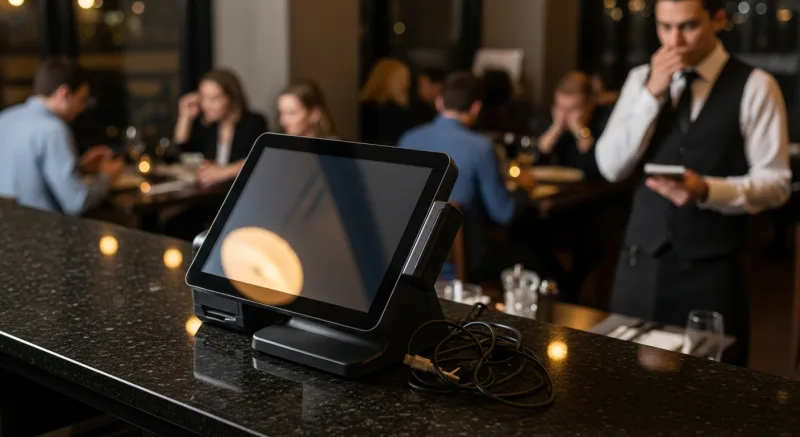
With Toast, your servers cannot process card payments. They cannot look up customer loyalty profiles. They cannot add items to open tickets from the handheld devices. Online orders stop flowing in. Your KDS goes dark because it cannot reach the cloud. Your $12,000 Saturday night becomes a $6,000 Saturday night because you lost two hours of functionality.
With KwickOS, nothing changes. The hybrid local-plus-cloud architecture processes everything on-site. Cards authorize through the local payment terminal. The KDS continues routing orders over your local network. Loyalty lookups happen against the on-site database. Your servers keep working. Your customers never know the internet was down. The system syncs everything to the cloud when connectivity restores.
A single Saturday outage that costs $6,000 in lost revenue exceeds the annual savings from processor freedom. But you get both: offline resilience and processing savings. There is no trade-off.
The Three-Year Cost for a Single-Location FSR
Full-service restaurant: $1.2M/year in card sales:
Locked processor (2.99% + $0.15): ~$37,080/year
Negotiated interchange-plus via KwickOS: ~$31,320/year
Annual savings: $5,760
Three-year savings: $17,280
$17,280. Add the tip processing savings ($3,600 over three years), the gift card portability value, and the avoided cost of one Saturday internet outage, and the total benefit of processor freedom for a single FSR easily exceeds $25,000 over three years.
Switching: Simpler Than You Think
The fear of switching POS systems in a full-service restaurant is understandable. You have complex menus, table maps, server assignments, course timing, and years of operational workflow built around your current system. But the migration is more straightforward than the fear suggests:
- Menu import: Your menu items, modifiers, course categories, and pricing structures import into KwickOS. The system handles FSR complexity natively — appetizer/entree/dessert sequencing, wine pairing suggestions, split-plate modifiers.
- Table map: Your floor plan recreates in KwickOS with table assignments, sections, and server rotation support.
- Staff training: 1-2 hours for servers, slightly more for managers. Shogun Japanese Hibachi's team reached full proficiency in under 5 minutes on the core ordering workflow.
- Timeline: 7-10 days from purchase to live operation. Installation: 1-3 hours.
Every month you delay costs $480. Every quarter: $1,440. Every year: $5,760. The cost of staying locked in accrues silently, month after month, while your processor sends you statements you never read closely enough.
Your restaurant deserves better processing rates. Call (888) 355-6996 or visit kwickos.com for a full-service restaurant POS demo.
KwickOS · 6405 Cypresswood Dr #250, Spring TX 77379
Turn One-Time Diners into Regulars: Built-In Gift Cards & Loyalty
Most POS companies treat gift cards and loyalty as afterthoughts — expensive add-ons that cost $50-100/month extra. KwickOS includes them at no additional charge because we believe they are essential revenue tools, not luxury features.
Gift Cards That Actually Drive Revenue
Here is what most restaurant owners do not realize: gift card buyers spend an average of 20-40% more than the card's face value. A $50 gift card typically generates $60-70 in actual spending. KwickOS supports both physical gift cards and electronic gift cards that customers can purchase, send, and redeem through their phones.
- Physical gift cards — branded plastic cards that sit on your counter and sell themselves during holidays
- E-gift cards — customers buy and send digitally via text or email, perfect for last-minute gifts
- Balance tracking — real-time balance across all your locations, no manual reconciliation
- Reload capability — customers top up their balance, creating a built-in prepayment habit
Loyalty Points That Keep Them Coming Back
KwickOS loyalty is not a punch card from 2005. It is a digital points system that tracks every dollar spent and automatically rewards your best customers:
- Earn points on every purchase — configurable ratio (e.g., $1 = 1 point, or $1 = 10 points)
- Tiered rewards — silver, gold, platinum levels to incentivize higher spending
- Birthday rewards — automated birthday offers that bring customers back during their special month
- Points-for-payment — customers redeem points directly at checkout, seamless for your staff
Membership Programs
For restaurants running VIP programs or subscription models (like monthly coffee clubs), KwickOS membership management handles recurring billing, exclusive pricing tiers, and member-only menu items — all within the same system your cashier already uses.
The bottom line: Toast charges $75/month extra for loyalty. Square's loyalty starts at $45/month. KwickOS includes gift cards, e-gift cards, loyalty points, and membership management in every plan. That is $540-900/year you keep in your pocket.

Tom Jin
Founder & CIO of KwickOS · 30 Years IT · 20 Years Restaurant Industry
After two decades owning and operating restaurants, Tom built KwickOS to solve the problems he lived daily — including the payment processing overcharges that drain FSR profits.
Related Articles
Bars: 200 Tabs a Night and the Processing Tax
Bar-specific lock-in analysis with tab, split, and tip processing costs.
Pizza Shops: Delivery Volume Meets Lock-In Fees
Why pizza delivery operations are uniquely vulnerable to processing lock-in.
KwickOS vs. Toast: The Detailed Comparison
Feature-by-feature breakdown of both platforms across every category.