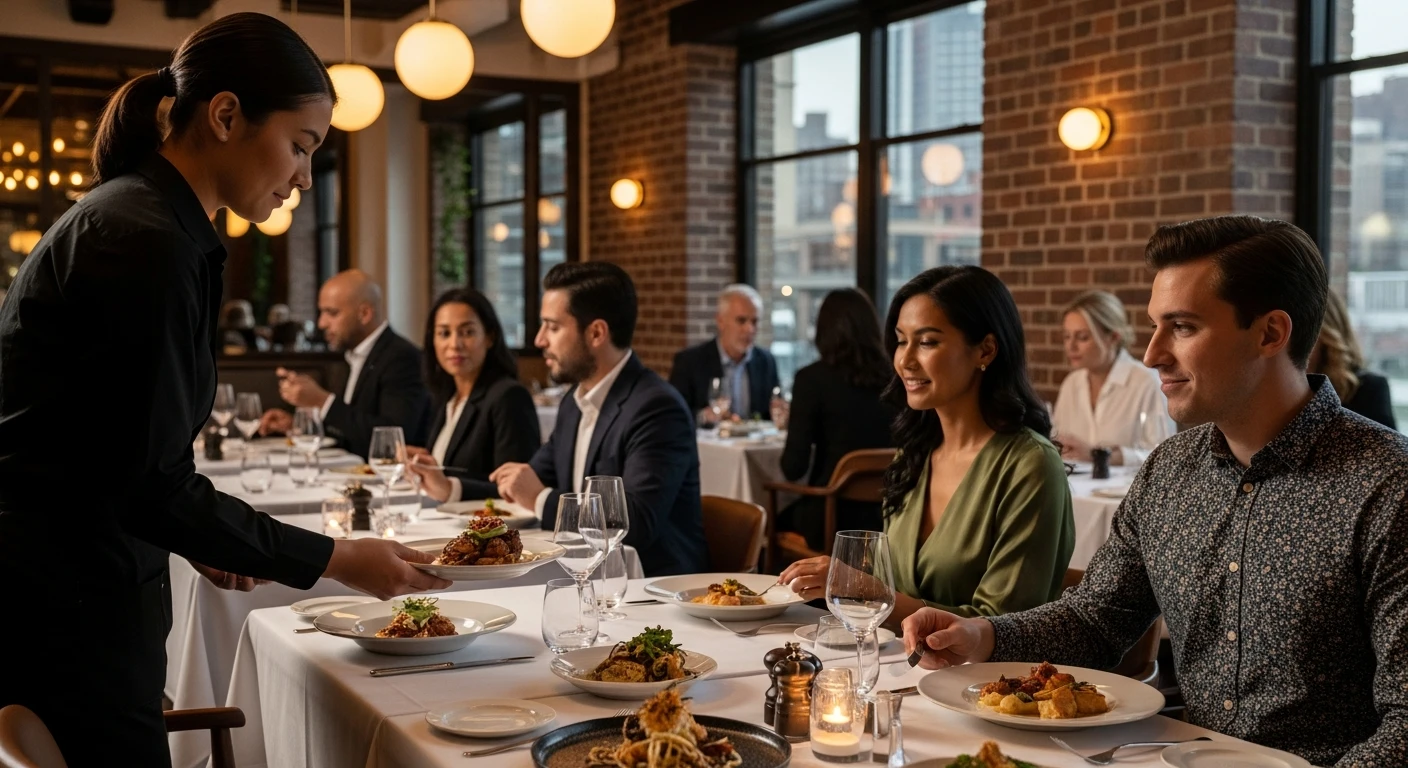
For New York business owners searching for Running Restaurants in Brooklyn, Manhattan, and Queens? Here's Why ..., here's what the top operators already know. The New York City restaurant market is the most competitive in the United States. Over 27,000 restaurants compete for approximately 8.3 million residents and 60+ million annual tourists. A restaurant group operating in multiple boroughs is not just managing multiple locations — they are managing multiple markets, each with distinct customer profiles, traffic patterns, and competitive dynamics.
Your Manhattan location serves the lunch rush from 11:30 to 1:30 — two hours of intense volume driven by office workers who need food in under 15 minutes. Your Brooklyn location has a slower, longer dinner service starting at 7 PM, with customers who linger for two hours over cocktails and shared plates. Your Queens location serves a predominantly immigrant community that values multilingual service and specific cultural menu items. Three locations, three operational realities, one brand that needs to feel consistent.
The POS system that runs this brand needs to be as versatile as the city itself.
The NYC Rent Reality: Every Dollar of Revenue Matters
Manhattan restaurant rents average $80-150 per square foot annually. A 2,000 square foot restaurant pays $160,000-300,000/year in rent alone. Brooklyn is lower but rising — $40-80/sq ft in prime neighborhoods. Queens offers relief at $25-50/sq ft but requires higher volume to compensate for lower average checks.
When rent consumes 8-12% of revenue (compared to the national average of 5-8%), every other cost line item faces intense scrutiny. Payment processing is one of the largest controllable costs — and one that most NYC restaurant groups overpay because their POS locks them into a specific processor.
A 3-location NYC restaurant group processing $400,000/month on Toast at 2.99% + $0.15 pays approximately $12,535/month in processing. At a negotiated rate of 2.15% + $0.10 through an independent processor, the same volume costs $9,000/month. Annual savings: $42,420. In Manhattan, that savings covers two months of rent for a small location. It is not a rounding error — it is a strategic financial advantage.
KwickOS is processor-agnostic. You negotiate one rate based on your aggregate $400K/month volume. You choose the processor. You switch if a better offer comes along. Toast takes that choice away from you — and in NYC, where margins are thinner than anywhere else, that lack of choice is particularly costly.
Multi-Borough Gift Cards: The Tourism Multiplier
NYC restaurant gift cards have a unique dynamic driven by tourism. A tourist visiting Manhattan buys a gift card at your Times Square-adjacent location. Six months later, they return and stay in Brooklyn. They want to use the card at your Williamsburg location. If it does not work, you have lost a return customer in a city where repeat tourist visits represent significant revenue.
Local customers cross boroughs too. A Manhattan office worker who discovers your restaurant at lunch buys a gift card for a friend who lives in Astoria. That friend should be able to use it at your Queens location. The cross-borough nature of NYC life means your gift card program's geographic flexibility directly impacts customer acquisition.
KwickOS gift cards work at every location from the moment of purchase. Physical cards, e-gift cards through KwickMenu, and promotional credits — all synchronized in real time across all boroughs. No "sorry, that card is for our other location." No embarrassed customers. No lost sales.
Unified Loyalty Across Boroughs
New Yorkers are loyal to brands, not neighborhoods. A customer who lives in Brooklyn but works in Midtown might visit your Brooklyn location on weekends and your Manhattan location on weekdays. On fragmented loyalty systems, this customer has two accounts earning at half speed. Neither location recognizes them as a high-frequency visitor. The bartender at the Manhattan location has no idea that the person ordering a drink is one of the brand's most loyal customers.
KwickOS loyalty creates one profile across all locations. Points from the Brooklyn dinner and the Manhattan lunch accumulate in one account. Membership tiers — based on total cross-location spend — let you identify and reward your most valuable customers regardless of which borough they frequent. When a Gold member walks into any location, the staff sees their status and treats them accordingly.
Haidilao operates 600+ locations worldwide with this same principle: a customer's status follows them everywhere. In NYC, where customers routinely patronize restaurants in multiple boroughs, unified loyalty is not a luxury — it is a customer retention necessity.
Menu Management: Borough-Specific Customization with Central Control
Your Manhattan lunch spot needs a speed-focused menu with quick-fire items and efficient combos. Your Brooklyn dinner location needs a more elaborate menu with shared plates, seasonal items, and a cocktail program. Your Queens location might need menu items in multiple languages and cultural specialties that the other locations do not carry.
KwickOS supports a master menu with location-specific overrides. The core items — your signature dishes, your standard pricing, your brand staples — sync across all locations. Borough-specific items, pricing adjustments (Manhattan pricing might be $2-3 higher than Queens on the same dish), and menu layouts are configured as location overrides that do not reset when the master menu syncs.
When headquarters adds a new seasonal item, it appears at all locations simultaneously — unless you specify otherwise. When Queens adds a cultural specialty, it stays local. The system maintains central consistency while allowing borough-specific customization.
Crafty Crab Seafood uses this approach across 19 locations in multiple states. Their core menu syncs chain-wide, while location-specific specials stay local. The same architecture works for a NYC restaurant group operating across boroughs with different market dynamics.
NYC Labor Law Compliance
New York has some of the most complex labor regulations in the country. The city minimum wage ($16/hour in 2026), predictive scheduling requirements, sick leave mandates, and overtime rules create a compliance environment where accurate time tracking is not just operationally useful — it is legally required.
For multi-location groups with employees who work at multiple stores (a common NYC practice given the cost of living and the proximity of boroughs), payroll compliance requires accurate cross-location time tracking. An employee who works 32 hours at the Manhattan location and 12 hours at the Brooklyn location has worked 44 hours total — 4 hours of overtime. On separate POS systems that do not share employee data, this overtime might go undetected until a Department of Labor audit surfaces it.
KwickOS fingerprint authentication (1:N matching — touch the sensor, no ID entry needed) works at every location. One employee record tracks hours across all stores. The total weekly hours are calculated automatically, flagging overtime before it becomes a compliance issue. The biometric verification also eliminates buddy punching — a particular concern in NYC's high-turnover restaurant labor market.
The NYC Internet Reality
New York City internet infrastructure varies dramatically by location. A Manhattan office building might have fiber with 99.9% uptime. A Brooklyn storefront in an older building might rely on cable that drops during storms. A Queens location in a strip mall might share a commercial ISP that throttles during peak hours.
A cloud-dependent POS in a Brooklyn brownstone with unreliable internet is a revenue risk. Friday night dinner service and the internet drops — on Toast or Square, you are either processing payments in a degraded offline mode or not processing at all. A full dinner service lost to an ISP outage can cost $3,000-8,000 depending on the location.
KwickOS processes every transaction locally at 1ms speed. The internet is used for cloud sync and centralized management, not for core POS operations. When the internet drops at your Brooklyn location during Saturday brunch, every register, every KDS screen, and every payment terminal continues operating at full capability. When connectivity returns, data syncs automatically. Your Queens location's spotty ISP is an inconvenience for email, not a threat to revenue.
The Real-Time Dashboard: Managing Across Boroughs
You cannot be in Manhattan, Brooklyn, and Queens simultaneously. On a typical Friday night, each location is running independently — and you need to know how each one is performing without being physically present.
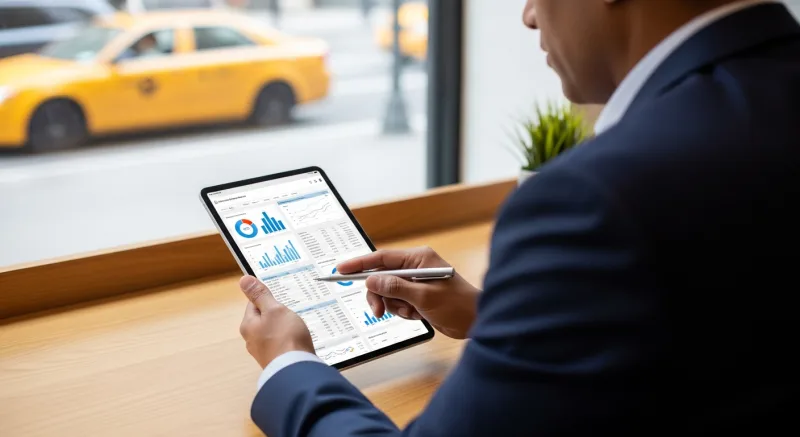
KwickOS's multi-location dashboard shows all three (or five, or ten) locations on one screen. At 8 PM on Friday, you see that Manhattan is at capacity with a 25-minute wait (good — the host team is managing the flow). Brooklyn is 30% below target for the hour (investigate — is it a staffing issue, a kitchen slowdown, or just a slow night?). Queens is running a new weekend special that is driving 15% higher average check (the promotion is working — consider extending it).
T. Jin China Diner monitors 15 locations across this same dashboard. For a NYC group spread across boroughs, the dashboard eliminates the need for the owner's nightly driving circuit — the visual confirmation that each location is functioning happens on a phone screen, not through a windshield.
Digital Signage: Multilingual and Borough-Appropriate
NYC's diversity means your digital signage needs to communicate across languages and cultural contexts. The Manhattan location's menu board might be in English only. The Queens location might need English, Chinese, and Spanish simultaneously. KwickOS digital signage — which syncs with the menu system — supports multilingual displays that update automatically when the menu changes.
KwickOS itself supports English, Chinese, and Spanish natively across the POS interface. In a city where staff and customers speak dozens of languages, a system that operates in multiple languages without third-party add-ons is a practical requirement, not a feature.
The NYC Multi-Location Checklist
- Can you see all borough locations on one real-time dashboard?
- Do gift cards work across all boroughs instantly?
- Does loyalty accumulate across all locations into one customer profile?
- Can you maintain a master menu with borough-specific overrides?
- Does the system track employee hours across locations for NYC labor law compliance?
- Can each location operate offline when the internet drops?
- Can you use one processor at one rate for all locations?
- Does the POS support multilingual operation (English, Chinese, Spanish)?
KwickOS answers yes to all eight — serving 5,000+ businesses across 50 states with the hybrid local+cloud architecture that NYC's demanding environment requires.
Running Restaurants Across NYC?
Schedule a demo and we will show you the multi-borough dashboard, cross-location gift cards and loyalty, one-click menu sync with borough overrides, and processing savings — calculated for your specific NYC volume.
Get Your Free DemoOr call us directly: (888) 355-6996