POS Systems for New York City Restaurants: Surviving $300 Rent, 12-Foot Kitchens, and 30% Delivery Revenue
Updated March 2026
Running a restaurant in New York City is an exercise in operational compression. You compress 80 seats into 1,200 square feet. You compress a full kitchen into a space smaller than most suburban bathrooms. You compress three revenue streams — dine-in, takeout, and delivery — through a single 30-inch counter opening that separates your dining room from your kitchen. And you do all of this while paying rent that ranges from $150 per square foot in outer boroughs to $400 per square foot in Midtown Manhattan.
The POS system in a New York City restaurant is not back-office technology. It is the nervous system of an operation where every square inch, every second, and every penny is already allocated. Choosing the wrong system does not just inconvenience you — it occupies physical space you cannot spare, wastes seconds you do not have, and costs money you have already committed to rent.
The Rent Equation and Why Every Dollar Matters More Here
Consider a 1,500-square-foot restaurant in the East Village paying $200 per square foot annually. That is $300,000 per year in rent alone — $25,000 per month before you turn on the lights. At a 5% net margin (generous for NYC), you need $6 million in annual revenue just to cover rent and produce a modest profit. That works out to $16,438 in revenue every single day, 365 days a year.
At that daily target, your POS system’s impact on revenue is not marginal. If processing fees take an extra 0.7% compared to what you could get with processor freedom, you are losing $42,000 annually. If delivery commissions run 20% higher than they need to, you are surrendering $50,000-80,000. These are not abstract percentages — they are months of rent.
KwickOS is processor-agnostic. A NYC restaurant processing $200,000 per month in card volume (common for a moderately busy location) saves $12,000-18,000 annually by negotiating independent processing rates versus being locked into Toast or Square’s fixed rates. In a city where a single month of missed rent triggers default proceedings, those savings are existential.
Tiny Kitchens Demand Tiny Hardware
Walk into the kitchen of a typical Manhattan restaurant and you will find 120-200 square feet of workspace. A prep cook, a line cook, a grill station, and a dishwasher share a space the size of a parking spot. There is no room for a printer churning out paper tickets. There is no room for a full-size POS terminal on the pass. There is barely room for the humans.
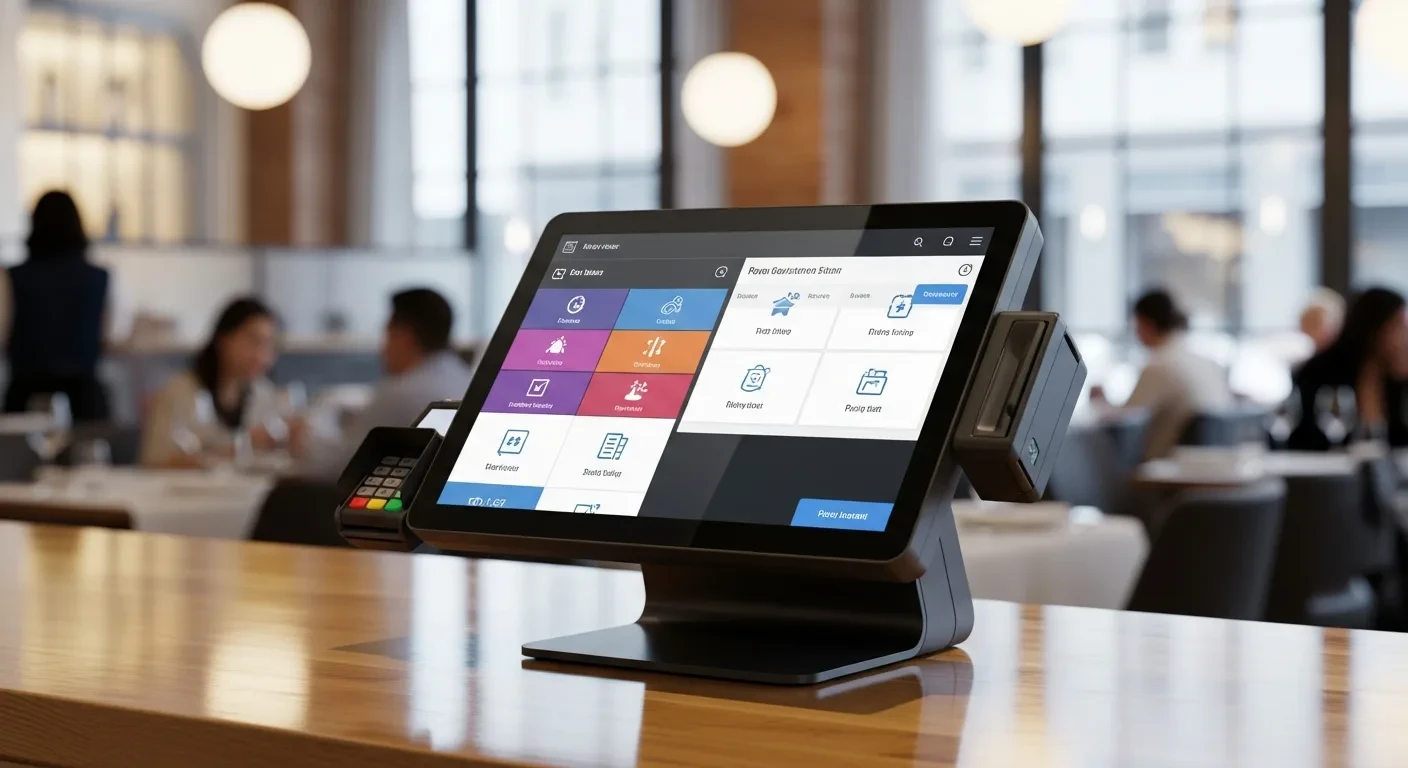
KwickOS runs on wall-mounted tablets and compact touchscreens. A 10-inch KDS display mounts above the line where a ticket rail used to hang. No paper, no printer, no counter space consumed. The KDS screen is the ticket rail — but it sorts orders by priority, tracks timing, and routes items to the correct station. When you are working in a kitchen where elbows touch, eliminating physical clutter is not an aesthetic choice. It is a safety requirement.
Hardware flexibility matters for another reason: when a terminal fails at 7 PM on a Saturday in Manhattan, you need it replaced immediately. KwickOS runs on commodity hardware. Any Android tablet or touchscreen with a browser can become a terminal in minutes. Toast requires proprietary hardware that ships in 3-5 business days. In NYC, 3-5 days without a terminal means $50,000-80,000 in missed revenue.
Delivery Dominance: 30% of Revenue and Growing
New York City restaurants generate 30-40% of revenue through delivery, the highest percentage of any U.S. market. In some Manhattan neighborhoods, delivery exceeds 50% of total sales. The density of apartments, the scarcity of parking, and the cultural acceptance of paying for convenience create a delivery-dependent market that no other American city matches.
This dependency makes delivery economics the most critical variable in a NYC restaurant’s P&L. Third-party platforms charge 15-30% commission. On a restaurant doing $80,000 per month in delivery revenue, that is $12,000-24,000 per month in commissions — often exceeding the restaurant’s net profit.
New York City passed a cap on delivery commissions at 15% for marketing fees and 5% for non-marketing fees in 2021, but the practical impact has been limited as platforms restructure their fee categories. The only complete solution is owning your delivery channel.
KwickMenu provides branded online ordering that appears in Google Search results. When a customer searches "Thai food delivery East Village," your KwickMenu-powered ordering page competes directly with the DoorDash listing — but orders placed through your site carry zero commission. Pair it with KwickDriver at $2 flat per delivery, and the economics invert: delivery becomes your most profitable channel instead of your most expensive.
Multilingual Staff Is the Default, Not the Exception
In New York City, a restaurant kitchen where everyone speaks the same language is the exception. The typical Manhattan kitchen includes Spanish-speaking prep cooks, Mandarin or Cantonese-speaking wok cooks, Bangla-speaking dishwashers, and an English-speaking expeditor trying to coordinate all of them. Flushing kitchens operate primarily in Chinese. Jackson Heights kitchens operate in Spanish, Hindi, and Nepali. Williamsburg has pockets of Yiddish, Polish, and Italian alongside English.
KwickOS displays in English, Chinese, and Spanish simultaneously across different terminals. The expeditor’s screen shows English. The wok station shows Chinese characters. The prep station shows Spanish. Orders are identical — only the display language changes. This eliminates the telephoned-across-the-kitchen translation that slows production and creates errors.
For Flushing restaurants serving Chinatown’s enormous dim sum and hot pot culture, Chinese language display is non-negotiable. A 300-item dim sum menu cannot be effectively managed on a KDS that only shows transliterated English names. "Ha Gow" means nothing to a dim sum cart runner who reads it as "shrimp dumpling" in Chinese characters. KwickOS displays the characters natively — not as a bolted-on translation but as core interface functionality.
NYC Department of Health: Grade A or Close
New York City’s letter grading system for restaurants is the most visible health inspection framework in the country. The grade card must be displayed in the front window. An "A" grade is expected. A "B" grade drives away 20-30% of walk-in traffic. A "C" grade is effectively a closure notice in competitive neighborhoods.
The inspection covers 89 violation categories, several of which are directly related to kitchen technology and food handling documentation. Temperature logs, food holding times, and employee hygiene verification all factor into scoring. A POS system that integrates food safety reminders into the kitchen workflow helps maintain compliance between inspections, not just during them.
KwickOS KDS stations can be configured with timed alerts: "Check cold holding temps" every 2 hours, "Rotate prep containers" at shift change, "Sanitize cutting boards" every 4 hours. These alerts display on the kitchen screen where cooks already look — not on a paper checklist hanging behind a door that nobody opens. The digital log creates timestamped documentation that demonstrates due diligence during inspections.
Times Square vs. Brooklyn: Two Operational Universes
A Times Square restaurant serves 800 covers on a Saturday, mostly tourists who will never return. Average dwell time is 35 minutes. Menu decisions are fast. Turnover is everything. The POS needs to process transactions at maximum speed, support multiple languages for international tourists, and handle a volume of credit card transactions that would overwhelm a system designed for a neighborhood bistro.
A Cobble Hill restaurant in Brooklyn serves 120 covers on a Saturday, mostly neighborhood regulars who come weekly. Average dwell time is 90 minutes. The POS needs robust customer profiles, loyalty tracking, and the ability to remember that Table 4 is Mrs. Chen who always orders the salmon without capers and prefers still water.
KwickOS serves both models because its configuration is per-location, not per-system. The Times Square location runs maximum-speed checkout with multilingual customer-facing displays and rapid-fire KDS timing. The Brooklyn location runs CRM-integrated service with customer notes, order history, and a loyalty program that rewards frequency. Same platform, different operational profiles, centralized management for a restaurant group that operates in both worlds.
The Space-Saving Impact of All-in-One
In a NYC restaurant, every separate system occupies space. A standalone online ordering tablet sits on the counter. A separate loyalty system requires its own card reader. A delivery management screen takes up wall space. A receipt printer consumes counter real estate. An employee time clock needs wall mounting near the entrance.
KwickOS consolidates all of these into a single platform. One terminal handles POS, online ordering display, loyalty enrollment, delivery management, and employee clock-in. The physical footprint shrinks from four or five devices to one. In a 1,500-square-foot restaurant paying $200/sqft, the 6 square feet saved by eliminating redundant hardware represents $1,200 per year in rent equivalent. Small savings, but in NYC, small savings survive when margins do not.
Late Night Service and the Reliability Factor
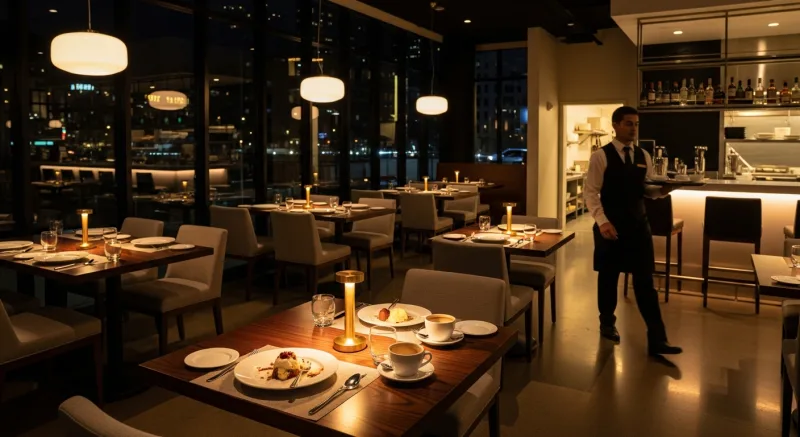
New York restaurants operate later than any other American market. A significant number of Manhattan restaurants serve until midnight or later. In the East Village, Koreatown, and parts of Flushing, 2 AM closes are normal. Late-night service means your POS system runs 16-18 hours daily, every day. Hardware failure at 11 PM on a Friday is not an edge case — it is a predictable outcome of running equipment at that utilization rate.
KwickOS runs on Linux, which is inherently more stable than Windows for continuous-operation environments. No forced restarts for updates. No background processes consuming memory until the system slows to a crawl at hour 14. The web-based interface means the POS is as stable as the browser it runs in — and modern browsers on Linux can run for weeks without degradation.
Cloud-dependent systems like Toast introduce a different reliability concern: their servers, not yours. If Toast’s cloud infrastructure experiences latency during NYC dinner service — when thousands of Toast terminals simultaneously hit the same servers — every restaurant on the platform slows down together. KwickOS processes locally. Your terminal speed depends on your hardware, not on how many other restaurants in Manhattan are running the same software.
Kiosk Self-Ordering in Fast-Casual NYC
Fast-casual restaurants dominate NYC’s lunch market. The noon rush in Midtown delivers 200-300 customers in 90 minutes to a single location. Staffing counter positions for that volume is expensive and inefficient — you need five cashiers for 90 minutes and one for the rest of the day.
Self-ordering kiosks absorb the peak without the staffing spike. KwickOS kiosk mode runs on iPads or Android tablets mounted at counter height. Customers order, customize, and pay without staff interaction. Average ticket increases 15-25% because kiosk upsell prompts convert at 3x the rate of verbal upselling. Staff redeploys to food prep and order staging, where their labor directly accelerates throughput.
Rockin’ Rolls Sushi Express proved this model at scale with 49 iPad self-ordering stations. The same approach in a Midtown fast-casual location replaces three lunch cashiers with three kiosks and one floating staff member — handling the same volume at lower labor cost with higher average tickets.
Getting Started in the City That Never Stops
NYC restaurant operators cannot afford downtime for a POS transition. KwickOS installation takes 1-3 hours per location. The system installs alongside your existing POS — you can run parallel for a day or a week until you are comfortable. Staff training averages under an hour for front of house and under two hours for kitchen display operation. Data migration from your existing system imports via CSV.
In a city where every hour of downtime costs $500-2,000 in lost revenue, the transition speed is as important as the system capabilities. New York does not wait for technology to catch up. Your POS needs to be ready before you are.
NYC restaurant owners: Call (888) 355-6996 or visit KwickOS.com for a consultation tailored to your borough.
The Revenue Features Most "All-in-One" Systems Charge Extra For
When POS companies say "all-in-one," they rarely mean gift cards and loyalty are included. Toast charges $75/month for their loyalty add-on. Square Loyalty starts at $45/month. Clover requires third-party apps. KwickOS includes all of these natively — zero extra cost.
Physical & Electronic Gift Cards
Sell branded physical cards at the register. Send e-gift cards via text or email. Track balances across every location in real time. Gift card holders spend 20-40% more than face value — this is not a nice-to-have, it is a revenue multiplier.
Points-Based Loyalty System
Every transaction earns points. Customers see their balance on receipts and can redeem at checkout. Configurable earn ratios, tiered VIP levels, and automatic birthday rewards. No separate app required — it runs inside the POS your cashier already knows.
Membership & Subscription Management
Run coffee clubs, wine memberships, or VIP dining programs. Recurring billing, exclusive member pricing, and member-only items — managed from the same dashboard as your daily operations. Your customers feel special. Your revenue becomes predictable.
Real impact: businesses using KwickOS loyalty features see repeat visit rates increase by up to 35%. Gift card programs generate an average of 15% additional revenue during holiday seasons.

Tom Jin
Founder & CIO of KwickOS · 30 Years IT · 20 Years Restaurant Industry
Tom built KwickOS after decades running restaurants and IT companies. Today KwickOS serves 5,000+ businesses across 50 states.