The bubble tea industry has a scaling problem that most POS vendors do not understand. Unlike a burger restaurant where the menu is relatively stable, a bubble tea shop's value proposition is built on customization. Every drink is personalized. Sugar level, ice level, topping combinations, milk alternatives, size options — a menu of 30 base drinks multiplied by dozens of modifiers creates hundreds of possible combinations per order.
At one location, managing this modifier complexity is a training challenge. At three locations, it becomes a consistency challenge. At eight locations, it becomes an operational nightmare unless your POS handles multi-location modifier sync natively. And most POS systems were designed for burger restaurants, not bubble tea chains.
The Modifier Consistency Problem
Bubble tea customers are fanatically specific about their orders. "Large taro milk tea, 30% sugar, less ice, add boba and coconut jelly, sub oat milk." That order involves selecting from five separate modifier categories, each with multiple options. The customer expects that exact same drink — same price, same preparation, same taste — at every location in your chain.
On separate POS installations, modifier consistency drifts. Location A labels the sugar option "30% sweet." Location B labels it "Less Sugar." Location C has three sugar levels; Location D has five. The oat milk upcharge is $0.75 at one location and $0.50 at another because someone entered it incorrectly during initial setup. Coconut jelly costs $0.50 at most locations but Location E never added it because the manager did not receive the memo about the new topping.
These inconsistencies frustrate customers and create revenue leakage. An incorrect upcharge of $0.25 on 40 oat milk orders per day across one location is $10/day or $3,650/year. Multiply that kind of drift across 8 locations with dozens of modifiers, and the aggregate pricing inconsistency easily reaches $15,000-25,000/year.
KwickOS one-click menu sync eliminates modifier drift entirely. You build the master menu once — every drink, every modifier category, every option, every price — at headquarters. You push it to all locations with one click. Every kiosk, every register, every location has identical modifiers, identical prices, identical options. When you add a new seasonal topping (say, strawberry popping boba for summer), it appears at every location simultaneously. When you remove a topping that is out of season, it disappears everywhere at once.
Crafty Crab Seafood uses this same system across 19 locations and 152 terminals. Their menu includes seafood boils with dozens of sauce combinations and spice levels — a modifier complexity comparable to bubble tea. One-click sync keeps all 152 terminals consistent. The principle works identically for bubble tea chains.
Topping Inventory: The Daily Stockout Gamble
Bubble tea toppings are perishable, preparation-intensive, and high-margin. Boba pearls have a 4-hour window of optimal texture after cooking. Jelly toppings need daily preparation. Puddings and cream foams have short shelf lives. Running out of a popular topping during peak hours means lost revenue and disappointed customers. Over-preparing means waste.

At a single location, the tea master adjusts preparation based on daily experience. At multiple locations, each store makes independent decisions about how much to prepare, and those decisions are only as good as each individual manager's judgment. One location consistently over-prepares boba (waste). Another consistently under-prepares (stockouts at 3 PM). Without centralized data, HQ has no visibility into these patterns.
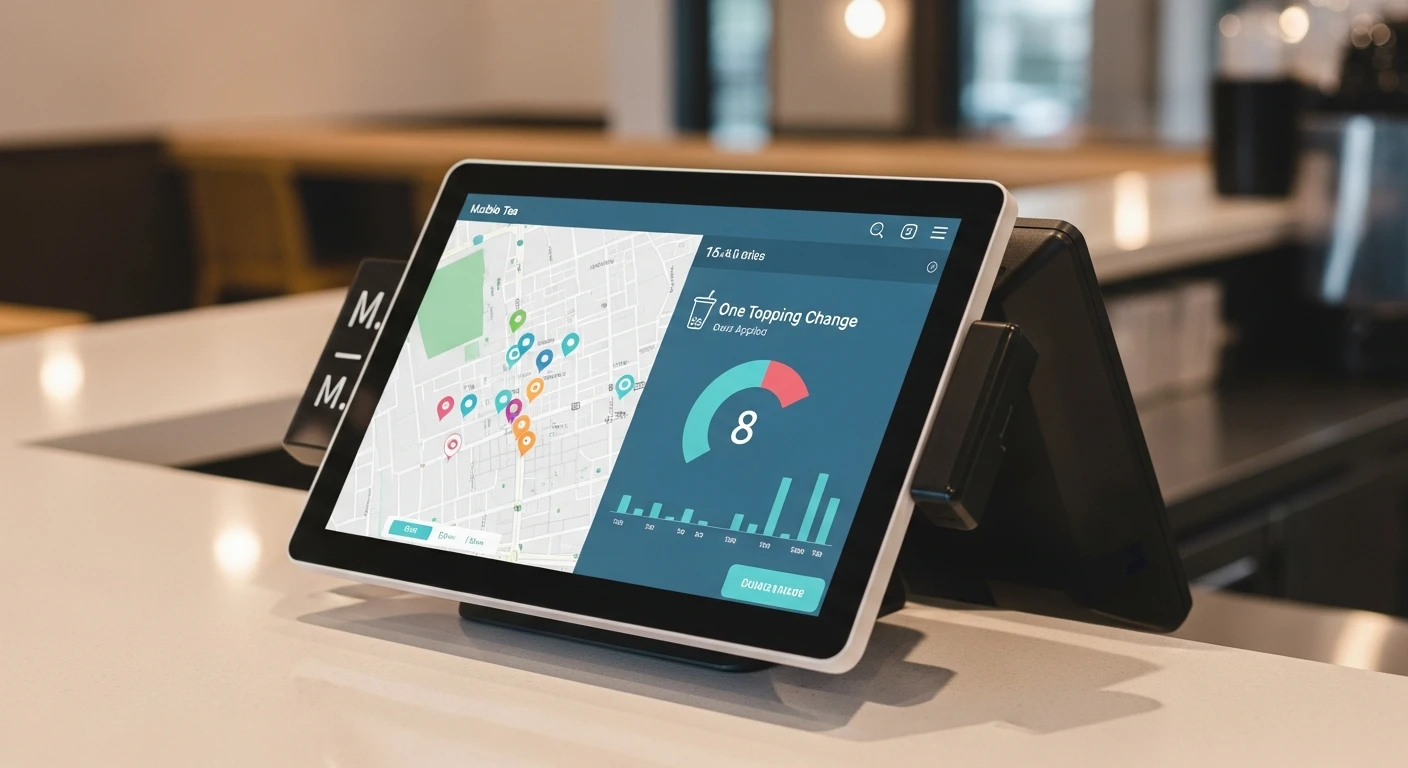
KwickOS tracks topping consumption at every location in real time. The centralized dashboard shows that Location A sells 80% of its boba by 2 PM (needs more), while Location C still has 40% of its boba at 5 PM (preparing too much). Over time, the data reveals location-specific consumption patterns that inform preparation schedules. The result is less waste, fewer stockouts, and higher margins on the highest-margin items in the bubble tea business.
Self-Ordering Kiosks Across Multiple Locations
Bubble tea shops increasingly rely on self-ordering kiosks to handle the complexity of customization without slowing down the line. A customer building a drink with 5 modifiers takes 90 seconds at a counter. On a kiosk, they take their time, explore options, and often add more toppings (higher ticket) without feeling pressure from the line behind them.
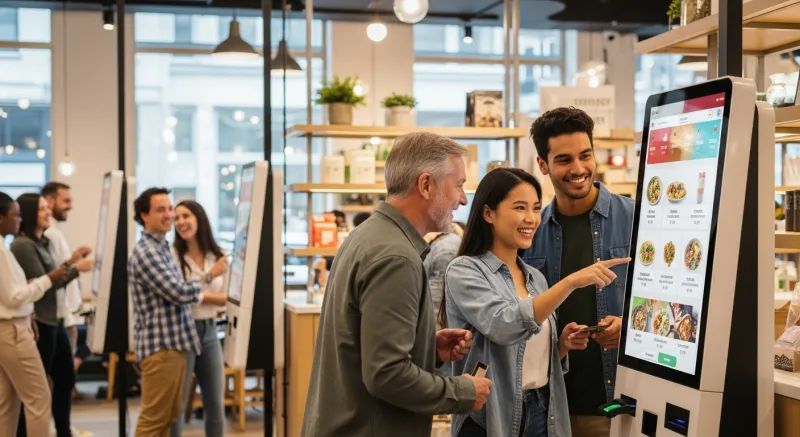
Tiger Sugar runs 2 locations with self-ordering kiosks powered by KwickOS. Their kiosks offer minimal-step personalization — customers build their drink with a few taps, see the total price update in real time, and pay at the kiosk. Electronic receipts automatically capture contact information for the loyalty program, growing the customer database with every transaction.
For multi-location bubble tea chains, the kiosk challenge multiplies. You need every kiosk at every location to display the same menu, the same modifiers, the same prices, and the same seasonal promotions. When you launch a summer special with a new fruit topping, it needs to appear on every kiosk across all locations simultaneously — not after a location manager manually updates each device.
KwickOS pushes kiosk menu updates as part of the same one-click sync that updates registers. Change the menu at headquarters, and every kiosk at every location refreshes. No per-device updates. No location manager involvement. No inconsistency risk.
Cross-Location Gift Cards for Bubble Tea
Bubble tea gift cards are popular gift items, especially among younger demographics. A $25 gift card from a friend is an introduction to your brand. But if that gift card only works at the location where it was purchased, and the recipient lives near a different location, you have just wasted an acquisition opportunity.
The bubble tea demographic is mobile. College students visit locations near campus, near home, and near their job. Young professionals visit locations near their office and near their apartment. A loyalty customer who moves neighborhoods should not lose their gift card balance because they now live closer to a different store.
KwickOS gift cards work at every location from the moment of purchase — physical cards, e-gift cards purchased through your KwickMenu online ordering page, and promotional credits loaded by headquarters. The balance is centralized and syncs in real time. No delay, no manual reconciliation, no "sorry, that card was bought at our other store."
Loyalty That Follows the Customer, Not the Store
Bubble tea loyalty programs drive exceptional repeat behavior. The typical bubble tea customer visits 2-4 times per week. At an average ticket of $7-9, that is $56-144/month per loyal customer. A loyalty program that keeps customers coming back one extra time per week increases their lifetime value by 25-50%.
But fragmented loyalty programs — where points at Location A do not count at Location B — suppress this potential. A customer who splits their visits across two locations never reaches reward thresholds at either one. They accumulate slowly at each, never feel the momentum of approaching a free drink, and eventually disengage. Your most valuable customers — the multi-location visitors — are the ones most harmed by fragmented loyalty.
KwickOS loyalty unifies across all locations and ordering channels. Points earned at any store, through the kiosk, or through online ordering on KwickMenu all accumulate in one account. A customer who visits Location A twice and Location B three times in a week has 5 visits in one account, not fragmented counts of 2 and 3 in separate systems.
Membership management from headquarters lets you create tiered programs — Regular, Gold, VIP — with automatic tier upgrades based on total cross-location spend. VIP customers get recognized at every location. Their preferences (always 30% sugar, always less ice, always add boba) are attached to their profile and displayed on the POS or kiosk when they check in.
The Real-Time Dashboard for Bubble Tea Chains
Bubble tea operations have extreme peaks. The afternoon rush (2-5 PM) can represent 40-50% of daily revenue. Knowing what is happening at every location during peak hours — in real time, not tomorrow morning — is the difference between optimizing and guessing.
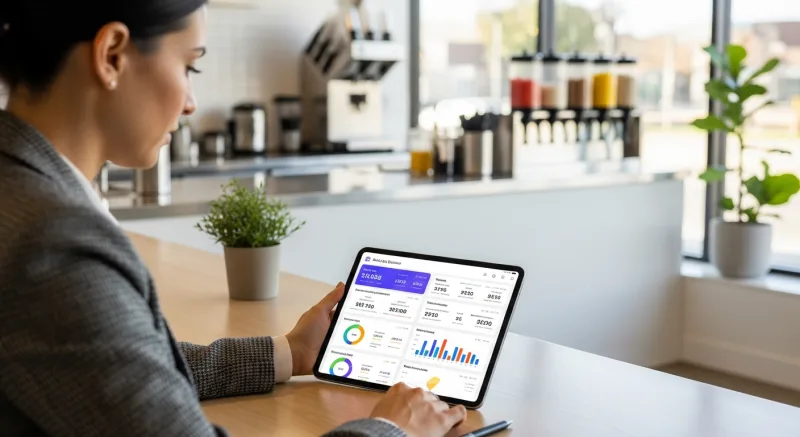
KwickOS shows every location on one dashboard. At 3 PM, you can see that Location A has a 12-minute average wait time (needs another team member), Location B has sold out of mango (needs an emergency prep batch or a temporary removal from the menu), and Location C is running 20% below yesterday's sales (why? check staffing, check if the kiosk is down, check if there is construction blocking foot traffic).
T. Jin China Diner monitors 15 locations and 75 terminals through this dashboard. For bubble tea chains, where the afternoon peak window is compressed and high-stakes, real-time multi-location visibility is not optional — it is essential for revenue optimization.
Why Toast, Square, and Clover Fail Bubble Tea Chains
The bubble tea industry has specific requirements that general-purpose POS systems handle poorly:
Toast charges per-location fees ($69+/month per location on their Starter plan). For an 8-location chain, that is $552+/month in software fees alone. Add Toast's locked processing rate and the math gets worse. Toast was designed for restaurants, not high-volume, high-modifier beverage operations. Their modifier system lacks the depth and speed needed for bubble tea customization.
Square has no native concept of centralized modifier management across locations. Each location's menu is technically a separate entity. Making consistent changes requires updating each location individually — exactly the problem that causes modifier drift.
Clover requires separate merchant accounts per location. For a bubble tea chain, this means separate everything — separate inventory, separate loyalty, separate gift cards, separate reporting. It is structurally incapable of multi-location unification.
KwickOS charges one platform fee for multi-location management, is processor-agnostic (choose your own processor, negotiate one rate based on aggregate volume across all locations), and provides true unification: one menu with one-click sync, one loyalty program, one gift card system, one dashboard, one employee database with fingerprint authentication.
Scaling From 2 to 20: What Changes
The technology decisions you make at 2 locations determine whether scaling to 5, 10, or 20 is operationally feasible. Here is what happens at each stage:

2-3 locations: Manual workarounds still function. You can call Location B to update the menu. You can email spreadsheets. The inefficiency costs $10,000-15,000/year but feels manageable because you are physically present at most locations most of the time.
4-7 locations: Manual workarounds break. You cannot personally oversee every location. Menu drift accelerates. Gift card complaints increase. Loyalty fragmentation suppresses repeat visits. The cost of POS fragmentation reaches $25,000-50,000/year and you start losing customers to competitors with more consistent experiences.
8+ locations: You need a centralized operating system, not a collection of independent POS installations. Every decision — menu changes, pricing, promotions, loyalty rules, gift card policies — must flow from headquarters to every location instantly. The cost of not having this infrastructure at 8+ locations exceeds $60,000/year and becomes a competitive disadvantage that threatens the entire chain.
Haidilao operates 600+ locations worldwide on a centralized system because the alternative — 600 independent installations — is operationally impossible. Your bubble tea chain may not be at 600 locations yet, but the principle applies from the moment you open your second store. Centralized control with local execution is the architecture that scales.
The Multi-Location Bubble Tea Checklist
Before signing the lease on your next location, confirm your POS handles these bubble tea-specific requirements:
- One-click modifier sync — Can you add a new topping to all locations simultaneously?
- Kiosk management — Can kiosk menus update centrally without touching each device?
- Cross-location gift cards — Do gift cards work at every store in real time?
- Unified loyalty — Do points from all locations accumulate in one customer account?
- Topping inventory visibility — Can you see consumption and stockout risk at every location?
- Centralized reporting — One dashboard, all locations, real-time data?
- Processor freedom — Can you use one processor at one negotiated rate for all locations?
- Offline operation — If a location's internet drops during afternoon rush, do kiosks and registers keep working?
KwickOS handles all eight with hybrid local+cloud architecture — 1ms local processing at every location, full offline capability, centralized management in the cloud.
Growing Your Bubble Tea Chain?
Schedule a demo and we will show you one-click modifier sync, cross-location loyalty and gift cards, centralized kiosk management, and real-time multi-store dashboard — configured for bubble tea operations.
Get Your Free DemoOr call us directly: (888) 355-6996