A Bakery Owner's Day: How the Right POS System Powers Every Hour From 4 AM to Close
Published March 2026 · 12 min read
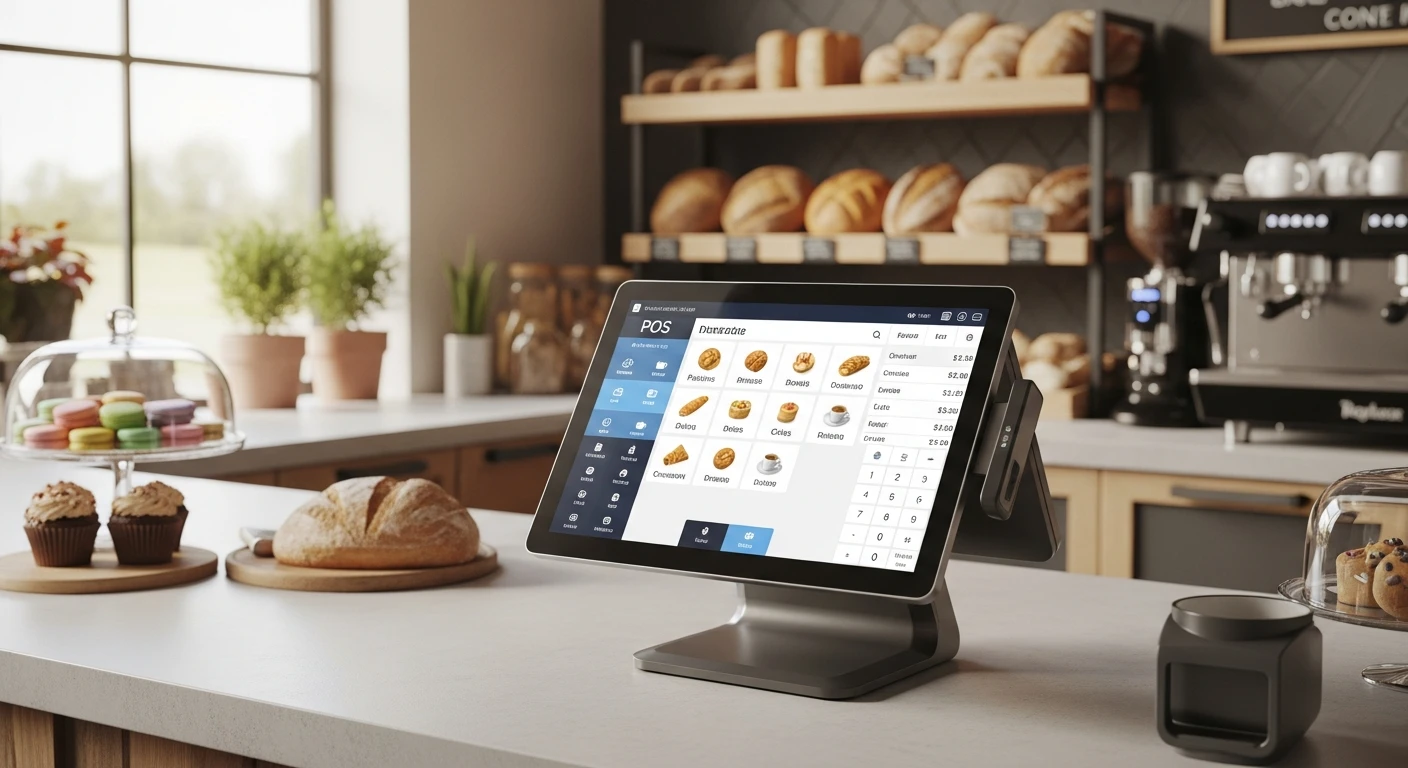
Running a bakery without the right pos system is like driving without a dashboard. The alarm screams at 3:45 AM. You silence it before the second ring because you were already half-awake, mentally running through today's production sheet. Fifty croissants for the hotel order. Three custom birthday cakes. Two hundred assorted pastries for the display case. And somewhere in there, a gluten-free wedding tasting that the bride confirmed at 11 PM last night.
This is the life you chose. You love it. But the administrative chaos that comes with running a bakery — the inventory that vanishes, the orders that get lost on sticky notes, the end-of-month accounting nightmare — that part you could do without.
After fifteen years helping bakeries, cafes, and food businesses streamline operations, I've learned that the technology you choose determines whether you spend your energy on artistry or on paperwork. This article walks through an actual bakery day, hour by hour, showing where an all-in-one system like KwickOS eliminates friction that most bakery owners have simply accepted as normal.
4:00 AM — Production Begins, and So Does Inventory Tracking
Your bakers arrive and start pulling ingredients. Flour, butter, sugar, eggs — the staples disappear fast. In a bakery without integrated inventory, nobody knows exactly how much AP flour is left until someone physically checks the walk-in. By then you've already committed to a production run you might not have the ingredients to finish.
With KwickOS running on a tablet mounted near the prep station, your bakers log ingredient pulls in real time. The system tracks par levels you've set: when all-purpose flour drops below 50 pounds, it flags a reorder. When butter hits your two-day threshold, it sends an alert to your phone. No clipboard. No guessing. No emergency runs to the restaurant supply store at 6 AM.
The offline capability matters here more than most bakery owners realize. Your shop's internet cuts out at 4 AM more often than your ISP admits. KwickOS runs on a local hybrid architecture — processing happens on-site with 1-millisecond response times, syncing to the cloud when connectivity returns. Your bakers never notice the difference.
5:30 AM — Wholesale Orders Ship Out
Your wholesale accounts — the hotel, the three coffee shops, the corporate cafeteria — need their standing orders packed and ready for the delivery driver by 6 AM. Each account has different pricing, different terms, different delivery schedules.
This is where most basic POS systems fail bakeries. They're built for walk-in retail transactions, not B2B invoicing with net-30 terms and volume discounts. KwickOS handles both channels from the same system. Your wholesale customers exist as accounts with negotiated pricing tiers. When you process the hotel's 50-croissant order, it automatically applies their contract rate, generates the invoice, and updates your production reporting so you know exactly how much revenue comes from wholesale versus retail.
The delivery driver scans a QR code on the packing slip, confirming pickup. The hotel receives an automatic notification. No phone calls. No "did our order ship?" emails clogging your inbox at 7 AM when you're trying to open the retail shop.
6:00 AM — The Display Case Gets Filled, and Every Item Needs a Price
Pricing in a bakery is deceptively complex. A single croissant is $4.50. A box of six is $24 (not $27, because you offer a bundle discount). The same croissant filled with almond cream is $5.75. The chocolate version is $5.25. Now multiply that across 40 items in your display case, each with potential size variations, filling options, and quantity breaks.
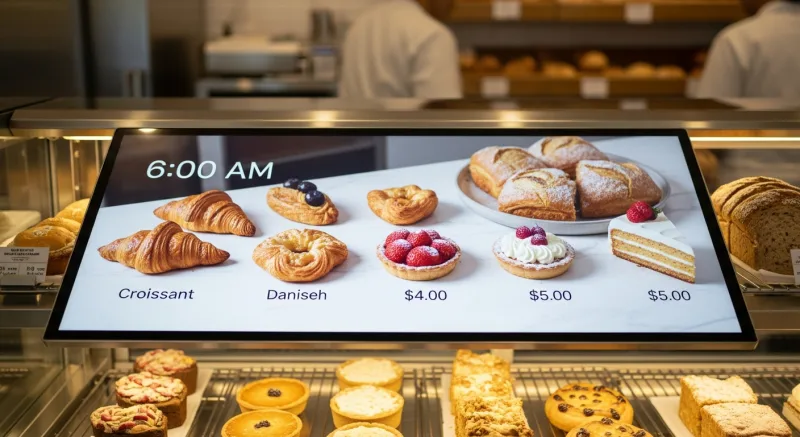
KwickOS uses a modifier matrix that bakeries actually understand. You define your base items, attach modifiers (filling, size, decoration), and set pricing rules once. The system calculates everything at the register. Your counter staff doesn't need to memorize a 200-item price list — they tap the item, select the modifiers, and the math is done.
For items sold by weight — bread loaves, cookie platters, bulk pastries for catering — the system integrates with your scale. Place the item, and the weight-based price populates automatically. No mental arithmetic. No accidentally charging platter prices for a half-pound cookie order.
7:00 AM — Morning Rush: The Line Out the Door
The first hour after opening is controlled chaos. Commuters want coffee and a pastry, fast. Parents grabbing breakfast before school drop-off. The retired couple who comes every Tuesday for sourdough.
Speed matters here, and the difference between a 45-second transaction and a 90-second one determines whether that line stays manageable or drives customers to the Starbucks down the street. KwickOS processes transactions locally, which means your terminal isn't waiting for a cloud server in Virginia to approve a $4.50 croissant sale. The response is instantaneous.
If you've set up a self-ordering kiosk — and more bakeries are doing this — customers handle their own orders while your staff focuses on making drinks and boxing items. Baked Cravings, a KwickOS customer running a self-serve kiosk at a major entertainment venue, proved that kiosk ordering works even in high-traffic environments where customers have zero patience.
During morning rush, you also see the value of KwickOS's kitchen display system. As espresso drink orders come in, they appear on the barista's screen in sequence. No shouted orders. No lost tickets. No remaking a latte because someone misheard "oat" as "whole."
9:00 AM — Custom Cake Orders and the Consultation Process
The morning rush fades and the phone starts ringing. Birthday cakes, wedding cakes, corporate event orders. Each custom order is a small project: consultation, design, pricing, deposit, production scheduling, pickup or delivery coordination.
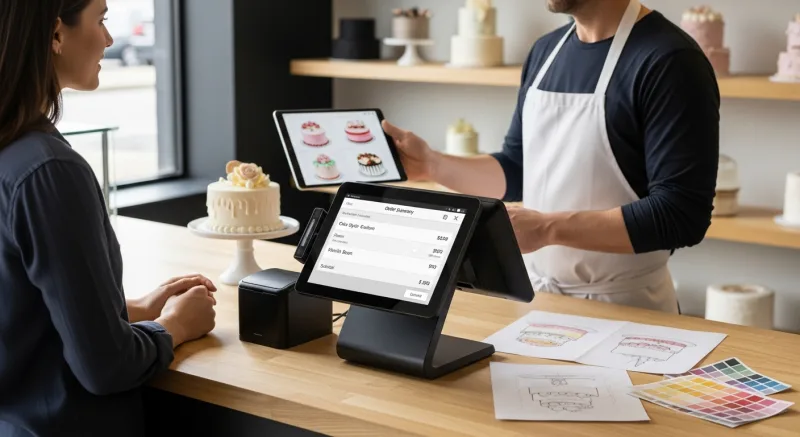
Most POS systems treat custom orders as an afterthought — maybe a "notes" field on a generic transaction. KwickOS lets you build detailed custom orders with line items for each component: base cake ($45), fondant covering ($30), custom topper ($25), delivery fee ($15). You attach the customer's reference photos directly to the order. Your decorator pulls up the order on their tablet and sees exactly what was promised.
The deposit workflow matters too. You collect 50% upfront, with the balance due at pickup. The system tracks the split payment automatically, sends the customer a reminder three days before pickup, and flags any orders where the balance hasn't been collected.
11:00 AM — Allergen Tracking: The Part That Keeps You Up at Night
A customer asks if the cranberry walnut scone contains tree nuts. Obviously yes — it has walnuts in the name. But what about cross-contamination with your other products? Was the chocolate chip cookie baked on the same sheet pan?
Allergen management in bakeries is life-or-death serious. KwickOS lets you tag every ingredient with its allergen profile: tree nuts, peanuts, gluten, dairy, eggs, soy, sesame. When you build a recipe in the system, the allergen flags aggregate automatically. Your staff can look up any item and see its complete allergen profile instantly, including cross-contamination warnings you've configured based on your production workflow.
This isn't just about liability — though a single allergen incident can bankrupt a small bakery. It's about building trust with customers who have learned to be skeptical. When your counter person can pull up detailed allergen information in seconds, that confidence is visible. Customers notice.
1:00 PM — The Afternoon Lull and the Numbers Game
The lunch rush is over. Your afternoon traffic won't pick up until 3 PM when parents swing by after school. This is your window to actually look at how the business is performing.
On your phone, you pull up the KwickOS dashboard. Today's revenue so far: $2,847. That's 12% above your Tuesday average. The new savory hand pies you launched last week are outperforming your projection — 34 sold before noon versus the 20 you budgeted. You make a mental note to increase tomorrow's production.
You also spot a problem: your cream cheese danish only sold 8 units against a production of 25. That's 68% waste on a single item. Over a month, that's roughly $400 in lost ingredients and labor. You decide to drop the par to 15 and see if that tighter window still meets demand.
This kind of data-driven decision-making is impossible when your POS is just a cash register that records transactions. The bakery owners I work with who've switched to integrated systems typically reduce food waste by 15-25% in the first quarter, simply because they can finally see what's selling and what's not.
3:00 PM — Online Orders and the Second Rush
Your online ordering page starts filling up. Customers placing orders for tomorrow's pickup, adding items to their weekend catering request, scheduling a birthday cake consultation. KwickOS processes these orders through the same system as your in-store sales, so inventory deducts in real time.
This prevents the nightmare scenario every bakery owner knows: you sell the last chocolate cake in-store at 3:15 PM, and at 3:20 PM someone places an online order for the same cake for pickup tomorrow. Without integrated inventory, you're either disappointing a customer or scrambling to bake an extra cake outside your production schedule.
The online ordering is built into KwickOS — not a third-party integration that charges 15-30% commission. Your customers order directly from your branded page, you keep the full margin, and the orders flow into the same system your staff already uses.
5:00 PM — Closing Procedures and the End-of-Day Reckoning
Your closer starts the end-of-day routine. In a bakery running on separate systems — one for POS, one for inventory, one for scheduling, one for accounting — closing takes 45 minutes to an hour of manual reconciliation. Did the register match the receipts? Did we count the remaining inventory? Did anyone log the waste?
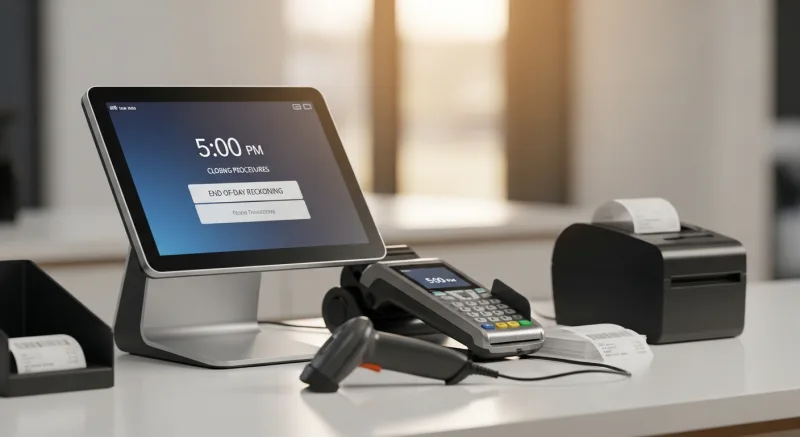
With KwickOS, your closer taps "End of Day." The system runs the Z-report automatically, reconciles card transactions against the processor's batch, and generates the day's P&L summary. Remaining display case items get counted and logged as either waste or marked for tomorrow's day-old discount shelf. The whole process takes 15 minutes.
The data syncs to your accountant's preferred format. No more shoebox of receipts. No more monthly panic assembling numbers for your bookkeeper. The financials are current, accurate, and accessible from any device.
The Payment Processing Question Every Bakery Owner Should Ask
Here's something most bakery owners don't think about until it's too late: who processes your card payments, and how much are they taking?
Systems like Toast and Square lock you into their payment processing. You have no choice — their POS only works with their processor. For a bakery doing $30,000/month in card sales, the difference between a locked-in rate and a competitively negotiated rate can be $300-500/month. That's $3,600-6,000/year — enough to fund a new deck oven or hire a part-time baker.
KwickOS is processor-agnostic. You choose your payment processor, negotiate your own rates, and switch anytime without changing your POS system. The merchant keeps 100% of their processing relationship. In an industry where margins are already razor-thin — most bakeries operate at 5-10% net profit — that processing flexibility can mean the difference between growth and stagnation.
Why "All-in-One" Actually Matters for Bakeries
I've seen too many bakery owners cobbling together five or six separate tools: Square for payments, a spreadsheet for inventory, a notebook for custom orders, DoorDash for delivery, a separate loyalty app, and maybe Homebase or 7shifts for scheduling. Each tool costs $30-100/month. None of them talk to each other. Data lives in silos, and the owner is the human API connecting them all.
The total cost for that patchwork typically runs $350-600/month. KwickOS replaces all of it — POS, inventory, online ordering, kitchen display, scheduling, loyalty, delivery coordination, reporting — for a single monthly fee. More importantly, every piece shares the same data. An online order automatically reduces inventory, triggers a kitchen display ticket, and credits the customer's loyalty account. No manual bridging. No duplicate entry.
For a bakery doing $40,000/month in revenue, consolidating from five separate tools to one integrated system typically saves $200-400/month in software costs alone, before counting the labor savings from eliminated manual processes.
The Question to Ask Before You Sign Anything
If you're evaluating POS systems for your bakery, ask one question that reveals everything: "What happens when my internet goes down during Saturday morning rush?"
If the answer involves any version of "transactions will queue" or "you can switch to cash only" or "service may be degraded," walk away. Your bakery cannot afford a 20-minute outage during your highest-volume hour. KwickOS processes everything locally. Internet down? You won't even notice. The system continues at full speed, syncing data when connectivity returns.
Your bakery runs on precision, timing, and consistency. Your technology should match that standard.
Ready to see how KwickOS fits your bakery's workflow? Call (888) 355-6996 or visit kwickos.com for a live demo.
The Revenue Features Most "All-in-One" Systems Charge Extra For
When POS companies say "all-in-one," they rarely mean gift cards and loyalty are included. Toast charges $75/month for their loyalty add-on. Square Loyalty starts at $45/month. Clover requires third-party apps. KwickOS includes all of these natively — zero extra cost.
Physical & Electronic Gift Cards
Sell branded physical cards at the register. Send e-gift cards via text or email. Track balances across every location in real time. Gift card holders spend 20-40% more than face value — this is not a nice-to-have, it is a revenue multiplier.
Points-Based Loyalty System
Every transaction earns points. Customers see their balance on receipts and can redeem at checkout. Configurable earn ratios, tiered VIP levels, and automatic birthday rewards. No separate app required — it runs inside the POS your cashier already knows.
Membership & Subscription Management
Run coffee clubs, wine memberships, or VIP dining programs. Recurring billing, exclusive member pricing, and member-only items — managed from the same dashboard as your daily operations. Your customers feel special. Your revenue becomes predictable.
Real impact: businesses using KwickOS loyalty features see repeat visit rates increase by up to 35%. Gift card programs generate an average of 15% additional revenue during holiday seasons.

Tom Jin
Founder & CIO of KwickOS · 30 Years IT · 20 Years Restaurant Industry
Tom built KwickOS after decades running restaurants and IT companies. Today KwickOS serves 5,000+ businesses across 50 states.