 Tom Jin
Picture your busiest Friday night. Two customers deep at the counter, a third waiting on a coil, the phone ringing. A kid walks up with a fake ID and a $40 disposable.
Your cashier is nineteen, three weeks on the job, and moving fast because the line is backing up.
That is the exact moment a smoke shop lives or dies. Because in most states, a single sale to a minor isn't a slap on the wrist — it's a fine that can run $10,000 or more, and a second or third strike can suspend or revoke the tobacco license your entire storefront depends on. Every product on your shelves becomes unsellable the day that license is gone.
Here's the thing: that risk is riding entirely on the judgment of your youngest, lowest-paid, most-distracted employee at the worst possible moment. That's not a training problem you can fully fix with a poster by the register. It's a system problem.
And it gets worse. The same shops that leave age verification to human memory are usually the same shops guessing at their inventory, hemorrhaging cash out the back, and never once texting the regular who spends $200 a month. This guide walks through what a vape and smoke shop POS actually needs to do — starting with the check that protects your license, and ending with the systems that grow your margin.
Age Verification: The Check That Protects Your License
Let's start where the money and the risk both concentrate: the moment of sale.
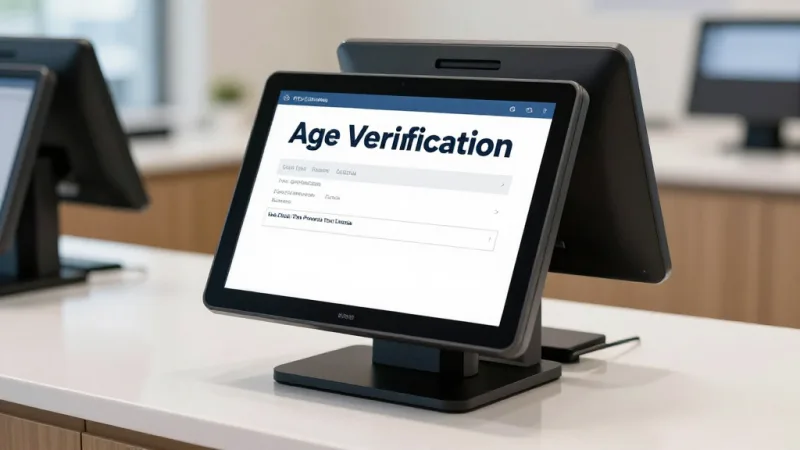
A compliance-aware POS doesn't ask the cashier to remember to check ID. It refuses to sell without it. When a restricted item is scanned, the register locks the transaction until an ID is verified. The cashier scans the barcode on the back of the customer's driver's license, the system reads the date of birth off the card, and it makes the call in a fraction of a second: clear the sale, or hard-stop it.
That distinction matters more than it sounds. There's a world of difference between "the cashier is supposed to check ID" and "the register physically will not ring up this item for anyone under 21 or holding an expired card." The first depends on a tired teenager doing the math on a birthdate under pressure. The second removes the judgment call entirely.
The payoff is threefold. You get a hard stop that blocks the sale that would cost you the license. You get a time-stamped record of the verification, so when a compliance officer runs a sting or an audit, you can prove the check happened. And you get consistency across every shift and every location — the newest hire enforces the exact same rule as the owner, because the rule lives in the software, not in someone's head.
Scanning the ID barcode also beats eyeballing it for spotting fakes, since a scannable barcode that doesn't parse is itself a red flag. Pair that with fingerprint clock-in so you always know which employee ran which sale, and you've closed the biggest liability gap a smoke shop has.
Restricted Inventory: Knowing What You Can Sell, and Where
Now let's talk about the shelves. A smoke shop's inventory isn't like a convenience store's, because a big chunk of it is regulated — and the rules change depending on where you stand.
Flavored vape products are banned outright in some states and cities and legal in others. Certain nicotine concentrations are restricted. Excise taxes vary by jurisdiction and by product category. And federal PACT Act reporting means your records have to be clean and pullable on demand. A shop running two or three locations across a metro area can easily straddle two different rule sets at the same time.
This is where inventory and compliance have to be the same system, not two. In a proper POS, every product carries flags: this SKU requires an age check, this one is restricted in Location B, this one carries an excise tax at this rate. The register enforces those rules automatically. A flavored product that's illegal at your downtown store simply can't be added to a sale there, even if it's perfectly legal at your suburban store twenty minutes away.
Underneath that, you get the retail fundamentals that any high-SKU shop needs. Real-time quantity-on-hand so you're not guessing. Reorder alerts on your fast movers — coils, disposables, popular juice lines — so you never lose a sale to an empty shelf. And accurate cost tracking so you know your true margin per category, which in a business with thin-margin cigarettes next to fat-margin glass and accessories is the difference between feeling profitable and being profitable. If inventory control is your weak point, our guide to retail inventory and barcode scanning goes deep on the mechanics.
The multi-location piece is worth dwelling on. When T. Jin China Diner runs 15 stores and 75 terminals on one platform, the owner sees every location in real time from a single dashboard. A smoke shop operator with three stores needs the exact same thing — one catalog, one set of compliance rules pushed to every register, and one report that rolls up sales, taxes, and stock across all of them. Update a price or flag a newly-banned product once, and it lands everywhere instantly.
Cash Handling: Plugging the Leak Nobody Watches
Here's a number that should get your attention: smoke and vape shops run one of the highest cash-sale ratios in retail. That's convenient for customers and dangerous for owners, because cash is the easiest thing in the world to lose track of — to theft from outside, and to shrinkage from inside.

But it gets worse: most owners don't find out they have a cash problem until it's been running for months, because a pile of untraceable bills doesn't leave a paper trail. Unless your POS creates one.
A POS with real cash controls turns that pile into an audit trail. Every drawer open ties to a logged transaction and a specific cashier. No-sales and voids are recorded and flagged for review. You can require a blind close-out — the cashier counts the drawer without seeing what the system expects, so they can't "fix" a shortage to match. Cash-drop thresholds prompt a mid-shift drop to the safe once the drawer crosses a set amount, so you're never sitting on a fat register. And discount abuse — the employee "comping" a friend's juice bottle — shows up in a report instead of vanishing into the noise.
Layer fingerprint verification (1:N, so an employee just touches the sensor — no shared PINs, no buddy-punching) on top, and every action at the register is attributable to a real person. This is the same loss-prevention discipline any cash-heavy retailer needs; our breakdown of retail loss prevention covers the full playbook. The point is simple: you can't manage what you can't see, and cash is invisible until your POS makes it visible.
Checkout, Loyalty, and the Regulars Who Fund Your Year
So far this has been about protection — your license, your inventory, your cash. Now let's talk about growth, because a smoke shop POS that only plays defense is leaving the best money on the table.
Start with the checkout itself. Smoke shop customers are impulse-and-habit buyers, and the line moves fast, so the register has to be quick — barcode scan, age check, tender, done — while still handling split payments and cards without friction. And because you control your own margins here, being processor-agnostic pays off directly. KwickOS lets you choose your own payment processor and negotiate your own interchange-plus rate instead of being locked into one mandatory processor at a flat markup. On a shop doing $50,000 a month in card volume, moving off a locked 2.99% rate to a negotiated plan typically saves several thousand dollars a year — and you can run your own numbers with the processing fee calculator.
Loyalty points, built into the checkout. This is where smoke shops win big, because their customers are the most repeat-happy in retail. Award one point per dollar, redeemable toward the next purchase. It costs almost nothing, it gives the customer a concrete reason to come back to you instead of the shop down the block, and — the real prize — it gives you a reason to capture their phone number at the counter. That contact is what powers the "your favorite juice is back in stock" text that pulls them in. Treat loyalty not as a discount but as a data-capture engine; our guide to loyalty program gamification shows how to make it addictive.
Membership and VIP tiers turn regulars into recurring revenue. This is the move that reshaped gyms and car washes, and it works here too. Sell a VIP membership: a flat monthly fee for a standing discount on coils and e-liquid, early access to new drops, or a monthly bonus point multiplier. The customer pre-commits, you get predictable revenue and a locked-in reason for them to buy from you, and every membership visit is a chance to upsell the new device or the premium glass.
Gift cards and e-gift cards — yes, in a smoke shop. Owners underestimate these, but they move well for birthdays and holidays, and an e-gift card delivered to a phone lets someone gift a vaper $50 of credit in ninety seconds. Better still, industry research suggests a meaningful slice of gift card value is never fully redeemed — that unredeemed balance is pure margin. Sell them at the counter and online, and keep the gift balance, loyalty points, and membership status all in one customer profile so nothing falls through the cracks. If you want the accounting angle on that unredeemed balance, see our piece on gift card breakage revenue.
One Platform, Not a Stack of Band-Aids
Here's what most smoke shop owners end up with: a basic register that can't check ID, a separate age-verification gadget, a spreadsheet for inventory, a shoebox for cash reconciliation, and a punch-card jar for loyalty. Five systems that don't talk to each other, each with its own failure point.
The alternative is one operating system where the age check, the restricted-inventory rules, the cash controls, the loyalty points, and the gift-card balances all live in the same place and reference the same sale. When the ID scan clears, the restricted item rings up, the cash drawer logs the tender, the customer's points update, and their profile records the visit — in one motion, one system, one record.
Because KwickOS is hybrid local + cloud, the register keeps running even when the internet drops — no small thing for a strip-mall shop on a flaky connection, where "the system is down" means you either sell cash-only-and-blind or you close the doors. It runs on Linux with no Windows license and no manual update cycle, and it's multi-language (English, Spanish, Chinese) out of the box for a diverse crew and customer base. It's the same platform that runs 5,000+ businesses across all 50 states and processes over $2M in daily sales — configured for the way a smoke shop actually operates, not a restaurant POS with a retail module bolted on. Your front counter is a retail counter, and our retail platform overview shows how the inventory and checkout tools carry straight over.
What to Look For in a Vape & Smoke Shop POS
Pulling it together, here's the checklist that separates a POS that protects and grows your shop from one that just takes money:
- Built-in age verification that scans ID barcodes and hard-stops underage or expired-ID sales, with a time-stamped record.
- Restricted-item flags that enforce per-jurisdiction rules (flavored bans, nicotine limits) and track excise tax for PACT Act reporting.
- Real-time inventory with reorder alerts and true per-category margin on a high-SKU catalog.
- Cash-drawer controls — logged opens, blind close-outs, cash-drop thresholds, void and discount-abuse alerts.
- Fingerprint verification (1:N) to kill shared PINs, buddy-punching, and un-attributed register actions.
- Processor-agnostic payments so you keep your negotiating leverage and your margins.
- Loyalty points, memberships, and gift cards that share one customer profile.
- Multi-location control — one catalog and one rule set pushed to every register from a single dashboard.
- Hybrid local + cloud so the shop rings up sales offline and stays in sync across stores.
The Bottom Line
Every other business in this blog is trying to protect its margin. A smoke shop is trying to protect its right to exist. The tobacco license under your business isn't a formality — it's the load-bearing wall, and one careless sale by a distracted cashier can bring it down.
So build the check into the system, not the shift. Let the register refuse the sale you can't afford to make. Flag every restricted product so the rules follow you across locations. Turn your cash pile into an audit trail. And then — once you're protected — use the loyalty points, memberships, and gift cards to turn your habitual regulars into the predictable, growing revenue that funds the year.
Defense first, offense second, both on one platform. That's the difference between a smoke shop that's one bad Friday from disaster and one that's built to last.
Run Your Shop on One System
KwickOS handles age verification, restricted-item inventory, cash controls, loyalty, and gift cards — with the freedom to choose your own payment processor. See how much you could save and simplify.
Compare KwickOSFrequently Asked Questions
Can a POS system actually stop a sale to a minor?
Yes. A compliance-aware POS forces an age check before any tobacco, vape, or nicotine item can be rung up. The cashier scans the barcode on the customer's ID, the system reads the date of birth, and it either clears the sale or hard-stops it — the transaction cannot be completed for an underage or expired ID. Because the check is built into the checkout flow rather than left to a cashier's judgment, it removes the single most expensive mistake a smoke shop can make: a failed compliance check that costs a fine and, on a second strike, your license.
How does a vape shop POS handle restricted and regulated inventory?
Restricted items are flagged in the product catalog so the POS knows they require an age check and, where applicable, that they can't be sold at all in a given jurisdiction (for example, flavored vape products banned in certain states or cities). The system enforces those rules at the register, tracks quantity on hand for excise-tax and PACT Act reporting, and alerts you before fast-moving SKUs run out. That means you stay compliant, you don't over-order slow movers, and you have clean records if a regulator asks for them.
Do gift cards and loyalty programs work for smoke and vape shops?
They work extremely well because smoke and vape customers are habitual, repeat buyers. A points-based loyalty program — one point per dollar, redeemable toward the next purchase — increases visit frequency and captures the phone number you need for restock alerts and promotions. Physical and e-gift cards sell for birthdays and holidays, and a share of gift card value is never fully redeemed, which is margin in your pocket. A membership or VIP tier (for example, a monthly fee for a standing discount on coils and juice) turns loose regulars into predictable recurring revenue.
Why does cash handling matter so much for smoke shops, and how does a POS help?
Smoke and vape shops run a high share of cash sales, which makes them a target for both external theft and internal shrinkage. A POS with cash-drawer controls ties every drawer open to a logged transaction and cashier, enforces blind close-outs and cash-drop thresholds, and flags voids, no-sales, and discount abuse. Fingerprint clock-in (1:N verification) removes shared PINs and buddy-punching. Together these turn an untraceable cash pile into an auditable trail, which is the only way to know whether your register is short because of an honest mistake or something else.