 Rain Lee
Every June, produce prices drop 15-30% on tomatoes, stone fruits, zucchini, corn, and fresh herbs. Meanwhile, your menu is still running the same winter-priced items with the same winter-sourced ingredients.
You are paying more for ingredients that are out of season. You are missing the items customers actually want when it is 90 degrees outside. And you are leaving an average of $8,400 in seasonal revenue on the table between Memorial Day and Labor Day.
But it gets worse: your competitors who do run a summer menu are capturing those dollars instead. A limited-time watermelon salad. A frozen cocktail program. A patio-only appetizer special. These are not gimmicks — they are calculated revenue plays backed by ingredient economics and customer psychology.
This guide gives you the exact playbook. Four categories of summer items, when to launch them, how to price them, and the POS data you need to track whether they are actually working.
The Economics of Seasonal Menus (Why Summer Is Your Biggest Opportunity)
Seasonal menu items are not just a marketing play. They are a margin play.
Here is what happens to ingredient costs during peak summer months (June through August):
| Ingredient | Winter Wholesale (per lb) | Summer Wholesale (per lb) | Cost Reduction |
|---|---|---|---|
| Tomatoes | $2.80 | $1.60 | 43% |
| Zucchini / Squash | $2.10 | $0.90 | 57% |
| Fresh Herbs (basil, mint) | $14.00 | $6.00 | 57% |
| Stone Fruits (peach, plum) | $3.50 | $1.80 | 49% |
| Sweet Corn | $0.75/ear | $0.30/ear | 60% |
When your food cost on a dish drops from 34% to 22% because the core ingredient is in peak season, every plate you sell carries 12 extra margin points. Multiply that across 40-60 covers a day for 14 weeks, and you start to see why smart operators treat summer menu planning as seriously as they treat labor scheduling.
And that is not all: seasonal items also drive higher check averages. National Restaurant Association data shows that limited-time offers increase average check size by 8-12% because customers perceive seasonal items as premium, even when they cost you less to produce.
The 4 Summer Items That Pay for Themselves in Week One
You do not need to overhaul your entire menu. Based on margin analysis across restaurants using KwickOS — from single-location spots to multi-unit operators like T. Jin China Diner (15 stores, 75 terminals) — the highest-ROI summer additions fall into four categories.
1. The Signature Summer Salad ($2.10 Cost, $15.50 Price, 86% Margin)
Every restaurant needs one hero salad for summer. Not a side salad buried in the appetizer section — a main-course, Instagram-worthy, this-is-why-I-came-here salad.
The formula: seasonal produce base + one premium protein + a house-made dressing + one unexpected texture element.
Example: Grilled peach and burrata salad with arugula, toasted pistachios, and basil-honey vinaigrette. Food cost: $2.10 per plate. Menu price: $15.50. That is an 86% margin on an item your guests will photograph and post for free.
Here's the thing: this salad sells itself in the first week. Once three or four tables order it and the dish starts passing through the dining room, neighboring tables ask their server what it is. Train your staff with one sentence: "That is our summer peach salad — it is only available through Labor Day."
Scarcity drives demand. Limited availability reduces price sensitivity. This is not restaurant theory — it is how menu psychology works at every level.
2. The Frozen Drink Program ($1.40 Cost, $13.00 Price, 89% Margin)
If you are not running a frozen drink program in summer, you are ignoring the highest-margin category on your menu.
The numbers are almost absurd:
| Drink | Ingredient Cost | Menu Price | Margin |
|---|---|---|---|
| Frozen Margarita | $1.40 | $13.00 | 89% |
| House Lemonade (non-alc) | $0.55 | $4.50 | 88% |
| Frozen Rosé | $1.80 | $14.00 | 87% |
| Mango Lassi (non-alc) | $0.70 | $5.50 | 87% |
| Cold Brew Espresso Martini | $1.60 | $14.50 | 89% |
A single frozen drink machine costs $800-$2,000. If you sell 15 frozen cocktails a day at $13 each, that machine pays for itself in under two weeks. For the remaining 12 weeks of summer, it is printing money.
Multi-location operators have an even bigger advantage here. Crafty Crab Seafood (19 stores, 152 terminals) uses KwickOS to push a unified seasonal drink menu across all locations with one click — same recipes, same pricing, same modifier setup, zero re-keying at each store.
3. The Patio-Only Shareable ($3.80 Cost, $18.00 Price, 79% Margin)
If you have outdoor seating, you have an asset that most operators undermonetize by simply extending the indoor menu outside.
Instead, create one appetizer that is only available on the patio. A grilled corn and elote dip. Chilled seafood shooters. A smoked watermelon and feta board. The exclusivity makes it an event — customers specifically request patio seating to access the item.
The ROI math: a patio-only shareable at $18, ordered by 30% of patio tables (say 8 out of 25 tables per service), generates an incremental $144/night or $2,016 over a 14-week summer. Two services a day? That is over $4,000 from a single appetizer.
But it gets worse for restaurants that skip this: customers who sit on your patio and see nothing special on the menu have no reason to come back specifically for patio dining. You lose the repeat visit trigger that seasonal exclusivity creates.
4. The Seasonal Dessert ($1.20 Cost, $10.00 Price, 88% Margin)
Dessert ordering drops 15-20% in summer because heavy, winter-style desserts (chocolate lava cake, bread pudding, crème brûlée) feel wrong when it is 85 degrees outside.
The fix is light, cold, fruit-forward desserts that feel like a reward, not a punishment:
- Stone fruit crisp with vanilla bean gelato — $1.20 cost, $10.00 price
- Lemon-basil panna cotta — $0.90 cost, $9.50 price
- Watermelon granita with mint and lime — $0.45 cost, $7.50 price (94% margin)
When you replace one heavy dessert with a seasonal cold option, dessert ordering rates recover by 12-18%. On 80 covers a night, that is 10-14 more desserts sold per service, or $700-$1,400 per week in recovered dessert revenue.
Timing Your Summer Menu Launch (The 3-Phase Approach)
Launching a seasonal menu is not flipping a switch. The restaurants that capture the most revenue use a three-phase rollout:
Phase 1: Pre-Launch Tease (2 Weeks Before Memorial Day)
Start building anticipation. Post behind-the-scenes content of your chef testing new dishes. Add a "Coming Soon" card to your digital signage. Train servers to mention it: "We are launching our summer menu in two weeks — you should come back for the frozen rosé."
If you run a loyalty program through your POS, send a members-only preview. KwickOS operators can segment their CRM by visit frequency and send targeted messages to their top 20% of customers first. This creates a VIP feeling and guarantees your best customers show up opening weekend.
Phase 2: Full Launch (Memorial Day Weekend)
Go live with all seasonal items on Thursday before Memorial Day. Not Monday — Thursday. You want the full weekend to build momentum.
Update your POS menu to feature summer items prominently. With KwickOS, this takes minutes — drag and drop items into a "Summer Specials" category that appears at the top of your order screen. If you are running self-ordering kiosks (like Rockin' Rolls with 49 iPad stations across 3 stores), the kiosk menu updates simultaneously.
Update your online ordering menu at the same time. This is where multi-location operators burn hours if their system requires manual updates per location. A processor-agnostic, unified platform eliminates this bottleneck entirely.
Phase 3: Mid-Summer Refresh (Early July)
Six weeks in, review your POS data. Which seasonal items are selling? Which are not? Replace underperformers with a "version 2" item to reignite interest.
This mid-summer refresh also creates a second marketing moment: "New summer items just dropped." It re-engages customers who tried your first wave and gives them a reason to return.
Pricing Your Seasonal Items for Maximum Revenue
Most restaurant owners underprice seasonal items because they anchor to their regular menu prices. This is a mistake.
Seasonal items command a 10-15% premium over comparable regular items because:
- Scarcity effect — "only available through Labor Day" reduces price comparison behavior
- Perceived freshness — customers associate seasonal with farm-fresh, local, and premium
- Novelty premium — people pay more for new experiences than routine orders
If your regular house salad is $13, price the summer peach salad at $15-$16. If your regular cocktails average $11, the frozen summer cocktail should be $13-$14. Customers do not blink at this premium when the menu copy emphasizes seasonality.
Here is the thing: you can use your POS data to test this in real time. Run the item at $14.50 for week one and $15.50 for week two. If order volume does not drop, keep the higher price. KwickOS tracks item-level sales by day, so this A/B test takes exactly zero extra effort — just change the price on Monday and compare the dashboards Friday. Use our menu pricing calculator to model the margins before you commit.
Patio Optimization: Turning Outdoor Seating into a Revenue Engine
Patio seating capacity is finite and weather-dependent. That makes every patio seat worth more per hour than an indoor seat during prime summer evenings.
Three tactics to maximize patio revenue:
1. Reduce patio table-turn time by 15 minutes. Equip patio servers with handheld terminals for tableside ordering and payment. No more walking inside to enter orders or run a card. Shogun Japanese Hibachi cut their average table time by 12 minutes after switching to KwickOS handheld ordering — their staff were fully proficient in under 5 minutes.
2. Add patio-specific upsell prompts. When a server opens a patio table in the POS, trigger a modifier prompt for the seasonal shareable appetizer and frozen drink. This is not pushy — it is helpful. Customers who just sat down on a 85-degree evening want to be told about the frozen margarita special.
3. Extend patio hours with lighting and atmosphere. If your patio closes at sunset because it gets dark, spend $200 on string lights and extend service by 90 minutes. At an average of $45/table, adding 8 more table-turns per night generates $360 in incremental revenue per evening.
The POS Data That Drives Your Summer Menu Decisions
Gut feeling does not scale. Here is exactly what to track, and when:
| Metric | What It Tells You | Check Frequency |
|---|---|---|
| Seasonal item mix % | Are customers actually ordering the new items? | Weekly |
| Average check (patio vs indoor) | Is the patio strategy driving higher spend? | Weekly |
| Dessert attach rate | Did the seasonal dessert recover lost dessert orders? | Weekly |
| Drink-to-food ratio | Is the frozen drink program pulling its weight? | Weekly |
| Seasonal item food cost % | Are ingredient costs staying where you planned? | Bi-weekly |
| Server sell-through rate | Which servers are recommending seasonal items? | Weekly |
A processor-agnostic POS like KwickOS gives you this data in real time across every location. The hybrid local+cloud architecture means reports pull instantly — 1ms local latency versus the 20ms+ cloud delay of systems like Toast or Square. When you are making pricing decisions mid-service based on tonight's sales velocity, that speed difference matters.
Real Example: How 4 Items Generated $8,400 in Incremental Summer Revenue
Let us put it all together with realistic projections for a single-location restaurant doing 80 covers per night, 6 nights a week, over a 14-week summer season:
| Item | Orders/Night | Net Margin/Item | 14-Week Revenue |
|---|---|---|---|
| Summer Peach Salad | 12 | $13.34 | $1,344 margin |
| Frozen Cocktails (avg) | 18 | $11.44 | $1,730 margin |
| Patio Shareable | 8 | $14.22 | $956 margin |
| Seasonal Dessert | 14 | $8.80 | $1,036 margin |
| Total Incremental | $5,066 margin |
That $5,066 in pure margin from a single location over one summer. Factor in the check-size lift on non-seasonal items (the "halo effect" of an exciting menu draws more traffic and longer visits) and total incremental revenue typically hits $8,000-$9,000.
For multi-location groups, multiply accordingly. A 5-store operation captures $40,000-$45,000 in summer seasonal revenue. That is not a rounding error — it is an employee's annual salary.
What Your POS Needs to Do for Seasonal Menu Management
Not every POS system handles seasonal menus well. Here is what to look for:
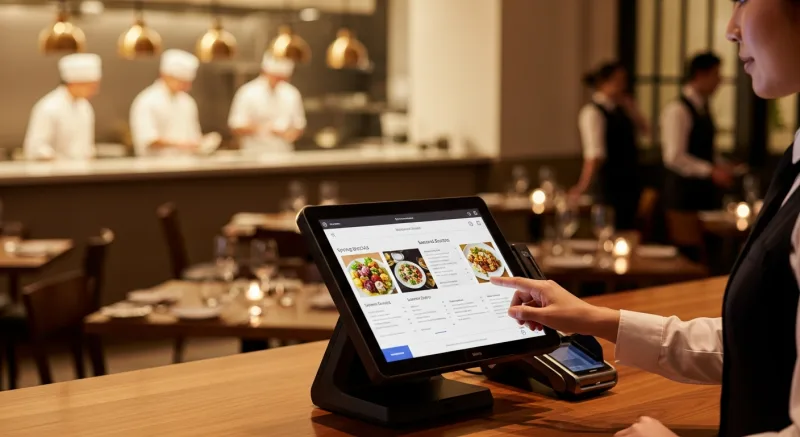
- Timed menu categories — automatically show/hide seasonal items by date range so you do not forget to remove them after Labor Day
- Multi-location sync — push menu changes to every store simultaneously (Crafty Crab manages 19 stores this way through KwickOS)
- Item-level reporting — track sales, margin, and velocity for each seasonal item individually
- Modifier flexibility — seasonal items often have unique modifiers (protein add-ons, spice levels, spirit upgrades) that your standard items do not
- Kiosk and online ordering sync — seasonal items should appear everywhere customers order, not just the server terminal
- Offline reliability — your seasonal menu should work even if WiFi drops during a Saturday night rush. Hybrid local+cloud architecture ensures orders keep flowing at 1ms local speed regardless of internet status
If your current POS requires a support call or manual upload to change menu items, you are losing agility that directly costs you revenue. The mid-summer refresh alone — swapping underperformers for new items — should take minutes, not days.
The Labor Angle: Summer Menus and Staffing
One concern restaurant owners raise about seasonal menus: "My kitchen is already stretched thin. Adding new items will slow us down."
Here is the reframe: you are not adding items. You are swapping items. Remove your 2-3 lowest-selling dishes (your POS tells you which ones) and replace them with seasonal alternatives. Net item count stays the same. Prep complexity may actually decrease because summer items tend to be simpler — grilled, chilled, and assembled rather than braised, reduced, and plated.
Use your POS fingerprint authentication to track which cooks are preparing seasonal items and how fast. KwickOS supports 1:N fingerprint matching, which means any cook can clock into any station without carrying a card or remembering a PIN. When you are cross-training staff on new summer prep, this frictionless station assignment matters.
The real staffing win from a summer menu is on the front-of-house side. Servers who have a seasonal item to recommend — something new, something exciting, something that expires — are more engaged and sell more. A server who says "you have to try the frozen rosé before it is gone" is generating revenue that a server reciting the same year-round menu simply does not.
The Bottom Line
A summer menu is not a nice-to-have. It is a revenue strategy that exploits three simultaneous advantages: lower ingredient costs, higher customer willingness to pay, and increased foot traffic.
Four well-chosen seasonal items, launched on Memorial Day weekend and refreshed in early July, can generate $8,000-$9,000 in incremental revenue for a single location over 14 weeks. The investment is minimal: ingredient sourcing, a few hours of recipe development, and a POS system flexible enough to manage the rollout without operational friction.
The restaurants that skip seasonal menus are not just missing revenue. They are training customers to think of them as the place that never changes — and in an industry where novelty drives repeat visits, that is a slow path to irrelevance.
Start planning your summer menu now. Run the numbers through your food cost calculator. Pull your current sales mix from your POS. Identify the items to swap out. And launch before your competitors do.
Make Seasonal Menus Effortless
KwickOS lets you push summer menu updates to every location, kiosk, and online ordering channel in minutes. No support tickets. No manual uploads. Just drag, drop, and sell.
Get a Demo