 Kelly Ho
You spent years perfecting your signature hot sauce. Customers ask about it every week. Some beg to buy a bottle. A few have even brought their own containers, hoping you'd fill them up.
And what do you do? You smile, say thanks, and watch them walk out the door with nothing but a full stomach.
Here's the thing: that hot sauce sitting in your kitchen is worth more on your retail shelf than it is on your plates. A single batch that costs $64 to produce fills 20 bottles that sell for $14 each. That's $280 in revenue from one batch — a 337% markup. Compare that to the 28-35% food cost margins you're fighting for on every entree.
But it gets worse. While you're ignoring merchandise revenue, the restaurant down the street is pulling in $2,000 a month selling branded sauces, spice rubs, t-shirts, and tote bags. That's $24,000 a year in pure incremental revenue — from products that don't require a cook, a server, or an extra seat in your dining room.
This guide shows you exactly how to build a restaurant merchandise program from scratch: what to sell, how to price it, where to display it, and how to ring it up through your POS without adding a second system.
Why Restaurant Merchandise Is the Highest-Margin Revenue You're Not Capturing
Restaurant margins are brutal. After food cost (28-35%), labor (25-35%), rent (6-10%), and overhead, you're lucky to keep 5-10 cents on every dollar. You already know this. What you might not know is that merchandise flips those economics upside down.
Consider the margin difference:
| Revenue Type | Typical Gross Margin | Labor Required |
|---|---|---|
| Dine-in food | 28-35% | Cook, server, busser |
| Delivery food | 15-25% (after commission) | Cook + delivery fee |
| Bottled sauce / condiment | 60-80% | None at point of sale |
| Branded apparel | 50-65% | None at point of sale |
| Gift cards | 70-100% (with breakage) | None |
That last row is worth a second look. Gift cards — both physical cards displayed at checkout and e-gift cards sold through your website — are technically merchandise with the highest margins in your entire operation. According to industry research, 20-30% of gift card value is never redeemed. That's pure profit with zero cost of goods.
And that's not all. Merchandise creates a second revenue stream that isn't limited by your seating capacity. You can only serve 80 covers during a dinner rush. But you can sell 200 bottles of hot sauce in the same week without hiring another cook or adding another table.
The 6 Merchandise Categories That Actually Sell
Not every product works. A branded napkin holder? No one wants that. Here are the six categories that consistently generate revenue for restaurants, ranked by profit potential:
1. Signature Sauces and Condiments ($12-18 per unit, 65-80% margin)
This is the top performer across every restaurant type. If customers already ask about your sauce, salsa, or dressing, you have a built-in market. The economics are compelling: a recipe that costs $3.20 per bottle to produce and package retails for $12-14. At 20 bottles per week, that's $960-1,120/month in revenue with under $260 in costs.
Start with your most-requested item. One sauce. One bottle size. One label design. Scale from there.
2. Spice Rubs and Dry Mixes ($8-15 per unit, 70-85% margin)
Even higher margins than sauces because dry products have longer shelf life, lower packaging costs, and zero refrigeration requirements. A BBQ restaurant's signature rub, a Mexican restaurant's taco seasoning, or a coffee shop's house blend — these are the flavors customers want to recreate at home.
3. Branded Apparel ($18-35 per unit, 50-65% margin)
T-shirts, hats, hoodies, and aprons. The key is design. Generic restaurant logos on cheap cotton don't sell. A well-designed graphic tee that people would actually wear in public? That sells itself — and turns every customer into a walking billboard.
Here's the thing: apparel works best for restaurants with strong brand identity. If your name or logo sparks recognition and loyalty, apparel is a no-brainer. If you're a generic "Main Street Grill," invest in food products first.
4. Packaged Dry Goods ($6-20 per unit, 55-75% margin)
Coffee beans, tea blends, pasta, rice, specialty ingredients. These products let customers extend the dining experience into their home kitchen. A ramen shop selling its noodles and broth base as a take-home kit. A bakery selling its cookie dough. A bubble tea shop like Tiger Sugar packaging its signature brown sugar syrup for home use.
5. Gift Cards and E-Gift Cards ($25-100 per card, 70-100% effective margin)
Every restaurant should sell gift cards. Period. Physical cards displayed near the register cost pennies to produce and generate significant revenue — especially during holidays. November and December alone account for nearly 40% of annual gift card sales, according to industry data.
E-gift cards take it further: zero inventory, zero production cost, available 24/7 through your website or app. A customer in another city can buy a gift card for their friend at 2 AM without you lifting a finger. If your POS doesn't support both physical and digital gift cards, you're leaving money on the table.
6. Branded Accessories ($5-25 per unit, 55-70% margin)
Tote bags, stickers, mugs, water bottles, keychains. These are lower-ticket items that work as impulse purchases near the checkout counter. They're also perfect for building brand visibility — a $3 sticker on a laptop is advertising you never have to pay for again.
How to Price Restaurant Merchandise (Without Guessing)
Pricing merchandise is different from pricing menu items. With food, you're constrained by customer expectations and competitor pricing. With merchandise, you have more latitude because customers are buying a brand experience, not a commodity.
Use this formula:
Retail Price = Production Cost × 3.5 to 5
That might sound aggressive if you're used to food cost ratios. But it gets worse if you price too low — you signal cheap quality and erode the perceived value of your brand. A $6 hot sauce feels like a generic grocery store product. A $14 hot sauce in a well-designed bottle with your restaurant's story on the label feels like a premium artisan product.
| Product | Production Cost | Retail Price | Gross Margin |
|---|---|---|---|
| Hot sauce (5 oz bottle) | $3.20 | $13.99 | 77% |
| Spice rub (4 oz tin) | $2.10 | $9.99 | 79% |
| T-shirt (screen printed) | $6.50 | $24.99 | 74% |
| Tote bag (canvas) | $3.80 | $14.99 | 75% |
| Coffee beans (12 oz bag) | $5.40 | $18.99 | 72% |
One pro tip: bundle merchandise with dining experiences. A "Date Night Box" with a $50 gift card, a bottle of signature sauce, and a branded tote bag for $69.99 creates perceived value while moving multiple products. Your POS upselling system can prompt servers to mention bundles during checkout.
Retail Displays That Sell: Where to Put Your Merchandise
You can have the best hot sauce in your city, but if it's sitting in a back corner behind the host stand, nobody buys it. Placement is everything.
The checkout zone is your most valuable real estate. According to industry research, impulse purchases near the register account for the majority of retail merchandise sales in restaurants. This is the same psychology that puts candy bars at grocery store checkouts — customers are already in a spending mindset, and a $14 bottle of sauce feels insignificant next to a $85 dinner tab.
Here's how to set up your retail display:
- Near the POS terminal — Customers see products while waiting to pay. Display gift cards, sauces, and small items within arm's reach of the checkout counter.
- At the host stand / waiting area — Guests waiting for their table browse merchandise. Use a small shelf or display case with your top 3-5 products.
- On the table (tent cards) — A small table tent that says "Take home our famous habanero sauce — $13.99 at the front" turns every table into a sales channel.
- On your customer-facing display — If your POS has a customer-facing screen, use it to promote merchandise with rotating images during checkout.
And that's not all. Your digital signage is another untapped channel. If you use a POS system with integrated digital signage, you can display merchandise promotions on your in-store screens — "NEW: Our signature hot sauce. $13.99. Ask your server." — rotating throughout the day without printing a single flyer.
Setting Up POS Retail Mode (Without a Second System)
Here's the part that stops most restaurant owners: "Do I need a separate system to sell retail products?"
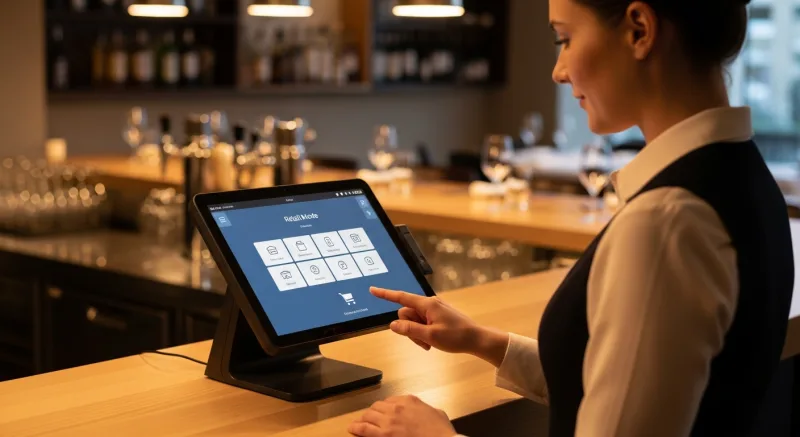
No. And if your current POS can't handle both food and retail transactions from the same terminal, that's a sign you've outgrown your POS — not a reason to buy a second one.
A modern all-in-one POS like KwickOS includes retail mode built into the same system your servers use for food orders. Here's what that looks like in practice:
- Separate product categories — Create a "Retail" or "Merchandise" category alongside your food menu. Each product gets its own SKU, price, and inventory count.
- Barcode scanning — Assign barcodes to merchandise products. When a customer brings a bottle of sauce to the register, the cashier scans it instead of searching through the menu. This speeds up checkout and reduces errors. (See our barcode scanner guide for setup details.)
- Inventory tracking — Track retail stock separately from food inventory. Get low-stock alerts when you're down to 5 bottles of hot sauce so you can reorder before you run out.
- Split reporting — View food revenue and merchandise revenue separately. Know exactly how much your retail program generates without manually filtering spreadsheets.
- Online retail — List merchandise products on your online ordering page. A customer ordering dinner delivery can add a bottle of sauce to their cart with one tap.
T. Jin China Diner — operating 15 locations with 75 terminals — manages both dine-in and retail products from the same KwickOS dashboard across all stores. When they introduced packaged sauces at 3 locations as a test, they rolled it out to all 15 within two months using centralized menu management. No separate system. No extra hardware.
The Online Store: Selling Merchandise Beyond Your Four Walls
Your physical restaurant limits merchandise sales to walk-in customers. An online store removes that ceiling entirely.
But it gets worse if you overthink it. You don't need a custom e-commerce website on day one. Start with the simplest path:
- Add merchandise to your online ordering page. If you already use a system like KwickMenu for online ordering, adding retail products takes minutes. Customers browsing your delivery menu see "Bottled Sauces" or "Gift Cards" as a category and add items to their food order.
- Use social media as a storefront. Post a photo of your hot sauce on Instagram with "Link in bio to order." Direct customers to your online ordering page. Zero additional tech needed.
- Launch e-gift cards immediately. E-gift cards require no inventory and no shipping. They're the fastest merchandise product to launch online. Promote them year-round, but especially during holidays — Mother's Day, Father's Day, Christmas, and Valentine's Day are peak gift card buying seasons.
- Ship only after you prove demand. Don't invest in shipping infrastructure until you're consistently selling 50+ units per month online. Start with local pickup and delivery through your existing delivery system — KwickDriver at $2 + $6.99 is far cheaper than DoorDash taking 25% of every order that includes merchandise.
Once online sales hit $3,000/month, consider a dedicated e-commerce integration. But most restaurants never need it — their POS online ordering system handles the volume just fine.
Loyalty Programs Meet Merchandise: The Multiplier Effect
Here's where it gets interesting. Your loyalty and membership program is the best marketing channel for merchandise — and merchandise is the best incentive for your loyalty program. They feed each other.
Three ways to connect them:
- Points on merchandise purchases. Award loyalty points for merchandise purchases, not just food orders. A customer earns 25 points on a $14 sauce bottle the same way they earn points on a $14 entree. This incentivizes both purchase types and keeps customers engaged with your rewards program.
- Merchandise as a reward tier. Instead of the typical "free appetizer" redemption, offer a free t-shirt at 500 points or a free bottle of signature sauce at 300 points. Customers wearing your branded tee become walking advertisements — and the cost to you is $6.50 per shirt versus the $4-5 food cost of a free appetizer. Better margin, better marketing.
- VIP/membership exclusive merchandise. Create limited-edition products only available to loyalty members. A seasonal spice rub. A numbered hot sauce batch. An annual members-only t-shirt design. Exclusivity drives both merchandise sales and loyalty enrollment.
Crafty Crab Seafood, with 19 locations and 152 terminals, uses their loyalty program to drive gift card sales during holidays: members earn double points on gift card purchases in December. The result is a spike in both gift card revenue and new loyalty sign-ups from gift card recipients who create accounts to check their balances.
Packaging and Labeling: What You Need to Know
Selling food products retail has regulatory requirements. Skip these and you're risking fines, lawsuits, or a health department shutdown.
- FDA labeling requirements — All packaged food sold retail must include: product name, net weight, ingredient list (in descending order by weight), allergen warnings, nutrition facts (if you sell more than a minimal quantity), and your business name and address.
- State cottage food laws — Many states allow small-scale food production from commercial kitchens (which your restaurant already is) with simplified labeling. Check your state's specific requirements.
- Shelf stability — Products sold at room temperature must be tested for pH, water activity, and shelf life. Hot sauces with vinegar base are typically shelf-stable. Cream-based sauces or fresh salsas require refrigeration and have shorter shelf lives — which limits your retail window.
- Liability insurance — Your existing restaurant insurance may cover retail food products. Check with your insurer. If not, a product liability rider typically costs $300-800/year.
For non-food merchandise (apparel, accessories), there are no special requirements beyond standard retail practices. Just make sure your branding is trademarked if you're scaling up.
Real Numbers: Building to $24,000/Year
Let's build a realistic merchandise revenue model for a single-location restaurant:
| Product | Units/Week | Price | Monthly Revenue |
|---|---|---|---|
| Signature hot sauce | 15 | $13.99 | $839 |
| Spice rub | 8 | $9.99 | $319 |
| T-shirts | 4 | $24.99 | $400 |
| Gift cards (physical + e-gift) | 6 | $40 avg | $960 |
| Stickers / small items | 12 | $4.99 | $239 |
| Total | $2,757 |
Annual total: $33,084 in revenue. At an average 68% gross margin across all products, that's $22,497 in gross profit — from a revenue stream that requires no additional kitchen labor, no extra seating, and no food cost pressure.
Even a conservative start with just hot sauce and gift cards — $839 + $960 = $1,799/month — puts you at $21,588/year.
And here's the pattern interrupt: every dollar of merchandise profit goes straight to your bottom line because you've already absorbed your fixed costs (rent, insurance, base labor) through your food operation. Merchandise revenue isn't subject to the same margin compression that crushes food profits.
Getting Started This Week: The 5-Step Launch Plan
- Pick one product. Your most-requested sauce, your best-selling dessert as a take-home kit, or simply gift cards if you don't sell them yet. One product. Don't overcomplicate it.
- Set up POS retail mode. Create a retail category in your POS, add the product with a SKU and price, assign a barcode if applicable. In KwickOS, this takes under 10 minutes through the menu management dashboard. Your POS checkout flow should handle merchandise alongside food orders seamlessly.
- Create a display. Place the product near your register. Use a small shelf, a basket, or even a stack of neatly arranged bottles. Add a price card. Done.
- Tell every customer. Brief your servers: "When someone compliments the food, mention we sell [product] to take home." Add a line to the bottom of receipts. Post on social media. Add it to your online ordering menu.
- Track and expand. After 30 days, check your POS reports. If the product sells 10+ units per week, add a second product. If it sells fewer than 5, adjust placement, pricing, or switch to a different product.
The hardest part isn't the product, the pricing, or the display. It's deciding to start. Every week you don't sell merchandise is a week of revenue you'll never get back.
Turn Your Restaurant Into a Retail Brand
KwickOS includes built-in retail mode, gift card management, loyalty programs, and online ordering — everything you need to launch merchandise sales from the same system that runs your kitchen. No second POS. No extra monthly fees.
Calculate Your Merch Revenue