 Ming Ye
Open your DoorDash Merchant Portal right now. Click "Financials." Look at the commission line from last month.
Now multiply it by 12.
If you are like the average restaurant doing 200 delivery orders per week at a $35 average ticket, you just found $50,400 per year going to DoorDash — not to your cooks, not to your rent, not to the ingredients on the plate. To an app.
Here's the thing: that number is not fixed. It is not the cost of doing business. It is a choice — and most restaurant owners do not realize they have alternatives that could cut that number by 60% or more.
But it gets worse. DoorDash, UberEats, and Grubhub are not just taking a commission. They are taking your customer data, your brand identity, and your ability to build direct relationships with the people who love your food.
This guide breaks down the exact commission structure of every major delivery platform in 2026, shows you the real per-order math, and lays out a concrete plan for taking back control of your delivery revenue.
The Real Commission Rates: What Every Platform Actually Charges
Every third-party platform publishes "starting at" rates that look reasonable on a marketing page. The actual cost structure is more complicated — and more expensive — than any of them want you to realize.
DoorDash Commission Tiers (2026)
DoorDash offers three plans for restaurant partners:
| Plan | Commission | Delivery Area | DashPass Visibility |
|---|---|---|---|
| Basic | 15% | Smallest radius | No |
| Plus | 25% | Larger radius | Yes |
| Premier | 30% | Largest radius | Yes + priority |
Sounds straightforward. But here is what the table does not show: the 15% Basic plan buries your listing. DoorDash's algorithm prioritizes restaurants on higher-commission plans. Basic plan restaurants report 40-60% fewer orders than Premier restaurants in the same area. So the "affordable" option comes with an invisible penalty that forces most restaurants onto the 25% or 30% tier just to maintain order volume.
And that's not all: DoorDash also charges a credit card processing fee of approximately 2.5% on every order, plus a $6 delivery fee charged to the customer (which reduces what they are willing to spend on food). Some merchants also pay for DoorDash Storefront integration — another $0.99 per order.
UberEats Commission Tiers (2026)
| Plan | Commission | Includes Delivery? | Notes |
|---|---|---|---|
| Lite | 15% | No (pickup only) | Reduced visibility |
| Plus | 25% | Yes | Standard listing |
| Premium | 30% | Yes + larger area | Priority placement |
Notice the pattern? UberEats' 15% tier is pickup only — no delivery. If you want delivery, you start at 25%. For a restaurant where 85% of online orders are delivery, the 15% "starting rate" is marketing fiction.
Grubhub Commission Structure (2026)
Grubhub operates on a base commission of 15-25% plus an additional marketing fee if you want visibility. Their "Grubhub+" loyalty members (who order the most frequently) are shown restaurants that pay the highest commission first. Some Grubhub partners report effective rates of 30-35% when marketing fees are included.
The Bottom Line on Third-Party Commissions
Here's what matters: the realistic commission for delivery orders on any major platform is 25-30%. The lower tiers exist for press releases and sales pitches. In practice, the algorithm punishes restaurants that choose them.
The Per-Order Math That Changes Everything
Percentages are abstract. Dollars are not. Let us calculate exactly what each platform costs on a single $35 delivery order — the national average for restaurant delivery in 2026.
| Cost Component | DoorDash (30%) | UberEats (25%) | Grubhub (25%) | KwickDriver (flat) |
|---|---|---|---|---|
| Platform commission | $10.50 | $8.75 | $8.75 | $2.00 |
| Delivery fee (restaurant side) | Included | Included | Included | $6.99 |
| Processing fee (~2.5%) | $0.88 | $0.88 | $0.88 | $0.00* |
| Total cost per order | $11.38 | $9.63 | $9.63 | $8.99 |
| You keep | $23.62 | $25.37 | $25.37 | $26.01 |
*KwickDriver delivery fee is typically passed to the customer. Processing fee depends on your chosen processor — KwickOS is processor-agnostic, so you negotiate your own rate.
On a single order, the difference between DoorDash at 30% and KwickDriver is $2.39. That sounds small.
Now here is where it gets real: multiply by volume.
Monthly and Annual Cost: The Numbers That Should Make You Angry
A restaurant doing 200 delivery orders per week (about 28 per day — modest for any restaurant with a delivery program) at $35 average ticket:
| Platform | Cost Per Order | Monthly Cost (800 orders) | Annual Cost |
|---|---|---|---|
| DoorDash (30%) | $11.38 | $9,104 | $109,248 |
| UberEats (25%) | $9.63 | $7,704 | $92,448 |
| Grubhub (25%) | $9.63 | $7,704 | $92,448 |
| KwickDriver (flat) | $8.99 | $7,192 | $86,328* |
*When the $6.99 delivery fee is passed to the customer (standard practice), the restaurant's actual cost drops to just $2.00 per order = $1,600/month = $19,200/year.
Read that last line again. $109,248 per year on DoorDash versus $19,200 per year on KwickDriver with customer-paid delivery. That is a difference of $90,048 per year. That is not a rounding error. That is a full-time employee's salary. That is a kitchen renovation. That is the difference between a restaurant that barely survives and one that thrives.
Want to run these numbers for your specific order volume? Use our delivery fee savings calculator — plug in your numbers and see the annual difference in 30 seconds.
What You Lose Beyond the Commission
The commission is the obvious cost. But there are three hidden costs that compound the damage over time:
1. You Lose Your Customer Data
When a customer orders through DoorDash, DoorDash owns that relationship. You do not get the customer's email address, phone number, or order history. You cannot send them a birthday coupon. You cannot invite them to a tasting event. You cannot even thank them for ordering 50 times.
That customer data is worth far more than any single order. A repeat customer spends 67% more than a new customer on average. Without data, you cannot build loyalty. Without loyalty, you are renting customers from DoorDash at 30% per visit — forever.
2. You Lose Brand Control
On third-party platforms, your restaurant is a listing among thousands. Your menu is reformatted into their template. Your photos are compressed. Your brand story disappears. And worst of all — competitors' ads appear on your own restaurant page.
A customer searching for your restaurant on DoorDash will see "Sponsored" listings from your competitors before they even reach your menu. You are paying 30% commission to a platform that actively promotes your competition.
3. You Lose Pricing Power
Many restaurants inflate menu prices on third-party platforms by 15-20% to offset commissions. Customers notice. A $14 pad thai that costs $17 on DoorDash teaches customers that ordering through apps is expensive — which pushes them toward cooking at home rather than ordering from you directly at the original $14 price.
Here's the thing: with first-party ordering through your own website, you can offer the real price — and customers reward you with loyalty because they feel like they are getting a better deal (because they are).
The Hybrid Strategy: How Smart Restaurants Use Both
Dropping third-party platforms entirely is rarely the right move. DoorDash and UberEats are discovery engines — 43% of first-time customers find new restaurants through delivery apps. The mistake is treating them as your permanent delivery solution instead of what they actually are: a customer acquisition channel.
The smartest restaurants run a hybrid strategy:
- Stay on third-party platforms for discovery. Keep a presence on DoorDash and UberEats, but on the lowest commission tier. Accept that order volume will be lower. That is fine — you are using them for new customer acquisition, not revenue.
- Convert every third-party customer to first-party. Include a flyer in every DoorDash bag: "Order direct at [yourrestaurant.com] — same food, faster delivery, 10% off your first order." This one tactic converts 15-25% of third-party customers to direct ordering within 60 days.
- Build your direct ordering channel. Use a platform like KwickMenu integrated with KwickDriver for delivery. Your own ordering page, your own customer data, your own pricing — at a fraction of the cost.
- Reward direct customers. Offer loyalty points, exclusive menu items, or priority delivery windows for customers who order directly. Make the direct channel obviously better than the third-party experience.
Crafty Crab Seafood runs this exact playbook across 19 locations with 152 terminals on KwickOS. They maintain a basic DoorDash presence for visibility but drive 70% of their delivery volume through KwickMenu — saving an estimated $180,000+ per year in commission fees across their restaurant group.
Setting Up First-Party Ordering: It Takes 48 Hours, Not 48 Days
The biggest objection restaurant owners raise is complexity. "I don't have time to build a website." "My customers only know DoorDash." "I can't manage my own delivery drivers."
And that's not all — those objections were valid in 2020. They are not valid in 2026.
Modern first-party ordering platforms handle everything:
- Your ordering page is generated automatically from your POS menu — no web design required. Change a price in KwickOS, and it updates on KwickMenu instantly. Crafty Crab syncs menu changes across all 19 locations with a single click.
- Delivery logistics are handled by KwickDriver's network of local drivers. You do not hire, insure, or manage drivers. A customer places an order, a driver is dispatched automatically, and you pay $2 per order + $6.99 per delivery (within 5 miles). Compare that to DoorDash's 30%.
- Customer data flows into your POS automatically. Every order builds a customer profile — name, address, order history, preferences. After 30 days, you know your top 50 delivery customers by name.
- Payments process through your existing processor. Because KwickOS is processor-agnostic, delivery orders process at your negotiated rate — not a platform's inflated rate. That saves another 0.5-1.0% per transaction compared to platforms that force their own processing.
T. Jin China Diner set up first-party ordering across 15 locations in a single weekend. Their real-time remote monitoring dashboard shows delivery order status across every location from one screen — something no third-party platform provides.
The ROI of Switching: A Real Scenario
Let us walk through a realistic conversion scenario for a single-location restaurant currently doing all delivery through DoorDash at 30% commission:
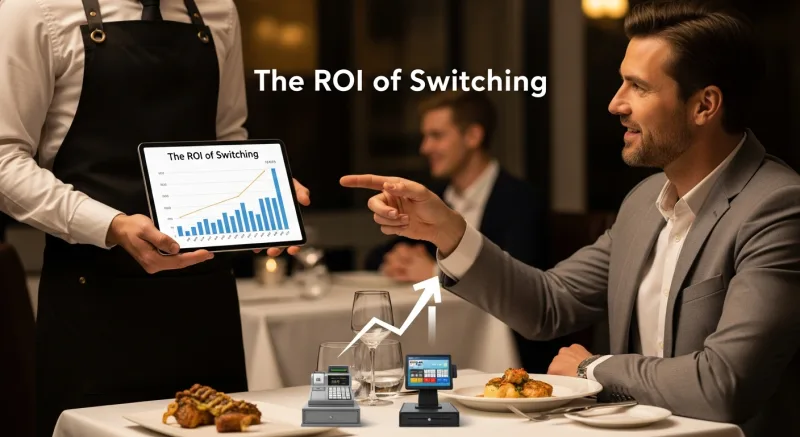
Current state: 200 delivery orders/week, $35 average ticket, 30% DoorDash commission.
Monthly delivery revenue: $28,000
Monthly DoorDash commission: $8,400
After 90 days with hybrid strategy:
| Channel | Orders/Week | Commission Rate | Monthly Cost |
|---|---|---|---|
| DoorDash (kept for discovery) | 60 | 15% (Basic tier) | $1,260 |
| First-party via KwickMenu | 140 | $2.00 flat | $1,120 |
| Total | 200 | $2,380 |
Monthly savings: $6,020. Annual savings: $72,240.
That is not a hypothetical. That is arithmetic. And the savings compound — as your direct ordering reputation builds, the percentage of first-party orders increases, and your third-party spend decreases further.
5 Steps to Start Cutting Commissions This Week
You do not need to overhaul your entire operation overnight. Here are five concrete steps you can take this week:
- Pull your delivery platform reports. Calculate your exact monthly commission spend across all platforms. Most owners underestimate this by 30-40%. The real number will motivate you to act.
- Set up your first-party ordering page. If you are on KwickOS, your KwickMenu page can be live in under 2 hours. If you are on another POS, look for an integrated online ordering option — do not sign up for another platform that charges commission.
- Print 500 bag flyers. "Order direct at [URL]. 10% off your first direct order. Same food, less fees." Put one in every single delivery bag starting today. This is the highest-ROI marketing tactic in the restaurant industry right now.
- Drop to the lowest third-party tier. Call your DoorDash and UberEats account managers today and downgrade to Basic/Lite. Yes, your third-party order volume will drop. That is the point — you are replacing those orders with direct ones at a fraction of the cost.
- Track your split weekly. Set a goal: 50% direct orders within 60 days, 70% within 90 days. Review your first-party vs third-party split every Monday morning. What gets measured gets managed.
The Delivery Landscape Is Shifting — Position Yourself Now
Third-party delivery commissions have not decreased since these platforms launched. DoorDash's commission rates have actually increased for many merchants over the past two years. There is no reason to believe they will get cheaper.
Meanwhile, first-party ordering technology has gotten dramatically better and cheaper. Five years ago, building your own ordering system required custom development, driver management, and payment integration headaches. In 2026, platforms like KwickOS bundle ordering, delivery dispatch, payment processing, and customer management into a single system that costs a fraction of what DoorDash charges.
The restaurants that will thrive in the next five years are the ones building direct customer relationships today. Every day you wait is another day of 30% commissions you will never get back.
Rockin' Rolls Sushi Express understood this early — with 3 locations and 49 iPad self-ordering stations already integrated with KwickOS, adding KwickMenu for first-party delivery was a natural extension that reduced their per-order cost by over 70%.
Stop Paying 30% on Every Delivery Order
KwickOS + KwickMenu + KwickDriver gives you first-party ordering, flat-fee delivery, and full customer data ownership. See the math for your restaurant.
Calculate Your Savings