 Tom Jin
Picture Lunar New Year's Eve, 7:00 p.m. Every table is full. Three generations of one family crowd around the lazy Susan, a whole steamed fish in the middle, the kids clutching red envelopes. The room is loud and warm and the kitchen is slammed. By every appearance, you're having the night of the year.
Now look closer. That big round table by the wall? A 10-top that booked for the reunion dinner, then never showed — and you turned away two other families who'd have happily filled it. The party in the corner ordered à la carte and somehow walked out spending less per head than on a normal Saturday. The grandmother at table four would have bought a stack of gift cards to hand out as New Year's presents if anyone had offered — but nobody did. And every one of those families will walk out tonight, and you'll have no way to ever reach them again.
Here's the uncomfortable truth: a "busy" Lunar New Year and a maximized Lunar New Year can look identical from across the dining room — and differ by tens of thousands of dollars. Industry research consistently pegs Lunar New Year spending in the United States in the billions, with dining out near the top of how families celebrate. The demand is guaranteed. What's not guaranteed is how much of it you actually convert.
So let's build the version that captures all of it. I've spent 20 years in the restaurant business before building KwickOS, and I've watched far too many operators treat the biggest feast of the year like just another busy weekend. This is the complete playbook — how to price a banquet menu that clears $588 a table instead of $280, how to stop no-shows from gutting your most valuable seating, how to turn the holiday's gifting culture into stored-value revenue, and how to convert a two-week crowd of strangers into a list you can sell to all year. Stay with me, because the single most profitable move in this plan doesn't happen on New Year's Eve at all.
Why Lunar New Year Is the Easiest Feast to Charge More For
Most holidays require you to manufacture a reason for people to spend. Lunar New Year is the rare occasion where the spending decision is already made before your guest ever sees a menu. The reunion dinner — the meal on New Year's Eve — is the single most important family gathering of the year for hundreds of millions of people, and the whole point of it is abundance. Nobody is hunting for the cheapest option. They're looking for the right table, the lucky dishes, and a room that feels like a celebration.
Here's the thing: that changes everything about how you should approach the holiday.
- Guests expect a premium. A set banquet at $588 a table doesn't feel like a markup during New Year — it feels like the occasion demands it. The same menu at the same price on a random Tuesday would feel steep.
- Symbolism sells. Whole fish (for surplus), longevity noodles, dumplings shaped like gold ingots, a whole chicken, sticky rice cake — these aren't just menu items, they're required elements of the celebration. Guests want them, and they carry premium margins.
- The celebration is long, but the peak is non-repeatable. The festival runs about 15 days through the Lantern Festival, so you have two weeks of elevated demand — but New Year's Eve itself is a single, finite seating. Every empty banquet table that night is gone forever.
That last point is the one to sit with. On a normal night, a slow table or a no-show is a minor annoyance. On New Year's Eve — when you could have sold that big round table twice over — every leak is amplified. Which is exactly why this plan starts not with the food, but with locking down the room.
Step 1: Lock In the Banquet Tables with Deposits (Before You Cook a Thing)
The money on Lunar New Year is won in the three weeks before New Year's Eve, quietly, through reservations. Two things have to happen: you fill every banquet table, and you make sure every table that's booked actually shows up.
Open bookings early and make them impossible to miss
The reunion dinner is a planned event, not an impulse. The eldest family member typically locks in the restaurant 10 to 21 days out — and once they've booked, they're done shopping. If your banquet reservations aren't open and easy to find two full weeks before New Year's Eve, you're handing those families to the restaurant down the street that opened theirs first. Open bookings three to four weeks ahead, and put the link everywhere: your site, your social bios, every email and text on your list, and a sign at your own host stand for the regulars already walking in.
Take a deposit — this is the move that protects the whole night
Here's the part that separates a great New Year's Eve from a painful one: require a per-table deposit at booking. Say $100 to $200 for a banquet table, applied directly to the final check. It does two jobs at once. First, it pulls cash into your account before you've spent a dollar on whole fish or premium cuts. Second — and this is the big one — it nearly eliminates no-shows on the one night you can least afford an empty 10-top.
But it gets worse if you skip it. Run the math on a no-show banquet table. A booked 10-top that ghosts you on New Year's Eve isn't a $0 event — it's a $400 to $900 hole, because the family that wanted that table at 7:00 already gave up and booked elsewhere. You can't resell it. A deposit turns "we'll see if they show" into "they've already paid to be here," and across a full book of banquet tables, the difference is enormous.
This is where your point-of-sale either helps you or gets in the way. A platform that ties the deposit to the reservation and then applies it automatically to the bill at checkout kills the awkward "now, about your deposit" moment entirely. The server rings the family out, the prepaid amount drops onto the check, they pay the difference, done. T. Jin China Diner — 15 stores, 75 terminals — runs exactly this kind of deposit-backed booking for high-volume banquet nights, and a packed Lunar New Year is banquet logic applied to every round table in the building. For the full deep dive on running large preset-menu events smoothly, see our guide to Chinese restaurant banquet management. And if you want to put a real number on what no-shows cost you, our no-show cost calculator does the math for your average check and table count.
Step 2: Engineer a Set Banquet Menu That Prints Money
Now the feast itself. The single biggest lever on your Lunar New Year revenue is the menu structure — and a fixed family-style banquet menu beats à la carte on almost every count.
Build a set menu priced by the table, not the plate
Set one fixed price for a multi-course feast, sized for a full table of 8 to 10 and priced accordingly — $388, $588, and $888 per table is a natural three-tier ladder, and those lucky numbers do real work during the holiday (eight sounds like "prosperity" in Cantonese and Mandarin; combinations of eight feel auspicious to order). A set menu isn't merely a way to charge more — it's a way to control more. When every table moves through the same multi-course path, you can:
- Pre-portion and pre-prep the entire feast, slashing ticket times on the busiest service of the quarter.
- Forecast covers exactly from your deposit-backed reservations, so you buy the right amount of fish, poultry, and premium protein and schedule the right number of cooks and servers.
- Steer the menu toward symbolic, shared-prep, high-margin dishes — so the food cost on a $588 table often runs better than your normal à la carte mix despite the bigger number.
Design it around the symbolism, because that's what guests are actually buying: a whole steamed fish for abundance, longevity noodles, a tray of dumplings, a whole chicken, sticky rice cake, and a dessert built for the table to share. Make at least one dish dramatic enough to photograph — that's free marketing, and we'll come back to it. Three tiers also lets families self-select: the $388 table for a casual gathering, the $888 for the big multi-generation reunion that wants every premium dish on the lazy Susan.
And here's a tip from two decades of watching kitchens on their worst nights: a structured set menu is what lets you survive the rush with seasonal help. Shogun Japanese Hibachi gets new staff fully proficient on its system in under five minutes precisely because the service flow is repeatable. A fixed banquet menu gives even your temporary New Year hires that same guardrail on a night when there's zero room for mistakes. If you run a Chinese concept specifically, our Chinese restaurant POS guide covers how to set up family-style portioning and banquet preset menus so the kitchen fires in the right order.
Step 3: Turn the Red Envelope into a Gift Card Machine
Now for the move most restaurants completely miss. Lunar New Year is, at its heart, a gifting holiday — the red envelope, the hongbao, is the central ritual, and money changing hands is not just accepted but expected. So meet your guests where the culture already is, and turn it into stored-value revenue.
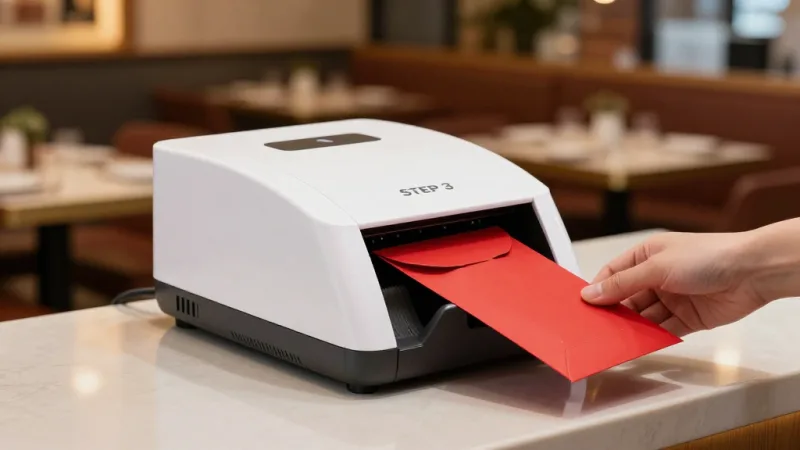
Here's how. Hand every table a branded red envelope at checkout. Inside: a bonus gift card or a return-visit coupon — "Come back before the Lantern Festival and this $20 is yours." You've just turned the holiday's most beloved tradition into a reason to come back during the slower second half of the festival, at essentially zero cost until it's redeemed.
Then run the gift card promotion that captures everyone you couldn't seat — because you will turn away more families than you fit. Your room has a hard limit; demand doesn't. Run a real campaign in the two weeks around New Year: buy a $100 gift card, get a $20 bonus card, or use lucky-number tiers like "load $88, get $18." The buyer perceives a generous gift to hand out as a present; you've locked in $100 of guaranteed future revenue and handed out a coupon that only converts when someone comes back and spends more.
And push the e-gift card hardest of all. A digital card can be bought at 10 p.m. by an adult child three states away who wants to treat their parents to a New Year dinner, delivered by text in under a minute, and redeemed weeks later. It rescues the procrastinators, captures the families who couldn't get a table, and pulls traffic back during the long tail of the festival. Gift card balances also almost never get spent alone — the classic pattern is a family walking in to "use up" a $100 card and leaving having spent $180. Model how that stored value compounds with our loyalty and rewards ROI calculator, and you'll see why this is the highest-leverage line item of the whole campaign. For a month-by-month framework, our holiday gift card sales strategy shows how to stack these pushes across every gifting occasion on the calendar.
Step 4: Market Across Cultures (Authentically) and Run a Social Countdown
You've built the menu and opened the books. Now you have to fill them — and the final week before New Year's Eve is when urgency does your selling for you.
Treat the last seven days as a countdown, not a single announcement. Post the banquet menu with one mouthwatering photo of the whole fish. The next day, post the symbolism — what each lucky dish means, which is genuinely interesting content that gets shared. Then a behind-the-scenes shot of the kitchen prepping dumplings by the hundred. Then the line that fills your last tables: "Only 3 banquet rooms left for New Year's Eve — book tonight." Scarcity isn't a trick during Lunar New Year; it's the literal truth, and saying it out loud converts the families who've been meaning to book all week.
Here's something a lot of operators get wrong, though: Lunar New Year isn't only for Chinese restaurants, and it isn't only for Chinese guests. It's celebrated across Vietnamese, Korean, and many other communities, and increasingly embraced by the broader public who simply want to take part in a joyful tradition. That's a real opportunity — but it has to be genuine. If you run a non-Chinese concept, participate with respect: feature a real festive dish or two, train your staff on the greeting and what it means, price a special with a lucky number, and invite your community to celebrate with you rather than slapping decorations on the window. Done authentically, it adds an incremental revenue night during a slow winter stretch without requiring a concept change. Our guide to cross-cultural restaurant marketing walks through how to do this without missing the mark, and the 52-week marketing calendar maps where Lunar New Year fits among the rest of the year's levers so each holiday isn't a last-minute scramble.
One more channel that pays off all month: corporate and group bookings. Companies host New Year team dinners, and community associations book banquet halls for celebrations. A simple "Book your company's New Year banquet" landing page and a few direct emails to local businesses can fill your weeknights through the entire 15-day window with prepaid, high-cover bookings.
Step 5: Turn Two Weeks of Strangers into a Year of Regulars
Here's the open loop I promised to close — and the most profitable move in this entire plan. The feast isn't the prize. The customer data the feast generates is.
Think about who's in your dining room during Lunar New Year: dozens of families, many of them first-time guests or once-a-year visitors, all in a celebratory, generous mood, all spending more than they would on a normal night. On most Lunar New Years, every one of them walks out and is gone until — maybe — next year. That's the real loss, bigger than any no-show or missed upsell. You ran a packed, profitable two weeks and threw away the single most valuable asset they produced.
So capture it. Every deposit, every gift card sold, every red envelope coupon redeemed, every loyalty or membership enrollment at checkout adds a name to a list you can reach directly. Then work that list:
- A thank-you and a reason to return. A short message a few days into the new year — "Thank you for celebrating with us — here's double points on your next visit before the Lantern Festival" — converts a once-a-year occasion into a second and third visit while the goodwill is warm.
- Double or triple loyalty points during the 15-day festival. Run a points multiplier across the whole celebration so the first-timers who came for New Year's Eve have a concrete reason to come back the following week. The entire point of a points program is to give an annual visitor a reason to become a monthly one.
- A family or occasion flag in their profile. A guest who held their reunion dinner with you is a guest you can invite back next year — and for the birthdays, anniversaries, and graduations in between. That's a customer you "acquired" for the cost of one already-profitable feast.
And that's not all. The economics here are brutally in your favor: reactivating a family that already had a great night with you costs a fraction of acquiring a stranger through ads. You're not buying attention — Lunar New Year already bought it for you. The only question is whether your system captured it.
The Whole Celebration Runs on One Connected System
Step back and notice what every part of this plan has in common. The deposit that protects the banquet table, the set menu that controls your margin, the red envelope gift cards, the e-gift cards that capture the overflow, the loyalty enrollment that drives the follow-up — these aren't five separate tools you bolt together. They're one customer relationship moving through one system.
That's the case for running Lunar New Year on an all-in-one platform instead of a patchwork. When your POS, reservations, deposits, gift cards, e-gift cards, CRM, and loyalty all live in the same place, the data flows by itself: the family that put down a deposit on New Year's Eve is automatically the loyalty member you thank three days later and the gift-card holder you nudge before the Lantern Festival. Stitch that together from disconnected vendors and the seams are exactly where the revenue leaks out. It's also why a processor-agnostic platform matters on a night like this — when you're clearing premium banquet tickets all evening, the half-point you save by choosing your own payment processor instead of a locked rate is real money back in your pocket, not your software vendor's. Over a holiday this volume-heavy, that's thousands of dollars that stay in the business.
And because a hybrid local-plus-cloud POS like KwickOS runs checkout on your local network at roughly 1ms latency, it keeps ringing sales even if your internet drops mid-service — then syncs automatically when it returns. On the most fully-booked night of your year, "the system's down" is not a sentence you can afford to say. Crafty Crab Seafood runs this kind of connected operation across 19 locations and 152 terminals — one-click menu sync to push a New Year set menu to every store at once, customized kitchen displays to handle a packed banquet night, and unified guest data across the group. Even Haidilao Hot Pot, with 600+ locations worldwide, lives or dies on exactly this kind of standardized, system-driven consistency at scale. You don't need 600 locations to use the same logic. You need one room, one connected system, and a plan that treats Lunar New Year as a two-week campaign, not just a busy night. If you run or sell to a portfolio of restaurants, you can partner with KwickOS to bring this playbook to every merchant you serve. And if you're still weighing whether the platform fits your concept, start at our restaurant solutions overview.
Make This Lunar New Year Your Most Profitable Stretch Yet
KwickOS ties your reservations, deposits, set banquet menu, gift cards, checkout, and loyalty into a single platform — so a packed dining room actually turns into a packed bank deposit and a year of returning families. See how it works for your restaurant.
Explore KwickOS for RestaurantsFrequently Asked Questions
How far in advance should a restaurant start promoting Lunar New Year?
Start at least three to four weeks out and open banquet reservations no later than two weeks before New Year's Eve. Reunion dinners on Lunar New Year's Eve are planned family events, often booked by the eldest family member 10 to 21 days ahead, and the celebration runs roughly 15 days through the Lantern Festival. Open bookings early, require a per-seat or per-table deposit to hold large parties, and run a countdown on social media in the final week with a clear "last banquet rooms remaining" message.
Should restaurants offer a set banquet menu for Lunar New Year?
Yes. A fixed family-style banquet menu — commonly priced per table for 8 to 10 guests, such as $388, $588, or $888 per table — lets you forecast covers from reservations, pre-portion and pre-prep your highest-volume night, and steer guests toward symbolic, high-margin dishes like whole fish, longevity noodles, and dumplings. A well-engineered set menu often runs a better food and labor cost than à la carte despite the higher ticket, while making the meal feel like a proper celebration rather than an ordinary dinner.
What are the best Lunar New Year promotions for a restaurant?
The highest-leverage promotions tie into the holiday's gifting culture: a red envelope (hongbao) handed to every table at checkout containing a bonus gift card or a return-visit coupon, a "buy $100 gift card, get $20 bonus" campaign that captures the overflow you can't seat, double or triple loyalty points during the 15-day celebration, and corporate banquet packages for company New Year dinners. Lucky-number pricing such as $88 or $188 and lucky-number bonus tiers also convert well because the numbers themselves carry meaning during the holiday.
How can a non-Chinese restaurant profit from Lunar New Year?
Lunar New Year is celebrated across many cultures and increasingly by the broader public, so any restaurant can participate authentically with a limited-time special, a festive prix fixe, lucky-number pricing, or a gift card promotion themed around prosperity and good fortune. The key is genuine, respectful participation rather than surface decoration: feature a real dish or two, train staff on the greeting and the meaning, and market it as a celebration your community is invited to share. Done well, it adds an incremental revenue night during a slow winter stretch without requiring a full concept change.
Why do reservation deposits matter for Lunar New Year banquets?
Lunar New Year's Eve is one of the highest-revenue seatings of the year, and a single no-show 10-top banquet can be $400 to $900 in revenue you can never resell because every other family already booked elsewhere. A prepaid per-table deposit collected at booking nearly eliminates no-shows and pulls cash in before you spend a dollar on ingredients. A POS that ties the deposit to the reservation and applies it automatically to the final check at checkout removes any awkwardness and protects your most valuable banquet night of the quarter. Multi-location operators can partner with us to bring the same playbook to every restaurant they serve.