
 Ming Ye
Last July, a scoop shop owner in Phoenix told me his worst Saturday ever. The line wrapped around the building. Two employees called out. The POS froze mid-transaction. And when the dipping cabinet temperature climbed past 8°F because the lid was open constantly, his signature lavender honey flavor turned to soup.
He lost an estimated $1,400 in revenue that day — not because he didn't have customers, but because his operation couldn't keep up with them.
Here's the thing: that $1,400 loss wasn't a freak accident. It's the daily reality for ice cream shops that haven't designed their summer workflow. Industry research suggests the average scoop shop loses 15% to 25% of potential summer revenue to operational bottlenecks — slow lines, melting product, POS delays, and staff confusion.
On a shop doing $3,000/day in peak summer, that's $450 to $750 per day walking out the door. Over a 90-day summer season, you're looking at $40,000 to $67,000 in revenue you never collected.
And that's not all: the customers you lose during a bad experience don't just leave. They post about it. One-star reviews during your highest-traffic months cost you customers for the rest of the year.
This guide breaks down the exact operational systems that separate 340-scoop-per-hour shops from 150-scoop-per-hour shops. Every section is something you can implement before your next weekend rush.
The 3-Station Layout That Doubles Throughput
The single biggest mistake ice cream shops make is running a single-line operation where the same person takes the order, scoops the ice cream, adds toppings, and rings up the sale. This workflow caps you at about 40 to 50 customers per hour — no matter how fast your team works.
The fix is splitting your operation into three distinct stations:
Station 1: Order + Payment. A dedicated cashier takes orders and processes payment before the customer moves to the scooping area. This station needs a fast POS with quick-tap flavor buttons — not a dropdown menu, not a search bar. Every extra second at checkout multiplies across hundreds of transactions. With KwickOS, you can configure single-tap buttons for every flavor and size combination, and the average transaction completes in under 8 seconds.
Station 2: Scooping + Assembly. One or two scoopers work from dipping cabinets, filling orders as they come off the POS ticket queue. They never touch the register. They never handle money. They scoop, they top, they hand off. A kitchen display screen mounted at eye level shows the order queue in real time — no shouting, no paper tickets getting wet.
Station 3: Toppings + Handoff. A separate station handles sprinkles, sauces, whipped cream, and the final handoff. This prevents the scooper from stopping mid-flow to drizzle hot fudge, which sounds minor but saves 12 to 15 seconds per order.
But it gets worse if you don't separate these stations: during peak hours, a single-line setup creates a visible bottleneck that discourages walk-up customers from even joining the line. Restaurant industry data shows that visible lines longer than 8 people cause 30% of potential customers to leave without ordering.
The 3-station layout processes customers faster and keeps the line moving visually, which keeps more people in it.
Topping Organization: The System That Saves 15 Seconds Per Order
Toppings seem like a minor detail until you realize that topping selection and application accounts for 20% to 30% of total order time. Most shops organize toppings alphabetically or randomly. Both are wrong.
Here's what works: organize toppings by frequency of selection, not by name. Your POS data tells you exactly which toppings sell the most. According to restaurant industry data, the typical distribution looks like this:
- Top 5 toppings account for 65% of all topping orders (usually: hot fudge, sprinkles, whipped cream, caramel, Oreo crumble)
- Toppings 6-12 account for 25%
- Toppings 13+ account for the remaining 10%
Place your top 5 toppings within arm's reach of the handoff position. Place toppings 6 through 12 one step away. Everything else goes to the back. This simple reorganization — driven by actual POS sales data — saves an average of 15 seconds per topped order.
At 200 topped orders per day, that's 50 minutes of cumulative labor savings. Over a summer season, it adds up to over 75 hours — nearly two full work weeks — reclaimed from reaching for gummy bears nobody orders.
Here's the thing: most shops never analyze their topping data because their POS doesn't make it easy. KwickOS tracks modifier frequency automatically, so you can pull a topping popularity report in 30 seconds and reorganize your station based on actual numbers, not guesswork.
Flavor Rotation: How to Manage 28 Flavors Without Waste
Flavor management is where ice cream shops either make or lose money. A 3-gallon tub of premium ice cream costs $40 to $65. If it sits in the cabinet too long, it develops ice crystals, loses texture, and eventually gets tossed. Industry data suggests that the average scoop shop wastes 8% to 12% of its ice cream inventory to quality degradation.
On a shop buying $4,000/month in product during summer, that's $320 to $480 per month melting into your trash can.
The solution is a data-driven flavor rotation system:
Core flavors (16-18): These never rotate. Vanilla, chocolate, strawberry, cookies and cream, mint chip — the flavors that collectively account for 60% to 70% of sales. Keep 2-day safety stock for each during summer.
Rotating flavors (8-14): These change weekly or bi-weekly. They create urgency ("Get it before it's gone") and give customers a reason to come back. Post them on your digital signage and social media every rotation.
Tracking what works: Your POS should tell you exactly how many scoops of each flavor sold each day. KwickOS generates flavor-level sales reports that show you not just total sales, but velocity — how fast a flavor sells relative to when it was stocked. A flavor that sells 40 scoops/day stays. A flavor that sells 8 scoops/day gets rotated out or made in smaller batches.
And that's not all: flavor data also informs your cabinet positioning. Put your top-selling flavors at the front-center of the dipping cabinet where the scooper can reach them fastest. Put specialty flavors at the ends. This shaves 3 to 5 seconds per scoop when you're moving at rush-hour speed.
POS Speed: Why 8 Seconds Per Transaction Is the Target
In a high-volume ice cream shop, your POS is either an accelerator or a chokepoint. There is no middle ground.
Here's the math. If your average transaction takes 20 seconds at the register and you have one cashier, you can process 180 customers per hour. Drop that to 8 seconds and you're at 450 customers per hour — a 150% increase in capacity from the same single register.
What makes an 8-second transaction possible?
- Quick-tap buttons for every size and flavor combination — no scrolling, no searching
- One-touch modifiers for toppings, cones vs cups, and special requests
- Tap-to-pay default — contactless payment completes in 2 seconds vs 6 seconds for chip insert
- No-receipt default — email or text receipt only, no thermal printer delay
- Offline capability — when your WiFi hiccups during a rush (and it will), the POS keeps processing
This is where most cloud-only POS systems fail ice cream shops. A 200ms round-trip to a cloud server doesn't sound like much, but when you multiply it across every button tap, every modifier, and every payment, you're adding 2 to 4 seconds per transaction. KwickOS runs a hybrid local+cloud architecture with 1ms local processing — the screen responds instantly, and the data syncs to the cloud in the background.
For shops running self-service kiosks — like Tiger Sugar does with their 2 kiosks handling customized orders — the speed advantage is even more dramatic. Customers build their own orders on the kiosk while the line keeps moving at the register. It's two checkout lanes for the footprint of one.
Staffing the Rush: The 2x Saturday Formula
Ice cream shop staffing is uniquely challenging because the difference between a slow Wednesday and a peak Saturday can be 4x or 5x in volume. Staff too lean on Saturday and you lose revenue. Staff too heavy on Wednesday and you burn labor dollars.
The formula that works for most scoop shops:
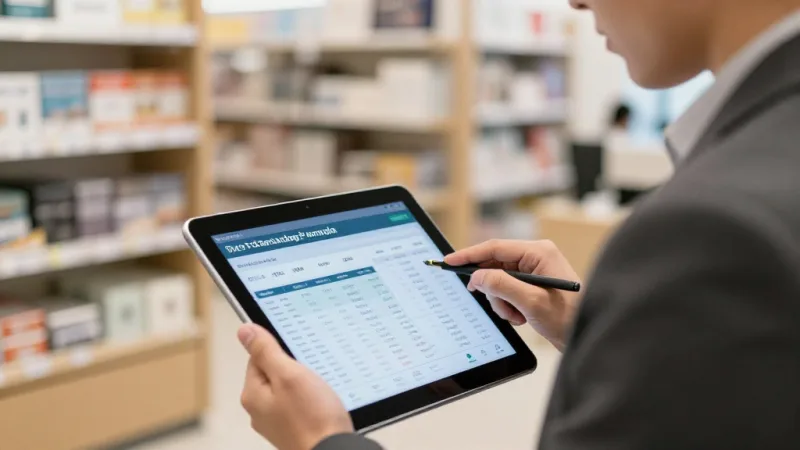
| Hourly Volume | Station 1 (Order/Pay) | Station 2 (Scoop) | Station 3 (Top/Handoff) | Total Staff |
|---|---|---|---|---|
| Under 80 customers | 1 | 1 | 0 (scooper handles) | 2 |
| 80-150 customers | 1 | 2 | 1 | 4 |
| 150-250 customers | 2 | 2 | 1 | 5 |
| 250+ customers | 2 | 3 | 2 | 7 |
But here's the problem most owners face: how do you predict which Saturday will be an 80-customer day versus a 250-customer day?
Your POS data holds the answer. KwickOS tracks hourly sales by day of week, so after one summer season, you have a reliable heat map of when your rush hours hit. Cross-reference that with weather data (temperature above 85°F = 30% to 50% volume increase) and local events, and you can staff with precision instead of guessing.
Fingerprint clock-in via KwickOS also solves a persistent ice cream shop problem: seasonal workers buddy-punching or arriving late. When every clock-in requires a fingerprint, you know exactly who showed up and when — critical when you're paying $15 to $18/hour for summer staff.
Waffle Cone Production: Batch Timing That Never Runs Out
Nothing kills an ice cream shop's reputation faster than telling a customer you're out of waffle cones at 2 PM on a Saturday. But waffle cone production takes time (3 to 4 minutes per cone on a single press), and if you're baking to order during rush, you've already lost.
The production timeline that works:
- Morning prep (before open): Bake enough cones to cover 60% of expected daily waffle cone demand
- Mid-shift batch: Start a second production run 2 hours before your predicted peak, based on POS historical data
- Emergency batch trigger: Set a par level (e.g., 20 cones remaining) that triggers immediate production
Track waffle cone vs. regular cone vs. cup selection in your POS. According to industry data, most shops see a 35/25/40 split (waffle/regular/cup), but this varies dramatically by region and demographic. Your actual data might show 50% waffle cone demand — and if you're prepping for 35%, you run out every Saturday.
Gift Cards and Loyalty: Your Off-Season Lifeline
Here's the reality most ice cream shop owners don't want to face: your summer revenue has to carry you through fall and winter. According to industry data, seasonal ice cream shops see revenue drop 50% to 70% from peak summer to winter months. That means your summer operation isn't just about maximizing July revenue — it's about building the financial cushion and customer relationships that keep you alive in January.
Two tools make this possible:
Gift cards and e-gift cards. Summer is when people buy ice cream gift cards — for birthdays, thank-yous, and impulse purchases. A visible gift card display at the register and an e-gift card option on your online ordering page can generate $8,000 to $15,000 in gift card revenue during a single summer. That's cash in your account today for product you deliver later — often during slow months when you need the traffic most.
The psychology is powerful: gift card recipients visit an average of 2.3 times to use their balance, and they overspend by 20% to 40% beyond the card value. A $25 gift card typically generates $30 to $35 in total revenue.
Loyalty and membership programs. Ice cream is the perfect loyalty product because it's a frequent, low-ticket purchase. A simple "buy 10, get 1 free" punch card (digital, not paper — paper cards have an 80% loss rate) drives repeat visits. But the real power is in the data.
A POS-integrated loyalty program tracks which customers visit, what they order, and when they stop coming. When October hits and visits drop, you can send targeted offers to your summer loyalists: "We miss you — here's a free topping on your next visit." That single text message, sent to the right customer at the right time, costs less than $0.02 and brings back a customer worth $15.
KwickOS handles both gift cards and loyalty in a single system — no third-party integrations, no separate apps, no monthly fees from Square or Toast's locked-in platforms.
Checkout Flow: From Line to Lick in Under 3 Minutes
The ultimate metric for an ice cream shop isn't revenue per hour. It's time from joining the line to first lick. Keep this under 3 minutes and customers leave happy. Push it past 5 minutes and you start losing people.
Here's the optimized flow with actual time targets:
- Line to register: 60 seconds (managed by line flow and visible menu boards)
- Order + payment: 8 to 12 seconds (quick-tap POS, tap-to-pay)
- Scoop + assembly: 30 to 45 seconds (2-scoop order with cone)
- Toppings + handoff: 15 to 20 seconds
- Total service time: 53 to 77 seconds per customer after reaching the register
The POS checkout is the one step that's entirely within your control from a technology standpoint. Everything else depends on human speed. But if your register takes 30 seconds instead of 8, you just added 22 seconds to every single transaction. At 300 transactions per day, that's 110 minutes of wasted time — almost 2 extra labor hours.
This is why processor-agnostic POS matters even for small ice cream shops. When your POS locks you into a specific payment processor charging 2.99% + $0.15 per transaction, and you're processing $2,500/day in summer, you're paying over $27,000/year in processing fees. An interchange-plus deal through a processor you chose yourself might cost $19,000 for the same volume. That $8,000 annual difference is meaningful for any small business, but especially for a seasonal one. Use our processing fee calculator to see your exact savings.
Handling the Unexpected: Heat Waves, Equipment Failures, and Social Media Surges
Even the best-planned operation will face surprises. Here's how top shops handle the three most common disruptions:
Heat wave surges. When temperatures spike unexpectedly, your volume can double overnight. Have a "heat wave protocol" ready: call in your on-call staff (always have 2 to 3 trained people available via text), pre-batch extra waffle cones, and switch your dipping cabinet from display mode to service mode (lids partially closed to maintain temperature). Your POS mobile reporting lets you monitor sales from your phone — if volume is spiking at 11 AM, you have time to call in backup before the 1 PM peak.
Equipment failures. The two most critical pieces of equipment are your dipping cabinet and your POS. If the cabinet fails, you have about 30 minutes before product starts degrading. If your POS fails, you have zero minutes — the line stops. KwickOS runs locally on the terminal hardware, so even if your internet drops or your router dies, transactions keep processing. The data syncs when connectivity returns. This hybrid architecture is the difference between weathering a network outage and sending 50 customers home.
Social media surges. A single viral TikTok video can send 3x your normal traffic to your shop within hours. Monitor your tagged posts and if you see one trending, activate your heat wave protocol immediately — before the crowd arrives. Shops that react in real time turn viral moments into banner days. Shops that get caught flat-footed turn them into one-star reviews.
The Numbers That Matter: Daily KPIs for Ice Cream Shops
Track these numbers daily during summer season. If you can't pull them from your POS in under 60 seconds, your POS is slowing you down.
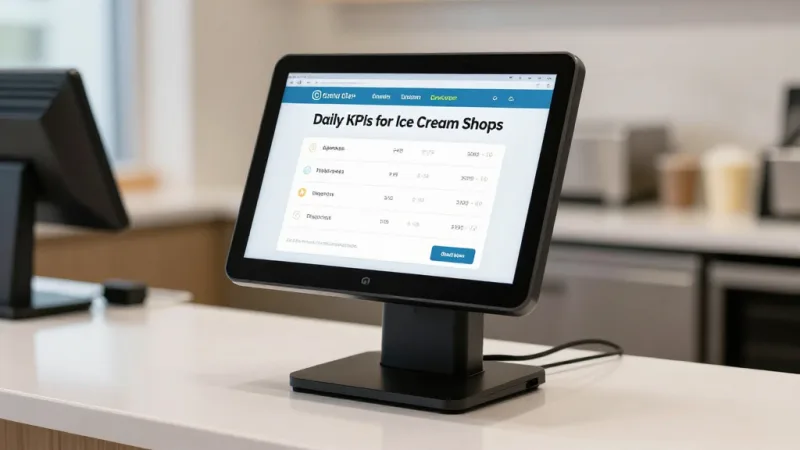
| KPI | Good | Great | Why It Matters |
|---|---|---|---|
| Average transaction value | $7.50 | $10+ | Upselling toppings and sizes |
| Transactions per labor hour | 25 | 40+ | Operational efficiency |
| Flavor waste % | Under 10% | Under 5% | Inventory management |
| Peak hour throughput | 200/hr | 340+/hr | Rush capacity |
| Gift card sales (% of revenue) | 5% | 10%+ | Off-season cash cushion |
| Loyalty enrollment rate | 20% | 40%+ | Repeat visit pipeline |
Multi-location operators like Rockin' Rolls — which runs 3 stores with 49 iPad self-ordering stations — track these KPIs across all locations from a single dashboard. When one store's throughput drops, they can identify the bottleneck immediately and fix it before the next rush.
Frequently Asked Questions
How many scoops per hour should an ice cream shop handle during peak summer?
A well-organized ice cream shop should handle 250 to 400 scoops per hour during peak summer weekends. The key factors are station layout, pre-portioned toppings, POS speed, and having at least one dedicated cashier separate from scoopers. Shops that separate ordering from fulfillment consistently outperform single-line setups by 40% or more in throughput.
How many flavors should an ice cream shop carry during summer?
Industry data suggests 24 to 32 flavors is the sweet spot for most scoop shops. Fewer than 20 makes the selection feel limited, while more than 36 creates decision paralysis that slows the line. Keep 16 to 18 core flavors year-round and rotate 8 to 14 seasonal or specialty flavors to drive repeat visits and social media buzz.
What POS features are most important for ice cream shops?
Speed is everything. Look for a POS with quick-tap buttons for sizes and flavors, modifier screens that add toppings in one touch, and a checkout flow that completes in under 8 seconds. Offline capability matters because ice cream shops often have limited connectivity. Built-in loyalty programs and gift card support drive repeat visits during off-peak months.
How do ice cream shops handle inventory for perishable flavors?
Successful shops track flavor-level sales daily through their POS system to forecast demand. A 3-gallon tub of premium ice cream costs $40 to $65 and should sell within 3 to 5 days during summer. POS-integrated inventory alerts flag slow-moving flavors before they degrade, and sales data informs weekly production or ordering cycles. Most shops maintain a 2-day safety stock for top sellers and make specialty flavors in smaller batches.
Should ice cream shops offer online ordering and delivery?
Yes, but with caveats. Online ordering for pickup works well — customers skip the line and spend 18% more on average because they browse the full menu without crowd pressure. Delivery is trickier due to melt risk, but pint and quart pre-packs solve this. Use an in-house delivery platform like KwickDriver ($2 + $6.99 flat fee) instead of third-party apps that charge 25% commission on already thin margins.
Ready to Handle Your Busiest Summer Yet?
KwickOS gives ice cream shops the speed, offline reliability, and flexibility to handle 340+ scoops per hour without breaking a sweat. Processor-agnostic. Built-in loyalty and gift cards. Ready in days, not weeks.
Get a Free Demo