 Ming Ye
It's 7:40 on a Friday. A group of eight walks in for an 8:00 axe-throwing booking they made online.
Now watch what happens at the counter. The kid at the front desk pulls up the booking in one app. Takes their deposit — wait, did they already pay a deposit? He's not sure, so he checks a second screen. Waivers? Everyone signs on a clipboard while the group gets restless. Then the party wants a round of beers, so he opens a third system — the bar POS — and starts a tab that has no idea a $200 booking is attached to these same eight people.
Two hours later, at close-out, he's got a paid reservation in one place, a bar tab in another, and a fuzzy memory of whether the deposit was supposed to come off the total. He guesses. Sometimes the venue eats it. Sometimes the customer gets annoyed. Every single night, small amounts of money leak out of the gap between systems.
Here's the uncomfortable truth: an entertainment venue running bookings, bar, and waivers on three disconnected systems isn't running one business — it's running three, badly, and reconciling them by hand at midnight. The lanes, bays, and rooms are your inventory. The bar is your margin. And the software is quietly dropping the handoff between them.
But it gets worse. That gap doesn't just cost you a mis-applied deposit here and there. It costs you the memberships you never sold, the no-shows you never prevented, and the gift cards you never put on the counter — because when your staff is busy fighting three logins, nobody's building the recurring revenue that actually makes a venue valuable.
This guide breaks down exactly what an entertainment-venue POS has to do — book a lane and take a deposit, run an open bar tab on the same check, sell memberships and league passes that fill your slow nights, and turn every party into loyalty points and gift cards. We'll use real numbers, not vague promises.
Why an Entertainment Venue Breaks a Normal POS
Most POS systems were built to do one thing: take an order, take a payment, print a receipt. That's fine for a taco shop. It falls apart the moment your product is time on a resource.
An entertainment venue sells things a restaurant POS has no concept of:
- Reservable resources. A lane, a bay, a throwing pit, an escape room, a party suite — each is a slot on a calendar that can be booked, held, and only sold once for a given hour.
- Timed sessions. The charge depends on how long the party plays. Ninety minutes on a golf simulator isn't a menu item; it's a running clock.
- Deposits and holds. To stop a booked slot from evaporating into a no-show, you need money down at the time of booking, applied to the final bill later.
- Open bar tabs that live on the same check. The party that booked the bay is the party drinking the beer. Those can't be two separate bills.
- Waivers and party sizes. Everyone throwing an axe signs something. The system should know who's covered before the activity starts, not after.
Bolt a booking widget onto a bar POS and you've got two databases that each know half the story. The booking app knows the reservation but not the beer. The bar POS knows the beer but not the deposit. Nobody knows the customer. That's the structural problem — and it's why venue owners end up doing math on a legal pad after the last group leaves.
Bookings & Deposits: Stop Letting Slow Nights Sell Themselves Short
Start with the core asset: your calendar. Every lane, bay, and room is a slot, and every empty slot on a Friday night is money you can never get back — that hour is gone whether or not anyone played it.
A venue-aware POS treats the schedule as first-class inventory. Guests book online or at the counter; the system prices the slot by activity, duration, and time of day (peak Friday night is not the same price as a dead Tuesday afternoon, and it shouldn't be). The slot is held, the party size is recorded, and the waiver goes out ahead of time so eight people aren't crowding a clipboard while their booking clock ticks.
Then the piece that pays for the whole system: the deposit. A held slot that no-shows is the single most expensive event in your business, because you turned away other bookings to protect it and then earned nothing. Requiring a deposit at booking — say $10 a head, or a flat $50 on a bay — does two things. It gives the guest a real reason to show up or to call and reschedule, and it means even a genuine no-show isn't a total loss. On KwickOS the deposit is collected at booking, tracked against the reservation, and automatically credited to the final check when the party arrives, so your front desk never has to remember or manually adjust anything.
The mechanics here are the same ones that keep salon chairs and restaurant tables full; if you want the deeper playbook on deposits, reminders, and reschedule flows, our guide on preventing no-shows maps directly onto lanes and bays. And to see what dynamic peak-vs-off-peak pricing does to your weekly revenue, our membership & recurring revenue calculator lets you model booked-hours math against your slot count.
One Open Tab: The Booking and the Bar on the Same Check
Here's where a venue POS earns its keep, and it's the thing the three-app setup can never do cleanly.
A party books two hours on a simulator at 8:00. They arrive, their deposit comes off the total, and the session timer starts. Over the next ninety minutes they order three rounds, a couple of appetizers, and a birthday shot for the guy who shot a 41. Every one of those charges lands on one open tab tied to that party — the booking, the timed session, and the bar, all on the same running check.
At the end, it's one total, one card, one tip, one signature. Not a reservation they paid at the door plus a bar bill nobody can connect to it. The server sees the whole party's spend in one place, which also means they can actually sell — suggest the next round before the clock runs out, offer to extend the bay for another half hour, add a shareable platter. On disconnected systems that upsell instinct dies, because nobody can see the tab and the timer at the same time.
This is exactly the model high-volume bars already win on — the tab is the relationship. Our breakdown of private event revenue shows how the same single-check discipline turns group bookings into the most profitable nights on the calendar.
Staff, Tips, and the Fingerprint Nobody Can Share
A venue with bartenders, hosts, and game attendants has the same payroll headache every service business has: who rang what, who's owed which tips, and who clocked in for a friend who was running late. On disconnected systems, it's a Sunday-night reconstruction with a calculator.
A proper venue POS ties every tab and every ticket to the staff member who ran it, splits tips correctly, and separates bar sales from booking revenue automatically. On KwickOS this runs on fingerprint 1:N login — a bartender touches the sensor and is identified instantly, no shared PIN, no borrowed login. That credits every sale to the right person and eliminates time theft, because nobody clocks in as somebody else. It's not a hypothetical benefit: Diva Nail Beauty, running automated commission and staff tracking across four locations, reported roughly a 90% jump in efficiency on exactly this kind of payroll admin — and a busy bar with tipped staff has the same problem to solve. If you're comparing systems on this alone, our KwickOS vs. Toast comparison shows where locked-in platforms fall short on fingerprint verification and processor choice.
Memberships & League Passes: The Recurring Revenue Hiding in Your Off-Peak Hours
Now the big lever — the one that turns a good venue into a genuinely valuable business.
Entertainment is repeatable. Leagues, regulars, hobbyists, the guy who wants to practice his golf swing every week — these people want a reason to come back on a schedule. That makes your venue practically built for memberships, and almost nobody in the space runs them well.
The move is to package your least-valuable inventory — slow daytime and early-week hours — into a monthly plan. A membership might bundle a set number of hours a month, unlimited off-peak play, a standing weekly league booking, priority reservations, and a bar discount. Run the numbers:
| Plan | Members | Monthly fee | Annual recurring revenue |
|---|---|---|---|
| Off-Peak Unlimited | 50 | $50 | $30,000 |
| League + Priority Booking | 40 | $90 | $43,200 |
That's over $70,000 a year arriving before you open the doors, from members who visit more often (they've pre-paid, so they use it), spend more at the bar when they're there, and fill the exact hours you were struggling to sell. Offer three tiers so the middle one looks like the obvious pick, and most members self-select into the plan you'd have chosen for them anyway. For the full pricing-psychology and tier-design playbook, our membership program guide lays out the structure step by step.
Here's the catch, and it's a real one: a membership program is only as good as the billing engine underneath it. Cards expire. Charges fail. If your system silently drops a failed payment, you're losing members without even knowing it. KwickOS runs recurring billing with automatic dunning and failed-card recovery — it retries, prompts the member to update their card, and flags the ones that need a human touch. That's the difference between a membership base that compounds and one that quietly leaks out the back.
Loyalty & Points: The On-Ramp From First Visit to Regular
Not every first-timer is ready to commit to a membership. That's fine — loyalty is the on-ramp.
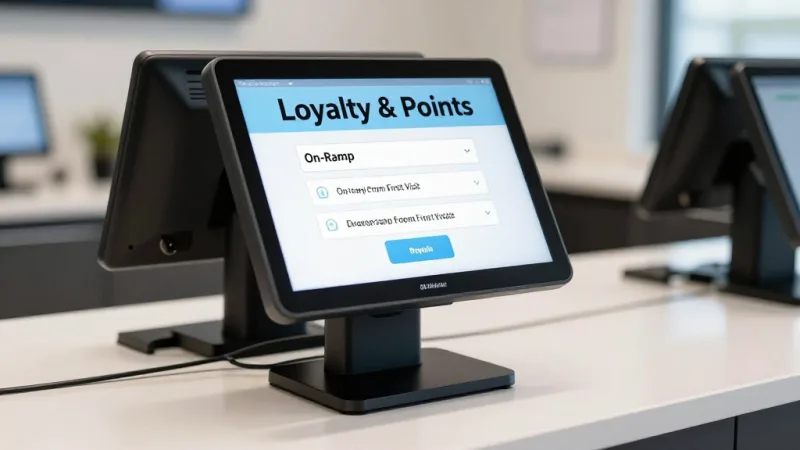
A points program built into checkout rewards every visit and every dollar: earn points on bookings, on the bar, on arcade cards, and redeem them for a free game, a discounted bay, or money off the next round. The psychology is simple and it works — a guest sitting on enough points for a free hour is a guest who books with you, not the new place across town running an opening-week discount.
And loyalty is the natural feeder into membership. A regular who's earned three free sessions this quarter has already shown the visit frequency that makes a monthly plan a no-brainer, and the POS can spot that pattern and prompt your host to make the offer at exactly the right moment. Our breakdown of points vs. membership shows why the two work best as a ladder, not an either/or.
Gift Cards & E-Gift Cards: The Revenue Sitting on Your Counter
Here's a revenue stream entertainment venues are almost uniquely positioned to own: you sell experiences, and experiences are the easiest gift in the world. A night of axe-throwing, a golf-sim session, an arcade card for a birthday — a venue gift card is the present for anyone who's out of ideas, which is everyone, especially in December.
Native gift cards and e-gift cards at checkout do three things for you at once:
- They collect cash today for an experience you deliver later — an interest-free loan from your customers.
- They bring in brand-new guests. A gift card recipient is a first-time customer someone else paid to acquire for you — and they almost always spend past the card value at the bar.
- A meaningful share is never fully redeemed. That breakage is pure margin, and it's ordinary, legal, and real.
The key is that gift cards have to be native to checkout — sold, loaded, and redeemed on the same POS, not run through a separate gift-card vendor that skims a fee and doesn't talk to your customer records. Sell an e-gift card by text on a holiday and you've turned a closed day into a revenue day. Baked Cravings ran a 24-hour self-serve KwickOS kiosk inside Lego Land on a Pax A35 terminal — proof that entertainment-destination retail runs clean on this hardware. You can size your own gift-card opportunity with our gift card revenue calculator.
What Your Entertainment Venue POS Actually Needs
Pull it together, and the checklist for a venue POS looks like this:
- Bookable resources with time-of-day pricing — lanes, bays, rooms, and pits as calendar inventory, priced for peak vs. off-peak.
- Deposits and no-show protection — money down at booking, auto-credited to the final check.
- Digital waivers — signed ahead of time and tied to the party, not a clipboard at the door.
- One open tab per party — booking, timed session, and bar on a single check with one close-out.
- Fingerprint 1:N staff login — accurate tips and sales attribution, zero time theft.
- Membership & league plans — recurring billing with dunning and failed-card recovery so members don't silently churn.
- Loyalty & points — the on-ramp that bridges first-timers into members.
- Native gift cards & e-gift cards — sold, loaded, and redeemed at checkout, textable for holidays.
- Group & event billing — deposits, package pricing, and a single itemized check for parties and corporate outings.
- Hybrid local + cloud — bookings, timers, tabs, and checkout keep running through an internet outage, then sync.
- Processor freedom — choose any payment processor and keep your margin on every large bar-and-event ticket.
- Multi-language — English, Spanish, and Chinese built in, for whoever's behind your counter.
Those aren't a dozen separate purchases. On the right platform they're one system — which is the entire point. A venue stitching together a booking app, a bar POS, a waiver service, a gift-card vendor, and a spreadsheet is doing five integrations badly. One platform runs them as a single flow, and the data actually connects. For a broader look at running services, retail, and hospitality on one processor-agnostic system, our restaurants industry page covers the same all-in-one model venues can adopt wholesale, and our partner program is how resellers put it in front of local operators.
The Bottom Line
An entertainment venue running three disconnected systems is rebuilding its night from scratch at every counter, leaking deposits, missing upsells, and never getting around to the recurring revenue that makes the business worth something. A venue that books its lanes, takes deposits, runs one tab per party, sells memberships and league passes, and turns every group into loyalty points and gift cards — all on one POS — is a business that fills its own slow hours and gets paid before it opens.
Your calendar is your inventory, your bar is your margin, and your regulars are your recurring revenue. The only question is whether your technology captures all three as one connected flow — or hands the handoff back to a kid with three logins and a legal pad at midnight. Get the system right, and that Friday-night group of eight isn't a scramble. It's a booked slot, a deposit already down, waivers already signed, one clean tab, a membership pitch at exactly the right moment, and a gift card on the way out the door.
Run Bookings, Bar Tabs, and Memberships on One System
See how KwickOS books your lanes and bays, takes deposits, runs one open tab per party, and turns every night into memberships, loyalty, and gift cards — on a processor-agnostic platform that keeps working even when the internet drops.
Get My Free DemoFrequently Asked Questions
What makes an entertainment venue POS different from a restaurant POS?
An entertainment venue sells time and space, not just food. Its POS has to book and price lanes, bays, or rooms by the hour; take a deposit to hold the reservation; run an open bar tab against the same guest at the same time; and settle everything on one check at the end. A plain restaurant POS handles the food and drinks but has no concept of a reservable resource, a booking deposit, or a session timer, so venues end up bolting a separate booking app onto a card reader and reconciling two systems by hand. A venue-aware POS like KwickOS runs the booking, the timer, the bar tab, memberships, and checkout as one flow.
How do deposits stop no-shows at an entertainment venue?
A held lane or bay that no-shows is revenue you can never resell — that hour is gone. Requiring a deposit at the time of booking, applied to the final bill when the party arrives, gives the guest a real reason to show up or to call and reschedule instead of ghosting. On KwickOS the deposit is collected at booking, tracked against the reservation, and automatically credited at checkout, so the front desk never has to remember who paid what. For larger group and event bookings, the deposit can scale to a percentage of the package.
Can one POS run a bar tab and an activity booking on the same check?
Yes, and that is the entire point. A guest books two hours on a golf simulator, opens a bar tab under the same party, orders three rounds and an appetizer over ninety minutes, and pays once at the end. On a venue-aware POS the booking, the timed session charge, and every drink land on a single open tab tied to that party, so the closing check is one total, one signature, one tip — not a reservation paid at the door plus a separate bar bill nobody can reconcile.
Do memberships actually work for entertainment venues?
They work very well because most entertainment is repeatable — leagues, regulars, and enthusiasts want to come back on a schedule. A monthly membership that bundles a set number of hours, a standing weekly booking, or unlimited off-peak play collects revenue every month whether the member shows or not, fills your slow daytime and early-week slots, and turns occasional visitors into predictable recurring income. Fifty members at $50 a month is $30,000 a year that arrives before you unlock the doors, and it pairs naturally with loyalty points and priority booking.
Why does an entertainment venue need offline mode and processor freedom?
A venue packed with a Saturday-night crowd cannot stop opening tabs and checking out parties because the internet dropped. A hybrid local-plus-cloud POS keeps booking, session timers, bar tabs, and checkout running locally during an outage and syncs when the connection returns. Processor freedom matters because bundled systems lock you into their payment processing at non-negotiable rates. On the large bar-and-event tickets a venue runs, even a half-percent difference in your processing rate is real money every month, so keeping the ability to choose your own processor protects your margin.