 Rain Lee
Look at your POS report from last Monday night.
How many covers? Probably somewhere between 12 and 30. Maybe less. Now calculate the revenue. For most full-service restaurants, a slow Monday pulls in $800 to $1,500 — barely enough to cover the labor and utilities for keeping the doors open.
Here's the thing: that same dining room, those same staff, that same kitchen — on that same Monday night — could generate $3,000 to $8,000 from a single private event.
Not a hypothetical. Not a best-case fantasy. A corporate team dinner for 40 people at $75/head is $3,000. A rehearsal dinner for 60 at $85/head is $5,100. A birthday celebration for 30 with a $4,000 food and beverage minimum is... $4,000 guaranteed before anyone walks through the door.
You're leaving $2,000 to $6,000 on the table every slow night you don't fill with a private event. Over a year, that's $100,000 to $300,000 in revenue your restaurant could generate from space you're already paying for.
But it gets worse: your competitors are already doing this. The restaurants that figured out private events aren't just making extra money on slow nights — they're booked solid seven days a week. Every unfilled Monday at your place is a Monday someone else is filling.
This guide covers everything you need to build a private event program from scratch: packages, pricing, deposits, marketing, and the operational systems that make it all work without overwhelming your team.
Why Private Events Are the Highest-Margin Revenue in Your Restaurant
Private events aren't just a nice addition to your revenue stream. They're fundamentally different from regular service in ways that make them more profitable per dollar:
Guaranteed minimums eliminate risk. Walk-in dinner service is a gamble every night. You staff up, prep food, and hope people show up. With private events, you have a signed contract and a deposit before you spend a single dollar on prep. If someone books a $5,000 event with a 50% deposit, you have $2,500 in hand weeks before the event happens.
Fixed menus reduce food waste to near zero. When you know exactly how many guests are coming and exactly what they're eating, your food cost drops dramatically. No specials that don't sell. No overprepped proteins that get tossed. A well-run private event can achieve food costs of 22-26%, compared to the typical 28-35% on regular service.
And that's not all: beverage revenue per head skyrockets at events. The average per-person beverage spend at a private event is $28-$45, compared to $12-$18 during regular dinner service. That's because event hosts often include a bar package, wine pairings, or an open bar tab. Beverage margins of 75-85% mean this extra spend drops almost entirely to your bottom line.
Labor efficiency improves. Serving a preset menu to 50 guests is operationally simpler than managing 50 individual orders with substitutions, allergies, and modifications. Your kitchen runs a controlled, predictable service. Your servers focus on hospitality rather than order-taking. Tips are usually included in the package, making the shift more profitable for your staff too.
Let's put real numbers to it:
| Metric | Slow Monday (Walk-in) | Monday Private Event |
|---|---|---|
| Covers | 22 | 50 |
| Revenue | $1,100 | $5,000 |
| Food cost % | 32% | 24% |
| Food cost $ | $352 | $1,200 |
| Labor cost | $480 | $600 |
| Gross profit | $268 | $3,200 |
That's a $2,932 improvement in gross profit from a single Monday. Multiply by 50 weeks and you're looking at $146,600 in additional annual profit — from one night per week.
5 Private Event Packages That Sell Themselves
The biggest mistake restaurants make with private events is treating every inquiry as a custom project. Custom is exhausting. Custom takes 14 emails back and forth. Custom leads to scope creep and underpriced events.
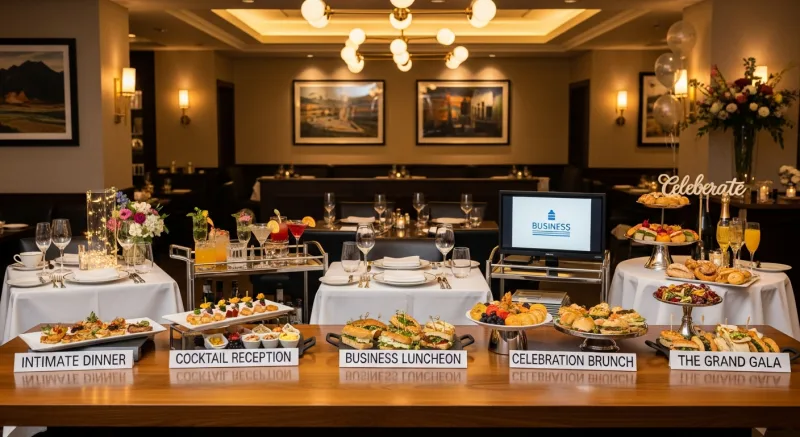
Instead, create structured packages. Give your clients options to choose from, then customize around the edges. Here's the thing: packages make decision-making easier for clients and pricing more profitable for you.
Package 1: The Corporate Dinner ($75-$120/person)
Target: office team dinners, client entertainment, board meetings, retirement celebrations.
- 3-course preset menu (2-3 choices per course)
- 2-hour premium bar package
- Dedicated server team
- A/V setup for presentations (if applicable)
- Minimum 20 guests
Corporate events are your bread and butter. They're recurring (quarterly team dinners, annual holiday parties), they're decisive (one person makes the decision), and they're less price-sensitive than personal events. A company spending $4,000 on a team dinner doesn't blink — it's a line item in their entertainment budget.
Package 2: The Celebration ($65-$100/person)
Target: birthdays, anniversaries, graduations, promotion parties.
- Family-style or buffet menu
- Complimentary cake cutting (bring your own cake)
- Custom menu cards with guest of honor's name
- 1.5-hour bar package or consumption-based bar
- Minimum 15 guests
Package 3: The Rehearsal Dinner ($80-$130/person)
Target: wedding rehearsal dinners, engagement parties, bridal showers.
- 4-course plated dinner
- Wine pairings or 3-hour premium bar
- Champagne toast
- Custom printed menus
- Minimum 30 guests
Wedding-adjacent events are high-value and planners book 6-12 months in advance, filling your calendar far into the future. And one rehearsal dinner at your restaurant often leads to recommendations to other engaged couples in the same social circle.
Package 4: The Full Buyout ($3,000-$8,000 minimum)
Target: holiday parties, launch events, large celebrations, fundraisers.
- Exclusive use of entire restaurant
- Custom menu designed with the host
- Full bar with specialty cocktails
- DJ/music setup option
- Up to 4 hours
Full buyouts are the most profitable events because you're replacing an uncertain walk-in night with a guaranteed high-revenue booking. Set the minimum based on your typical peak-night revenue — if Saturday generates $6,000, your buyout minimum should be at least $6,000. For slow nights, $3,000-$4,000 is usually enough to dramatically exceed walk-in revenue.
Package 5: The Standing Reception ($45-$70/person)
Target: networking events, gallery openings, cocktail parties, book launches.
- Passed appetizers and stationary displays
- 2-hour cocktail and wine service
- High-top cocktail tables
- Minimum 25 guests
Standing receptions fit more guests into less space. A dining room that seats 60 can handle 90-100 standing guests, meaning higher revenue per square foot. Food cost is lower because passed apps and charcuterie displays are less expensive per head than plated entrees.
Pricing Psychology: Minimums vs. Per-Person vs. Room Fees
Here's where most restaurants leave money on the table. There are three ways to price private events, and the one you choose dramatically affects both revenue and close rate.
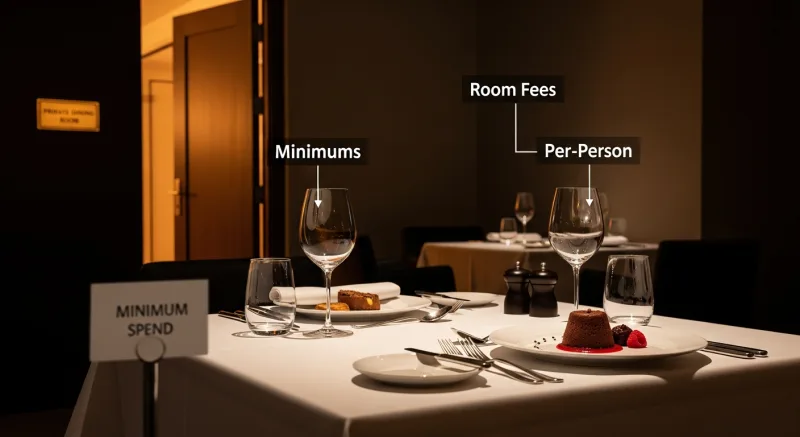
Food and beverage minimum (recommended): Set a minimum total spend rather than a per-person rate. "$4,000 food and beverage minimum" feels like a guarantee of quality, not an additional fee. The guest mentally thinks "we were going to spend money on food and drinks anyway." If the group's natural spending exceeds the minimum, you make even more. If it falls short, you're still protected.
Per-person pricing: Works well for structured events with set menus. "$85 per person" is easy to understand and easy to budget. The downside is it caps your upside — a table of heavy drinkers can't spend their way past the package price. Use per-person pricing when the menu is fixed and beverage service is included.
Room rental fee (avoid): "$500 room fee plus food and beverage" makes the client feel like they're paying for empty space. It creates resistance. The only time a room fee makes sense is when you have a genuinely separate private dining room with its own entrance and restrooms — a true standalone space worth paying for independently.
But it gets worse: many restaurants undercharge because they use regular menu prices as their baseline. Event menus should be priced 15-25% above your regular menu. You're providing a private experience, dedicated service, guaranteed space, and custom coordination. That premium is expected and justified.
The Deposit and Contract System That Protects Your Revenue
No deposit, no booking. This is non-negotiable.
Here's the deposit structure that protects you without scaring off clients:
- 50% deposit at booking — non-refundable if cancelled within 14 days of the event
- Final guest count due 7 days before — this becomes the minimum billing count (actual headcount can be higher, not lower)
- Remaining balance due day of event — plus any overage from additional drinks, guests, or add-ons
For events over $5,000, break it into three payments: 25% at booking, 25% at 30 days, and 50% at 7 days. This eases the client's cash flow concern while still protecting yours.
Your contract should include:
- Date, time, and duration (with overtime rate — typically $500/hour)
- Guaranteed guest count and maximum capacity
- Menu selections and any dietary accommodations
- Bar package details and duration
- Cancellation policy with specific deadlines
- Setup and teardown time (what's included, what's extra)
- Noise/music policy
- Damage liability
- Automatic gratuity (typically 20-22%)
Here's the thing: your POS system needs to handle deposits and partial payments cleanly. If your POS can't split a $5,000 event across a deposit today and a final payment in six weeks, you're managing it manually — which means errors, forgotten follow-ups, and lost revenue. Systems like KwickOS track deposits natively, linking partial payments to future events and alerting you when balances are due.
Marketing Your Private Events: Where the Bookings Actually Come From
You can't just add a "Private Events" tab to your website and wait. The restaurants that fill their calendars take an active, multi-channel approach to event marketing.
Channel 1: Your Existing Customer Database
This is the most overlooked and highest-converting channel. Your regulars already love your food. They already trust the experience. When they need to book a birthday dinner, anniversary, or team event, you should be the first restaurant they think of.
Send a quarterly email to your customer list highlighting upcoming availability, seasonal packages, and photos from recent events. Include a direct "Book Your Event" link. Restaurants using CRM-integrated POS systems can segment by spend level and visit frequency — targeting customers who spend $100+ per visit, because they're the ones most likely to host events.
Channel 2: A Dedicated Events Page
Your website's events page should include:
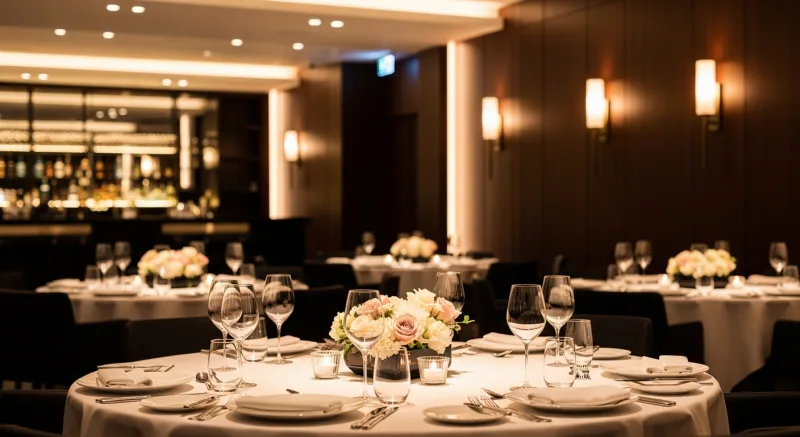
- Professional photos of your private dining space (or your dining room set for events)
- Your package options with starting prices
- Sample menus
- Capacity information
- A simple inquiry form (name, email, date, estimated guests, event type)
- Testimonials from past event hosts
Respond to every inquiry within 2 hours during business hours. The first restaurant to respond gets 78% of private event bookings, according to industry data. Speed wins.
Channel 3: Corporate Outreach
Within a 2-mile radius of your restaurant, there are office buildings, coworking spaces, and businesses that need venues for team events, client dinners, and celebrations. Make a list of the 50 largest employers nearby. Send each one a physical mailer with your event menu and a special corporate rate — 10% off the first booking.
Follow up with the office manager or executive assistant. These are the people who actually book venues. One corporate relationship can generate 4-6 events per year.
Channel 4: Event Platforms and Wedding Sites
List your space on The Knot, WeddingWire, Peerspace, Eventective, and local event directories. These platforms charge either a subscription fee or a per-lead fee, but the ROI is strong — a single rehearsal dinner booking at $6,000 pays for a year of platform fees.
Channel 5: Social Media Content
Post photos and short videos from every event (with the host's permission). A 15-second Instagram Reel of a beautifully set private dining table with the caption "Monday night. 45 guests. $5,200 in revenue. Your restaurant can do this too" generates inquiries. Tag the host's company or the event occasion. When their network sees it, you're the restaurant they remember.
Operations: Running a Private Event Without Wrecking Regular Service
If you're hosting events alongside regular service (which most restaurants do), the key is separation — separate prep, separate service team, and separate POS tracking.
Prep planning starts 48 hours before the event. Your chef should receive the final guest count and menu 7 days out, create a prep list, and order any specialty items. The day-of prep for a private event should be completed before the restaurant opens for regular service. No sharing prep time between event and walk-in — that's where mistakes happen.
Assign a dedicated event captain. One server or manager owns the event from setup to teardown. They're the client's single point of contact, the kitchen's liaison, and the person responsible for timing courses. This person is not pulled to cover regular tables. Their only job is making the event flawless.
Use preset menus in your POS. A well-configured POS eliminates the chaos of event ordering. Operators like T. Jin China Diner, running 15 locations with 75 terminals through KwickOS, use preset banquet menus that fire courses automatically at timed intervals. The kitchen gets a clean, organized ticket — "Table: Chen Birthday, Course 2: 45 Salmon, 5 Vegetarian" — instead of 50 individual orders flooding the printer.
Here's a pattern interrupt for you: the most common private event failure isn't food quality. It's timing. The salads come out too slow. There's a 40-minute gap between appetizers and entrees. The kitchen forgot to fire dessert because they were buried in walk-in orders. Every one of these failures is a POS and communication failure, not a cooking failure.
The fix is a KDS system that separates event tickets from regular service. When the event's appetizer course fires, it appears on a dedicated screen — not mixed in with 30 other tickets. Your expo calls "Course 1 for Chen birthday — all plates" and the kitchen executes cleanly. Shogun Japanese Hibachi uses exactly this approach, routing event tickets to dedicated stations with customized display groupings that keep service organized.
Tracking Event Profitability: The Numbers You Need to Know
Not all events are equally profitable. You need to track event-level P&L to know which packages, which nights, and which event types generate the best margins.
For every event, track:
- Total revenue (food + beverage + service charge + any add-ons)
- Food cost (actual cost of ingredients used, not estimated)
- Beverage cost (bottles opened, draft poured, wine consumed)
- Labor cost (hours worked by event-specific staff, including setup/teardown)
- Gross profit (revenue minus food + beverage + labor)
- Gross margin % (target: 55-65%)
After 10-15 events, you'll see clear patterns. Maybe your $85/head plated dinners yield 62% margins while your $45/head standing receptions yield only 48%. Maybe corporate events are twice as profitable as birthday parties because companies drink premium spirits while birthday groups order beer. Use this data to adjust pricing, promote high-margin packages, and set smarter minimums.
KwickOS generates per-event profitability reports automatically, breaking down food cost, beverage cost, and labor by individual event. That means you can review the numbers the morning after — not two weeks later when your accountant gets around to it. Use our profit margin calculator to model different event scenarios before you set your pricing.
Scaling: From 1 Event Per Week to a Full Calendar
Once your private event program proves profitable, the question becomes: how many events can you handle?
Phase 1 (Months 1-3): 1-2 events per week. Focus on weeknight events (Monday-Wednesday) where you're replacing dead revenue. Keep regular service running on the rest of the floor. Learn your operational flow, refine your packages based on client feedback, and build your photo/testimonial library.
Phase 2 (Months 4-8): 3-4 events per week. Start accepting Thursday events. Add a second package tier. Train a second event captain so you can run events on consecutive nights. By this point, you should have 20+ events under your belt and a clear understanding of your most profitable configurations.
Phase 3 (Months 9-12): 5+ events per week. Consider dedicating certain nights exclusively to private events. A restaurant that does full buyouts every Monday and Tuesday generates $8,000-$16,000 per week from nights that used to bring in $2,000. Some restaurants at this stage invest in permanent private dining infrastructure — a partition wall, a separate bar area, improved lighting and sound.
Multi-location operators have even more leverage. Crafty Crab Seafood, running 19 locations on KwickOS, can route event inquiries to whichever location has availability, using centralized booking management across all 19 restaurants. One inquiry, one coordination team, 19 possible venues. That's the power of an integrated system.
The 30-Day Launch Plan: Start Booking Events This Month
You don't need six months of planning to launch a private event program. Here's the 30-day playbook:
Week 1: Build Your Packages
- Create 3 packages (corporate dinner, celebration, full buyout)
- Set pricing based on your food cost and target margins
- Draft your event contract and deposit policy
- Configure your POS with preset event menus and deposit tracking
Week 2: Create Your Marketing Assets
- Take professional photos of your space set for events (table settings, lighting, ambiance)
- Build a private events page on your website with packages, photos, and inquiry form
- Write an email announcement for your customer database
- Create a one-page PDF flyer for corporate outreach
Week 3: Start Outreach
- Send the email announcement to your full customer list
- Mail physical flyers to 50 nearby businesses
- List on 2-3 event platforms (The Knot, Peerspace, local directories)
- Post on social media: "Now booking private events — inquire today"
Week 4: Book and Execute
- Follow up on every inquiry within 2 hours
- Offer a 10% launch discount on the first 5 bookings
- Book at least 2 events for the following month
- After each event, request a testimonial and take photos for marketing
The Gift Card and Loyalty Angle Most Restaurants Miss
Private events are a goldmine for gift card and loyalty program growth. Every event brings 30-80 guests into your restaurant — many for the first time. Most of them will never come back unless you give them a reason.
Here's the play:
- Place a $10 gift card at every event guest's seat. Cost to you: roughly $3-$4 in food cost when redeemed. Return: a first-time guest who comes back and spends $45-$60 on a regular visit. For a 50-person event, that's a potential $2,250-$3,000 in future revenue from $150-$200 in gift card cost.
- Enroll the event host in your loyalty program with bonus points for booking. Make them feel special. When their next celebration rolls around, they already have points accrued — and a reason to book with you again.
- Offer event attendees instant loyalty enrollment via QR code at the table. "Scan to join our rewards program and get a free appetizer on your next visit." Capture 30-40% of event guests as new loyalty members.
These tactics turn a one-night event into ongoing revenue. The KwickOS CRM tracks which customers were acquired through events, so you can measure the long-term value of your private event program — not just the night-of revenue.
The Bottom Line
Every restaurant has slow nights. The question is whether you treat those nights as an unavoidable cost of doing business or as an opportunity worth $100,000 to $300,000 per year.
Private events don't require a private dining room. They don't require a complete overhaul of your operations. They require structured packages, a simple contract, a deposit system, and active marketing to the people and businesses that need venues.
The math is straightforward. One $5,000 Monday event replaces four dead Mondays of walk-in service. One corporate relationship generates $20,000-$30,000 in annual event revenue. One rehearsal dinner leads to three more wedding-related bookings from the same social circle.
Your space is already there. Your kitchen is already there. Your staff is already there. The only thing missing is the system to fill those empty nights with guaranteed, high-margin revenue.
Fill Your Empty Nights with Guaranteed Revenue
KwickOS handles preset event menus, deposit tracking, per-event profitability reporting, and multi-location booking management — everything you need to run a professional private event program.
Get a Demo