 Kelly Ho
You're processing 847 transactions a day. Your average ticket is $8.40. Your net margin hovers around 3%.
Do the math: that's $7,115 in daily revenue generating roughly $213 in profit. One bad day of shrinkage — a cooler failure, a tobacco compliance fine, an employee giving away free fountain drinks — and your entire week's profit disappears.
But it gets worse. While you're watching every penny on product margins, your checkout process is bleeding time. Every second wasted per transaction at 847 transactions per day adds up to hours of lost capacity. Hours when customers see the line, walk out, and drive to the competitor half a mile down the road.
Here's the thing: the convenience stores making 4-5% net margins aren't selling different products than you. They're operating differently. They've optimized the invisible systems — traffic flow, cooler rotation, age verification speed, checkout throughput — that separate stores barely surviving from stores printing money.
This guide covers every operational system that drives convenience store profitability. Not theory. Actual operational playbooks used by high-volume stores processing $2M+ annually.
Traffic Flow: The Layout That Makes Customers Buy More
Your store layout is either working for you or against you — and according to industry research, most convenience stores lose 15-20% of potential impulse sales to poor traffic flow alone.
The principle is simple: customers who walk deeper into your store buy more. The challenge is getting them past the register area without friction. Here's what high-performing stores do differently:
The decompression zone. The first 5-8 feet inside your door is dead space. Customers don't register anything placed here because they're adjusting from outside. Stop putting promotional displays in this area — they're invisible. Use it for transition: floor mats, a clean sight line to the back of the store.
Destination items in the back. Coolers along the back wall. Coffee station in the rear corner. Fountain drinks past the midpoint. Every trip to grab a Gatorade or a cup of coffee forces the customer to walk past 40+ linear feet of impulse opportunity.
And that's not all. The path to destination items should be slightly indirect — a soft curve or an island display that forces customers to see seasonal items, new snacks, or promotional bundles without feeling blocked.
The checkout gauntlet. The last 6-8 feet before the register is where impulse items live. Gum, candy bars, energy shots, phone chargers, lighters. According to convenience industry data, items placed within arm's reach of the queue generate 3-5x more sales than the same items on a regular shelf. Your POS counter should have a customer-facing display showing order totals and loyalty point balances — this alone triggers last-second add-ons from members trying to hit their next reward tier.
Cooler Management: Where Your Biggest Margins Hide
Beverages represent 25-30% of convenience store revenue but up to 40% of gross profit. Your cooler is your money machine. Treat it like one.
Temperature kills profit two ways. A cooler running 3 degrees too warm shortens product shelf life and triggers health code violations. A cooler running 5 degrees too cold wastes electricity — roughly $400-$600 extra per year per unit. Industry research shows that 18% of convenience stores have at least one cooler operating outside optimal temperature range at any given time.
Here's what smart operators do:
- IoT temperature sensors with POS-integrated alerts. When cooler #3 drifts above 41°F at 2 AM, your phone buzzes. You call the overnight clerk. Problem solved before $8,000 in inventory spoils.
- Planogram-driven stocking based on velocity data from your POS. Your top 20 SKUs by unit volume get eye-level, front-door-side placement. Slow movers go to the bottom shelf or get discontinued entirely.
- FIFO enforcement with date stickers. Every delivery gets a colored dot (Monday = blue, Tuesday = red, etc.). Clerks stock new product behind old product. Simple, visual, nearly impossible to mess up.
- Automated reorder points. Your POS tracks real-time cooler depletion. When Red Bull 12oz hits 8 units remaining (1.5 days of supply based on velocity), the system generates a purchase suggestion. No more guessing. No more stockouts on your #1 seller.
A store running $4,000/week in cooler revenue that reduces waste by 30% and improves in-stock rates by 10% adds roughly $18,000 in annual profit — more than many stores spend on technology for the entire year.
Tobacco Compliance: $11,000 Fines You Can Prevent With Technology
Here's a number that should keep you up at night: one failed tobacco compliance check costs between $1,000 and $11,000 depending on your state, plus potential license revocation. A second offense in many jurisdictions means automatic 30-day suspension of your tobacco license — which for most convenience stores means 25-35% of revenue gone for an entire month.
The problem isn't that your clerks don't know the law. It's that they're processing 847 transactions a day, and at 10 PM on a Tuesday when they've been on shift for 6 hours, a 17-year-old who looks 25 walks in and buys a pack of Marlboros. Your clerk doesn't ask for ID because they're tired, the line is long, and "they look old enough."
That one moment costs you $11,000.
Technology eliminates human judgment from the equation:
- POS-forced age prompts. When a tobacco or alcohol item scans, the transaction cannot proceed until the clerk enters a birthdate or scans an ID. No override. No skip button. The system forces compliance.
- ID scanner integration. A $200 ID scanner reads the magnetic stripe or barcode on a driver's license and auto-populates the birthdate field. Transaction time: 3 seconds. Manual entry time: 8-12 seconds. Accuracy: 100% vs. human error.
- Shift-level compliance reporting. Your POS generates a nightly report showing how many age-verified transactions occurred per clerk. If Clerk A verified 45 tobacco sales and Clerk B verified 12 despite similar shift traffic, you know exactly who's skipping the check.
- Quantity limits. Some jurisdictions limit purchases to 2-3 packs per transaction. Your POS can enforce this automatically — no clerk discretion needed.
KwickOS handles this with built-in restricted item management that forces age verification on any flagged category, logs every check, and generates compliance-ready audit reports. The hybrid local+cloud architecture means the age verification system works even when your internet goes down — because the verification logic runs locally with 1ms response time, not on a remote server.
Checkout Speed: Every Second Costs You $47/Day
Let's do uncomfortable math. If your average transaction takes 45 seconds at the register and you could reduce it to 35 seconds, you'd save 10 seconds × 847 transactions = 8,470 seconds = 2.35 hours of register time per day.
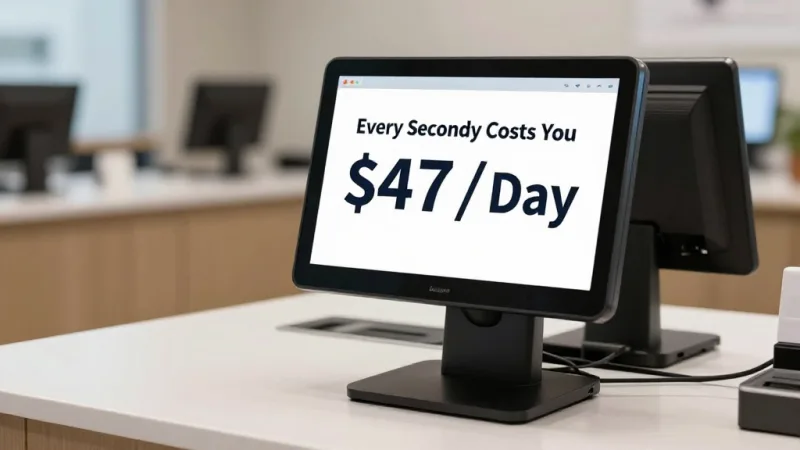
But it gets worse. Those 2.35 hours aren't just labor — they're customer walkouts. Industry data shows that convenience store customers who see more than 3 people in line have a 22% chance of leaving without purchasing. At an $8.40 average ticket, even 5-6 walkouts per day means $47 in daily lost revenue — $17,000 per year from slow checkout alone.
Here's how to compress every transaction:
Tap-to-pay as default. Contactless payment completes in 2-3 seconds vs. 8-12 seconds for chip insert. According to industry data, 68% of consumers now prefer tap-to-pay. If your terminal doesn't support it or your staff doesn't prompt for it, you're adding 6-9 seconds to the majority of transactions.
Barcode scanning, not price lookups. Every item in your store needs a scannable barcode. Loose items (individual bananas, bakery items) need PLU stickers. The moment a clerk has to type in a price or look something up, you've lost 15-30 seconds — and created an error opportunity for shrinkage.
Integrated lottery terminal. If lottery transactions require switching to a separate system, you're adding 20-40 seconds per lottery sale. A POS with lottery integration processes the transaction in the same workflow as any other item. For stores doing 80-120 lottery transactions per day, this saves 30+ minutes of register time daily.
Self-checkout for simple transactions. A single self-checkout kiosk handles 30-40% of simple transactions (drinks, snacks, pre-packaged items) and frees your clerk to handle age-restricted sales, lottery, and customer service. Baked Cravings deployed self-serve kiosks at their Lego Land location to handle high-volume, simple transactions — the same principle applies to convenience stores during rush hours.
The checkout flow at KwickOS is specifically optimized for high-transaction-count environments. Fingerprint 1:N authentication means shift changes happen in under 2 seconds (no logging out, no PIN entry), and the processor-agnostic payment integration means you're not locked into slow terminal firmware from a single provider.
Lottery Integration: 15% of Revenue That Most POS Systems Ignore
Lottery represents 12-18% of total revenue for the average convenience store, yet most POS systems treat it as an afterthought — a separate terminal, a separate cash drawer, a separate accounting nightmare.
The operational cost of running lottery as a separate system:
- 20-40 seconds extra per lottery transaction switching between systems
- Manual reconciliation at end-of-day between lottery sales and POS totals
- Cash management complexity when lottery payouts come from the main register
- Shrinkage opportunities when lottery transactions aren't tracked in the main POS audit trail
An integrated system logs every lottery sale, every payout, and every instant ticket activation in the same transaction stream as your other products. End-of-day reconciliation becomes automatic. Your Z-report tells the whole story.
Fuel POS Integration: When Your Forecourt and Store Don't Talk
If you operate fuel pumps, you know the pain: two separate systems, two separate reports, and customers paying at the pump who never walk inside. According to industry research, only 35% of fuel customers enter the store — and those who do spend an average of $6.80 on in-store items.
Here's the thing: that $6.80 in-store purchase carries a 35-45% gross margin, while fuel margins average 2-5 cents per gallon. A customer who buys 12 gallons at $0.03/gallon margin generates $0.36 in profit. The same customer buying a coffee and a snack generates $2.72 in profit — 7.5x more.
Strategies to drive pump customers inside:
- Pump-screen promotions showing in-store specials while they fuel
- Loyalty points for in-store purchases only — fuel points earn slower than store points, creating incentive to come inside
- Bundle discounts (10¢ off per gallon with any food purchase over $5) displayed at the pump and tracked through unified POS
- Mobile app integration that sends push notifications when loyalty members are detected at the pump
The key is a unified POS system that manages both forecourt and store in a single platform. When fuel and store transactions live in the same database, you can build loyalty programs that bridge both, track customer behavior across touchpoints, and run promotions that drive the highest-margin behavior: walking inside.
Gift Cards and E-Gift Cards: The Profit Center You're Probably Ignoring
Most convenience stores stock third-party gift card racks (iTunes, Amazon, Google Play) and earn 2-4% commission on activations. That's fine — it's passive income. But it's not where the real gift card profit lives.
Your own store gift cards are pure profit accelerators. Here's why:
- Breakage. According to industry data, 10-15% of gift card balances are never redeemed. That's 100% profit on money already collected.
- Overspend. Customers using gift cards spend 20-30% more than the card value per visit because they perceive the card as "free money" and add impulse items.
- Cash flow. You collect the money today but fulfill the purchase weeks or months later.
- E-gift cards drive new traffic. A customer buys a $25 e-gift card for a friend who has never been to your store. That's customer acquisition at zero cost.
The setup is simple with a modern POS: physical gift cards at the counter (great impulse buy during holidays), plus e-gift cards purchasable online or via text message. During holiday seasons — Christmas, Valentine's Day, Father's Day — gift card sales can spike 300-400% with zero additional inventory risk.
Loyalty Programs: Turning 847 Anonymous Transactions into Repeat Customers
Here's the problem with convenience stores: you process 847 transactions a day and you probably don't know who 90% of those customers are. They're anonymous. You can't email them. You can't reward them. You can't bring them back when they start going to the competitor.
A convenience store loyalty program changes this equation overnight:
Enrollment must be instant. No app download. No form to fill out. Phone number at the register. That's it. One clerk prompt — "Want to earn a free coffee? Just your phone number" — and enrollment takes 5 seconds. The POS creates the profile automatically.
Rewards must be frequent and visible. Unlike restaurants where $15-$20 tickets can support "buy 10, get 1 free," convenience stores need faster reward cycles. Every $50 spent earns a free fountain drink. Every 7th coffee is free. Points accumulate visibly on the customer-facing display at every checkout.
The real value is data. Once you know who your customers are, you know:
- Which products your top 20% of customers buy (and what to never run out of)
- Visit frequency patterns (so you can trigger a "we miss you" text after 7 days of absence)
- Average basket composition (so you can send personalized promotions that actually work)
- Which dayparts need traffic boosts (double points on Tuesday mornings, anyone?)
KwickOS loyalty works at convenience store speed: phone number entry, instant point calculation, reward redemption in the same transaction — no extra steps, no separate screens, no customer waiting. The system supports multi-language enrollment (English, Chinese, Spanish) for stores in diverse communities, and digital loyalty integration that lets customers check balances without calling the store.
Age Verification and Compliance Reporting
Beyond tobacco and alcohol, convenience stores face a growing list of age-restricted products: vape/e-cigarettes (21+ federal), certain OTC medications, spray paint (18+ in many jurisdictions), and even energy drinks in some localities.
The compliance landscape is getting more complex, not simpler. And the penalties are escalating. A single tobacco violation in California can trigger a $6,000 fine. In New York, it's up to $2,500 per incident plus potential license revocation. Multi-location operators like T. Jin China Diner manage compliance across 15 stores by centralizing age-verification rules in their POS — one policy change propagates to all 75 terminals instantly.
What your compliance system needs:
- Category-level age flags — not just tobacco, but any product where your jurisdiction requires verification
- Hard stops — no manager override that bypasses age entry. Period.
- Audit trail — date, time, clerk ID, customer birthdate, transaction ID for every restricted sale
- Failed-attempt logging — if an underage ID is scanned and the sale is refused, log that too. It proves your system works during compliance audits.
- Automated reporting — monthly compliance summaries ready for your attorney or franchise compliance officer
Shrinkage Control: Plugging the $4,800 Annual Leak
Convenience stores lose 1.5-2.5% of revenue to shrinkage annually. On $2.6M in annual revenue, that's $39,000-$65,000 walking out the door. According to industry data, the breakdown is typically: 35% employee theft, 35% shoplifting, 20% administrative error, 10% vendor fraud.
Your POS is your first line of defense:
- Void and refund tracking by clerk. If one clerk has 3x the void rate of others, that's a red flag.
- Cash drawer variance reports. End-of-shift counts that flag any drawer more than $5 over or under.
- Discount abuse detection. Employee discounts applied to non-employee transactions.
- Fingerprint authentication. KwickOS 1:N fingerprint recognition prevents buddy-punching and unauthorized register access — no PIN sharing, no "borrowing" someone else's login.
- No-sale drawer opens. Track every time the drawer opens without a transaction. More than 2-3 per shift? Investigate.
The processor-agnostic advantage matters here too. Stores saving $3,000-$8,000 annually on processing fees can reinvest that money in loss prevention technology — cameras, sensors, better staffing during high-theft hours — without increasing total operating costs.
Putting It All Together: The High-Performance C-Store Tech Stack
The convenience stores making 4-5% net margins share a common technology profile:
| System | Function | Impact |
|---|---|---|
| Processor-agnostic POS | Checkout, inventory, compliance | $3,000-$8,000/yr savings on processing alone |
| Integrated age verification | Tobacco, alcohol, vape compliance | Prevents $1,000-$11,000 per violation |
| IoT temperature sensors | Cooler monitoring | Prevents $8,000+ inventory loss events |
| Self-checkout kiosk | Simple transaction offload | Handles 30-40% of volume, reduces walkouts |
| Loyalty + gift cards | Customer identification, retention | 20-35% more visits, 12-18% larger baskets |
| Fingerprint authentication | Employee accountability | Eliminates buddy-punching, unauthorized access |
KwickOS delivers this entire stack in a single platform. No bolting together 5 different vendors. No praying that your age verification software talks to your POS talks to your loyalty program. One system, all modules integrated, running locally at 1ms speed with cloud backup — so even when the internet drops during a thunderstorm, your 847 daily transactions keep flowing.
Compare that to locked-in systems like Toast or Square that charge 2.6-2.99% on every transaction, can't handle tobacco compliance natively, and go offline when their servers hiccup. At 847 transactions per day, you can't afford even 5 minutes of downtime — and you certainly can't afford to pay a locked processor $4,000+ more per year for the privilege of that risk.
Run Your C-Store Like a Machine
KwickOS handles POS, compliance, loyalty, gift cards, and inventory in one integrated system — with no processor lock-in. See how much your store could save.
Calculate Your Savings