Everything Is Bigger in Dallas — Including the Cost of Choosing the Wrong POS
Updated March 2026 · By Tom Jin
Dallas does not do small. The metro area spans 9,286 square miles with 7.6 million people, making it the fourth-largest metropolitan area in the country. There are over 12,000 restaurants across the DFW Metroplex, ranging from billionaire steakhouses in Highland Park to family Tex-Mex joints in Oak Cliff that have been serving the same enchilada plate for forty years. The scale of dining in Dallas is matched only by the scale of the financial decisions that restaurant operators make — or fail to make — about the technology running their businesses.
Consider this: a mid-range Dallas restaurant processing $120,000 per month in card transactions pays Toast $3,728 monthly in processing fees. That is $44,736 per year. Over a standard five-year equipment commitment, that is $223,680 — paid to a company in Boston for the privilege of using their hardware and their locked-in processor. Dallas did not become a business capital by accepting that kind of deal without examining alternatives.
The Uptown Power Lunch and Its Hidden Processing Tax
Dallas’s Uptown neighborhood along McKinney Avenue concentrates corporate dining in a way that few American corridors match. Energy executives, real estate developers, private equity partners, and law firm associates fill restaurant seats between 11:30 AM and 1:30 PM with average lunch tickets of $45-$65 per person — virtually all on corporate cards. A single Uptown restaurant might process $8,000-$12,000 in lunch transactions alone on a Tuesday.
At this volume, every basis point of processing cost matters. Toast’s 2.99% plus $0.15 on a $55 average ticket costs $1.79 per transaction. A competitive processor through KwickOS at 2.1% plus $0.08 costs $1.24. The difference of $0.55 per transaction, multiplied by 200 daily lunch transactions, is $110 per day. Over 260 business days, that is $28,600 annually in processing savings on lunch service alone — before accounting for dinner, weekend brunch, and private events.
KwickOS does not process your payments. It does not take a percentage of your sales. The software operates independently from payment processing, allowing Dallas restaurants to negotiate processor rates that reflect their volume, their industry, and their leverage. In a city where business negotiations are a cultural art form, why would a restaurant operator accept non-negotiable processing rates?
The Texas Ice Storm Lesson
Winter Storm Uri in February 2021 taught every Texas business a lesson about infrastructure dependence. Power grids failed. Internet service collapsed. Cell towers lost battery backup. The restaurants that continued operating did so with generators, cash registers, and determination. The ones that depended entirely on cloud-based technology could not process a single transaction when the infrastructure that cloud systems require disappeared for four days.
Dallas does not face these conditions annually the way Chicago or Minneapolis does, but the Texas power grid’s vulnerability is now a known risk rather than a theoretical one. KwickOS processes every transaction locally on the device itself. Internet connectivity is used for synchronization, not for processing. If the next ice storm takes out Spectrum, AT&T, and the cell towers simultaneously, KwickOS keeps processing payments on local hardware powered by the restaurant’s generator. When infrastructure returns, everything syncs.
The hybrid local-plus-cloud architecture is not just a cold-weather feature. Dallas thunderstorms between April and June produce lightning strikes that knock out localized internet service with regularity. A restaurant in Deep Ellum that loses internet at 7 PM on a Friday due to a thunderstorm does not lose its dinner service — it loses only its cloud sync until connectivity restores.
Tex-Mex and the Modifier Explosion
Dallas Tex-Mex restaurants operate with modifier complexity that POS systems designed for burger joints cannot handle gracefully. A single enchilada plate involves protein selection (chicken, beef, cheese, shrimp), sauce choice (red, green, sour cream, mole), side selections (rice, beans, both, neither), tortilla type (corn, flour), and topping additions (guacamole, pico, queso). That is one menu item with potentially 120 permutations before accounting for quantity and portion-size modifiers.
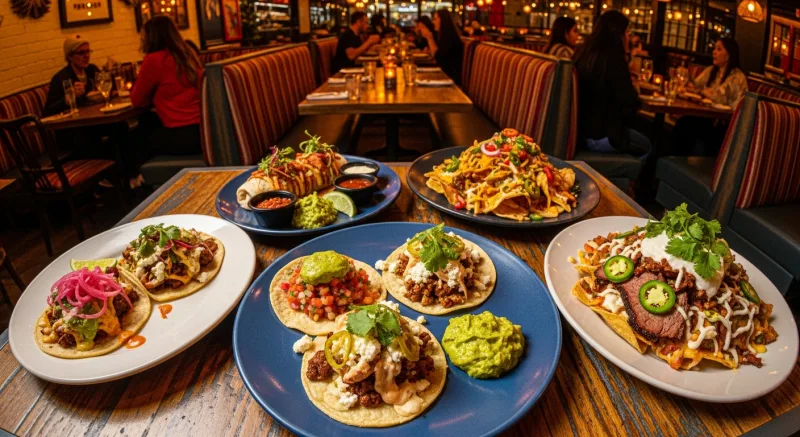
KwickOS handles deep modifier trees without the cascading dropdown nightmare that simpler POS systems create. Each modification step presents clearly on the ordering screen, and the resulting ticket displays on the kitchen display system in a format that the line cook reads instantly. The complete build — “2 chicken enchiladas, green sauce, sub flour tortilla, rice and beans, add guac” — appears as a structured, scannable ticket rather than a paragraph of text that requires interpretation under time pressure.
For the Spanish-speaking kitchen staff that predominates in Dallas Tex-Mex restaurants, KwickOS displays the entire order in Spanish on the KDS. The front-of-house terminal runs in English for order entry while the kitchen display runs in Spanish for production. Same data, different languages, zero translation confusion.
Dallas Cowboys Sundays and the Three-Hour Stampede
AT&T Stadium in Arlington sits at the geographic center of the DFW Metroplex, and game-day dining activity radiates outward to affect restaurants across a 20-mile radius. From sports bars in Victory Park to barbecue joints in Fort Worth, Cowboys Sundays produce a sustained volume spike that lasts from 10 AM pregame through midnight postgame. Restaurants within walking distance of the stadium see volume increases of 200-400%.
Self-ordering kiosks powered by KwickOS manage the pregame rush without requiring restaurants to staff at four times their normal level for a five-hour window. Customers order, customize, and pay at the kiosk in 90 seconds — faster than any counter interaction. A restaurant with three kiosks can process 120-150 orders per hour, handling the pregame surge while kitchen staff focus entirely on production rather than splitting attention between cooking and order-taking.
KwickOS fingerprint security is essential for the temporary staff that game-day volume requires. A sports bar that adds ten temporary bartenders and servers for Cowboys Sunday registers each one with a fingerprint on their first shift. Every pour, every transaction, every void is biometrically tracked. When the season ends and the temps disperse, there are no outstanding PINs, no unreturned access cards, and no security gaps.
Richardson and Plano: The Asian Restaurant Corridor
The Richardson-Plano corridor along US-75 has developed one of the most diverse Asian restaurant concentrations outside of the coasts. Chinese, Vietnamese, Korean, Japanese, Indian, and Taiwanese restaurants occupy nearly every strip mall between Spring Valley Road and Parker Road. This corridor represents a dining ecosystem where kitchen language support is not a nice-to-have feature — it is a functional requirement.
KwickOS’s native Chinese language interface serves the significant Chinese restaurant population in this corridor. Kitchen display systems render dish names in characters rather than romanized approximations. For dim sum restaurants, hot pot houses, and Sichuan restaurants where the menu may contain 200+ items with names that do not translate meaningfully into English, this native language support eliminates the daily miscommunication that slows kitchen production.
Tiger Sugar, a KwickOS customer operating international dessert locations, demonstrated how specialized Asian beverage and dessert operations benefit from a POS designed for their workflow. With minimal-step personalization for customized drinks, electronic receipts with built-in loyalty, and an interface that matches the speed of bubble tea production, Tiger Sugar processes high-volume orders without the customization bottleneck that forces customers to wait and lines to grow.
Deep Ellum After Dark: Nightlife POS Requirements
Deep Ellum is Dallas’s entertainment and nightlife district, where restaurants transition into bars and music venues after 10 PM. This dual-identity operation requires a POS system that handles table-service dinner at 7 PM and high-volume bar service at midnight with equal capability. Many Deep Ellum establishments run both simultaneously — dinner on one side, live music and drinks on the other.
KwickOS configures different operational modes within the same system. The dinner section runs with table assignments, course-based firing, and standard restaurant workflow. The bar section runs with fast-pour tabs, drink-queue optimization, and volume-based pricing for happy hour. Both sections report to the same dashboard, share the same inventory system, and process through the same financial reporting. The manager sees a unified picture of the entire operation rather than reconciling two separate systems at closing.
Loyalty programs in Deep Ellum serve a customer retention function that addresses the neighborhood’s specific challenge: intense competition for nightlife spending. A customer who earns loyalty points at your restaurant-bar returns to yours rather than trying the twelve other options within walking distance. KwickOS loyalty integrates into every transaction type — dinner, drinks, and entertainment cover charges — building a comprehensive customer profile that informs targeted promotions.
The Suburban Expansion Pattern: Frisco, McKinney, Allen
Dallas restaurant operators who succeed in the city proper inevitably eye the northern suburbs. Frisco, McKinney, Allen, and Prosper are among the fastest-growing cities in America, with new residential developments creating instant customer bases for restaurants willing to follow the population northward. This expansion pattern means a restaurant group might operate locations in Uptown Dallas, Legacy West in Plano, and Stonebriar in Frisco — three distinct markets requiring three different menu configurations managed from a single dashboard.
KwickOS centralized management with per-location customization supports exactly this growth trajectory. Crafty Crab’s expansion to 19 locations with 152 terminals followed a similar DFW-outward pattern. Each location runs its own menu with local modifications while corporate maintains real-time visibility across all locations. Menu updates push to all locations with one click. Pricing adjustments for higher-rent markets like Uptown apply to specific locations without affecting suburban pricing. The technology grows with the business rather than constraining it.
Delivery Across 9,286 Square Miles
DFW’s geographic enormity creates delivery economics unlike any other American metro. A delivery from a restaurant in Deep Ellum to a customer in North Dallas covers 15 miles. DoorDash charges the same 20-30% commission regardless of distance, but KwickDriver’s distance-based flat rate ($2 plus $6.99 per five miles) provides predictable costs that restaurants can factor into their delivery service area.
The strategic advantage is in controlling the delivery radius. A restaurant that knows its KwickDriver cost structure can define a profitable delivery zone — perhaps 8 miles — and decline orders outside that zone rather than accepting every DoorDash order regardless of whether the delivery is profitable. This geographic targeting is impossible on third-party platforms that show your restaurant to every customer in the metro area regardless of delivery economics.
KwickMenu online ordering drives customers to order through the restaurant’s own website, eliminating the discovery-platform model where DoorDash shows your menu alongside every competitor within five miles. A customer who orders directly from your website sees your brand, your menu, and your promotions — not a marketplace comparison that commoditizes your food.
Dallas POS Decision Framework
Dallas restaurants operate at scale. The volumes are high, the competition is intense, and the geographic reach is enormous. Technology decisions compound over time — the wrong processor rate at these volumes costs six figures over a five-year period. Before signing any POS agreement, Dallas operators should verify:
- Processor independence — DFW volume justifies the most aggressive rates available; do not surrender negotiating power
- Ice storm resilience — Texas grid vulnerability makes offline processing a survival requirement
- Deep modifier support — Tex-Mex modifier complexity demands a system designed for it
- Spanish-language KDS — Dallas kitchen workforce operates predominantly in Spanish
- Chinese-language support — Richardson-Plano corridor restaurants need native character rendering
- Self-ordering kiosks — Game-day and high-volume surges need automated ordering throughput
- Multi-location scalability — Dallas-to-suburbs expansion is the standard growth path
- Distance-based delivery pricing — 9,286 square miles of metro means delivery costs must be geography-aware
Dallas has always thought big about business. It is time to think equally big — and equally critically — about restaurant technology.
Dallas restaurant owners: Call (888) 355-6996 or visit KwickOS.com to calculate what processor freedom would save your DFW operation annually.

Founder & CIO of KwickOS · 30 Years IT · 20 Years Restaurant Industry
Tom built KwickOS after running restaurants and IT companies for decades. He relocated the company to a 10,000 sq ft office in 2023 and now serves 5,000+ businesses across all 50 states, processing over $2M in daily sales.