A first-time customer walks into your restaurant. The food is excellent. The service is warm. They leave satisfied. And then—statistically speaking—they never come back.
That is not a failure of your food or your team. It is a failure of systems. Without a structured reason to return, 67% of restaurant customers simply drift to wherever is most convenient or top-of-mind next time they are hungry. Your outstanding Tuesday dinner becomes a distant memory by Friday.
But here is what the data shows on the other side of that equation: customers enrolled in a loyalty program visit 35% more frequently and spend 23% more per visit than non-enrolled customers. Not 2% more. Not 5% more. Twenty-three percent more, on every single visit, compounding across months and years.
Harvard Business School's famous research on customer retention found that increasing retention rates by just 5% boosts profits by 25-95%. Not revenue—profits. Because returning customers cost almost nothing to acquire. They already know where you are. They already know they like your food. They just need a reason to choose you over the 47 other options within a 10-minute drive.
A loyalty program is that reason. And if you are not running one today, this guide will change that by the time you finish reading it.
The Behavioral Science of Why Loyalty Programs Work
Loyalty programs exploit three deeply wired human psychological patterns. Understanding these patterns helps you design a program that feels rewarding rather than gimmicky.
1. The Endowed Progress Effect
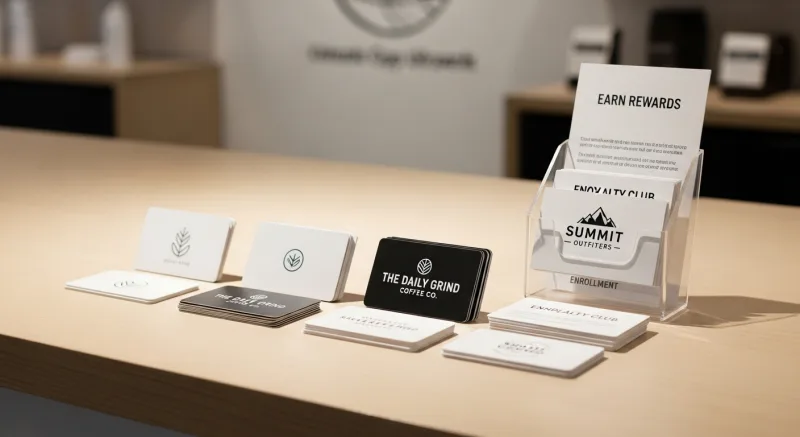
Researchers Nunes and Dreze ran a now-famous experiment at a car wash. Group A received a loyalty card requiring 8 stamps for a free wash. Group B received a card requiring 10 stamps, but with 2 stamps already filled in. Both groups needed 8 more washes. But Group B—the one that felt like they had a head start—completed the card at nearly double the rate (34% vs. 19%).
The lesson: people are more motivated to complete a goal when they feel they have already started. This is why KwickOS loyalty automatically enrolls customers with a welcome bonus (typically 50-100 points) at signup. They are not starting at zero. They are starting with progress.
2. Loss Aversion
Humans feel the pain of losing something roughly twice as intensely as the pleasure of gaining something equivalent. Once a customer has 347 loyalty points, choosing a competitor feels like throwing away those points. The points create a psychological switching cost that has nothing to do with your food quality or pricing.
This is why point balances should be visible on every receipt, every email, and every digital interaction. KwickOS prints the current point balance at the bottom of every receipt automatically. Every transaction reminds the customer what they would lose by going elsewhere.
3. Variable Reward Scheduling
Predictable rewards lose their emotional impact over time. The tenth free coffee feels less exciting than the first. But surprise rewards—an unexpected double-points day, a random free appetizer at the 25th visit, a birthday dessert they did not know was coming—trigger a dopamine response that resets the excitement cycle.
KwickOS supports both scheduled rewards (earn X points, redeem for Y) and surprise rewards (triggered by visit count, spending milestones, or random selection). The combination keeps the program feeling fresh even for longtime members.
The Four Loyalty Program Models (And Which One Fits Your Restaurant)
Not every loyalty program should look the same. The right structure depends on your average check size, visit frequency, and customer demographics. Here are the four models, with real math for each.
Model 1: Points-Per-Dollar (Best for Most Restaurants)
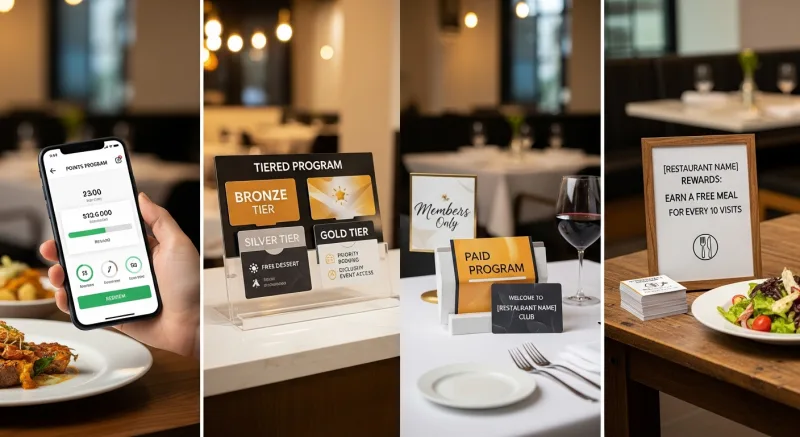
The simplest and most effective model. Customers earn points on every dollar spent. Points accumulate toward rewards.
- Earn: 1 point per $1 spent
- Reward: 100 points = $5 off
- Effective discount rate: 5%
- Average customer earning period: 4-6 visits
Why it works: The math is intuitive. Customers understand "spend a dollar, get a point" instantly. The 4-6 visit redemption cycle is frequent enough to maintain engagement but not so frequent that you are giving away margin on every visit.
Real numbers: If your average check is $22, a customer earns 22 points per visit. At 100 points = $5, they reach a reward in 4.5 visits. Over a year with monthly visits, that is 2.6 free $5 rewards—$13 in comps on $264 in spending. Your effective loyalty cost: 4.9% of loyalty member revenue.
Model 2: Tiered Rewards (Best for High-Frequency Businesses)
Tiered programs add status levels that unlock progressively better benefits. This model works brilliantly for coffee shops, bubble tea stores, and fast-casual restaurants where customers visit weekly or more.
Three-Tier Structure Example
| Tier | Qualification | Benefits |
|---|---|---|
| Silver | 0-499 points | 1 pt/$1, birthday reward, welcome bonus |
| Gold | 500-1,499 points | 1.5 pts/$1, birthday reward, exclusive offers, free upgrades |
| Platinum | 1,500+ points | 2 pts/$1, birthday reward, priority seating, chef's specials, annual gift |
The psychology: Tier upgrades create aspiration. A Gold member who is 73 points from Platinum will find a reason to visit this week. The status itself becomes a reward, separate from the tangible benefits. People pay for status in every other area of life—airlines, hotels, credit cards. Your restaurant can leverage the same instinct at zero cost.
Model 3: Punch Card / Visit-Based (Best for Single-Item Businesses)
The digital version of the classic paper punch card. Buy 9, get the 10th free. This model works for coffee shops, juice bars, and any business where most transactions are a single item at a similar price point.
KwickOS digitizes this completely—no physical card to lose, no stamps to fake. The customer's phone number is their punch card. Every qualifying purchase automatically logs a punch. At the threshold, the reward applies automatically on the next visit.
Model 4: Membership / Subscription (Best for Premium Experiences)
This is the most aggressive model: charge a monthly or annual fee for premium benefits. Think "Coffee Club: $14.99/month for one free coffee per day" or "VIP Dining Club: $49/year for 10% off every visit plus priority reservations."
The math on a coffee club: If your average coffee costs $5.50 and a member claims 20 coffees per month, their "free" coffee cost you $110 in product but you collected $14.99 in subscription revenue. Sounds like a loss—until you factor in that the member also buys a pastry with their coffee 60% of the time ($3.50 average), generating $42 in additional pastry revenue. Net: $14.99 + $42.00 - $33.00 (food cost on 20 coffees at 30%) - $10.50 (food cost on pastries) = $13.49 net profit per member per month, plus guaranteed daily foot traffic.
KwickOS supports membership programs with recurring billing, member-only pricing, and automatic benefit application at the register. No third-party app needed.
How KwickOS Loyalty Works: The Complete Technical Walkthrough
Let us walk through exactly what happens when a customer interacts with KwickOS loyalty, from enrollment to redemption.
Enrollment (10 Seconds, Not 10 Minutes)
This is where most loyalty programs fail. If enrollment requires downloading an app, creating an account, entering an email, and verifying a password, you will lose 80% of potential members before they finish. The friction kills participation.
KwickOS enrollment works like this:
- Customer pays at the register (or online through KwickMenu).
- Cashier asks: "Would you like to earn points? Just need your phone number."
- Customer gives their phone number. Cashier types it in (or customer enters it on the customer-facing display).
- Done. The customer is enrolled. Points from this transaction are credited. A welcome text goes out with their current balance and a link to view their account online.
No app. No download. No email verification. No password. A phone number is the only required field. Name is optional. Email is optional. The program captures the minimum data needed to function and reduces friction to near-zero.
Signup rates on this model are 3-4x higher than app-based enrollment. When you remove the barrier, the vast majority of customers say yes.
Earning Points (Automatic, Every Transaction)
Once enrolled, the customer earns points automatically on every transaction tied to their phone number. They do not need to present a card. They do not need to remember a code. The cashier enters their phone number at checkout (or recognizes them through KwickOS fingerprint authentication if the customer uses a self-ordering kiosk), and points are credited.
Points earn across all channels:
- Dine-in: Phone number entered at register checkout
- Takeout: Phone number associated with takeout order
- Online ordering: Automatic via KwickMenu account (phone number is the identifier)
- Kiosk: Customer enters phone number on the self-ordering kiosk screen
- Gift card redemption: Loyalty points earned even when paying with a gift card
The receipt displays: current point balance, points earned this visit, and points needed for next reward. Every receipt is a reminder. Every receipt is a reason to come back.
Redeeming Rewards (One Tap)
When a customer has enough points for a reward, the POS notifies the cashier at checkout: "Customer has 127 points. Eligible for $5 reward." The cashier asks if they would like to redeem. One tap applies the discount. The remaining balance updates instantly.
For online orders, eligible rewards appear automatically at checkout. The customer selects the reward and it applies to the order total. No codes to remember, no coupons to clip.
Points-for-payment is an additional option: instead of fixed rewards, customers can use points as direct currency. 100 points = $5, applied in any amount toward any check. This gives customers maximum flexibility and increases perceived value.
Birthday Rewards
If the customer provides their birth date at enrollment (optional field), KwickOS automatically sends a birthday reward via text message. The reward can be a fixed discount ($10 off), a free item (free dessert), or bonus points (double points for the birthday week).
Birthday rewards have the highest redemption rate of any loyalty offer—typically 40-60%. They create a powerful emotional association between your restaurant and a personal celebration. The customer remembers that you remembered.
The ROI Math: What a Loyalty Program Actually Generates
Let us run real numbers for a mid-volume restaurant. No hand-waving. No "up to" qualifiers. Just math.
Loyalty Program ROI Calculator
Assumptions: Restaurant with 200 daily covers, $24 average check, 30% loyalty enrollment rate
Now compare the net revenue to the cost of the loyalty platform:
Loyalty Platform Cost Comparison
| Platform | Monthly Cost | Annual Cost | Net ROI (Annual) |
|---|---|---|---|
| KwickOS | $0 | $0 | $291,372 |
| Toast Loyalty | $75/mo | $900/yr | $290,472 |
| Square Loyalty | $45/mo | $540/yr | $290,832 |
| FiveStars | $200-$300/mo | $2,400-$3,600/yr | $287,772-$288,972 |
Note: Toast and Square also require their respective payment processing, which means you cannot negotiate competitive processing rates. The hidden cost of processor lock-in ($5,000-$15,000/year on $1M in processing) dwarfs the loyalty software fee.
The software cost difference between platforms is modest compared to the revenue a loyalty program generates. But the processor lock-in that Toast and Square impose is where the real cost hides. KwickOS works with any payment processor, so the loyalty program costs you $0 and your processing rates remain negotiable.
Advanced Loyalty Strategies That Drive Outsized Results
Double-Points Days
Identify your slowest day of the week (typically Monday or Tuesday) and run a recurring double-points promotion. KwickOS lets you schedule these automatically—every Tuesday, loyalty members earn 2x points. No manual configuration each week. The promotion applies at checkout without cashier intervention.
Expected impact: 15-25% increase in loyalty member visits on the promoted day. You are filling empty seats with your highest-value customers.
Referral Bonuses
Your best marketing channel is your existing customers. KwickOS loyalty supports referral tracking: when a loyalty member refers a friend who enrolls and makes their first purchase, both the referrer and the new member earn bonus points (typically 50-100 points each).
This turns your loyalty program into an acquisition engine. Every member becomes a recruiter with a financial incentive to bring in new customers.
Points-For-Reviews
Online reviews directly impact your restaurant's visibility on Google. Offering bonus loyalty points for leaving a Google review (25-50 points) creates a steady stream of fresh reviews. KwickOS can include a review link on the loyalty text message sent after each visit.
Seasonal Promotions
Limited-time bonus point events create urgency: "Earn triple points on all seafood entrees this weekend." KwickOS lets you attach bonus points to specific menu items, categories, or time windows. This lets you drive traffic to high-margin items or move seasonal inventory while rewarding your most engaged customers.
Loyalty + Gift Card Integration
This is the synergy that most systems miss entirely. When a loyalty member redeems a gift card, they should still earn loyalty points on the transaction. And when a loyalty member reaches a high tier, they could receive a bonus gift card as a tier upgrade reward. KwickOS connects loyalty and gift cards natively—no integration needed because they are the same system.
6 Loyalty Program Mistakes That Kill Engagement
- Making enrollment too complicated. If it takes more than 15 seconds or requires an app download, you will lose most potential members. Phone number enrollment is the gold standard.
- Setting the reward threshold too high. If customers need 20 visits to earn their first reward, they will lose interest by visit 5. Aim for a 4-6 visit redemption cycle.
- Not communicating point balances. If customers don't know how many points they have, those points have zero motivational value. Print balances on every receipt. Send balance updates via text.
- Running a purely transactional program. Points for dollars is a foundation, not a strategy. Layer on surprise rewards, tier upgrades, birthday specials, and limited-time promotions to keep engagement high.
- Ignoring lapsed members. A member who hasn't visited in 60 days needs a win-back offer: "We miss you! Here's 50 bonus points, valid for the next 2 weeks." KwickOS automates lapsed-member outreach via text.
- Paying monthly fees for loyalty software. Every dollar spent on loyalty software is a dollar that could be going to actual rewards for actual customers. Choose a platform where loyalty is included.
Launching Your Loyalty Program on KwickOS: The 20-Minute Setup
Step 1: Choose Your Model (5 minutes)
Open KwickOS admin → CRM → Loyalty Program. Select your program type: Points-Per-Dollar, Tiered, Punch Card, or Membership. For most restaurants, start with Points-Per-Dollar. You can add tiers later as your member base grows.
Step 2: Configure Rewards (5 minutes)
Set your earning rate (1 point per $1 is standard), reward thresholds (100 points = $5), and optional birthday reward. Enable welcome bonus points for new members (50-100 points recommended). If running tiers, set your tier thresholds and benefits.
Step 3: Enable Enrollment Prompts (5 minutes)
Turn on the checkout enrollment prompt. When a non-member transaction completes, the POS displays: "Would the customer like to join the rewards program?" with a phone number entry field. For online ordering, KwickMenu adds a "Join Rewards" checkbox to the checkout page.
Step 4: Train and Launch (5 minutes)
Tell your cashiers two things: (1) ask every non-member customer if they'd like to earn points, and (2) mention the current point balance when a loyalty member checks out. That is the entire training. The system handles everything else.
Ready to Stop Losing 67% of Your Customers?
KwickOS loyalty is included free—points, tiers, birthday rewards, and automated engagement. No monthly fees. No processor lock-in. See it in action.
Book Your Free Demo
(888) 355-6996 · 6405 Cypresswood Dr #250, Spring TX 77379