Los Angeles Restaurant Tech: From Outdoor Dining Year-Round to Earthquake-Proof POS Systems
Updated March 2026
Los Angeles is a restaurant market unlike any other in America. Three hundred days of sunshine create a permanent outdoor dining economy. A geographic footprint stretching 30 miles from the San Fernando Valley to Long Beach means delivery logistics that would paralyze any other city. A population that treats dietary restrictions as identity statements demands menu flexibility that rigid POS systems cannot accommodate. And the ever-present seismic risk means your technology needs to keep working when the ground moves and the internet drops.
Choosing a POS system for an LA restaurant requires understanding what makes this market different from the generic "restaurant technology" advice published by companies headquartered in San Francisco or Boston. The challenges here are specific, and the solutions need to be equally specific.
Outdoor Dining Is Not a Seasonal Feature — It Is the Business Model
LA restaurants allocate 30-60% of their total seating to patios, sidewalk tables, and rooftop spaces. Unlike Chicago or New York, where outdoor seating is a four-month bonus, LA outdoor seating operates year-round. This means your POS system must support outdoor service permanently, not as a seasonal add-on.
Permanent outdoor service creates specific technology requirements. Servers need mobile terminals that work in direct sunlight (screen brightness and glare resistance matter). Tablets need to survive heat — an iPad left in direct LA sun reaches 113 degrees internally, which triggers thermal shutdown. Payment processing needs to work via Wi-Fi that extends reliably to the patio, the rooftop, and the sidewalk 40 feet from the router.
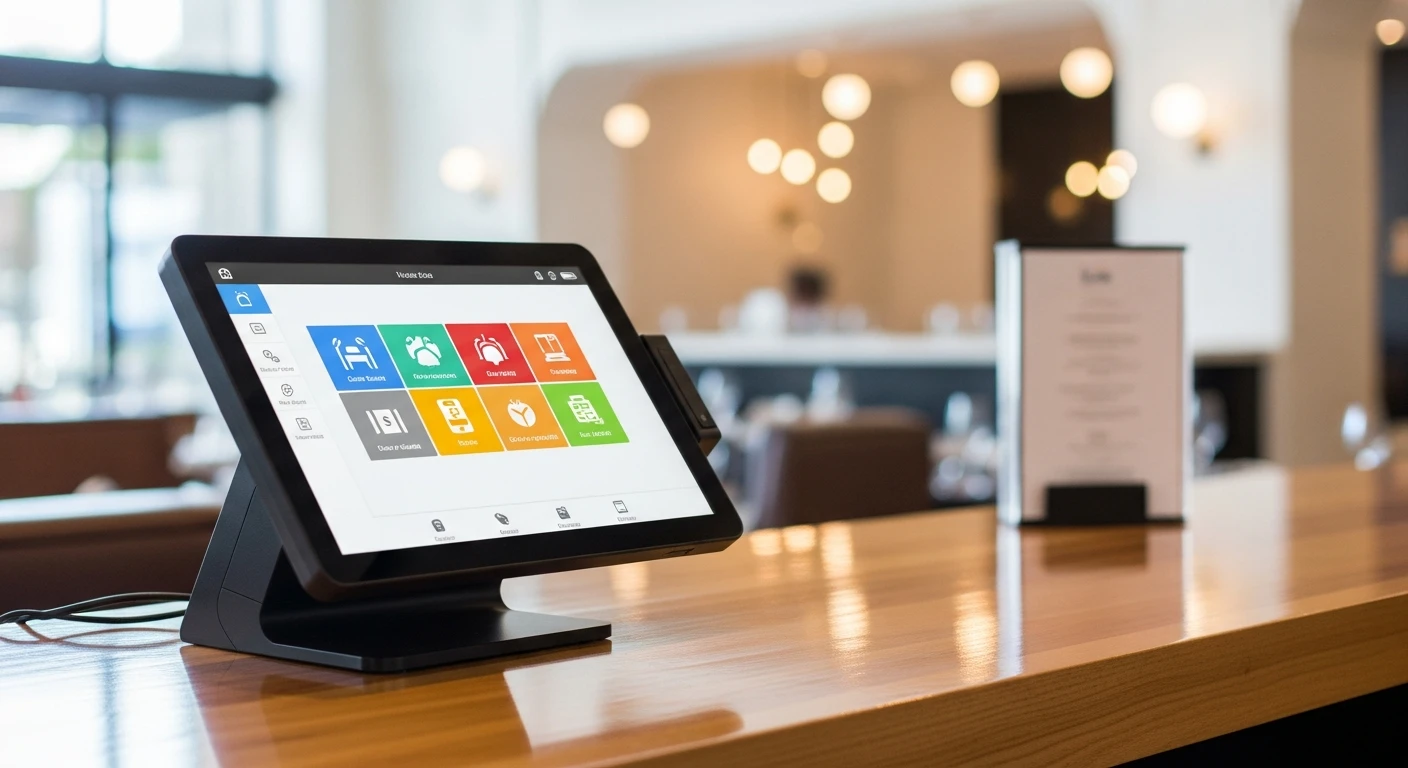
KwickOS runs on any hardware with a browser, including ruggedized tablets designed for outdoor environments. Orders entered on a server’s handheld device route instantly to the kitchen display. Payments process tableside. In a market where 40% of your covers sit outside, the ability to provide the same service speed outdoors as indoors is a revenue requirement, not a convenience.
The 30-Mile Delivery Radius Problem
Los Angeles is geographically enormous. A customer in Santa Monica ordering from a restaurant in Silver Lake is 15 miles and 45 minutes away in traffic. Traditional delivery models — designed for dense cities where everything is within 3 miles — collapse in LA’s sprawl.
This creates a delivery zone calculation that most POS systems handle poorly. You cannot charge $3 for a delivery that takes a driver 90 minutes round-trip through the 405. But you cannot charge $15 either, because the customer will order from somewhere closer. You need zone-based pricing that reflects actual distance and drive time.
KwickDriver calculates delivery fees by mileage: $2 flat fee plus $6.99 per 5 miles. A customer 2 miles away pays $2. A customer 12 miles away pays approximately $19. This transparent, distance-based model lets customers decide whether the delivery is worth it, while protecting the restaurant from unprofitable long-distance runs. The POS manages the zone map, calculates fees automatically, and dispatches drivers with route optimization that accounts for LA traffic patterns.
Third-party platforms obscure this calculation. DoorDash charges the customer a delivery fee and the restaurant a commission, but neither party sees the true cost of distance. The restaurant in Silver Lake pays the same 25% commission whether the order goes 1 mile to Echo Park or 15 miles to Santa Monica. On a $40 order, that is $10 in commission regardless of driver cost. KwickDriver’s distance-based model aligns fees with actual delivery cost, which is the only sustainable approach for a city this spread out.
Health-Conscious Menus and Modifier Complexity
LA diners modify orders at a rate that would exhaust any other city’s restaurant staff. Gluten-free, dairy-free, keto, vegan, paleo, seed-oil-free — and combinations thereof. A single entree might carry five modifiers before it reaches the kitchen. A table of four generates 15-20 modification notes that all need to transmit accurately to the cook.
Legacy POS systems handle modifiers as text notes appended to an order. The cook reads a paragraph of exceptions and hopes they catch everything. Miss one — serve tree nuts to an allergic customer — and you face a lawsuit that ends your business.
KwickOS structures modifiers as tagged attributes that display on the KDS with visual priority. Allergen flags display in red, bold text at the top of the item. Preference modifiers (less oil, extra sauce) display below in standard text. The cook sees the critical information first. When a ticket has three allergen-flagged items, the entire order highlights for attention.
For LA restaurants where 30-40% of orders carry at least one health-related modifier, this structured approach to modifications prevents the errors that create liability. It also speeds kitchen production because the cook does not need to parse a wall of text to find the critical allergen note buried in the middle.
The Food Truck Economy
Los Angeles has the largest food truck scene in America. Over 4,000 licensed food trucks operate in LA County, generating an estimated $1 billion in annual revenue. A food truck is a restaurant compressed into 80 square feet with no wired internet, no fixed power (or generator-dependent power), and a customer line that expects to order and pay in 90 seconds.
Food truck POS requirements are extreme. The system must work on battery-powered tablets. It must process payments on cellular connection or offline. It must withstand heat, vibration, and the occasional dropped device. And it must be fast enough to keep a lunch line moving when you have 45 minutes of peak demand at a corporate office park before the truck needs to relocate.
KwickOS runs on tablets with cellular connectivity. Its hybrid local-plus-cloud architecture means transactions process locally even when the cell signal drops — which happens frequently at LA events and food truck gatherings where thousands of phones saturate the nearest tower. The system syncs to the cloud when connectivity returns, so your sales data and inventory are always current, but the transaction itself never depends on a stable connection.
For food truck operators specifically, KwickOS on a single tablet replaces the three-device setup many trucks use (one for ordering, one for payments, one for online pre-orders). Consolidation matters when your entire "restaurant" fits in a truck and every inch of counter space is shared between a cash register and a condiment station.
Earthquake Preparedness: When Offline Mode Becomes a Necessity
Los Angeles experiences over 10,000 earthquakes per year, most imperceptible. But several times a decade, a quake strong enough to disrupt power and telecommunications hits the region. The 1994 Northridge earthquake knocked out power to 3 million customers. The 2019 Ridgecrest sequence disrupted cell service across wide areas of Southern California. Seismologists consistently warn that the San Andreas Fault is overdue for a major event.
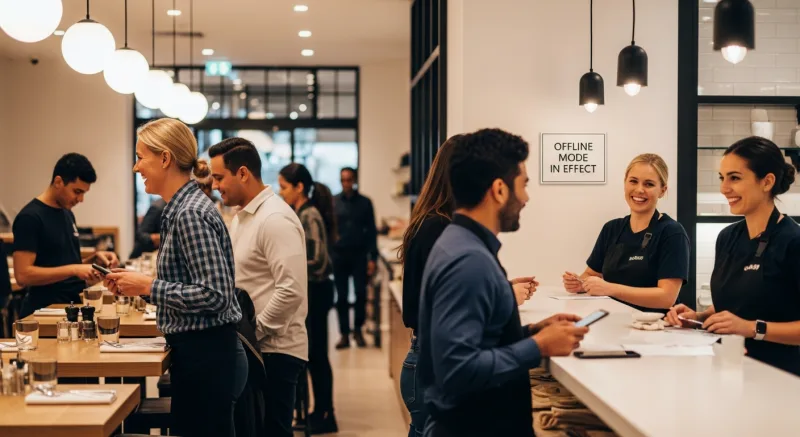
When the ground shakes and the internet drops, a cloud-dependent POS system becomes a brick. Toast requires cloud connectivity to function. Square processes payments through their cloud. If a moderate earthquake disrupts internet service — which happens with any quake above 4.5 magnitude in a populated area — restaurants on these platforms stop processing orders.
KwickOS processes every transaction locally. The terminal does not need internet to ring up an order, process a card payment (stored-and-forward mode), display kitchen tickets, or track inventory. It operates as a fully functional local system that happens to sync to the cloud when connectivity is available. After an earthquake disrupts service, a KwickOS restaurant continues operating normally while cloud-dependent competitors are manually calculating orders on paper.
This is not a theoretical advantage in LA. It is a practical one that matters multiple times per decade. And when a significant quake hits, the restaurants that stay open serve the community when it needs them most — and earn revenue when their competitors cannot.
Latino Cuisine and the Bilingual Kitchen
LA County’s population is 48% Hispanic or Latino. The restaurant industry reflects this demographic heavily — from taco stands to upscale Mexican restaurants to Peruvian ceviches to Salvadoran pupuserías. Spanish is the dominant language in the majority of LA restaurant kitchens, regardless of the cuisine being served.
KwickOS supports Spanish as a native interface language. Kitchen display stations show orders in Spanish. Employee management interfaces display in Spanish. Clock-in prompts, inventory labels, and reporting dashboards all toggle between English and Spanish at the terminal level. A restaurant owner who manages in English and a kitchen crew that operates in Spanish use the same system without language friction.
For restaurants serving Latino cuisine specifically, Spanish-language online ordering through KwickMenu reaches the community directly. A customer in Boyle Heights searching in Spanish finds your restaurant’s KwickMenu page with menu items, descriptions, and ordering flow in their language. This is not Google Translate bolted onto an English page. It is native Spanish content that reads correctly and orders accurately.
Celebrity Openings and Volume Spikes
LA’s restaurant scene is uniquely affected by celebrity culture. A restaurant that gets mentioned on an influencer’s Instagram story or featured on a Netflix food show can see volume spike 300-500% within days. These spikes are unpredictable, unsustainable at that level, and absolutely must be captured while they last because they often fade within weeks.
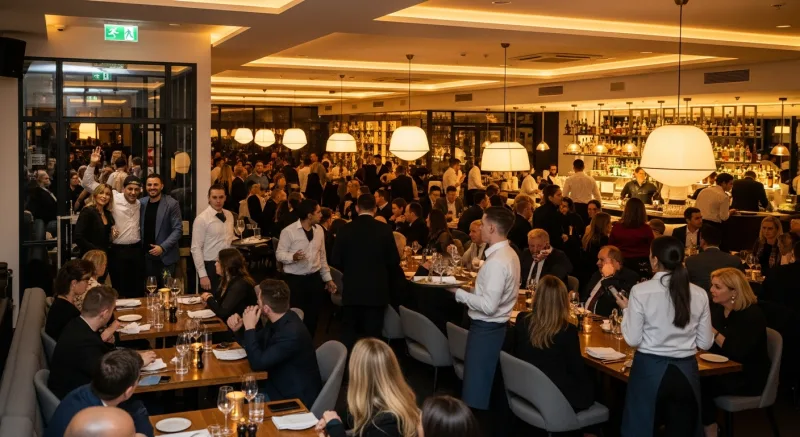
A POS system needs to scale instantly for volume spikes. Adding a self-ordering kiosk takes minutes with KwickOS — install the app on an iPad, connect to the system, and it is processing orders. Adding a kitchen display station takes the same effort. During a volume spike, you can add temporary terminals and remove them when demand normalizes. No hardware contracts, no proprietary equipment orders, no waiting for Toast to ship another terminal.
KwickOS kiosk mode, combined with online ordering through KwickMenu, absorbs volume spikes by distributing orders across channels. Walk-ins order at kiosks. Fans order online for pickup. Delivery orders route through KwickDriver. The kitchen sees a single unified queue regardless of channel, preventing the chaos of managing five separate order streams during a spike.
The Los Angeles Sustainability Angle
LA customers care about sustainability at a rate that exceeds national averages. Restaurants marketing environmental responsibility attract a loyal customer segment willing to pay 10-15% more for the commitment. Your POS system plays a quiet role in this narrative.
Digital receipts instead of paper receipts save 50-75 feet of receipt paper per day for a busy restaurant. Multiply across a year and you are talking about 4 miles of paper not sent to landfill. KwickOS defaults to digital receipts via text or email, with paper printing as an opt-in exception. This is a small operational detail that aligns with LA customer expectations.
Inventory tracking that reduces food waste is a bigger impact. KwickOS tracks ingredient depletion against actual sales, flagging variance that indicates over-portioning or waste. For LA restaurants promoting farm-to-table sourcing and minimal waste philosophy, the ability to demonstrate actual waste reduction metrics is a marketing asset, not just an operational one.
Multi-Location in a Spread-Out Market
An LA restaurant group might operate in Venice, DTLA, Pasadena, and the Valley — four locations separated by 20-30 miles each. Centralized management across this geography requires a cloud dashboard that lets ownership see every location without driving the 405 for two hours.
KwickOS provides real-time multi-location visibility. Sales, labor, inventory levels, and kitchen performance for every location appear on a single screen accessible from any browser. Menu changes deploy across locations with one click (or per-location, when Venice carries items that Pasadena does not). Employee profiles transfer between locations — a staff member who picks up a shift in DTLA uses their same fingerprint and appears on that location’s schedule automatically.
Crafty Crab Seafood manages 19 locations and 152 terminals through KwickOS. Their one-click menu synchronization and centralized reporting model demonstrates exactly what a growing LA restaurant group needs: control without commuting.
Getting LA-Ready
Los Angeles demands more from restaurant technology than most markets. The outdoor dining culture, the geographic sprawl, the health-conscious customer base, the seismic risk, and the bilingual workforce each create specific requirements that a generic POS cannot address.
KwickOS was not built for a generic restaurant in a generic city. It was built for the specific, complex, demanding operational realities that restaurants face in the markets where it matters most — markets like Los Angeles where conditions test every assumption that simpler systems make.
LA restaurant owners: Call (888) 355-6996 or visit KwickOS.com to schedule a demo at your location.
The Revenue Features Most "All-in-One" Systems Charge Extra For
When POS companies say "all-in-one," they rarely mean gift cards and loyalty are included. Toast charges $75/month for their loyalty add-on. Square Loyalty starts at $45/month. Clover requires third-party apps. KwickOS includes all of these natively — zero extra cost.
Physical & Electronic Gift Cards
Sell branded physical cards at the register. Send e-gift cards via text or email. Track balances across every location in real time. Gift card holders spend 20-40% more than face value — this is not a nice-to-have, it is a revenue multiplier.
Points-Based Loyalty System
Every transaction earns points. Customers see their balance on receipts and can redeem at checkout. Configurable earn ratios, tiered VIP levels, and automatic birthday rewards. No separate app required — it runs inside the POS your cashier already knows.
Membership & Subscription Management
Run coffee clubs, wine memberships, or VIP dining programs. Recurring billing, exclusive member pricing, and member-only items — managed from the same dashboard as your daily operations. Your customers feel special. Your revenue becomes predictable.
Real impact: businesses using KwickOS loyalty features see repeat visit rates increase by up to 35%. Gift card programs generate an average of 15% additional revenue during holiday seasons.

Tom Jin
Founder & CIO of KwickOS · 30 Years IT · 20 Years Restaurant Industry
Tom built KwickOS after decades running restaurants and IT companies. Today KwickOS serves 5,000+ businesses across 50 states.