 Tom Jin
Here's a Tuesday that happens in tattoo studios everywhere. A client books a five-hour half-sleeve for Saturday. Your artist blocks the whole afternoon, turns away two walk-ins to protect the time, and preps a custom design that took three hours to draw.
Saturday comes. The client doesn't.
No call, no text. Five hours of chair time — call it $350 to $600 in booked revenue — just evaporated. The custom art? Unpaid. And because the "deposit" was $60 in cash that went into the drawer three weeks ago with a name scribbled on a Post-it, nobody's even sure it was collected.
Now here's the part that should sting: this isn't a rare disaster. It's a line item. Industry research on appointment-based businesses consistently puts no-show and late-cancel rates in the 10–20% range when there's no deposit holding the slot. For a busy artist doing six booked sessions a week at an average of $350, even a 15% miss rate is roughly $18,000 a year in empty chair time — per artist. Multiply that across a four-chair shop and you're staring at real money walking out a door you can't see.
But it gets worse: the deposit that was supposed to protect that chair is the single most mishandled number in the whole shop. Cash in a drawer. A Venmo note. A screenshot. There's no system that says this person paid $60, it's reserved against this booking, and if they ghost, it's forfeited. So even when you take deposits, half the protection leaks away in the reconciliation.
This guide is about plugging that hole — and the three others hiding next to it. The tool that does it isn't your machine or your needles. It's the POS and checkout system at the front counter. Let's break down what a tattoo and piercing studio actually needs it to do.
Why a General Salon or Retail POS Fails a Tattoo Studio
Most POS systems were built for one of two worlds: retail (scan a barcode, take the money) or a nail-and-hair salon (book a 45-minute service, charge a flat price). A tattoo studio is neither.
Your "product" is a multi-hour, custom-priced session with a deposit attached weeks in advance. Your "inventory" is chair time, not SKUs. You have a hard legal requirement to capture a signed consent form and verify age on every single client. Your artists might be commission, might be booth rent, might be both. And a piercing walk-in, a $1,400 back piece, and a $30 tube of aftercare all have to ring up at the same counter.
Try to force that into a generic system and you get the mess most shops live with: deposits tracked in a notebook, waivers in a binder, payouts in a spreadsheet, and no single record that ties a client's ID, consent, healed work, and spending together. Every one of those gaps is either a revenue leak or a liability. A purpose-built platform closes them. Here's how.
The Signature System: Non-Refundable Deposits That Actually Stick
This is the one that pays for the whole system, so we'll spend the most time here.
A deposit only does its job if it's structurally impossible to lose track of. In KwickOS, the moment a client books, the deposit is collected at that step and stored as a credit against that specific booking on that artist's calendar — not as loose cash, not as a note. Three things happen automatically:
- The chair time is reserved. The booking holds the slot so the artist isn't double-booked and doesn't have to guess whether a "maybe" is real. A paid deposit is the only thing that turns a maybe into a booking.
- The deposit applies itself at checkout. When the client shows and the five-hour session wraps, the deposit is already sitting on the invoice as a credit. The artist rings the balance and moves on — no digging for the sticky note.
- A no-show forfeits it on the record — and flags the slot. If the client cancels inside your policy window or ghosts, the deposit is forfeited against the booking (documented, not disputed) and the open slot is flagged for waitlist backfill, so you can fill the afternoon instead of eating it whole.
That last piece is the difference between a policy and a system. A lot of shops have a deposit policy. Almost none have a way to prove the deposit was paid, apply it without friction, and forfeit it cleanly when someone flakes. Watch how much the math changes for a four-chair studio once deposits are enforced by the software instead of by memory:
| Deposits by memory | Deposits by system + waitlist | |
|---|---|---|
| Booked sessions / year (4 artists) | ~1,200 | ~1,200 |
| No-show / late-cancel rate | ~15% | ~5% |
| Unrecovered lost sessions | 180 | 60 |
| Average session value | $350 | $350 |
| Annual chair-time lost | $63,000 | $21,000 |
That's roughly $42,000 a year in recovered chair time across the shop — and it comes not from raising prices or working longer, but from a deposit that can't fall through the cracks and a waitlist that fills the gaps that remain. The same deposit primitive powers piercing appointments, guest-artist bookings, and big convention pieces where the no-show cost is highest.
Digital Consent Waivers Tied to the Client Record
Every tattoo and piercing is a signed-consent event. In most shops that means a paper form, a scanned ID, and a binder that grows until it's useless. When a client comes back two years later, nobody's finding their old waiver — so they re-sign, and the healed work, the allergy note, and the "she reacts to red ink" detail are all lost.
KwickOS turns the waiver into part of the client profile. At check-in, the client signs the consent and medical-history form on a tablet. It saves with a timestamp, the artist's name, and the design or piercing performed. Age-verification ID capture attaches to the same record. The next time that client books, their full history — prior waivers, allergies, aftercare notes, photos of healed work — is one tap away.
That's not just tidier. It's the difference between defensible documentation and a liability you're hoping never gets tested, and it's the difference between an artist guessing and an artist knowing exactly what they did last time. Because it's tied to a person, not a paper, it also becomes the foundation for everything else below — loyalty, memberships, and reminders all hang off that same profile.
Artist Commission vs. Booth Rent — Tracked Automatically
Ask ten shop owners how they pay their artists and you'll get ten answers: 60/40 splits, 70/30 for the senior artist, flat booth rent for the guest chair, a different rate on retail than on ink. Then ask how they calculate it — and watch them reach for a calculator and a stack of receipts.
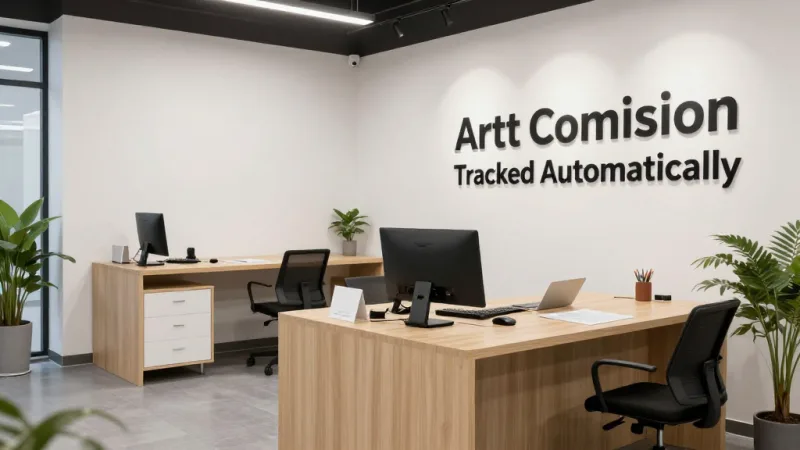
This is exactly the manual, error-prone work KwickOS automates, the same way it does for commission-based salons. Our own case study on this is Diva Nail Beauty, a four-location shop that used automated commission tracking to cut the back-office grind and post a 90% efficiency increase on payout reconciliation. A tattoo studio runs the same play:
- Commission artists get their split calculated automatically at checkout — say 60/40 on the session and a separate rate on aftercare retail — with a running payout ledger the owner can pull any time.
- Booth-rent artists keep their full sales while the system tracks their volume and bills the weekly or monthly rent on a recurring schedule (with the same failed-card recovery used for memberships).
- Every sale is attributed because artists sign in with fingerprint 1:N — no shared logins, no "who rang this up." Voids and discounts are attributed too, which quietly kills the discount-abuse and comp'd-friend leaks that plague cash-heavy shops.
Payday stops being an argument. The number is the number, and it's been sitting there in the ledger all week. If you're still deciding between models, our breakdown of commission versus booth rent walks through which one protects your margin at different volumes.
Processor Freedom on Big-Ticket Sessions
Here's a leak that's invisible because it's a percentage, not an event. A tattoo studio runs unusually large average tickets — a full-day session can be $800 to $1,500 on a single card swipe. On tickets that size, the difference between a locked flat-rate processor and a processor you chose yourself is real money.
KwickOS is processor-agnostic — you keep 100% of the choice, and you negotiate your own rate instead of being forced onto the POS vendor's mandatory processing. Watch what that does on a studio running $35,000/month in card volume:
| Locked flat rate (2.9% + $0.30) | Negotiated interchange-plus (~2.3%) | |
|---|---|---|
| Monthly card volume | $35,000 | $35,000 |
| Effective monthly fee | ~$1,353 | ~$1,050 |
| Annual processing cost | ~$16,236 | ~$12,600 |
| Kept per year | ~$3,600 | |
That's ~$3,600 a year that stays in the shop, every year, for doing nothing but owning your processor. Run your own numbers with the processing fee calculator — on the big-ticket sessions a tattoo shop rings up, the gap is usually wider than owners expect.
Aftercare Retail, Gift Cards, Loyalty, and a Recurring Aftercare Club
The session is the headline. The recurring revenue is everything around it — and it's where most shops leave the easiest money on the table.
Aftercare retail at checkout. Ointment, second-skin bandages, fragrance-free soap, sunscreen for healed pieces — these are high-margin add-ons that belong on every invoice. The POS prompts them at checkout the same way a customer-facing display prompts an upsell, so the artist doesn't have to remember to ask.
Gift cards and e-gift cards. A tattoo or a first piercing is one of the most-gifted "experiences" there is — birthdays, milestones, "I finally talked my friend into it." KwickOS includes native physical and digital gift cards and e-gift cards that a customer can buy online and send in seconds, perfect for a flash-day promo or a holiday push. And gift card breakage — the slice that's never fully redeemed — becomes recognized revenue on your books.
Loyalty points. A points program rewards both session spend and aftercare retail, giving a one-and-done client a reason to bring the next piece — and the next friend — back to your chairs instead of shopping artists across town.
A recurring aftercare / touch-up club. This is the membership play tattoo shops rarely run and absolutely should. A monthly "ink club" — bundling a free touch-up window, members-only flash pricing, priority booking, and an aftercare kit — turns unpredictable walk-in income into predictable recurring revenue, billed automatically each month with failed-card dunning so you're not chasing payments. Because membership, points, gift cards, and the client's waivers and healed work all live on one shared profile, you can time the touch-up reminder, the next piercing, and the aftercare reorder to the same person at exactly the right moment.
One Dashboard Across Multiple Studios — Even When the Internet Drops
Growing from one shop to three shouldn't mean three disconnected systems. KwickOS runs every location on one dashboard — the same architecture that lets T. Jin China Diner monitor 15 stores and 75 terminals in real time from anywhere. For a studio group that means one client database (a client who moves cities keeps their history and deposits), one commission ledger, and one view of which chairs and which artists are actually making money.
And because KwickOS is hybrid local + cloud, checkout, deposits, and waiver signing keep working even if the internet drops mid-session — the terminal runs locally at ~1ms and syncs when the connection returns. No "sorry, our system's down" in the middle of a $1,200 back piece. The platform is multi-language (English, Chinese, Spanish) out of the box, which matters for both a diverse client base and a diverse crew.
The Bottom Line
A tattoo and piercing studio doesn't lose money because the art isn't good enough. It loses money in the gaps around the art: the deposit nobody can find, the waiver in a binder, the payout worked out at midnight, the processing percentage skimmed off every big ticket, and the client who never comes back because nothing reminded them to.
Close those gaps and the same shop, with the same artists and the same chairs, keeps tens of thousands of dollars more a year. That's the job of a POS built for how a tattoo studio actually runs — deposits that stick, waivers that live on the client, payouts that calculate themselves, and gift cards, loyalty, and memberships that turn one session into a relationship.
Run Your Studio on a POS Built for Chair Time
KwickOS locks in every deposit, waiver, and artist payout — and lets you keep your own processor. See what it looks like for your shop.
Calculate Your SavingsFrequently Asked Questions
How do non-refundable tattoo deposits work in a POS system?
When a client books, the POS collects a non-refundable deposit (commonly $50 to $200) and reserves that artist's chair time on the calendar. The deposit is stored as a credit against the eventual session, not as loose cash in a drawer. If the client shows, it applies to the final invoice automatically. If they no-show or cancel inside the policy window, the deposit is forfeited on the record and the slot is flagged for waitlist backfill — so the chair time isn't a total loss. Because the deposit is tied to the client profile and the booking, there's no manual reconciliation and no argument about whether it was paid.
Can a tattoo studio POS store digital consent forms and ID?
Yes. With KwickOS the client signs the consent and medical-history waiver on a tablet at check-in, and it's saved to their profile with a timestamp, the artist's name, and the design or piercing performed. Age-verification ID capture attaches to the same record. Because everything lives on the client profile, a returning client's prior waivers, allergies, and healed work are one tap away instead of buried in a paper binder — which matters for both liability and repeat-work quality.
How does the POS handle artist commission versus booth rent?
KwickOS supports both models and mixes them per artist. For commission artists it calculates the split automatically at checkout (for example 60/40 on the session, with a separate rate on retail aftercare) and keeps a running payout ledger. For booth-rent artists it tracks their sales without taking a split and can bill the weekly or monthly rent on a recurring schedule. Fingerprint 1:N sign-in ties every sale, void, and discount to the specific artist, so payouts are exact and disputes disappear.
Does a tattoo shop POS support gift cards, loyalty, and memberships?
KwickOS includes native physical and digital gift cards and e-gift cards (a natural fit for gifting a flash-day session or a piercing), a points loyalty program that rewards both session spend and aftercare retail, and recurring memberships — an aftercare or touch-up club billed monthly with automatic failed-card recovery. Gift card breakage becomes recognized revenue, and because gift cards, points, membership, waivers, and healed work all sit on one shared client profile, you can time the next touch-up, the next piercing, and the next reorder to the same person.