 Ming Ye
It's 12:20 on a Tuesday. The line is twenty deep and out the door. The third person back checks the time, glances at how slowly the front is moving, and quietly steps out to go somewhere faster.
You didn't see them leave. You never do. That's the problem.
Here's what makes it brutal: a taqueria has the best unit economics in the restaurant business — low food cost, fast assembly, high frequency — and it gives most of that advantage back at the exact moment it should be cashing in. You don't lose money on the slow afternoon. You lose it during the rush, one walked customer at a time, in the sixty minutes when every seat in line is worth real cash and your line can't move fast enough to collect it.
Run the math on it. If your line moves five customers a minute, you serve 300 in a peak hour. If it moves seven, you serve 420. That gap — 120 customers at, say, a $12 average check — is $1,440 in a single lunch, walking down the street to the spot with the shorter line. Over a year of lunches, the difference between a fast line and a slow one is a six-figure swing on the same rent, the same food, the same staff.
Here's the thing: that speed isn't luck or hustle. It's design. A taqueria that serves 400 an hour isn't working harder than one that serves 280 — it's built differently. This guide breaks down exactly how: the assembly-line layout, the prep that has to happen before the doors open, the protein portioning that protects your margin, the speed targets that tell you when you're winning, and the quick-order POS workflow that keeps the register from becoming the bottleneck.
The Line Is the Product: Assembly-Line Layout
Forget thinking of your taqueria as a kitchen. At peak, it's a factory line, and the single most important design decision you make is the order of the stations. Product flows in one direction, never backward, never crossing itself. The classic high-volume taco line has four positions:
- Order / cashier — takes the order and rings it. This is the front gate, and it's where most lines secretly choke.
- Protein station — the plancha, the trompo, the steam table. Proteins are held hot and portioned to order.
- Build / toppings station — tortillas, the customized assembly, salsas, garnish.
- Expo / handoff — bag, tray, drink, call the name, hand it off.
The rule that governs all of it: the line moves at the speed of its slowest station. If your build station can dress eight tacos a minute but your cashier can only ring five orders a minute, you are a five-order-a-minute restaurant no matter how fast your cooks are. That's why the most common, most expensive mistake in taqueria operations is pouring all your attention into the kitchen and treating the register as an afterthought.
And here's the part that surprises people: the kitchen is almost never the real bottleneck. A line cook can dress a taco in a few seconds. The choke points live at the two ends — order entry at the front and handoff at the back — because those are the stations that depend on communication, not just hands. Fix the ends and the middle takes care of itself.
Mise en Place: The Rush Is Won Before It Starts
Walk into any taqueria that consistently turns a fast line and you'll find the same truth: the lunch rush was decided at 10:30 a.m., not 12:30. Speed at peak is almost entirely a function of prep done before the doors open.
Every protein portioned and held hot. Salsas made, labeled, and racked in order. Tortillas counted and staged. Toppings in their wells, backups in the lowboy directly underneath so a runner can swap an empty pan in five seconds instead of walking to the walk-in mid-rush. Cups stacked, bags pre-opened, lids within arm's reach at expo. Every item the line will touch during the rush is already where a hand expects it to be.
But it gets worse if you skip it: the cost of weak mise en place doesn't show up as one big failure. It shows up as a hundred tiny ones — the cook who leaves the line to grab more cilantro and the whole build station stalls behind him, the cashier who has to call back to ask if you're out of barbacoa, the three-second reach that becomes a fifteen-second hunt. Multiply small friction across a 400-cover hour and you've quietly given back a third of your throughput.
This is also where a connected system earns its keep before service even starts. When your POS feeds yesterday's sales into a prep view, your kitchen lead isn't guessing how much al pastor to fire — the numbers tell them. A multi-location operator like Crafty Crab Seafood runs 19 stores on one-click menu and recipe sync, so a prep sheet standardized at one location rolls out to every store; the same central control means a growing taqueria brand preps off real data instead of one manager's memory.
Protein Portioning: Where Your Margin Lives or Dies
Let's talk about the number that actually determines whether your taqueria is profitable: protein cost per taco. It's almost always your single largest food expense, and it's the one most operators control by feel — which is to say, not at all.
Here's the math that should keep you up at night. Say a taco is built on a 3-ounce protein portion. If your line cooks are running closer to 3.5 ounces because nobody's measuring, that's a half-ounce of giveaway on every taco. Sell 600 tacos a day and you're handing out roughly 18 pounds of protein you charged nothing for — every single day. At even a modest cost per pound, that's a number with a comma in it, gone every month, and it never appears on a single report because no one's looking for it.
The fix is mechanical, not motivational:
- Portion by tool. A fixed scoop, a portion scale, a pre-weighed protein cup — anything that takes the judgment out of the line cook's hands during a rush. You can't ask someone to eyeball three ounces accurately while forty people watch them work.
- Track theoretical vs actual. When your POS knows you sold 600 al pastor tacos, it knows exactly how much meat that should have consumed. The gap between that theoretical number and what you actually went through is your waste, over-portioning, and shrinkage — finally visible.
- Watch the free stuff. Chips, the salsa bar, the "throw an extra scoop on for a regular." Generosity is good marketing and a silent margin leak; you can't manage it until you can measure it against what you sold.
That last point is the whole game with a salsa bar and self-serve toppings. You'll never ring a register tap on a salsa station, but a POS that feeds into inventory lets you track ingredients flowing into it against your covers — so you catch the week where chip-and-salsa usage spikes out of line with traffic before it eats a full point off your margin. You manage what you measure, and a connected platform measures the parts of a taco menu that never touch a register.
The Register Is the Real Bottleneck: Quick-Order POS Workflow
Now back to the front gate, because this is where most taquerias quietly cap their own ceiling. Your cooks can keep up. The question is whether your order entry can.
The problem is that Mexican food is the most customization-heavy cuisine in fast-casual. One taco isn't one product — it's a protein choice, a tortilla, a handful of toppings out of dozens, a salsa, a spice level, maybe a premium add-on. If ringing all of that means hunting through five screens and free-typing modifications, the cashier becomes the slowest station on the line by a mile, and the entire operation is throttled behind one tablet.
The fix is a POS built for speed at exactly this kind of menu:
- A quick-order grid that puts your fifteen highest-volume items — the al pastor taco, the carnitas burrito, the combo, the horchata — one tap away on the front screen. The 80/20 rule is brutal here: a handful of items are most of your volume, and they should never be more than a tap or two from rung.
- Structured modifier groups — protein, tortilla, toppings, salsa, spice — so a fully customized taco rings in a few taps with required and optional rules that stop an incomplete or nonsense order from ever reaching the kitchen.
- Automatic price adjustments so the cashier never has to remember that carnitas is a dollar more or extra guac is $2 — the POS adds it the instant they tap it, protecting both speed and margin at once.
- Kitchen display routing so the build station sees a clean, top-to-bottom ticket — protein, base, toppings, salsa, spice — instead of a wall of free-typed notes. Fewer remakes, faster handoffs, no shouting back and forth.
That last piece is the secret to keeping the back of the line fast. Rockin' Rolls Sushi Express cut serving time using exactly this kind of KDS-integrated customization across 49 self-ordering stations — the cooks always saw a clean, unambiguous build. The principle is identical on a taco line: when the kitchen display does the communicating, the build station never stalls to ask "what was on that one?" (Our QSR speed-of-service guide goes deeper on order-point and handoff timing.)
Speed Targets: Know Your Numbers or You're Guessing
You can't improve a line you don't measure. The taquerias that get fast run on numbers, not vibes, and the good news is your POS already captures most of them. The targets that matter:
- Order-to-handoff time. From the moment the order is rung to the moment it's handed off. A tuned taco line lands in the 90-second-to-3-minute range at peak. If yours is creeping past five, you have a station that's choking — find it.
- Orders per minute at the register. This is your true throughput ceiling. Five per minute is 300 an hour; seven is 420. Track it and you'll know whether to add a second register at peak — which is often the single highest-ROI move a busy taqueria can make.
- Covers per labor hour. Tells you whether you're staffed right for the rush and overstaffed for the lull. Time-stamped sales data from the POS shows you exactly when to schedule the extra hands.
- Average ticket. The lever combos and upsells move. A "make it a combo?" or "add chips and queso for $3?" prompt at the right moment lifts this without a single extra customer in line. (See our upselling guide for the exact prompts.)
And that's not all the data does. Because KwickOS runs a hybrid local-plus-cloud model, an owner can pull these numbers in real time from anywhere — the way T. Jin China Diner monitors 15 stores and 75 terminals remotely, watching the lunch rush at every location from one dashboard. You don't have to stand behind the register to know whether the line is winning.
Where the Margin Compounds: Checkout, Loyalty, and Gift Cards
Here's what separates a taqueria that grinds for every transaction from one that builds a base of regulars who come back every week: what happens in the last five seconds, at checkout.
A taqueria has the thing most restaurants would kill for — frequency. People eat tacos weekly, sometimes daily. That frequency is worthless if every visit is anonymous, and it's a goldmine the moment you start capturing it. The trick is doing it without adding a single second to the handoff, which means it has to live inside the POS, not in a separate app:
- Enroll regulars in loyalty and points at the register. For a weekly-frequency concept, a points or membership program — "buy 9, get the 10th," or points per dollar — is one of the highest-return retention tools that exists. With an all-in-one POS, the cashier enrolls or applies points in a couple of taps on the payment screen, no punch card to lose, no line slowdown.
- Sell gift cards and e-gift cards. "Want a gift card for a friend?" is the most overlooked upsell on the checkout screen. Gift cards are guaranteed future revenue plus a near-certain return visit, and e-gift cards spike hard around Cinco de Mayo, the holidays, and graduation — a slice never gets fully redeemed, which quietly lifts your margin.
- Save the customer profile. Tie the order to a customer record so you know their usual, can text them a Taco Tuesday offer, and can win them back if they go quiet. Tiger Sugar built minimal-step personalization and electronic receipts with loyalty into a two-kiosk operation — proof you don't need to be huge to run a sharp retention loop.
This is where a POS stops being a cash register and becomes a marketing engine. When checkout, loyalty, points, gift cards, e-gift cards, and customer profiles all live in one platform instead of four apps that don't talk to each other, that retention loop runs itself — and the lunch regular you served in 90 seconds becomes a member who comes back fifty more times this year.
The Platform Underneath: Why It Has to Stay Up
None of this matters if the technology buckles on your busiest shift — and the lunch rush is precisely when cloud-only systems fail. A packed line, dozens of customized orders firing at once, and one internet hiccup takes the whole POS dark at the worst possible moment.
This is where architecture quietly decides whether your rush is a triumph or a disaster. KwickOS runs on a hybrid local-plus-cloud model: the POS keeps ringing at 1ms local speed even if the internet drops mid-rush, then syncs when the connection returns. Toast and most cloud-only systems go down when the Wi-Fi does. On a Friday lunch with the line out the door, that difference is real money on the floor. A few other things that matter specifically for a high-volume taqueria:
- Built-in Spanish. Most taquerias run multilingual front-of-house and kitchen teams. KwickOS ships with English, Chinese, and Spanish built in, so each staff member works in the language they're fastest in and kitchen tickets print in the line cooks' language — fewer errors, faster ramp-up for new hires.
- Processor-agnostic payments. Keep your own processor and negotiate your own rates, saving most restaurants $3,000 to $8,000 a year versus locked-in systems. On a high-volume operation, that processing freedom lands straight in your margin. (See how it stacks up in our platform comparison hub.)
- Fingerprint employee verification. 1:N fingerprint authentication keeps time theft and unauthorized voids in check — exactly what you want when you're staffing up with extra hands for the rush.
- KwickDriver delivery. A $2 flat fee plus $6.99 per five miles instead of the 15–25% commission the third-party apps take — so delivery tacos stay profitable.
- One unified platform. POS, kitchen display, online ordering, CRM, loyalty, and gift cards in a single system — no patchwork of apps that don't sync.
That's the whole argument. A taqueria doesn't need five vendors and five logins. It needs one platform fast enough to keep the register from being the bottleneck, smart enough to protect protein margin, and connected enough to turn a 90-second transaction into a lifelong regular. Operators ready to see it running across one location or fifty can start on our restaurant solutions page, and resellers who set these systems up for local operators can learn more on our partner program page.
Price the Line With Numbers, Not a Guess
Before you finalize a combo price or a premium-protein add-on, run the actual math. Pricing a customization-heavy menu by feel is how operators give away margin on every guac upgrade and every "extra meat" — the same drift that erodes your protein cost, this time at the pricing end. Our free tools library has calculators for food cost, menu pricing, and promotion ROI that take the guesswork out of where to set your taco combos, your salsa-bar giveaways, and your catering tiers, so the speed you built into the line doesn't get undone by prices that are too low to profit from the volume.
The Bottom Line
A taqueria wins on throughput, and throughput is engineered, not improvised. Lay out the line so product flows one direction. Win the rush at 10:30 with disciplined mise en place. Portion protein by tool and track it against sales so your largest food cost stops leaking. Then attack the real bottleneck — the register — with a quick-order grid, clean modifiers, and kitchen-display routing that keeps the cooks from ever becoming the limiting factor.
Then close the loop where it compounds. Capture every one of those fast, frequent transactions into loyalty, sell a gift card, save the profile — and one 90-second lunch becomes a year of weekly visits at full price. On a platform that stays up when the internet doesn't and lets your team work in the language they're fastest in, that's the difference between a line that prints money for sixty minutes and a line that watches a third of its customers walk down the street.
Build a Line That Moves as Fast as Your Cooks
KwickOS unifies quick-order POS, kitchen display routing, inventory-connected portioning, loyalty, and gift cards in one platform — with built-in Spanish and a hybrid system that never goes down mid-rush. See how it works.
Get My Free Demo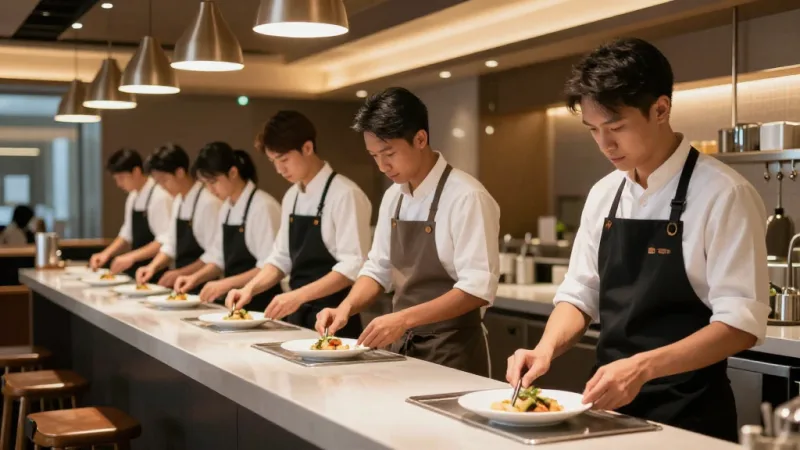
Frequently Asked Questions
How many tacos can one taqueria line realistically serve per hour?
A well-designed taqueria assembly line with three to four stations — order/cashier, protein, build/toppings, and expo — can move 350 to 400 covers an hour at peak. The ceiling is almost never the kitchen's cooking capacity; it's the order-entry and handoff speed at the two ends of the line. When the cashier rings a fully customized order in a few taps on a quick-order POS grid and the kitchen display shows the build top-to-bottom, the line moves at the speed of the slowest station instead of stalling on miscommunication.
What is the biggest bottleneck in a taqueria, and how do you fix it?
The biggest bottleneck is order entry, not cooking. A line cook can assemble a taco in seconds, but if the cashier is hunting through menu screens or free-typing "no onions," the whole line backs up behind the register. The fix is a quick-order POS grid with structured modifier groups so the most common items ring in one or two taps, plus kitchen display routing so the build station never has to ask "what was on that one?" Remove friction at the register and the cooks rarely become the limiting factor.
How do you control protein cost on a high-volume taco line?
Portion by tool, not by feel. Use a fixed scoop or scale-portioned protein at the build station so every taco gets the same weight, then track theoretical protein usage against actual sales through a POS-connected inventory system. When your POS knows you sold 600 al pastor tacos, it knows you should have used a specific amount of meat — and any gap between that and what you actually went through is waste, over-portioning, or theft you can now see and correct. Protein is usually a taqueria's single largest food cost, so a half-ounce of drift per taco adds up to thousands of dollars a year.
Can a taqueria run a loyalty program and gift cards without slowing the line?
Yes, as long as loyalty, points, gift cards, and e-gift cards live inside the POS checkout rather than in a separate app. A taqueria has something most restaurants envy — weekly frequency — so a points or membership program is one of the highest-return tools it can run. With an all-in-one platform like KwickOS, the cashier enrolls a regular, applies points, or sells an e-gift card in a couple of taps on the same payment screen, so retention is captured without adding seconds to the handoff.