 Kelly Ho
Picture the worst version of a Monday morning. You unlock the back door, and the smell hits you before the light does.
The walk-in freezer failed sometime Saturday night. Nobody was in the building. By the time you're standing in front of it, $8,400 of protein, seafood, and prep is a total loss — and your Saturday-night deliveries were already at risk because the compressor had been struggling for days.
Here's the part that stings: the freezer tried to warn you. Its temperature had been creeping up for 40 hours. A $30 wireless sensor would have sent you a text at 11 PM Saturday, you'd have moved the inventory to another unit, and Monday would have been ordinary.
That gap — between a machine that knows it's failing and a human who finds out too late — is exactly what restaurant IoT closes. And it isn't about chasing shiny gadgets. It's about the money that silently walks out the back door because nobody was watching a dial at 2 AM.
Let's break down what actually works, what it costs, and where the real payback hides.
What "Smart Restaurant" Really Means (Skip the Hype)
Strip away the marketing and "IoT" is simple: it's equipment that reports its own status automatically, so a person doesn't have to. Instead of a manager walking the line with a clipboard four times a day, sensors watch everything continuously and speak up only when something's wrong.
In a working kitchen, the useful devices fall into four buckets:
- Temperature monitoring. Wireless probes in every cooler, freezer, and hot-hold unit, logging readings 24/7 and alerting the instant one drifts out of a safe band.
- Equipment sensors. Fryers, dishwashers, ice machines, and HVAC units reporting cycle counts, oil quality, water temperature, and vibration — the early-warning signs of wear.
- Energy management. Smart thermostats, meters, and plug-level monitors that reveal which equipment burns the most power and let you schedule it around peak-rate hours.
- Predictive maintenance. The layer on top: software that watches all those signals over time and flags a part that's about to fail before it does.
Here's the thing: any one sensor is a nice gadget. All of them reporting into one dashboard — ideally the same platform running your POS and checkout — become an operations nervous system. That's the difference between "we bought a smart thermometer" and "we run a smart restaurant."
Temperature Monitoring: The Sensor That Pays for Everything Else
If you install exactly one category of IoT, make it this one. Cold storage is where the biggest, fastest losses live, and it's also where compliance risk hides.
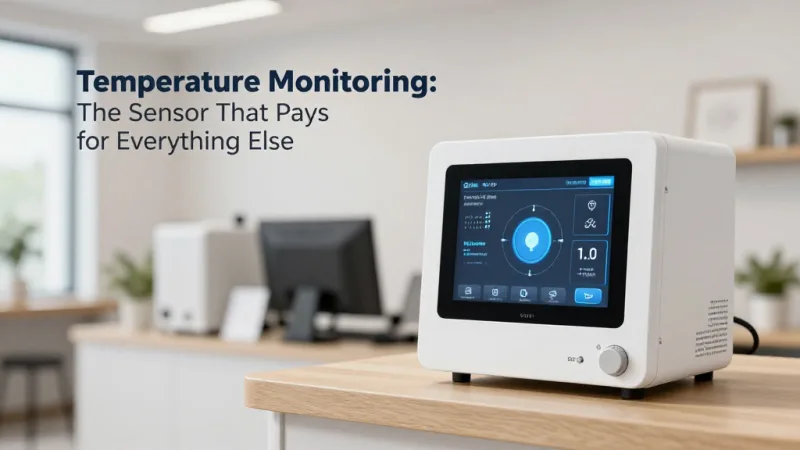
Automated temperature monitoring does three jobs at once. First, it protects inventory — the freezer story above is the headline, but the quieter win is catching the cooler that's running two degrees warm and shortening the shelf life of everything inside it. Second, it protects you legally. Paper temp logs are a health-inspector liability and, frankly, half of them are filled out from memory at the end of a shift. Digital logs are automatic, tamper-evident, and inspection-ready. Third, it protects your reputation — the food-safety incident you never have because a sensor caught the problem at 11 PM instead of a customer catching it at dinner.
But it gets better when the data doesn't live on an island. We covered the compliance side in depth in our guide to digital temperature monitoring and why paper logs are a liability — the short version is that a sensor feeding the same system that runs your inventory means a temperature excursion can automatically flag the affected stock for review before it ever reaches a plate.
Loss-aversion math, plainly: one prevented freezer loss typically covers years of monitoring hardware. You're not spending money to save money someday — you're buying an insurance policy that also happens to file your paperwork.
Equipment Sensors and the End of "Run It Till It Dies"
Most kitchens run equipment on a simple, expensive philosophy: use it until it breaks, then panic. IoT sensors replace panic with a heads-up.
Take the humble fryer. A smart fryer tracks oil temperature, filtration cycles, and total cook time, then tells you precisely when the oil is spent — not when a slammed cook eyeballs it. Restaurants that manage oil by data instead of guesswork routinely cut oil consumption by double digits, because half the oil that gets dumped still had life in it, and the other half should have been changed two batches ago (hello, off-flavor complaints). Trimming oil cost 30% on a line that fries all day is real, recurring money.
And that's not all. Ice machines report when they're scaling up and losing output. Dishwashers flag when final-rinse water isn't hitting sanitizing temperature — a silent health violation you'd otherwise never see. HVAC units warn when a motor is drawing more current than it should, weeks before it seizes during your Friday rush.
Every one of these is the same pattern: a machine that knows something is wrong, finally given a way to tell you.
Energy Management: Your Third-Biggest Bill, Finally Visible
After food and labor, energy is often the largest controllable cost in a restaurant — and it's the one almost nobody measures at the equipment level. You get one lump utility bill a month and no idea what drove it.
Energy IoT breaks that black box open. Plug-level and circuit monitors show you exactly which equipment eats the most power and when. That visibility unlocks concrete moves:
- Schedule around peak rates. Run high-draw prep and cleaning cycles during off-peak utility windows instead of at the most expensive hour of the day.
- Catch phantom loads. Equipment left running overnight that nobody needs — the classic "why is the second hood on at 3 AM?" — becomes obvious.
- Right-size HVAC. Smart thermostats tuned to occupancy and daypart, so you're not cooling an empty dining room at full blast between lunch and dinner.
Pattern interrupt: here's a way to turn a cost cut into a growth play. Take the monthly energy savings and route it straight into a customer-facing program — fund a loyalty points multiplier during your slow daypart, or a gift card bonus promotion for the holidays. The utility company was quietly taxing your inefficiency; now that money buys repeat visits instead. Because KwickOS runs energy monitoring, POS, and the CRM and loyalty engine on one platform, that hand-off from "saved on power" to "spent on retention" is a reporting view, not a spreadsheet project.
Predictive Maintenance: Fixing Problems Before They Cost You a Day
This is where the four buckets combine into something bigger than the sum of the sensors. Predictive maintenance watches equipment signals over time and learns what "normal" looks like, so it can flag "about to fail" while there's still time to act.
The economics here are brutal in your favor. Consider what a single unplanned equipment failure actually costs: the emergency-service premium (nights and weekends aren't cheap), the spoiled inventory if it's refrigeration, and — the big one — the lost revenue from closed or degraded hours. A restaurant doing $3,800 a day that loses a day to a dead compressor didn't just pay a repair bill; it lost a full day of sales, tips, and every gift card and loyalty transaction that would have run through the register. Industry data on commercial refrigeration consistently shows that scheduled, condition-based maintenance costs a fraction of emergency repair.
Predictive maintenance turns a $6,000 catastrophe into a $400 planned service call on a Tuesday morning when you're closed anyway. That's the whole pitch.
Why It All Has to Live With Your POS
Now the trap, because plenty of operators buy a pile of disconnected smart gadgets and end up worse off. The failure mode is the same one that sinks bad automated ordering: a separate app for every device.
One app for the freezer sensors. Another for the fryer. A third portal for energy. A fourth login for the POS. Each beeps in its own silo, and the promise of "less work" becomes four more things to check. Nobody watches all four, so alerts get missed and the whole investment quietly rots.
The fix is architectural. Sensor data belongs in the same operating system that runs your checkout, inventory, gift cards, and loyalty — so the person already watching sales is watching equipment health in the same glance. On a unified platform like KwickOS, that unlocks a few things a bolt-on gadget never can:
- Offline resilience by design. KwickOS runs a hybrid local-plus-cloud architecture with roughly 1ms local latency, so temperature and equipment monitoring keep working when the internet drops — the exact same resilience that keeps your POS checkout and gift card balances live during an outage. Your sensors don't go blind because the ISP hiccuped.
- One dashboard, one truth. Sales, labor, inventory, and equipment health on the same screen. A cooler alert can cross-reference the inventory it threatens — a link we explore in our guide to POS-integrated inventory and knowing your real food cost daily.
- Remote oversight that scales. T. Jin China Diner monitors 15 stores and 75 terminals from one real-time view; add equipment sensors to that same view and an owner can spot a failing freezer in store #9 from their phone. Crafty Crab Seafood runs 19 stores and 152 terminals on the same central nervous system — the platform that syncs a menu across all of them is the platform that can watch every walk-in at once.
The rule: if a smart device can't report into the system you already run your business on, it's not making you smarter — it's adding a chore.
A Sane Rollout (and What It Costs)
You don't wire up the whole kitchen on day one. Sequence it by risk and payback:
- Start with cold-storage temperature monitoring. Highest risk, fastest ROI, simplest install. Wireless probes in every walk-in and reach-in, alerting to your phone. This is the one that pays for the rest.
- Add your highest-cost equipment sensors. Usually the fryer line and refrigeration compressors — the gear whose failure or inefficiency costs the most.
- Layer in energy monitoring. Once you trust the data, meter your big draws and start scheduling around peak rates.
- Turn on predictive maintenance. With months of sensor history, the software can start forecasting failures instead of just reporting them.
At every step the non-negotiable is integration: the device must report into your operating platform, not a private app. Want to size the payback for your own numbers before you buy anything? Run your food-cost and processing figures through our free restaurant calculators, and if you're weighing platforms, our side-by-side comparisons show which systems actually unify equipment data with POS instead of leaving it stranded.
The Bottom Line
Smart-restaurant technology gets sold as futuristic. It isn't. It's deeply practical — a set of cheap sensors that watch the things a human can't watch at 2 AM, and a platform that turns their warnings into money kept instead of money lost.
The freezer that texts before it spoils $8,400. The fryer that cuts oil cost 30%. The compressor that gets a $400 tune-up instead of a $6,000 funeral. None of it is glamorous, and all of it drops straight to your bottom line. Wire those sensors into the same system that runs your checkout, gift cards, and loyalty, and you get one more quiet advantage: an owner who finally knows what every machine in the building is doing — even when the lights are off and everyone's gone home.
Run Your Whole Operation on One Platform
KwickOS unifies POS and checkout, inventory, gift cards, loyalty, and connected-equipment monitoring — with a hybrid local-plus-cloud architecture that keeps working when the internet doesn't. See what one dashboard for sales and equipment health looks like.
See KwickOS for RestaurantsFrequently Asked Questions
What are IoT devices in a restaurant?
IoT (Internet of Things) devices are sensors and connected equipment that report their status automatically over your network. In a restaurant that means wireless temperature probes in coolers and freezers, sensors on fryers, dishwashers, and HVAC units, smart thermostats and energy meters, and door or leak detectors. Instead of a person checking a thermometer and writing it on a clipboard, the device logs the reading continuously and raises an alert the moment something drifts out of a safe range.
How much money can restaurant IoT actually save?
The savings come from three places: prevented losses, lower running costs, and avoided downtime. A single freezer failure caught early can save thousands of dollars of inventory in one night. Smart fryer management and energy scheduling routinely trim utility and oil costs by double-digit percentages. And predictive maintenance that catches a failing compressor before it dies avoids emergency repair fees plus a day of closed doors. For most operators the sensors pay for themselves within the first prevented incident.
Does restaurant IoT connect to my POS system?
It should. The value multiplies when sensor data lives in the same platform that runs your POS, checkout, inventory, gift cards, and loyalty. On KwickOS, a hybrid local-plus-cloud architecture means temperature and equipment data is monitored on-site with about 1ms latency and keeps working even if the internet drops — the same resilience that keeps your register and gift card balances live during an outage. One dashboard shows sales, labor, inventory, and equipment health together instead of scattering them across separate apps.
Is smart restaurant technology worth it for a small independent restaurant?
Yes, and often more so than for a chain, because a single independent can't absorb a $6,000 spoilage loss or a two-day closure the way a 50-unit brand can. Entry-level wireless temperature monitoring starts small and scales up as you add energy and equipment sensors. The rule of thumb: start with the risk that would hurt most if it failed — usually cold storage — prove the ROI, then expand.