 Ming Ye
Here's the number that should reframe how you think about January: for a typical full-service restaurant, dine-in revenue can drop somewhere around 23% versus the fourth quarter. Traffic falls off a cliff almost the moment the new year begins.
And here's what makes that drop so dangerous. Your sales fall — but almost none of your costs do. Rent doesn't take January off. Your insurance premium, your equipment leases, your salaried managers, your base utilities: all of it shows up in full while the revenue that's supposed to cover it has been cut nearly a quarter. That's the math that turns a slow month into a losing month.
But it gets worse. Most owners respond to the slow season the way they respond to a cold snap — by hunkering down and waiting it out. They cut a few shifts, slash some prices in a panic, and hope March arrives quickly. That instinct is exactly backwards. Reactive cost-cutting protects nothing; it just shrinks the business while the overhead stays fixed. The slow season doesn't reward the restaurants that hide. It rewards the ones that show up with a plan.
So let's build that plan. Below are eight strategies — a mix of demand-generation, revenue protection, and the operational fixes the quiet months are actually perfect for — that turn January and February from the part of the year you dread into the part you use. We'll keep it concrete, with real numbers and the systems that make each one work.
First, Understand Why the Slow Season Hits So Hard
Before the tactics, the diagnosis. The post-holiday slump isn't one problem — it's three colliding at once, and each one needs a different answer:
- Demand evaporates. Customers are tapped out from holiday spending, half of them are dieting, and nobody wants to drive out in the cold. The desire to dine out simply isn't there.
- Fixed costs don't move. Rent, salaries, leases, and insurance are the same in January as in December. Lower revenue spread over the same overhead is a margin killer.
- The customer relationship goes cold. The guest who came three times in December has no reason on the calendar to come back in January — unless you give them one.
Notice that two of those three are things you can directly influence. You can manufacture demand, and you can keep the relationship warm. The fixed costs you can't change — but you can make them productive, which is the quiet theme running through everything below. Let's start with the most powerful lever you have, and it's one you may have already pulled without realizing it.
Strategy 1: Cash In the December List You Already Built
If you ran a real holiday season, you didn't just sell meals in December — you built an asset. Every gift card sold, every loyalty enrollment at the register, every party booking captured into a profile: that's a list of warm customers, and the slow season is precisely when it pays off.
Start with gift cards, because the timing is almost magical. Roughly half of all annual gift card sales happen in the six weeks before Christmas, and a huge share of those cards get redeemed in January and February — bringing guests through your door in the exact months you need them most. Better still, redeemers routinely spend beyond the card balance, so a $50 card often becomes an $80 check. If your POS makes redemption a one-tap action and prompts a reload or bonus top-up at checkout, a one-time December buyer turns into a recurring slow-season regular. (If you haven't built that engine yet, our holiday gift card sales strategy shows how December funds the new year.)
Then there's the relationship list. Every guest your checkout enrolled in loyalty or captured into a CRM profile is someone you can reach with a single "we miss you" message when the dining room is quiet — and a targeted win-back offer to a past guest converts far better and far cheaper than any ad to a stranger. This is the entire payoff of doing the work at the terminal during the rush: the packed December guest list becomes the January marketing list. Our guide to loyalty marketing automation covers the exact trigger sequence.
Strategy 2: Give Customers a Reason to Visit on a Specific Slow Day
Here's a pattern interrupt worth internalizing: blanket discounts don't fix a slow season — they just make you poorer on the traffic you'd have gotten anyway. "20% off everything in January" trains your regulars to wait for the discount and does nothing to pull in someone who wasn't already coming. The fix isn't a lower price. It's a specific reason to visit on a specific slow night.
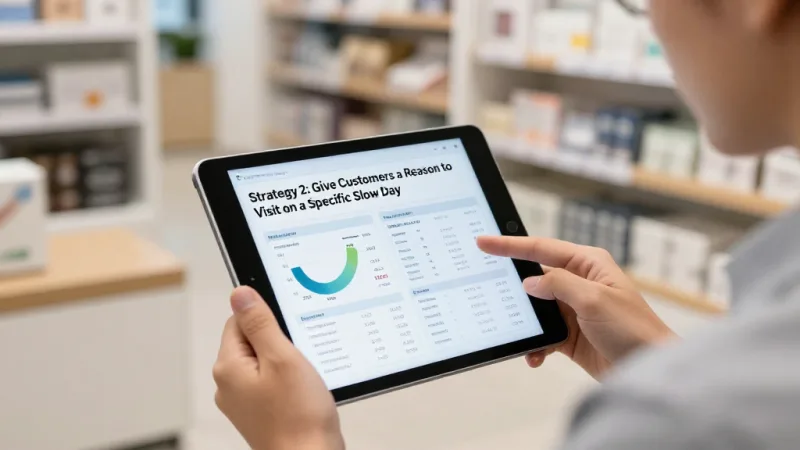
That's the logic behind a strong promotional calendar. Instead of discounting the whole month, you create events: a Tuesday-night three-course prix-fixe at a set price, a "industry night" for off-duty hospitality workers, a themed dinner tied to the Lunar New Year or the Super Bowl, a Valentine's prepaid couples package that collects cash up front. Each one gives a customer a reason to choose a date that would otherwise be dead — and each one can be priced for margin rather than markdown.
The operational key is making these limited-time offers easy to run and easy to ring up. This is where Tiger Sugar International Dessert is a useful model: they run seasonal personalization through self-ordering kiosks with minimal-step customization, so a new limited-time item gets configured once and every guest can order it without slowing the line or retraining staff. Whatever your machine is, a slow-season promotion should take minutes to launch in your POS — not a meeting and a reprint.
Strategy 3: Use Restaurant Week as Acquisition, Not Discounting
Most cities run a Restaurant Week in the dead of winter precisely because restaurants need the traffic. It can absolutely fill a quiet January — but here's the trap: the majority of participants lose money on it, because they treat a prix-fixe deal as a giveaway instead of a customer-acquisition channel.
Do it the profitable way. Build the fixed-price menu around high-margin, batch-prep dishes that your kitchen can fire fast at volume. Train every server to sell the things that live outside the prix-fixe price — wine, cocktails, a supplemental course, dessert to go. And treat every new face as the entire point: capture them into your loyalty or CRM list at checkout so you can bring them back at full price in March. A Restaurant Week cover who never returns is a loss you paid to acquire; one who becomes a regular is the cheapest customer you'll land all year. That single distinction is the difference between the 27% who profit and the 73% who don't.
Strategy 4: Launch a "New Year, New Menu" Moment
January customers are in a specific mindset — resolutions, fresh starts, lighter eating, trying something new. Meet them there. A "new year, new menu" launch gives your existing guests a concrete reason to come back and gives you a marketing story that costs nothing but a little kitchen creativity.
You don't need to overhaul the whole menu. Add a small cluster of new items aimed at the January mood — a few lighter or health-forward dishes, a Dry January mocktail program, a globally-inspired limited series — and present them as a genuine event with a date. Price the new items as occasions, not discounts, because a guest will happily pay a premium for something they can't get the rest of the year. The menu innovation also gives your social channels something fresh to post during the slowest content month of the year, and a single photogenic new dish can do more free marketing than a paid ad.
Strategy 5: Lock In Recurring Revenue With Memberships and Subscriptions
Everything so far drives traffic. This one does something better: it guarantees revenue before the month even begins. The most resilient slow-season operators don't just hope January traffic shows up — they sell a baseline of it in advance through memberships and subscriptions.
The model is straightforward and increasingly proven. A coffee shop sells a $29/month unlimited-drinks subscription; a full-service restaurant sells a VIP membership with perks and priority booking; a fast-casual spot sells a prepaid meal plan. Whatever the format, the effect is the same: cash collected up front and a customer with a standing reason to keep coming back. A few hundred members at $25–$30 a month is several thousand dollars of guaranteed January revenue landing in your account regardless of the weather. Our restaurant membership program guide walks through tier design and pricing psychology in detail.
And it gets better: paid members and subscribers are, by definition, your most committed guests. They visit more, spend more, and churn less — which means the program you launch to survive the slow season quietly becomes a year-round profit engine. The only requirement is a platform where membership billing, points, and redemption all live in the same system as your checkout, so a member is recognized and rewarded automatically at the register rather than through a clipboard and a manager's memory.
Strategy 6: Make Loyalty and Points Do the Heavy Lifting
A loyalty program isn't just a punch card — in the slow season, it's your cheapest demand lever. The reason is simple: you already have these customers' permission and contact info, so reaching them costs you almost nothing compared to acquiring someone new.
Run the slow months as loyalty campaigns. A double-points week costs you far less than a blanket discount but creates the same urgency to visit. A "bonus 500 points if you come back before February 14" message reactivates lapsed guests at a fraction of the price of an ad. A surprise reward dropped on your top spenders keeps your most valuable customers feeling seen exactly when competitors are ignoring everyone. Because the incentive is points rather than dollars off, you protect your margin while still manufacturing traffic — and every redemption pulls a guest back into the building where they'll usually spend beyond the reward. The restaurants that win January are the ones whose loyalty list was being quietly built at the POS all through the busy season, so they enter the slow stretch with an audience already in hand.
Strategy 7: Turn Your Fixed Costs Into Productive Time
Now for the strategy nobody markets but every great operator uses. Remember those fixed costs that don't drop in January? You're paying for the building, the equipment, and a portion of your team whether you're slammed or empty. The slow season is your one annual chance to make that paid-for time build something instead of just costing you.
This is the off-season every other industry plans for and most restaurants waste. Use the quiet weeks to deep-clean and service equipment before it fails during a future rush. Cross-train your staff so a single call-out doesn't break a Friday in July. Renegotiate vendor contracts and processing rates now, while you have time to actually read the statements. Audit your menu's real food costs and fix the dishes that are silently losing money. Build the operational systems — prep standards, scheduling templates, the corporate-catering pipeline — that you never have time to touch when you're busy. None of this generates revenue in January, but all of it compounds into a more profitable rest of the year.
There's a margin angle here too that's easy to overlook. Slow months are when small, fixed leaks hurt most, because there's less revenue to absorb them. Payment processing is the classic example: on a platform that locks you into mandatory processing at a non-negotiable rate, you overpay on every single swipe, all year. Because KwickOS is processor-agnostic, you keep 100% of your processing revenue and negotiate your own rate — and the quiet season is the perfect time to run the numbers and switch. (The free calculators in our tools library will show you exactly what that's worth on your volume.)
Strategy 8: Fill Dead Seats With Dayparts and Private Events
The last lever is about the seats themselves. In the slow season, an empty four-top at 7 p.m. on a Wednesday is pure loss — the table, the lighting, the server's hourly are all paid for whether someone's sitting there or not. The goal is to fill those seats with revenue you weren't capturing before.
Two moves do most of the work. First, dayparting: if your kitchen sits idle for big chunks of the day, a well-built brunch, an afternoon happy hour, or a late-night menu can turn dead hours into revenue without adding rent. Our dayparting strategy guide breaks down how to add a profitable daypart without blowing up your labor model. Second, private events: a quiet Monday is the easiest night in the world to sell as a private buyout, a corporate dinner, a birthday, or a community group's meeting. Prepaid, deposit-secured, fixed-menu bookings turn your slowest nights into your most predictable revenue — and they often rebook.
This is also where the platform underneath you matters more than it seems. When your POS, online ordering, gift cards, loyalty, and CRM live on one connected system — the way KwickOS combines them rather than stitching together a stack of disconnected apps — every slow-season tactic reinforces the others. The Restaurant Week guest gets enrolled in loyalty, the loyalty member gets offered a subscription, the subscriber books a private event, and all of it rolls up to one dashboard you can check from your phone at 2 a.m. Crafty Crab Seafood runs exactly this kind of coordination across 19 stores on 152 terminals, pushing a single slow-season promotion to every location in one click with no version drift — and for any multi-location operator, that consistency is the difference between a planned season and a scramble.
The Slow Season Is a Choice
Here's the open loop from the top of this article, finally closed: January and February are only the cruelest months for the restaurants that meet them passively. The demand drop is real and the fixed costs are unforgiving — but two of the three forces working against you are forces you can directly counter. You can manufacture demand with promotions, Restaurant Week, new menus, and loyalty campaigns. You can guarantee revenue with memberships, subscriptions, and the gift cards you sold in December. And you can turn your unavoidable fixed costs into the productive off-season that makes the rest of your year more profitable.

The restaurants that come out of February ahead aren't the ones that got lucky with weather. They're the ones that planned the slow season like a project, ran all eight of these levers off one connected platform, and used the quiet to build instead of just to wait. Treat January and February that way, and the toughest stretch on the calendar stops being something you survive — and becomes the months you grow.
Run Every Slow-Season Lever on One Platform
KwickOS handles limited-time promotions, Restaurant Week prix-fixe menus, memberships and meal subscriptions, points and loyalty, and built-in gift cards and e-gift cards on one offline-proof checkout — with your own payment processor so you keep 100% of processing revenue, and one dashboard across every location. See how it turns the slow season into a growth season.
See KwickOS for Restaurants
Frequently Asked Questions
Why do restaurants lose money in January and February?
After the December holiday peak, demand collapses: customers are tapped out from holiday spending, dieting and dining out less, and staying home in the cold. Industry data suggests dine-in traffic can fall roughly 20-25% versus the fourth quarter. The problem is that fixed costs — rent, insurance, salaried staff, equipment leases — don't drop with sales. A restaurant that doesn't plan for the slow season pays full overhead on half the revenue, which is why January and February quietly produce most of the year's losses.
What are the best promotions to drive restaurant traffic in the slow season?
The most effective slow-season promotions create a reason to visit on a specific slow day rather than discounting everything. Strong plays include a "new year, new menu" limited-time launch, weeknight prix-fixe events, Restaurant Week participation, a Valentine's prepaid package, and targeted win-back offers sent to the customer list you built in December. Pair any promotion with a loyalty or points incentive so a one-time deal-seeker becomes a repeat guest instead of a margin leak.
How can a loyalty or membership program help during slow months?
Loyalty and membership programs turn the slow season from a guessing game into a controllable channel. A points or rewards program gives you a reachable list of past guests to pull back in with a targeted offer when the dining room is quiet, and double-points weeks cost far less than blanket discounts. Paid memberships and meal subscriptions go further: they collect recurring revenue up front, guaranteeing a baseline of January cash flow before the month even starts. When loyalty enrollment happens at the POS during the busy season, you enter the slow season with the audience already built.
Should a restaurant participate in Restaurant Week?
Restaurant Week can fill a dead January or February, but most participants lose money by treating it as a discount instead of an acquisition channel. Do it profitably: design the prix-fixe menu around high-margin, batch-prep dishes, train staff to upsell wine, cocktails, and add-ons that sit outside the fixed price, and — most important — capture every new guest into your loyalty or CRM list so you can bring them back at full price. A Restaurant Week cover that never returns is a loss; one that becomes a regular is the cheapest customer you'll acquire all year.
How do gift cards sold in December help January revenue?
Gift cards are deferred slow-season traffic. Roughly half of annual gift card sales happen in the six weeks before Christmas, and a large share of those cards are redeemed in January and February — bringing guests through the door in exactly the months you need them, often spending beyond the card balance. A reload or bonus program extends the effect: prompt redeemers to top up at the register, and a one-time December buyer becomes a recurring slow-season visitor. The cash was collected in December; the traffic arrives when it matters most.