
 Kelly Ho
You've built something real. Lines out the door on weekends. A team that mostly runs itself. Numbers that make your accountant smile for the first time in years. So naturally, the next thought arrives: time for location number two.
Here's the thing: according to restaurant industry data, roughly 60% of second locations either fail outright or drag down the original location's profitability within two years. That's not a scare tactic — it's the math that separates operators who scale from operators who lose everything trying.
The difference between success and failure almost never comes down to the food, the brand, or the market. It comes down to whether your systems, finances, and team were truly ready before you signed that second lease.
This guide walks through every stage — from knowing when you're genuinely ready, to choosing the right site, to building the technology backbone that lets you run two locations without losing your mind or your margins.
The Readiness Test Most Owners Skip
Busy is not the same as ready. A restaurant can be packed every night and still be a terrible candidate for expansion. The question is not "are we doing well?" It's "can our success be replicated without me physically standing in the kitchen?"
But it gets worse: most owners confuse revenue growth with operational maturity. Revenue tells you customers like you. Operational maturity tells you the business can survive without you hovering over every ticket.
Here are the five readiness signals that actually matter:
- Consistent profitability for 18-24 months. Not revenue — profit. Your first location should be generating net margins above 10% consistently, not just during holiday rushes. If your margins swing between 3% and 15% month to month, you don't have a system — you have luck.
- The business runs without you for two weeks. Take a real vacation. Not a "vacation" where you check the POS dashboard every 30 minutes. If sales, labor costs, and customer satisfaction hold steady while you're completely absent, your systems and team are ready.
- Documented processes for everything. Recipes, opening procedures, closing checklists, ordering workflows, employee onboarding, complaint handling. If any critical knowledge exists only in your head or one manager's head, you're not ready to split that knowledge across two buildings.
- A management team, not just employees. You need at least one manager at your first location who can make real decisions — hiring, firing, handling vendor issues, adjusting operations — without calling you. If you're the single point of failure, a second location will break you.
- Cash reserves beyond the build-out. Industry data suggests you need enough capital to cover the new location's operating expenses for 12-18 months, on top of the build-out cost. Most second locations take 6-9 months to reach break-even. If your runway is shorter than your break-even timeline, you're gambling.
And that's not all: you also need technology that scales. If your first location runs on a standalone POS with no cloud reporting, no multi-location menu sync, and no remote access, you'll spend your days driving between buildings putting out fires instead of growing the business.
The Financial Reality of Location #2
Let's talk real numbers. Opening a second location is not half as expensive as opening the first — it's often 60-80% of the original cost, because you've already made the brand investment, built vendor relationships, and learned the expensive lessons.
Here's the thing: that 20-40% savings is deceptive, because it tempts owners into undercapitalizing the second location.
| Expense Category | Typical Range | Notes |
|---|---|---|
| Leasehold improvements | $75,000 - $350,000 | Depends on condition of space, cuisine type |
| Equipment & furniture | $40,000 - $150,000 | May save 10-20% reusing vendor relationships |
| POS & technology | $3,000 - $25,000 | Processor-agnostic POS saves $3,000-$8,000/yr |
| Initial inventory | $8,000 - $25,000 | Leverage existing supplier accounts |
| Pre-opening marketing | $5,000 - $20,000 | Grand opening, local PR, social media |
| Operating reserves (6-12 months) | $50,000 - $200,000 | Rent, payroll, utilities while ramping |
| Total estimated range | $175,000 - $750,000 |
One cost most owners overlook: the hidden tax of payment processing at scale. If your POS locks you into a single processor at 2.99% + $0.15 per transaction, you're now paying that inflated rate across two locations. On combined monthly volume of $80,000, that's roughly $30,000/year in processing fees. A processor-agnostic system at interchange-plus rates would run about $23,000 — saving you $7,000 annually. Over a three-year lease, that's $21,000 back in your pocket.
That $21,000 could fund your entire pre-opening marketing budget and initial inventory.
Site Selection: The 15-Minute Rule
Where you put your second location matters more than almost any other decision in the expansion process. Get the site wrong, and no amount of great food or marketing will save you.
Here's a counterintuitive truth most operators miss: your second location should be boring. Not in a bad way — it should be a low-risk, proven market within easy reach of your first location. The time for bold new territory is location three or four, once you've mastered the art of replication.
The 15-minute rule: keep your second location within a 15-30 minute drive of your first. This isn't just about convenience — it has real operational implications:
- Staff flexibility. Employees can cover shifts at either location, reducing your dependence on per-location staffing levels.
- Inventory transfers. When location one is overstocked on chicken and location two runs short, a 15-minute drive beats an emergency supplier delivery at premium pricing.
- Management presence. Your leadership team can visit both locations in a single day without losing half the day to driving.
- Shared vendor deliveries. Many suppliers will route deliveries to nearby locations on the same truck, reducing your per-location delivery minimums.
But it gets worse if you go too far: T. Jin China Diner learned this lesson building to 15 locations across 75 terminals. Tom Jin, KwickOS founder who spent 20 years in the restaurant industry, saw firsthand how multi-location operators succeed or fail. The ones who expanded methodically within a region outperformed the ones who chased "hot markets" three states away. Proximity is a competitive advantage you can't buy later.
Site Selection Checklist
- Demographics match. Your target customer profile exists in the new area in similar or greater density.
- Traffic patterns. Is there foot traffic, lunch-hour office density, or dinner-time residential proximity?
- Competition mapping. Direct competitors nearby can actually be a positive signal — it means demand exists. Just make sure you're differentiated.
- Lease terms. Negotiate a shorter initial term (3-5 years) with renewal options, not a 10-year commitment on an unproven location.
- Build-out condition. A second-generation restaurant space (previously a restaurant) can save $50,000-$150,000 in build-out costs vs. raw retail space.
- Parking and visibility. If your first location succeeds partly because of a visible corner lot with easy parking, don't sign a lease for a hidden strip mall unit.
The Technology Backbone: Running Two Locations Like One
This is where most second-location expansions go off the rails. The owner opens location two with the same standalone, single-location POS setup they used at the original — and suddenly they're managing two completely disconnected businesses.
Here's what happens without centralized technology:
- Menu updates require visiting each location physically (or trusting someone to manually re-enter prices without errors).
- You can't compare location performance side-by-side without exporting data to spreadsheets.
- Employee time theft spikes at the location where you're not physically present.
- Inventory counts are done separately with no cross-location visibility.
- Gift card balances don't transfer between locations, frustrating customers.
And that's not all: if your POS goes down and you have no local fallback, you're dead in the water at a location where you might not even realize there's a problem for hours.
What multi-location operators actually need:
| Capability | Why It Matters |
|---|---|
| Centralized menu management | Update prices/items once, push to all locations instantly |
| Real-time multi-location dashboard | See both locations' sales, labor, and alerts from your phone |
| Cross-location employee management | Schedule staff across locations, track hours, prevent buddy punching |
| Unified gift card & loyalty system | Customers use gift cards and earn loyalty points at any location |
| Consolidated reporting | Compare P&L, food costs, and labor by location from one screen |
| Hybrid local+cloud architecture | 1ms local speed, keeps running if internet drops |
| Processor-agnostic payment | Negotiate rates by combined volume, save $3,000-$8,000/yr per location |
Crafty Crab Seafood runs 19 locations with 152 terminals on a centralized platform. When they add a seasonal menu item, it goes live across all 19 stores in one click. When a manager at store #7 calls in sick, the system shows available staff at nearby locations who can cover. That's the difference between a multi-location operation and multiple single-location headaches.
Gift Cards, Loyalty, and the Multi-Location Revenue Multiplier
Here's something most operators don't think about until it becomes a problem: your gift card and loyalty programs need to work seamlessly across all locations from day one.
Why? Because gift cards and loyalty programs are multi-location revenue multipliers:
- Gift cards drive cross-location traffic. A customer buys a gift card at location one and redeems it at location two. That's a new customer at your second location who arrived with money already committed to spending at your business. According to industry research, gift card recipients spend 20-40% more than the card's face value per visit.
- E-gift cards accelerate new location awareness. Launch an e-gift card promotion when your second location opens: "Buy a $50 e-gift card, get $10 bonus — redeemable at both locations." This drives immediate traffic to the new location while rewarding loyal customers from location one.
- Loyalty programs prevent customer fragmentation. If a regular at location one visits location two and their loyalty points don't transfer, you've just created a frustrated customer. Unified loyalty means a customer's 50 visits across both locations earn them the same rewards as 50 visits to one.
- Membership tiers reward multi-location spending. Create loyalty tiers based on combined spending across all locations. A customer spending $200/month at each location hits your "VIP" tier at $400/month — encouraging them to consolidate dining at your brand instead of splitting with competitors.
Tiger Sugar runs 2 locations with self-ordering kiosks, and their loyalty program is unified across both. A customer earning points at their downtown location can redeem rewards at the mall location. The result: higher visit frequency and stronger brand loyalty than competitors with disconnected systems.
The Checkout Flow: Consistency Is Everything
Your second location's POS checkout experience should be indistinguishable from your first. Customers who visit both locations expect the same speed, the same payment options, the same receipt format, and the same post-transaction prompts.
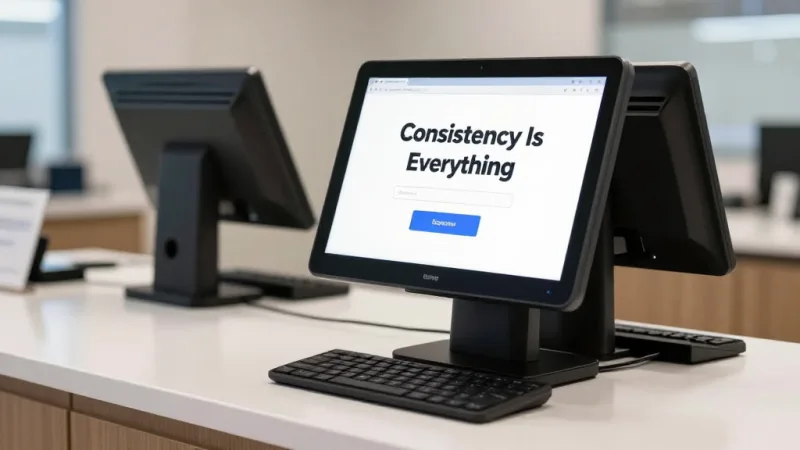
This means your POS needs to support:
- Identical checkout workflows — same modifier sequences, same tip prompts, same receipt layout
- All payment types — chip, tap, mobile wallet, gift cards, split payments
- Consistent tipping flow — if location one suggests 18/20/22%, location two shouldn't show 15/18/20%
- Loyalty enrollment at checkout — every transaction at both locations should prompt loyalty sign-up for non-members
- Gift card balance lookup and redemption at any location in your network
Diva Nail Beauty operates 4 stores and uses automated commission tracking tied directly to the POS checkout. When a stylist closes out a client, the commission calculates automatically — no end-of-week spreadsheets, no disputes. They report a 90% improvement in operational efficiency since adopting centralized POS across all locations.
Staffing the Second Location Without Gutting the First
The single biggest mistake in second-location expansion: pulling your best people from location one to "seed" location two. It makes intuitive sense — you want your strongest team members training the new crew. But it creates a vacuum at your original location that customers notice immediately.
Here's the thing: your regulars didn't fall in love with your brand. They fell in love with the specific people who take care of them. Move your best server, bartender, or manager to the new location, and watch first-location revenue quietly decline for the next three months.
A better approach:
- Hire for location two early. Start recruiting 8-12 weeks before opening, not 2 weeks.
- Train at location one. New hires work shifts at your original location alongside experienced staff. They learn your culture, standards, and systems in a proven environment.
- Send experienced staff temporarily, not permanently. Your top performers spend 2-4 weeks at the new location during the opening phase, then return to their home base.
- Use fingerprint authentication from day one. With new employees at a new location, time theft risk spikes. Fingerprint 1:N verification on your POS eliminates buddy punching and unauthorized access before it starts.
- Cross-train for flexibility. After both locations stabilize, maintain a pool of staff trained at both locations who can cover gaps at either site.
The First 90 Days: Where Second Locations Live or Die
Your second location's first 90 days determine its trajectory. Industry data shows that locations not on track to break even by month nine rarely recover — they become a permanent drag on the profitable original.
Week 1-2: Soft opening. Invite-only, reduced hours, limited menu. This is your stress test. Every system failure, every menu confusion, every staffing gap gets caught before the public judges you. Use your POS reporting to track average ticket time, void rates, and customer throughput compared to your first location's benchmarks.
Week 3-4: Grand opening. Full menu, full hours, marketing push. Run a gift card promotion to drive trial: "Buy $25 in e-gift cards, get $5 bonus — valid at both locations." This simultaneously builds your gift card float (immediate cash flow) and creates customers with a reason to return.
Month 2-3: Optimization. Analyze your POS data obsessively. Compare labor-to-sales ratios, food cost percentages, and average ticket size between both locations. The gaps tell you exactly where the new location needs attention.
Use our profit margin calculator to model different scenarios for your second location's ramp-up period.
Multi-Location Management: Daily, Weekly, Monthly Rhythms
Once both locations are operational, you need management rhythms that prevent problems from festering at the location you're not physically at.
Daily (10 minutes):
- Review both locations' previous-day sales, labor cost %, and void/comp reports from your POS dashboard
- Check for any flagged transactions (large discounts, excessive voids, unusual clock-in times)
- Review online ordering and delivery performance for both locations
Weekly (1 hour):
- Compare location performance side-by-side: revenue, labor %, food cost %, customer count
- Review inventory variances and place consolidated orders
- Check loyalty program enrollment and gift card sales metrics
- Hold brief manager meetings (can be virtual)
Monthly (half day):
- Full P&L review for each location
- Menu performance analysis — identify underperformers for removal and stars for promotion
- Review payment processing statements and compare rates
- Customer feedback review and action planning
When Technology Makes the Difference: Real Numbers
Let's quantify the technology advantage for a two-location operator doing $80,000/month combined ($40K per location):
| Category | Without Multi-Location POS | With KwickOS | Annual Impact |
|---|---|---|---|
| Processing fees (locked vs IC-plus) | $30,000/yr | $23,000/yr | +$7,000 |
| Menu update labor (manual vs 1-click) | 4 hrs/month × $25/hr | 5 min/month | +$1,200 |
| Time theft (no fingerprint vs 1:N) | ~$4,800/yr | ~$0 | +$4,800 |
| Internet outage losses (cloud-only vs hybrid) | ~$3,600/yr | $0 (local fallback) | +$3,600 |
| 3rd-party delivery commissions | 25% commission | $2 + $6.99/order (KwickDriver) | +$8,000-$15,000 |
| Total annual advantage | $24,600 - $31,600 |
That's $24,600 to $31,600 per year in real savings and recovered revenue — just from choosing the right technology stack. Over a 5-year lease, we're talking $123,000 to $158,000. That's the difference between a thriving second location and one that barely breaks even.
KwickOS currently serves 5,000+ businesses across 50 states, processing over $2M in daily sales. The platform supports English, Chinese, and Spanish, with multi-location operators like Crafty Crab (19 stores), Haidilao (600+ global locations), and Rockin' Rolls (3 stores, 49 iPad self-ordering stations) all running on the same unified system.
The Expansion Checklist: Your Go/No-Go Framework
Before you sign that lease, run through this checklist. If you can't check every box, you're not ready — and that's fine. Being honest about readiness is what separates the operators who build empires from the ones who lose their first location trying to open a second.
- ☐ First location profitable for 18+ consecutive months (net margin >10%)
- ☐ Business operates successfully without owner for 2+ weeks
- ☐ All key processes documented and followed consistently
- ☐ At least one manager capable of full independent operation
- ☐ Cash reserves cover build-out + 12-18 months operating expenses
- ☐ Multi-location POS system selected or current system supports expansion
- ☐ Gift card and loyalty programs can operate across locations
- ☐ Site within 15-30 minutes of first location
- ☐ Lease terms negotiated (3-5 year initial, renewal options)
- ☐ Staffing plan that doesn't gut original location
- ☐ 90-day launch plan with measurable benchmarks
Ready to see how the technology piece fits together? Explore our multi-location solutions or talk to a KwickOS partner who has helped dozens of operators navigate their second-location expansion.
Ready to Scale to Location #2?
KwickOS gives multi-location operators centralized control, processor freedom, and the hybrid reliability that keeps both locations running — even when the internet doesn't.
Talk to a Multi-Location Specialist