 Ming Ye
Count the hours you worked last week. Be honest — include the 6 a.m. produce delivery, the Saturday close, the "quick" Sunday inventory count, and the two hours you spent on the phone with a no-show cook during what was supposed to be dinner with your family.
If that number is north of 70, you already know where this is going.
Here's the thing most owners never say out loud: the restaurant industry has quietly normalized a level of self-sacrifice that would be considered a crisis in any other business. Restaurant industry data consistently shows owners working far longer than the small-business average, and the human cost is real — strained marriages, neglected health, and the slow erosion of the passion that made you open the doors in the first place.
But it gets worse: the 80-hour owner isn't just burning out personally. They're building a business that collapses the moment they step away. If you can't take a two-week vacation without the operation wobbling, you don't own a business — you own a very demanding job that you can never quit.
Now for the good news. Everything that's keeping you chained to the building can be traced to a missing system. Not a personality flaw. Not a lack of grit. A missing system. And systems can be built one at a time, starting this week.
Here are 12 of them — grouped into delegation, automation, remote monitoring, and self-care — that let owners drop from 80 hours to 45 without the wheels coming off.
Part 1: Delegation Frameworks (Stop Being the Only Adult in the Room)
The single biggest driver of owner burnout is being the only person who can make a decision. Every "let me check with the owner" is a chain tying you to the floor. These four systems cut the chain.
System 1: Documented Open and Close Checklists
If opening and closing live only in your head, you are the only person who can open and close. Write them down — every step, in order, with photos. A laminated open checklist and close checklist turn a two-year veteran and a two-week hire into people who both lock up correctly.
This is the keystone habit. Once one shift lead can run a full day without you, you've proven the whole premise: the building does not require your body in it. That single day off is usually what convinces owners to build every other system on this list.
System 2: A Trained Second-in-Command (Not Just a "Good Employee")
There's a difference between a great line cook and a manager. A manager can hire, discipline, count a drawer, handle an angry guest, and make a $200 comp decision without calling you. Most owners never develop one because developing people is slow and doing it yourself is fast.
But that's the trap. Every task you keep because "it's faster if I do it" is a task that guarantees you'll do it forever. Spend the next 90 days deliberately handing your general manager real authority — including a written spending limit they can approve without you. Our guide to handling guest complaints is a good first playbook to hand them.
System 3: A Decision Tree for the Top 20 Recurring Problems
Cook calls out. Walk-in fails. A guest wants a refund. A vendor shorts the order. You've answered these same questions a thousand times. Write the answers down once. A one-page "if this, then that" decision tree eliminates 80% of the calls that interrupt your day off — because now your team already knows what you'd say.
System 4: Fingerprint Clock-In to Kill Time Theft While You're Away
Here's a fear that keeps owners physically present: "If I'm not watching, people will steal time." Buddy-punching — one employee clocking in a late friend — quietly inflates labor costs at restaurants everywhere.
KwickOS solves this with fingerprint 1:N and 1:1 employee verification built into the POS. Nobody clocks in for anyone else, period. When the technology enforces honesty, you don't have to. That's one less reason to stand by the time clock at 6 a.m. Run the numbers on what tighter labor control is worth with our labor cost percentage calculator.
Part 2: Automation (Let the Software Do the 2 a.m. Work)
Delegation moves work to people. Automation moves work to systems that never call in sick. This is where a modern, all-in-one platform earns its keep.
System 5: Automated Scheduling and Labor Forecasting
Building the schedule by hand every week is four hours you'll never get back — and it's four hours of exactly the low-value, high-frequency work that grinds owners down. Automated scheduling uses your own sales history to forecast the covers you'll do next Tuesday and staffs to it, then lets employees swap shifts without routing every request through you.
Pair it with the rest of the tools in our restaurant owner mobile toolkit and you've reclaimed most of a working day every single week.
System 6: One-Click Menu and Price Updates Across Every Channel
Change one price and you shouldn't have to update the POS, the kiosk, the online ordering page, the digital menu board, and the third-party apps by hand. When your dine-in menu, checkout, and every digital surface share one source of truth, an 86'd item or a new price propagates everywhere in one click.
This is exactly how Crafty Crab Seafood manages menu changes across 19 stores and 152 terminals — and how T. Jin China Diner keeps 15 locations consistent — without an owner driving store to store. If you run more than one location, our multi-location menu sync guide shows the full workflow.
System 7: Self-Running Gift Card and E-Gift Card Sales
And that's not all: some of your most valuable revenue can run with zero owner involvement. Gift cards and e-gift cards sell themselves — at the POS checkout, on your website, and from your phone — 24 hours a day. The customer pays you today for a meal they'll eat in three months. A meaningful slice of that value is never redeemed at all (breakage), and every card you sell drags in a new guest who arrives to spend it.
This is the opposite of burnout revenue. You don't cook it, you don't serve it, and you often collect it while you're asleep. Building an e-gift card program is one of the highest-leverage, lowest-effort systems on this entire list.
System 8: Automated Loyalty, Points, and Membership Programs
Marketing is one more thing owners try to do personally and then drop the moment things get busy. Automate it instead. A loyalty and points program built into checkout enrolls guests automatically, tracks their visits, and fires birthday rewards and win-back offers on its own.
Take it a step further with a paid membership — a monthly fee for perks and a members-only discount window. Now you have predictable, recurring revenue that lands before the month even starts, which is the single best cure for the feast-or-famine cash stress that keeps owners up at night. Members-only happy-hour pricing pairs naturally with the tactics in our dynamic pricing guide.
Part 3: Monitoring From Afar (Watch the Numbers, Not the Building)
You can't be in two places at once — but your data can. The goal isn't to watch your staff; it's to see the truth of the operation without standing inside it.
System 9: Live Sales and Labor on Your Phone
This is the system that changes how ownership feels. With a cloud-connected POS, you can check today's sales, labor percentage, average ticket, voids, discounts, and cash variance from your couch at 2 a.m. — or from a beach 1,000 miles away.
Here's why it matters: the anxiety that chains owners to the building isn't really about the work. It's about not knowing. When you can glance at your phone and see the numbers are healthy, you can actually leave. KwickOS runs a hybrid local-plus-cloud architecture, so the restaurant keeps ringing up sales at 1ms local speed even if the internet drops — and syncs to your dashboard the moment it's back.
| What You Used to Do In Person | What You Now Do From Your Phone |
|---|---|
| Drive in to check if it's busy | Glance at live covers and sales |
| Wait for the closing manager to call | See the day's totals auto-post at close |
| Count on staff to flag a slow night | Get an alert when sales dip below forecast |
| Review paper voids the next morning | See every void and discount in real time |
System 10: Exception Alerts Instead of Constant Watching
You don't need to stare at a dashboard all day — that's just a digital version of hovering. Set alerts for the exceptions that matter: a void over $50, a comp above your threshold, a drawer short at close, labor creeping past target. Silence means everything's fine. A ping means look. That's the difference between monitoring and obsessing.
System 11: A True Multi-Location Command Center
If you're scaling, the burnout math gets brutal fast — two locations can feel like four jobs. A single dashboard that rolls up every store's sales, labor, and inventory is what lets operators like Crafty Crab and T. Jin run their groups without living in a car. Automated commission and payroll tracking does the same for service businesses; Diva Nail Beauty runs commission across four locations automatically and reports a 90% efficiency increase over doing it by hand. Different industries, same lesson: the owner's job is to read the roll-up, not to be the roll-up.
Part 4: Protecting the Owner (Self-Care Is an Operating Requirement)
System 12: Scheduled, Non-Negotiable Time Off
All the systems above exist to enable this one. Put your days off on the schedule the same way you schedule a server — in advance, in writing, and treated as immovable. Block a full day every week and one real vacation a year, and defend them. The systems are what make the time off safe; the discipline to actually take it is what makes it real.
Because here's the loss you're actually staring at: it isn't a slow night or a missed order. It's the years. Owners who never build these systems don't just work more hours — they trade away the one thing the restaurant was supposed to buy them, which was a good life. Don't pay that price when a set of systems can prevent it.
Your 90-Day Burnout-Reduction Plan
You can't build 12 systems at once. You don't need to. Here's the order that compounds fastest:
- Days 1–30: Document open and close checklists (System 1). Train one shift lead to run a full day. Take one day off and prove it works.
- Days 31–60: Turn on automated scheduling (System 5) and live phone monitoring (System 9). Set your first exception alerts (System 10).
- Days 61–90: Launch gift cards and a loyalty or points program at checkout (Systems 7 and 8). Give your GM a written spending limit (System 2). Put a weekly day off on the schedule and defend it (System 12).
Ninety days from now, you won't have a different restaurant. You'll have the same restaurant that finally runs without you standing in the middle of it.
Build a Restaurant That Runs Without You
KwickOS puts scheduling, fingerprint clock-in, gift cards, loyalty, and live phone monitoring into one processor-agnostic platform — the systems that turn 80-hour weeks into 45. See how much time you could get back.
Explore KwickOS for Restaurants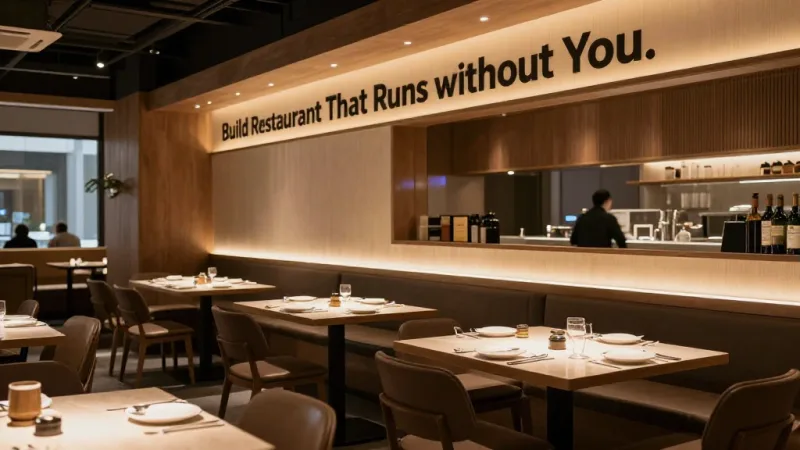
Frequently Asked Questions
Why do so many restaurant owners burn out?
Most restaurant owners burn out because they are the system. Every decision, approval, and fire drill routes through them, so the business cannot run for a day without their physical presence. Burnout is rarely a lack of toughness — it is the predictable result of never building the delegation frameworks, automation, and remote-monitoring tools that let the operation function without the owner in the room.
How many hours should a restaurant owner actually work?
A well-systematized independent restaurant owner should be able to operate at roughly 45 to 50 hours per week once managers are trained, opening and closing checklists are documented, and reporting is automated. Owners routinely working 70 to 80 hours are usually doing manager-level or line-level tasks that should have been delegated or automated years earlier.
Can I really run my restaurant remotely?
You cannot run the floor remotely, but you can monitor the numbers remotely. A cloud-connected POS lets you see live sales, labor percentage, voids, discounts, and cash variance from your phone. Multi-location operators like T. Jin China Diner (15 stores) and Crafty Crab Seafood (19 stores) manage dozens of locations from a single dashboard instead of driving between them every day.
How do gift cards and loyalty programs reduce owner stress?
Gift cards, e-gift cards, and membership programs generate revenue that does not depend on the owner being present. Prepaid balances are collected up front, a portion is never redeemed (breakage), and automated loyalty and points campaigns bring customers back without the owner personally marketing to them. This recurring, self-running revenue is one of the most effective antidotes to the feast-or-famine cash stress that fuels burnout.
What is the first system I should build to reduce burnout?
Start with documented opening and closing checklists plus a trained shift lead who can run a full day without you. Once one person can open and close correctly, you can take a day off without the building falling apart — and that single win usually makes the case for every other system, from automated scheduling to remote POS monitoring.