 Rain Lee
You have been selling POS systems for a year. Maybe two. You have pitched restaurants, nail salons, a vape shop, a yoga studio, a car wash. You close maybe one out of every eight demos.
Now look at the reseller in the next territory who only sells to Chinese restaurants. She closes one out of every three demos. She does not cold call anymore — her phone rings because the owner of Szechuan Palace told the owner of Golden Dragon who told the owner of Lucky Star.
She made $312,000 last year. You made $104,000.
Same product. Same commission structure. Same territory size. The only difference is that she picked one industry and went all in.
Here's the thing: this is not a talent gap. It is a strategy gap. And it is the single most consequential decision you will make as a POS reseller.
This guide breaks down exactly why vertical specialization works, how to pick the right niche, and how to build the referral engine that turns one sale into twenty.
The Math Behind Specialization: Why 1 Niche Beats 10
Let us start with numbers, because the gap is wider than most resellers realize.
A generalist POS reseller averages these metrics across a 12-month period:
| Metric | Generalist | Specialist |
|---|---|---|
| Demos per month | 12 | 10 |
| Close rate | 12% | 35% |
| New merchants/month | 1.4 | 3.5 |
| Average monthly residual/merchant | $250 | $310 |
| 12-month portfolio (cumulative) | ~17 merchants | ~42 merchants |
| Monthly residual at month 12 | $4,250 | $13,020 |
| Total year-one earnings | ~$104,000 | ~$312,000 |
The specialist does fewer demos but closes at nearly 3x the rate. She also commands a higher per-merchant residual because she bundles industry-specific add-ons — online ordering, KDS configurations, multilingual menus — that generalists either skip or do not know to offer.
But it gets worse for the generalist. Look at what happens in year two.
The specialist's portfolio compounds. Her 42 merchants each refer 0.5 to 1 new merchant per year through word-of-mouth. The generalist's merchants rarely refer anyone, because a yoga studio owner does not know what a seafood restaurant needs.
By month 24, the specialist is earning $26,000/month in residuals. The generalist is at $7,500. Same hours. Same product. Different strategy.
Why Merchants Pay More for Industry Expertise
When a nail salon owner sits down for a POS demo, she has three questions in her mind before you open your laptop:
- Does this person understand my business?
- Has this system worked for salons like mine?
- Will setup be painful, or does someone handle the parts I hate?
A generalist answers question one with "I have worked with all kinds of businesses." That is the wrong answer. It tells the salon owner she will be the one explaining how commission splits work, how tip pooling is different from tip sharing, and why she needs service-level time tracking.
And that's not all: the generalist will probably configure the POS wrong. He will set up flat commission percentages when the salon uses tiered structures. He will miss the automated end-of-day commission reports that prevent disputes. He will not know that nail salons need fingerprint clock-in to prevent buddy punching across 12-hour shifts.
A specialist walks in and says: "I set up the POS for Diva Nail Beauty — 4 locations, 4 terminals. Their biggest problem was commission calculation errors. We automated it and their back-office time dropped 90%. Here is exactly how I will set yours up."
That is a different conversation. That is a conversation that closes in one meeting instead of four.
How to Pick Your Niche (The 5-Filter Framework)
Not all niches are equal. A niche that makes one reseller $300,000 in Houston might produce $80,000 in rural Montana. Here's the thing: the niche has to pass five filters before it is worth your time.
Filter 1: Market Density (Can You Reach 50+ Prospects?)
Count the number of businesses in your target vertical within a 30-mile radius. If you cannot find at least 50, the niche is too small for dedicated specialization. For most metro areas, restaurants, nail salons, and retail shops easily clear this bar. Niche categories like hookah lounges or axe-throwing venues do not.
Filter 2: Technology Pain (Is Their Current POS Failing Them?)
The best niches have merchants who are actively frustrated with their technology. Chinese restaurants running decade-old Windows POS systems with no cloud backup. Nail salons using pen-and-paper commission tracking. Bubble tea shops trying to manage 200+ drink customizations on a system built for burger joints.
High pain = fast sales cycles. If merchants are "fine" with their current setup, you are selling a nice-to-have instead of a must-have.
Filter 3: Community Tightness (Do Owners Talk to Each Other?)
This is the filter that separates good niches from great ones. In some industries, owners operate in isolation — they do not know each other, do not attend the same events, and do not share vendor recommendations. Selling to these merchants is a cold-call grind forever.
In other industries, owners are deeply connected. Chinese restaurant owners in the same city know each other by name. Nail salon owners in Korean communities share supplier lists and employee referrals. Bubble tea franchise operators attend the same trade shows.
One sale in a tight community triggers a referral chain. One sale in a disconnected market triggers nothing.
Filter 4: Average Deal Size (Is the Revenue Worth Your Time?)
A single-terminal coffee shop generates roughly $150/month in combined residuals (processing + software). A 15-location Chinese restaurant group generates $4,500/month. You need to know which end of the spectrum your niche sits on.
The sweet spot for most resellers is merchants with 2-5 terminals and $30,000-$80,000/month in card processing volume. That translates to $250-$400/month in residuals per merchant — meaningful enough that 50 merchants puts you at $12,500-$20,000/month.
Filter 5: Product-Market Fit (Does KwickOS Solve Their Specific Problems?)
This is where KwickOS resellers have an unfair advantage. The platform's processor-agnostic architecture saves merchants $3,000-$8,000/year compared to locked-in systems like Toast or Square. But beyond processing freedom, certain KwickOS features align perfectly with specific verticals:
| Vertical | KwickOS Killer Features | Why Competitors Lose |
|---|---|---|
| Chinese Restaurants | Bilingual (EN/ZH), banquet mode, dim sum tracking, remote multi-location management | Toast has no Chinese language support |
| Nail Salons | Fingerprint 1:N authentication, automated commission calculation, multi-location staff tracking | Square has no fingerprint, no commission automation |
| Bubble Tea Shops | Complex modifier groups (sweetness/ice/toppings), kiosk with minimal-step customization, multilingual | Clover cannot handle 200+ modifier combinations |
| Japanese Restaurants | Customizable KDS per station (sushi bar vs. kitchen), course fire timing, bilingual | Generic systems lack station-specific display logic |
| Multi-Location Groups | Centralized menu sync, real-time cross-location reporting, hybrid local+cloud (works offline) | Cloud-only systems fail when internet drops |
Pick the niche where KwickOS has the widest competitive moat. That is your unfair advantage in every demo.
The Referral Engine: How 1 Sale Becomes 20
Here is where the magic of vertical specialization really kicks in. And most resellers completely underestimate how powerful this dynamic is.
When you install KwickOS at T. Jin China Diner — 15 locations, 75 terminals — something happens that never happens for generalists. Tom Jin, the owner, becomes your unpaid sales rep. Not because you asked him to. Because other Chinese restaurant owners ask him what system he uses, and he tells them.
This is how Crafty Crab Seafood — 19 stores, 152 terminals — came to KwickOS. And Haidilao. And dozens of independent Chinese restaurants across the country.
But it gets worse for generalists trying to compete: these referral conversations happen in Mandarin, in WeChat groups, at Chinese restaurant industry gatherings that generalists do not even know exist. The generalist cannot access this network. The specialist lives inside it.
Here is how to build and accelerate this referral engine:
Step 1: Deliver a Flawless First Installation
Your first 3-5 installations in a niche are the most important deals you will ever close. They are not just revenue — they are your reference library. Go overboard on service. Configure every detail. Train every employee personally. Be available at 11 PM when the owner calls during Friday rush with a question about splitting a 12-top check.
These early merchants become your case studies, your demo references, and your referral sources for the next five years.
Step 2: Create Industry-Specific Case Studies
After 60 days of operation, ask your merchant for a 15-minute interview. Document the results with specific numbers. Not "they love it" — that is useless. Instead:
- "Diva Nail Beauty reduced back-office commission calculation from 2 hours/day to 12 minutes — a 90% efficiency increase across 4 locations."
- "Shogun Japanese Hibachi customized their KDS to show hibachi station orders separately from kitchen orders. New staff learned the system in under 5 minutes."
- "Tiger Sugar configured their 2 self-ordering kiosks with minimal-step customization — customers build a drink in 3 taps instead of 8."
These case studies are your most powerful sales tool. A generalist shows a generic product demo. You show a merchant who looks exactly like the prospect, running the same type of business, solving the same problems.
Step 3: Become Visible in the Community
Join the industry associations. Sponsor the local nail technician competition. Set up a booth at the Asian restaurant expo. Write for the trade magazine. The goal is not to sell directly at these events — it is to become the person that everyone in the niche knows as "the POS expert for [industry]."
When a nail salon owner in Houston asks another owner for a POS recommendation, you want your name to come up before any brand name does.
Step 4: Build a Referral Incentive Program
Formalize what happens organically. Offer existing merchants a one-month software credit for every successful referral that installs. This costs you nothing (the credit comes from your commission) but gives merchants a tangible reason to proactively introduce you to peers instead of passively mentioning your name.
Some top resellers offer $500 cash per referral that converts. At a customer lifetime value of $15,000+, paying $500 for an acquisition is a no-brainer.
Vertical Pricing Strategy: Bundles That Win
Generalists sell hardware and software. Specialists sell solutions — and solutions command premium pricing.
Here is what a vertical pricing bundle looks like for a nail salon niche:
| Component | What's Included | Value to Merchant |
|---|---|---|
| Hardware package | Terminal + fingerprint reader + receipt printer + cash drawer | Everything arrives pre-configured |
| Software setup | Commission tiers, service menu, staff profiles, appointment book | Salon-specific from day one |
| Data migration | Import customer list, gift card balances, service history | No starting from scratch |
| Staff training | On-site training for technicians and front desk | Operational within 2 hours |
| Processing setup | Connect merchant's chosen processor (interchange-plus) | Save $3,000-$8,000/year vs. Square |
| 30-day support | Direct phone/text access to you for first month | Peace of mind during transition |
A generalist might charge $1,500 for installation. A specialist charges $2,500-$3,500 for the same hardware — and closes faster — because the merchant is buying certainty. She is buying the knowledge that 40 other salons are running this exact setup without problems.
That $1,000-$2,000 premium on every deal is pure profit. Over 40 installations per year, that is $40,000-$80,000 in additional revenue that the generalist never captures.
The 6 Most Profitable POS Reseller Niches Right Now
Based on our partner network data across 5,000+ active KwickOS merchants in 50 states, these are the verticals producing the highest reseller earnings in 2026:
- Chinese Restaurants — Highest deal size (multi-location groups are common), strongest referral networks, massive underserved market. KwickOS's bilingual support and hybrid local+cloud architecture are decisive advantages. Average residual: $380/merchant/month.
- Nail Salons & Beauty Spas — Rapidly growing segment, desperate for commission automation and fingerprint authentication. Extremely tight referral communities, especially in Vietnamese and Korean networks. Average residual: $290/merchant/month.
- Bubble Tea & Specialty Drink Shops — Fastest-growing food category in the US, underpenetrated by POS vendors. Owners are young, tech-savvy, and share recommendations on social media. Average residual: $260/merchant/month.
- Japanese Restaurants — Complex operations (sushi bar + kitchen + robata) require station-specific KDS that generic POS systems cannot deliver. Shogun-style customization sells itself in demos. Average residual: $310/merchant/month.
- Multi-Location Restaurant Groups — The whale accounts. Crafty Crab (19 locations, 152 terminals) and T. Jin China Diner (15 locations, 75 terminals) demonstrate the scale. One deal can generate $3,000-$5,000/month in residuals. Fewer deals needed, but longer sales cycles.
- Quick-Service & Fast Casual — High volume, kiosk-driven, with strong self-ordering demand. Rockin' Rolls Sushi Express runs 49 iPad self-ordering stations across 3 stores — that is the kind of deployment that transforms a reseller's monthly income overnight. Average residual: $340/merchant/month.
Common Mistakes That Kill Vertical Specialization
Before you commit, here are the traps that sink most resellers who attempt this strategy:

Mistake 1: Picking two niches on day one. You think you are being smart by hedging. You are actually halving your expertise, halving your case study library, and confusing your referral network. Pick one. Dominate it. Expand later.
Mistake 2: Choosing a niche you have no connection to. If you have never eaten at a Chinese restaurant, do not sell to Chinese restaurants. Cultural fluency matters. The best niche resellers have personal connections to their vertical — they grew up in the industry, they speak the language, or they have a deep personal interest that merchants can sense is authentic.
Mistake 3: Giving up after 90 days. The first three months of niche building are the hardest. You are investing in case studies and community credibility before the referral engine turns on. Most resellers abandon the strategy right before it starts working. Commit to six months minimum before evaluating.
Mistake 4: Neglecting existing merchants after the sale. Your installed base is your referral engine. If you disappear after installation, merchants stop recommending you. Quarterly check-ins, proactive feature updates, and being available when something breaks — these behaviors generate referrals. Read our retention playbook for the full system.
Mistake 5: Competing on price instead of expertise. When a prospect says "Toast offered me a lower rate," the generalist panics and drops their price. The specialist says: "Toast does not support bilingual menus. Toast does not do fingerprint authentication. Toast charges 2.99% + $0.15 per transaction with no processor choice. Let me show you what the owner of Golden Palace saved by switching." Expertise wins on value. Price-cutting is a race to zero margin.
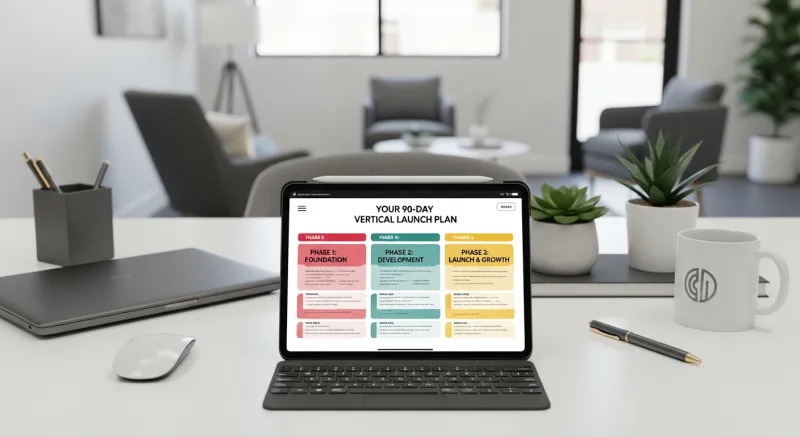
Your 90-Day Vertical Launch Plan
Ready to commit? Here is the step-by-step plan:
Days 1-14: Research and Select
- Run all five filters against 3-4 candidate niches
- Count addressable merchants in your territory (Google Maps, Yelp, trade directories)
- Identify 2-3 community hubs (associations, WeChat groups, Facebook groups, local events)
- Select your niche and commit
Days 15-30: Build Your Playbook
- Configure a KwickOS demo environment tailored to your niche (real menu items, real modifiers, real workflow)
- Prepare a 1-page industry pain point sheet with specific dollar amounts
- Use the processing fee calculator to build savings scenarios for your niche's typical volume
- Script your 3-minute pitch using industry-specific language
Days 31-60: Land Your First 5 Merchants
- Target the highest-visibility merchant in your area first (the one everyone knows)
- Over-deliver on installation and training
- Document everything for case studies — take photos, record metrics, get quotes
- Join one community event or online group
Days 61-90: Activate the Referral Engine
- Publish your first 2-3 case studies (written + video if possible)
- Ask each installed merchant for 2 warm introductions
- Launch your referral incentive program
- Attend or sponsor one niche industry event
By day 90, you should have 8-12 installed merchants, 3+ published case studies, and a pipeline of 10-15 referral leads. That is the foundation for a $300,000+ year.
Build Your Reseller Business on KwickOS
KwickOS partners earn industry-leading residuals with processor-agnostic freedom, multilingual support, and features that win in every vertical. See what specialization can do for your income.
Explore the Partner Program