 Kelly Ho
Picture the week of July 2nd. Every household within five miles of your door is planning the same thing: feed a backyard full of people on Saturday. Burgers, brisket, ribs, sides, something cold to drink, something sweet to finish. They are going to spend real money on it — the question is only where.
Here's the uncomfortable part: for most independent restaurants, the answer is "the grocery store." The cookout host defaults to a cart full of raw meat and a long afternoon at the grill, not because they wouldn't rather have your smoked brisket and your sides, but because nobody ever offered them an easy way to buy it. No pre-order page. No platter sized for twelve. No "order by Wednesday, pick up Friday." So the single largest food-spending weekend of the summer slides right past the businesses best equipped to own it.
That's the loss I want to fix in this guide. Not "how to get a little busier on the 4th" — how to build a holiday revenue campaign that pre-sells the volume, paces your kitchen, keeps delivery off the commission treadmill, and turns a one-day crowd of strangers into a list of regulars you keep all summer. And stick with me, because the most profitable move in this entire plan happens days after the fireworks end.
Why the 4th of July Is the Easiest Big Day to Plan For
Most sales spikes force you to manufacture demand. The 4th is the opposite — the demand is locked in weeks ahead and it's enormous. According to restaurant and retail industry data, Independence Day consistently ranks as the top grilling holiday in America, with billions spent on food and the overwhelming majority of households hosting or attending a cookout. People know they need to feed a crowd. Your job isn't to convince them to spend; it's to be the obvious, effortless place they spend it.
Here's the thing: that certainty is your biggest advantage, and most restaurants squander it by treating the 4th like a normal Saturday that happens to get busy.
- The buying decision is made in advance. Nobody decides at 2 p.m. on the 4th whether to feed fifteen people. They plan it days out — which means you can capture the order days out, on your terms, with a deposit and a scheduled pickup time.
- Groups want packages, not à la carte. A host feeding a backyard doesn't want to build an order item by item. They want a platter or a catering package with a number on it. That's a gift to both your margin and your prep line.
- BBQ is built for batch production. Brisket, ribs, and pulled pork are cooked low and slow in volume anyway. A holiday that runs on smoked meat is a holiday you can forecast and pre-cook against confirmed orders — if you capture those orders ahead of time.
That last point is the whole game. When your demand is predictable and your product batches well, the only thing standing between you and a record week is a system that captures, paces, and follows up on the orders. So this plan starts not with the menu, but with how you take it.
Step 1: Pre-Sell Everything — and Cap Your Pickup Windows
The money on the 4th is won during the two weeks before it, quietly, through pre-orders. Two things have to happen: you pull as much volume as possible into scheduled orders, and you spread those orders across the holiday so your smoker and your line never hit a wall.
Open pre-orders early and make them impossible to miss
Open 4th of July catering and platter ordering at least two to three weeks out. Put the link everywhere — your website, every social bio, every email and text on your list, a sign at the register, a QR code on every to-go bag in late June. The host planning a 20-person cookout is shopping early, and once they've ordered, they're done. If your pre-order page isn't live and obvious a full week ahead, you're handing that order to whoever opened theirs first.
Cap each time slot — this is the move that saves your kitchen
Here's the part that separates a clean holiday from a chaotic one: limit how many orders each pickup window can hold. Instead of letting 150 orders all land at noon on the 4th, your online ordering system offers pickup slots — 10:00, 10:30, 11:00, and so on — each with a capacity cap. When a slot fills, it closes, and the next order rolls to the next available time.
But it gets better: this one mechanism does three jobs at once. It smooths your kitchen's load into a steady production run instead of a spike. It sets an honest expectation so nobody's standing at your counter fuming while their ribs sit in someone else's bag. And it lets you forecast your prep down to the pound, because every order is timestamped and confirmed before the holiday even arrives. Rockin' Rolls Sushi Express runs 49 self-ordering stations across three locations precisely so order capture never bottlenecks at a human — and the same logic, applied to scheduled pickup slots, is what keeps a holiday kitchen sane.
One more layer of protection: take a deposit, or full prepayment, on large catering and platter pre-orders. A booked $250 brisket package that ghosts you at noon isn't a $0 event — it's $250 of premium meat you bought, smoked overnight, and now can't resell, because everyone else already placed their order. Prepayment at checkout nearly eliminates that and pulls the cash in before you've spent a dollar on inventory. Want to put a real number on what those no-shows cost? Our no-show cost calculator does the math for your average ticket and volume.
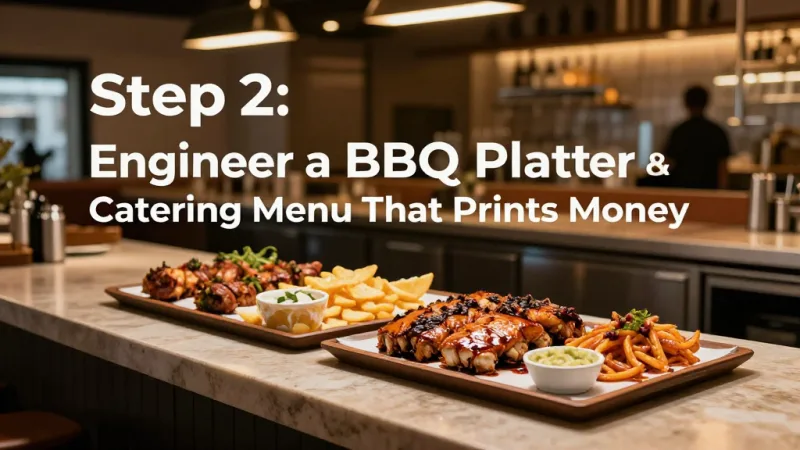
Step 2: Engineer a BBQ Platter and Catering Menu That Prints Money
Now the food. The single biggest lever on your 4th of July revenue is the menu structure — and a tiered package menu beats à la carte on nearly every count.
Build packages priced by the crowd, not the plate
Bundle your highest-margin shareables — brisket, ribs, pulled pork, sausage, plus the sides that cost pennies and sell for dollars (mac and cheese, beans, slaw, cornbread) — into fixed-price packages sized for a group. A natural three-tier ladder looks like the Backyard (feeds 6, $89), the Block Party (feeds 12, $169), and the Whole Street (feeds 25, $329). A package menu isn't just a way to charge more — it's a way to control more. When every order moves through the same defined packages, you can:
- Batch-prep the entire run, because you're making a handful of standardized packages in volume instead of hundreds of custom tickets.
- Forecast your protein buy exactly from confirmed pre-orders, so you smoke the right number of briskets and schedule the right number of hands.
- Steer guests toward your best-margin items, so the food cost on a $169 package often runs better than your normal mix despite the bigger ticket.
The math is the whole point. A normal individual order might be $20. A package lifts that same customer to $89, $169, $329 — and the work to produce it is more efficient, not less. That's how a busy day becomes a banner week. For the deeper mechanics of designing bundles that convert, our guide to online ordering menu design breaks down the photo, modifier, and combo tactics that lift every digital ticket. And if catering is going to be a real channel for you beyond the holiday, the corporate catering pipeline guide shows how to turn one big weekend into recurring orders.
Add the patriotic limited-time items, the drinks, and a locked-down menu
Pattern interrupt: the package is the engine, but the theme is the marketing. Run a short, photogenic lineup of red-white-and-blue limited-time items — a flag-decorated dessert tray, a berry shortcake, a star-spangled sheet cake for pre-order, a patriotic frozen drink where your license allows. Limited-time items create urgency, fill your social feed with free advertising, and give the host a reason to add one more thing to the cart. Tiger Sugar International Dessert builds its whole experience on minimal-step personalization at the kiosk — the same idea applies here: make the festive add-on a single tap, not a conversation.
Where your liquor license allows it, attach beer and beverage bundles to every package — a six-pack, growler, or batched cocktail add-on is a near-automatic yes for someone already buying cookout food, and drink margins are the best in the building. Then build a one-tap upsell at checkout: "Add a pound of brisket for $16?" On a few hundred orders, those prompts compound fast.
And here's a tip from watching kitchens on their hardest days: lock the menu down for the holiday. Pull the slow, fussy à-la-carte items and run a streamlined 4th of July lineup of batch-friendly food. Shogun Japanese Hibachi gets brand-new staff fully proficient in under five minutes because the service flow is simple and repeatable — and a stripped-down, standardized holiday menu gives even your seasonal help that same guardrail on the one weekend there's zero room for error.
Step 3: Keep Delivery Profitable Instead of Feeding the Apps
Now the move that quietly decides whether your big day actually makes money. You will get delivery demand on the 4th — and if all of it flows through third-party apps, the commission can swallow your entire profit on the busiest day of the summer.
Run the numbers. Push $5,000 of catering and platter orders through a delivery app at 28% commission and you just handed back $1,400 — on the day you can least afford it. Push that same volume through your own first-party ordering with scheduled pickup, and your delivery cost is zero. For the orders that genuinely need delivery, a flat-fee model like KwickDriver — roughly $2 plus a per-mile charge — costs a few dollars instead of a quarter of the ticket.
So here's the strategy: make first-party pickup the default and the easiest path, reserve delivery for who truly needs it, and route that delivery through a flat fee instead of a percentage. The savings aren't marginal — on holiday volume, the difference between a flat delivery fee and a 25-to-30% commission is frequently the entire gap between a profitable day and a merely busy one. Our delivery commission comparison lays out exactly what DoorDash, Uber Eats, and Grubhub take versus a flat-fee model, and the first-party ordering guide walks through how to stand up your own channel so the apps stop being your landlord on your best days.
Step 4: Run the Promotions That Capture the Overflow
You've built the packages and opened the books. Now turn the volume into more than a one-day spike — because the 4th of July's hosting and gifting culture is a stored-value opportunity most restaurants completely miss.
Start with the host. Whoever's throwing the cookout is spending real money to feed everyone — so reward it. Run a "buy $100 in gift cards, get a $20 bonus card" promotion in the two weeks around the holiday. The buyer treats it as a thank-you to hand the host, or a head start on their own next visit; you've locked in $100 of guaranteed future revenue and put a $20 hook in the water that only pays out when someone comes back and spends more.
Then push the e-gift card hardest of all. A digital card can be bought at 11:50 a.m. by someone three states away who wants to chip in for their family's cookout, delivered by text in under a minute, and redeemed any time. It rescues the last-minute crowd, captures the people who couldn't get a pickup slot, and pulls traffic back in the slower weeks of mid-summer. And stored value almost never gets spent alone — the classic pattern is a customer walking in to "use up" a $100 card and leaving having spent $170. Model how that compounds with our loyalty and rewards ROI calculator.
Finally, drop a return coupon or bonus gift card into every catering and platter pickup — "Come back before the end of July and this $15 is yours." You've just turned the holiday's biggest one-day crowd into a reason to come back during the dog days of summer, at essentially zero cost until it's redeemed. For the full month-by-month framework on stacking these pushes across every occasion, see our holiday gift card sales strategy.
Step 5: Turn One Cookout Day of Strangers into a Summer of Regulars
Here's the open loop I promised to close — and the most profitable move in this entire plan. The brisket isn't the prize. The customer data the brisket generates is.
Think about who's ordering from you on the 4th: hundreds of people, many of them first-timers, all buying more than they would on a normal day, all of them handing you their name, phone number, and order history at checkout. On most holidays, every one of them collects their package and vanishes — gone until maybe next year. That's the real loss, bigger than any buried ticket or commission hit. You ran a packed, profitable day and threw away the single most valuable asset it produced.
So capture it. Every pre-order, every gift card sold, every delivery, every loyalty or membership enrollment at checkout adds a name to a list you own and can reach directly. Then work it:
- A thank-you with a reason to return. A short message a few days later — "Thanks for celebrating the 4th with us — here's double points on your next visit this month" — converts a once-a-year customer into a second and third visit while the goodwill is fresh.
- Bonus loyalty points on every holiday order. A points multiplier on 4th-of-July tickets gives first-timers a concrete reason to come back the following week. The entire purpose of a points or membership program is to turn an annual visitor into a monthly one.
- An occasion flag in the profile. A customer who ordered a big package for the 4th is someone you can invite back for Labor Day, the big game, and every other reason a group needs feeding. You "acquired" them for the cost of one already-profitable holiday.
And that's not all: reactivating a customer who already had a great experience with you costs a fraction of acquiring a stranger through ads. The 4th already bought you the attention. The only question is whether your system captured it — or let it walk out the door with the ribs.
The Whole Holiday Runs on One Connected System
Step back and notice what every part of this plan has in common. The capped pickup windows, the prepaid catering packages, the first-party ordering that dodges commission, the flat-fee delivery, the patriotic limited-time items, the gift cards, the loyalty enrollment that drives the follow-up — these aren't seven separate tools you bolt together. They're one customer relationship moving through one system.
That's the real case for running the holiday on an all-in-one platform instead of a patchwork. When your POS, online ordering, kitchen display, delivery, gift cards, e-gift cards, CRM, and loyalty all live in the same place, the data flows by itself: the host who pre-ordered a brisket package is automatically the loyalty member you thank on the 7th and the gift-card buyer you nudge before Labor Day. Stitch that together from disconnected vendors and the seams are exactly where the revenue — and the orders — leak out. It's also why a processor-agnostic platform matters on a day like this: when you're clearing thousands in catering tickets all morning, the half-point you save by choosing your own payment processor instead of a locked rate is real money back in your pocket, not your software vendor's.
And because a hybrid local-plus-cloud POS like KwickOS runs checkout on your own network at roughly 1ms latency, it keeps ringing orders even if your internet drops mid-rush — then syncs automatically when it returns. On the most order-dense day of your summer, "the system's down" is not a sentence you can afford to say. Crafty Crab Seafood runs this kind of connected operation across 19 locations and 152 terminals — one-click menu sync to push a 4th of July package menu to every store at once, customized kitchen displays to keep a flood of pickup tickets in order, and unified guest data across the whole group. You don't need 19 locations to use the same logic. You need one kitchen, one connected system, and a plan that treats the 4th as a campaign, not just a busy Saturday. If you run or sell to a portfolio of restaurants, you can partner with KwickOS to bring this playbook to every merchant you serve. And if you're still weighing whether the platform fits your concept, start at our restaurant solutions overview.
Make This 4th of July Your Most Profitable Holiday of the Summer
KwickOS ties your online ordering, pickup scheduling, kitchen display, flat-fee delivery, gift cards, checkout, and loyalty into a single platform — so a flood of holiday orders actually turns into banked profit and a list of regulars you keep all summer. See how it works for your restaurant.
Explore KwickOS for Restaurants
Frequently Asked Questions
When should a restaurant start taking 4th of July orders?
Open 4th of July catering and party-platter pre-orders at least two to three weeks before the holiday, and push hardest in the final week. Independence Day is one of the biggest cookout and group-food occasions of the year, and Americans spend billions on food for it. The buying decision is made days ahead as people plan barbecues and gatherings, so open ordering early, cap each pickup time slot so your kitchen isn't crushed, and set a clear "order by July 2" deadline so you can prep and buy accurately.
Why are BBQ party platters and catering packages the most profitable 4th of July items?
BBQ platters and catering packages bundle high-margin shareables — brisket, ribs, pulled pork, sausage, sides, and cornbread — into fixed-price packages sized for a crowd, which raises the average order from a $20 individual ticket to a $90 to $250 platter or a multi-hundred-dollar catering order. Because the package is pre-defined and pre-ordered, you can batch-prep it, forecast your protein buy exactly from confirmed orders, and steer guests toward your best-margin items. A tiered package menu (for example, feeds 6, feeds 12, and feeds 25) lets groups self-select and consistently lifts the average holiday ticket several times over a normal order.
How can restaurants avoid losing 30% to delivery apps on the 4th of July?
Drive 4th of July orders to your own first-party online ordering and scheduled pickup instead of third-party apps, where commissions of 15% to 30% can erase the margin on your biggest volume day. Promote a direct order link everywhere, prioritize scheduled pickup (which costs you nothing in delivery fees), and for delivery use a flat-fee model like KwickDriver — roughly $2 plus a per-mile charge — rather than a percentage commission. On thousands of dollars of catering and platter orders, the difference between a flat delivery fee and a 25% to 30% commission is often the difference between a profitable holiday and a busy one that barely breaks even.
Does my restaurant need to serve BBQ to profit from the 4th of July?
No. While barbecue dominates Independence Day, any restaurant can build a holiday revenue plan around group platters, catering packages, patriotic limited-time items, and gift card promotions. A pizzeria can sell party packages, a taqueria can sell a taco bar, a dessert shop can sell red-white-and-blue trays, and a bar can run a patriotic cocktail and beer-bundle promotion. The winning move isn't the cuisine — it's pre-selling a fixed-price package sized for a crowd, capturing the customer data at checkout, and bringing those guests back all summer.
What 4th of July promotions bring customers back after the holiday?
Tie holiday volume to repeat visits with stored value and loyalty: include a bonus return coupon or gift card in every catering and platter pickup, run a "buy $100 in gift cards, get $20 free" campaign for hosts treating their cookout crowd, and enroll every pickup and delivery customer in your loyalty or membership program with bonus points on holiday orders. The goal is to convert a one-day flood of customers — many of them first-timers — into a list you can market to all summer, so a single profitable holiday becomes a season of returning regulars. Multi-location operators can partner with us to bring the same playbook to every restaurant they serve.