 Ming Ye
Picture the line at 1 p.m. on the busiest Saturday of the summer. Forty people deep. Every one of them holding cash or a card, ready to spend.
And your window is doing one order every three minutes.
Here's the brutal math: in a 6-hour festival, a three-minute order pace serves 120 people. At a $13 average ticket, that's $1,560 for the entire day — for a crowd that would have handed you five times that if you could have reached them.
But it gets worse: while your line crawls, the truck next to you is running 90-second orders, clearing the same crowd twice, and stacking $8,400 in the register by the time the headliner takes the stage. Same festival. Same weather. Same customers. The only difference is the operation behind the window.
A festival is the highest-leverage day on a food truck's calendar. You've already paid the vendor fee, the fuel, and the staff — the crowd is standing right there. The question is never whether the demand exists. It's whether your menu, your prep, your payment setup, and your POS can convert that demand before the customer gives up and walks to the next truck.
This is the playbook. Real numbers, no fluff — how to pick events that pay, build a menu for speed, hit a 90-second order target, take payment when the cell network is dead, handle cash without getting robbed, and turn every festival buyer into a customer you can reach again.
Pick Events That Actually Pay (Most Don't)
Not every festival is worth your Saturday. The vendor fee is only the visible cost. The real cost is opportunity — a bad event ties up your truck, your staff, and your inventory for a day you could have parked at a brewery lot doing steady $9 tickets with zero competition.
Before you sign a vendor agreement, get answers to five questions:
- What's the expected attendance, and how is it verified? "10,000 people" from an organizer usually means 4,000. Ask for last year's actual gate numbers or ticket sales, not projections.
- How many food vendors, and how many overlap with your concept? Twelve trucks at a 4,000-person event means roughly 330 potential customers each. Three other taco trucks means you're splitting the taco crowd four ways.
- What's the fee structure? A flat $300 vendor fee is predictable. A "20% of gross plus $150" arrangement can quietly eat your entire margin on a big day.
- Is there power, water, and — critically — connectivity? Festival grounds are notorious dead zones. Ten thousand phones on the same tower means your card reader may see nothing. (More on surviving this below.)
- What's the crowd's spending profile? A ticketed food-and-wine festival spends very differently than a free community fair. Match your menu and pricing to the wallet in front of you.
Run every event through a simple break-even: (vendor fee + fuel + labor + food cost) ÷ your average ticket = transactions needed to break even. If you can't clear that number in the first two hours, the event isn't worth it. Your POS reporting from past events is the best data you have here — pull the actuals from comparable festivals before you commit. If you're tracking sales per event in a platform like KwickOS, that history turns event selection from a gut call into a spreadsheet decision.
Build a Menu for Throughput, Not Variety
Here's the thing most new operators get exactly backwards: a festival is not the place to show off your range. It's the place to move volume. Every additional menu item is a tax on your line speed — more prep stations, more decision paralysis at the window, more waste at the end of the night.
The highest-grossing festival trucks run six to eight items, built on three or four bases you can batch ahead of time. One signature item, two or three variations, a combo that raises the average ticket, and a single drink line.
Rockin' Rolls Sushi Express — a KwickOS customer running 49 iPad self-ordering stations across its locations — proves the principle in reverse at their storefronts: tightly structured menus and pre-configured combos move lines fast because the choices are pre-made for the customer. On a truck, you compress that idea into a handful of one-tap buttons.
Menu design rules that protect your line:
- Batch everything you can. Proteins cooked in advance and held hot, sauces pre-portioned, garnishes prepped in deli containers. Assembly at the window should be seconds, not minutes.
- Kill the modifiers. "Choose your protein, choose three toppings, choose a sauce" is a storefront luxury. At a festival, offer built items with one optional swap. Every choice you remove is a few seconds returned to the line.
- Price for the event, not for your lot. Festival-goers expect to pay a premium and they're in a spending mood. A $2 bump on your signature item across 600 orders is $1,200 you leave on the table by pricing like it's a slow Tuesday.
- Anchor a combo. A signature-plus-drink combo priced just below buying both separately lifts the average ticket and simplifies the order into one button.
Program every item, combo, and price into your POS as a one-tap button before you leave the commissary. A cashier hunting through nested menu screens under pressure is the number-one hidden cause of a slow line.
The 90-Second Order: Where the Money Actually Lives
This is the whole game. Everything else — the menu, the event, the pricing — exists to serve this one number: how many seconds from "next!" to the customer stepping away with food.
Let the math make the case. In a 6-hour service:
| Seconds per order | Orders in 6 hours (single window) | Gross at $13.50 avg ticket |
|---|---|---|
| 180 sec (3 min) | 120 | $1,620 |
| 120 sec (2 min) | 180 | $2,430 |
| 90 sec | 240 | $3,240 |
| 90 sec, two payment lanes | 480 | $6,480 |
| 75 sec, two lanes + combo lift ($17.50) | 576 | $10,080 |
The jump from a single slow window to two fast payment lanes with a combo-lifted ticket is the difference between a $1,600 day and a $10,000 day. Nothing about the crowd changed. Only the operation did.
How to get there:
- Split the roles. One person takes the order and payment, another expedites, another assembles. The window cashier should never touch food.
- Run two checkout points. A second handheld or tablet POS turns one line into two. This single change is the biggest throughput multiplier available to a food truck, and it costs you one more device — not one more truck.
- Take payment while the food is being made. The order is rung and paid the instant it's placed; assembly happens in parallel. Customers wait for food, never for the register.
- Make the checkout itself fast. Tap-to-pay and chip should be the default; a customer-facing display that shows the total and offers a one-tap tip keeps the transaction moving. Fumbling for change is where 30 seconds vanish.
Fast, accurate checkout isn't a nice-to-have at a festival — it is the revenue. Want to see the throughput logic applied to counter service generally? Our QSR speed-of-service guide breaks down the same principles for fixed locations.
Payment When the Network Is Dead
And that's not all — here's the failure mode that quietly kills more festival revenue than slow cooking ever will: the card reader stops working at the exact moment the line is longest.
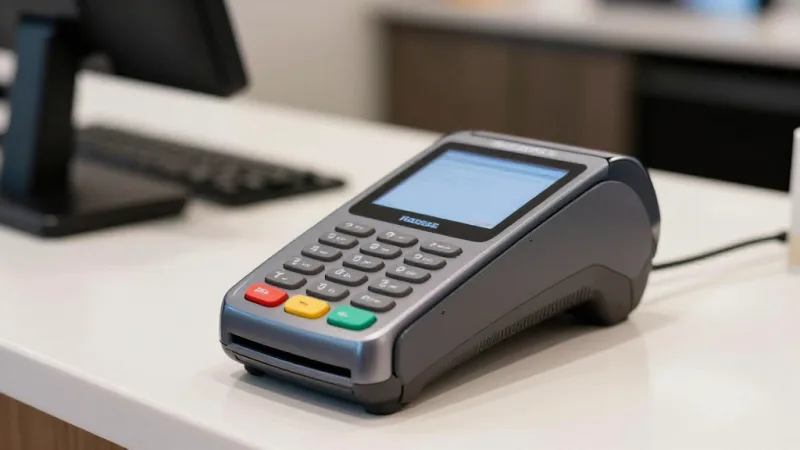
Festival grounds are the worst-case scenario for connectivity. Ten thousand people on their phones saturate the local cell tower. The "free vendor WiFi" collapses under load by noon. And a cloud-only POS that needs to phone home to authorize every transaction simply stops — mid-rush, with 40 people waiting and cash-only becoming your only option.
This is exactly where architecture matters. KwickOS runs on a hybrid local+cloud design: the terminal processes orders, prints tickets, tracks totals, and stores card transactions locally with roughly 1ms latency, then settles the batch to the cloud once connectivity returns. The line never notices the network is gone. Cloud-only systems like Toast and Square depend on a live connection to function at full capability — the precise thing a festival cannot guarantee.
Your connectivity survival kit:
- Run a POS with true offline mode that authorizes and queues transactions locally — not one that merely "caches" and locks you out after a few minutes offline.
- Bring a dedicated mobile hotspot on a different carrier than your phones, and keep it charged. It's your backup pipe when the festival WiFi dies.
- Never set a card minimum that blocks the sale. If a connection hiccups, the order should still ring and settle later — not turn into an argument at the window.
- Batch-settle at the end of the night from a stable connection back at the commissary, so every offline transaction clears cleanly.
If you want the full breakdown of why local processing beats cloud-dependent systems for mobile and high-traffic operators, see our KwickOS vs Toast comparison.
Cash Handling Without Getting Burned
Festivals still move real cash, and cash is where trucks quietly lose money — to miscounts, to sticky fingers, and to the chaos of making change during a rush.
- Start with a counted, documented bank. Photograph the opening drawer count. Your POS should log it so end-of-night reconciliation is a comparison, not a guess.
- Assign one cash handler per drawer. When three people share a till, no one is accountable. If your POS supports fingerprint 1:1 login — as KwickOS does — each transaction ties to a specific employee, which ends the "I don't know where the shortage came from" conversation.
- Price to eliminate coins. Round menu prices so cash totals land on clean dollar amounts. Making change for $13.47 forty times an hour is a throughput and error disaster.
- Drop cash mid-shift. Don't let $2,000 pile up in an open drawer on a truck. Skim to a locked box on a schedule and log each drop.
- Reconcile against POS totals, not memory. Your system knows exactly how much cash it expected. The drawer either matches or it doesn't — and now you know before you drive home.
Turn One-Day Buyers Into Season-Long Revenue
Here's the open loop most trucks never close: a festival puts hundreds of brand-new customers in front of your window for one single day — and then they vanish forever, because you never captured a way to reach them again.
That's the most expensive mistake in this entire playbook, and it's the easiest to fix. The tools live right in your checkout:
- Sell gift cards and e-gift cards at the window. A festival buyer who loves your food is in a spending mood. "Grab a $50 e-gift card, we'll text it to you" converts a one-time sale into future guaranteed revenue — and a portion of gift card value is never fully redeemed, which flows straight to your bottom line. Because KwickOS builds gift cards and e-gift cards into the same checkout, selling one adds no steps to the line.
- Enroll loyalty in two seconds. A phone-number-based loyalty and points program lets a cashier add a customer at checkout without slowing anything down. Now you own a channel: text every enrolled customer your schedule for the rest of the festival season and turn a one-day crowd into repeat visits at your regular spots.
- Put your schedule on the receipt. Every printed and e-receipt should carry where the truck will be next and a link to follow. Tiger Sugar International Dessert, a KwickOS customer, pairs electronic receipts with loyalty enrollment precisely to keep that connection alive after the customer walks away.
The truck that sells 30 gift cards and enrolls 200 loyalty members at a single festival didn't just earn $8,400 that day — it built a mailing list and a stack of prepaid revenue that pays out for months. Loyalty and stored value are how a festival stops being a one-day event and becomes a customer-acquisition engine. Dig deeper in our mobile loyalty guide, and if you want to model the payback, the KwickOS ROI calculator runs the numbers for you.
Why an All-in-One System Wins on a Truck
A food truck is the most constrained environment in food service. Limited power, limited space, unreliable connectivity, a skeleton crew, and a service window measured in seconds. Every one of those constraints punishes a patchwork of disconnected tools — one app for orders, another for payments, a third for loyalty, a shoebox for cash.
That's exactly the problem KwickOS was built to solve. One platform runs checkout, offline-capable payments, gift cards, e-gift cards, loyalty and points, employee login and cash accountability, and per-event sales reporting — on hardware as light as a tablet, over a connection you can't trust. And because KwickOS is processor-agnostic, you keep 100% of your processing relationship and negotiate your own rates instead of surrendering a flat cut on every festival swipe to a locked payment system. On a $10,000 day, the difference between a 2.2% negotiated rate and a locked 2.99% is real money in your pocket.
If you're evaluating systems for a mobile operation, start with our restaurant platform overview and the food truck POS operations guide, which cover the day-to-day setup beyond festival days.
Run Your Busiest Day Without Missing a Sale
KwickOS gives food trucks offline-capable checkout, built-in gift cards and loyalty, and processor freedom — all on hardware light enough to run from a truck window. See how much your next festival could earn.
Get a Free DemoFrequently Asked Questions
How much can a food truck realistically make at a festival?
A well-run truck with a tight menu and two payment lanes can turn 500 to 700 transactions at a $12 to $14 average ticket in a 6-hour window, which lands between $6,000 and $9,800 in gross sales. The number is capped less by the crowd size than by your line speed. Trucks that keep service under 90 seconds per order routinely clear $8,000+, while trucks with a slow, sprawling menu leave half the line unserved and cap out around $3,000.
How do I take card payments at a festival with no cell signal?
Use a POS with a true offline mode that authorizes and stores card transactions locally and settles the batch once connectivity returns. KwickOS runs on hybrid local+cloud architecture, so the terminal keeps ringing up orders, printing tickets, and tracking totals even when the festival's shared WiFi and cellular network are saturated. Bring a mobile hotspot on a different carrier as backup, and never set a card minimum that blocks a sale when the connection hiccups.
How many menu items should a food truck offer at a festival?
Six to eight items maximum, built around three or four proteins or bases you can batch ahead. Festivals reward throughput, not variety. Every extra item slows the line, complicates prep, and increases waste. The highest-grossing festival trucks run a signature item plus two or three variations, a combo, and one drink line, all pre-programmed as one-tap buttons on the POS so cashiers never hunt through screens.
Should a food truck sell gift cards and run a loyalty program at events?
Yes. A festival puts hundreds of new customers in front of you for one day only, so capture them. Digital gift cards and e-gift cards sold at the window turn one-time festival buyers into future revenue, and a phone-number loyalty program enrolls customers in two seconds at checkout so you can text them your schedule for the rest of the season. KwickOS builds gift cards, e-gift cards, and points-based loyalty into the same checkout, so enrollment adds no time to the line. Resellers can offer the same tooling to their own merchants through the KwickOS partner program.