 Kelly Ho
Pick up one falafel ball. Really look at it.
It's chickpeas, parsley, cilantro, garlic, cumin, a little flour to bind, and the oil it fries in. Pennies. The honest cost of a single falafel ball, fried, is somewhere around 60 to 70 cents.
Now put four or five of them in a pita with hummus, pickles, tahini, and a fistful of salad, and charge $12 for the plate. Do the same with shawarma — bulk chicken thigh or beef bottom round, marinated in spice, carved off a spit — and you've got one of the best food-cost profiles in the entire restaurant industry, sold at fast-casual speed with a fraction of the labor a full-service kitchen needs.
Here's the thing, though: that margin is theoretical until the line proves it. A falafel-and-shawarma shop is a build-your-own machine — base, protein, toppings, sauces — and every one of those stations is a place to either move fast and protect the margin, or stall out and give it away. You don't lose money on the expensive proteins. You lose it on the cheap stuff you over-scoop and the customers who walk because the line was eight deep.
And it gets worse: the two failure modes feed each other. A slow line forces builders to rush, rushing makes portioning sloppy, sloppy portioning blows the food cost, and a blown food cost on a cheap-ingredient concept is the whole game. Get the assembly line, the prep flow, and the POS right, and a falafel shop scales from one location to fifty on the same playbook. Get it wrong and you've got a great-tasting concept that never makes money.
This guide breaks down exactly how the best fast-casual Mediterranean operators build it: the assembly-line layout, the shawarma-spit and falafel-fry prep flow, sauce-station discipline, pita warming, and — the part most owners underestimate — the quick-order POS workflow that keeps the register from becoming the slowest station in the building.
The Assembly Line Is the Product: Build It Like Chipotle
Start with the layout, because the layout is the operation. A falafel-and-shawarma shop isn't a kitchen with a counter bolted on — it's an assembly line that customers walk past, and the order of the stations decides your speed.
The proven build-your-own sequence reads left to right: base → protein → toppings → sauces → check out. Rice, greens, or pita goes down first; falafel or carved shawarma lands next; then the cold toppings — pickled turnips, cucumber-tomato salad, onions, feta; then the sauce drizzle; then payment. The customer moves in one direction and never doubles back, and each builder owns one zone.
Three rules make that line actually move:
- Pre-portion everything into the line before the rush. Toppings in fixed pans, proteins held hot and ready, sauces in squeeze bottles staged at arm's reach. Mid-rush is for assembling, not for refilling or hunting.
- Portion by tool, never by feel. A fixed scoop for rice, a portion spoon for toppings, a measured carve for shawarma. The difference between "a scoop" and "looks about right" is a quarter-ounce per component, and a quarter-ounce across four components on 250 plates a day is real product you bought and gave away.
- One builder, one job. At volume, splitting protein and toppings across two sets of hands doubles your line speed without doubling labor cost, because nobody's reaching across the rail.
This is the same insight that makes self-order kiosks so powerful for this format. Baked Cravings runs a 24-hour self-serve kiosk at Lego Land on a single PaxA35 terminal — the customer builds and pays themselves, and the line behind the counter only assembles. Rockin' Rolls Sushi Express pushed it further, cutting serving time with 49 iPad self-ordering stations feeding a kitchen display. A falafel line has the exact same shape: when ordering moves off the counter and onto a kiosk, your staff stops taking orders and starts only building them — and throughput jumps.
Prep Is Where the Speed Is Won: Spit, Fry, and Batch
Here's a truth every fast-casual operator learns the hard way: the rush is won at 10:30 a.m., not at noon. By the time the line forms, every decision that determines your speed has already been made in prep.
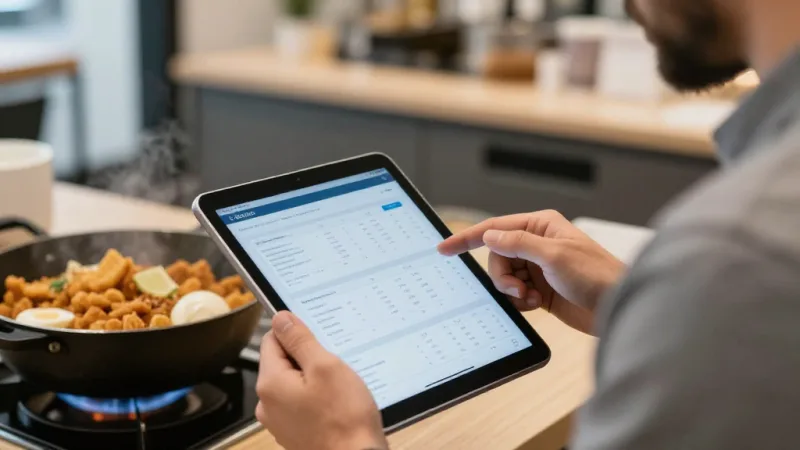
The shawarma spit is a demand clock, not a set-and-forget. A vertical broiler stacked with marinated thigh or beef looks effortless, but the skill is carving to pace — keeping the outer layer caramelized and ready without carving so far ahead that it dries under the heat lamp. Stack the spit to the day's forecast, not to a habit, and carve in response to the line. Over-build the spit on a slow Tuesday and you're throwing away your best protein at close.
Falafel is a batch-timing game. Fried falafel is glorious for about ten minutes and sad after thirty. The discipline is small, timed batches fired to demand — never one giant morning fry that's lukewarm and dense by the lunch peak. Mix and shape ahead (a falafel scoop keeps every ball the same size, which keeps both the cook time and the food cost consistent), then fry in waves so there's always a hot batch and never a graveyard tray.
Everything else gets prepped to a spec and a yield. Hummus, tahini, pickled vegetables, salads, rice — batched to documented recipes with known yields, so when your POS tells you you sold 220 plates, you know exactly how much chickpea, tahini, and rice that should have consumed. The gap between that theoretical number and what you actually burned through is your waste and over-portioning, made visible. Our POS-integrated inventory guide walks through exactly how that theoretical-versus-actual comparison catches the leak before month-end does.
And because a winning falafel concept almost always becomes a multi-location one, prep standardization is what lets it travel. Crafty Crab Seafood runs 19 stores on one-click menu and recipe sync; the same approach lets a falafel brand set a prep sheet and portioning spec once and push it to every location, so the food eats the same in store five as it did in store one instead of drifting kitchen by kitchen.
The Sauce Station: Your Signature and Your Silent Leak
Sauce is where a falafel-and-shawarma shop earns its reputation — toum that makes people gasp, amba you can't get anywhere else, a harissa with a real backbone — and it's also where margin quietly walks out the door. Here's why: sauces feel free, so they get treated as free, and tahini and olive-oil-heavy sauces are anything but cheap by the ounce.
The fix is to treat sauce as costed, portioned inventory:
- Portion with squeeze bottles or fixed pumps. A controlled drizzle is the same every time and looks more intentional than a ladle dump. Consistency protects both flavor and food cost.
- Price the generosity. Set a standard "extra sauce" or "side of toum" upcharge in the POS so the customer who wants double tahini pays for it instead of getting it gifted. A few cents of product priced at a dollar is margin, not stinginess.
- Track sauce as its own inventory line. Tie sauce usage to plate count. When your tahini burn rate climbs ahead of your sales, a connected system flags it — the early warning of over-pouring, before it costs you a full point of food cost.
Before you finalize a single plate price or an upcharge, run the real numbers — our free tools library has food-cost and menu-pricing calculators built for exactly this, so the sauces that make your shop famous don't quietly come straight out of your profit.
Pita Warming: The Small Detail Everyone Feels
Pita touches nearly every order, which makes it a small decision with an outsized effect on both food cost and the customer's first impression. Cold or stiff pita reads as "cheap" no matter how good the falafel inside is; warm, pliable pita reads as fresh and makes the whole plate better.
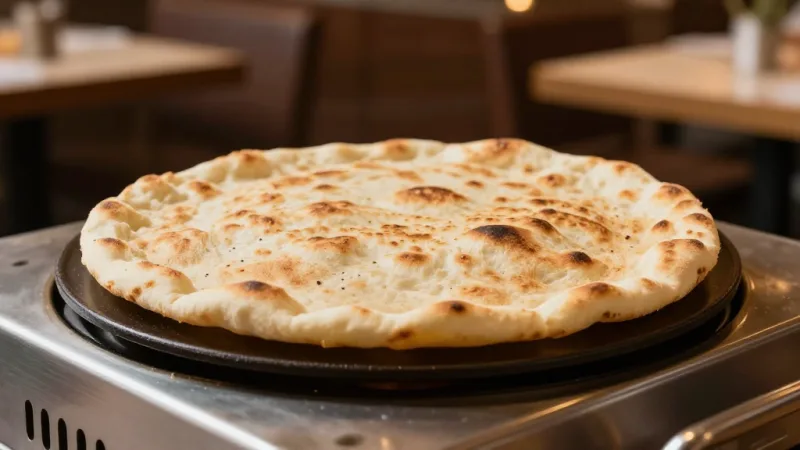
The operational rules are simple and worth holding: warm to demand on a flat-top or a dedicated warmer rather than warming a stack that goes leathery waiting, stage warm pita within arm's reach at the wrap station so it never becomes the thing that holds up an otherwise-finished order, and track pita as its own inventory line tied to covers so you can see the week usage drifts out of step with traffic — the early signal of over-portioning or waste. It's a tiny station that quietly sets the tone for the entire plate, so give it the same discipline you give the spit.
The Register Is the Real Bottleneck: Quick-Order POS
Here's the part most falafel-and-shawarma operators underestimate. Your line can be dialed in — falafel hot, spit carving clean, sauces portioned — and you can still cap your own throughput at the register, because a build-your-own Mediterranean menu is genuinely customization-heavy. A plate is a base, a protein, a half-dozen toppings, a sauce, a spice level, a side swap. If ringing all of that means hunting through screens and free-typing modifications, the cashier becomes the slowest station on the line and the whole shop throttles behind one tablet.
The fix is a POS built for this kind of menu:
- A quick-order grid that puts your highest-volume items — the falafel pita, the chicken shawarma bowl, the combo plate — one tap away. A handful of items are most of your volume; they should never be more than a tap or two from rung.
- Structured modifier groups — base, protein, toppings, sauce, spice — so a fully customized bowl rings in a few taps, with required-and-optional rules that stop an incomplete or nonsense order from ever reaching the line.
- Automatic price adjustments so the cashier never has to remember that double protein is an upcharge or extra feta costs more — the POS adds it the instant they tap it, protecting speed and margin at the same time.
- Kitchen display routing that fires the ticket to the right station — fry, spit, wrap — so each builder sees only their part of the order, clean and unambiguous.
That last point is how you keep the back of the line fast. Shogun Japanese Hibachi got operators proficient in under five minutes with customized cook-station displays; a falafel line has the same shape of problem — split an order across a hot protein station and a cold topping rail — and the same answer: let the display do the communicating so nobody stalls asking "what was on that one?" Our QSR speed-of-service guide goes deeper on order-point and hand-off timing, and our platform comparison hub shows how a quick-order POS stacks up against the locked-in systems.
Run on Numbers: The Metrics That Matter
You can't improve a line you don't measure, and the good news is your POS already captures most of what matters:
- Order-to-hand-off time. From rung to handed-off. A tuned fast-casual line lands in the two-to-four-minute range at peak; if yours is creeping past five, a station is choking — find it.
- Theoretical vs actual food cost. The single most important number on a cheap-ingredient menu. Tighten the gap between what you should have used and what you did and you've recovered your best margin.
- Average ticket. The lever that "make it a combo?", "add a side of fries?", and "want a drink with that?" prompts move — lifting revenue without one extra customer in line. (See our upselling guide for the exact prompts.)
- Covers per labor hour. Time-stamped sales data shows exactly when to schedule the extra builder for the lunch rush and when to cut for the 3 p.m. lull.
And because KwickOS runs a hybrid local-plus-cloud model, an owner can pull these numbers in real time from anywhere — the way T. Jin China Diner monitors 15 stores and 75 terminals remotely, watching every location's lunch rush from one dashboard. You don't have to stand behind the line to know whether it's winning.
Where the Margin Compounds: Checkout, Loyalty, and Gift Cards
Here's what separates a falafel shop that grinds for every transaction from one that builds a base of regulars: what happens in the last five seconds, at checkout.
Fast-casual Mediterranean draws a crowd most restaurants envy — health-conscious, habitual, the kind of guest who grabs a falafel bowl for lunch twice a week. That frequency is worthless if every visit is anonymous and a goldmine the moment you start capturing it, as long as it never adds time to the hand-off. Which means it has to live inside the POS, not a separate app:
- Enroll regulars in loyalty and points at the register or kiosk. For a repeat-visit concept, a points or membership program — points per dollar, "buy 9 bowls, get the 10th free" — is one of the highest-return retention tools you can run. With an all-in-one POS, the cashier or the self-order kiosk enrolls or applies points in a couple of taps on the payment screen, no punch card to lose, no line slowdown.
- Sell gift cards and e-gift cards. A craveable, shareable concept makes "want a gift card?" a natural prompt at checkout, and e-gift cards spike around the holidays, graduations, and Ramadan and Eid. Gift cards are guaranteed future revenue plus a near-certain return visit — and a slice never gets fully redeemed, which quietly lifts your margin.
- Save the customer profile. Tie the order to a customer record so you know their usual build, can text them a slow-Tuesday offer, and can win them back if they go quiet. Tiger Sugar built minimal-step personalization and electronic receipts with loyalty into a two-kiosk operation — proof you don't need to be big to run a sharp retention loop.
This is where a POS stops being a cash register and becomes a marketing engine. When checkout, loyalty, points, gift cards, e-gift cards, and customer profiles all live in one platform instead of four apps that don't talk to each other, that retention loop runs itself — and the lunch regular you served in three minutes becomes a member who comes back fifty more times this year.
The Platform Underneath: Why It Has to Stay Up
None of this matters if the technology buckles on your busiest shift — and the lunch rush is precisely when cloud-only systems fail. A line out the door, a wall of customized bowls, kiosks firing tickets to the back, and one internet hiccup takes the whole POS dark at the worst possible moment.
Architecture quietly decides whether your rush is a triumph or a disaster. KwickOS runs on a hybrid local-plus-cloud model: the POS keeps ringing at 1ms local speed even if the internet drops mid-rush, then syncs when the connection returns. Toast and most cloud-only systems go down when the Wi-Fi does. A few other things that matter specifically for a fast-casual Mediterranean operation:
- Processor-agnostic payments. Keep your own processor and negotiate your own rates, saving most operators $3,000 to $8,000 a year versus locked-in systems. On a high-volume lunch concept, that processing freedom lands straight in your margin.
- Multi-language built in. Mediterranean kitchens and front-of-house often run multilingual teams. KwickOS ships with English, Chinese, and Spanish, so staff work in the language they're fastest in and tickets read in the builders' language — fewer errors, faster ramp-up.
- Fingerprint employee verification. 1:N fingerprint authentication keeps time theft and unauthorized voids in check — exactly what you want when you staff up with extra hands for the rush.
- KwickDriver delivery. A $2 flat fee plus $6.99 per five miles instead of the 15–25% commission the third-party apps take — so delivery bowls and wraps stay profitable.
- One unified platform. POS, kitchen display, self-order kiosk, online ordering, CRM, loyalty, and gift cards in a single system — no patchwork of apps that don't sync.
That's the whole argument. A falafel-and-shawarma shop doesn't need five vendors and five logins. It needs one platform fast enough to keep the register from being the bottleneck, smart enough to protect a cheap-ingredient menu's margin, and connected enough to turn a three-minute transaction into a lifelong regular. Operators ready to see it running across one location or fifty can start on our restaurant solutions page, and resellers who set these systems up for local operators can learn more on our partner program page.
The Bottom Line
Falafel and shawarma is one of the best margin profiles in the business and one of the easiest to give away. The falafel that should be your engine goes lukewarm and over-portioned. The spit dries out when it's carved on a habit instead of demand. The sauce station gifts away tahini by the ounce. And the register — not the line — quietly caps how many of those high-margin plates you can sell in an hour.
Fix all four the same way: lay the line out like an assembly line, portion every component by tool, batch the fry and pace the spit to demand, and ring the customization-heavy menu on a quick-order POS — or a self-order kiosk — that never becomes the bottleneck. Then close the loop where it compounds: capture every fast, frequent transaction into loyalty, sell a gift card, save the profile, so one served plate becomes a year of repeat visits at full price. On a platform that stays up when the internet doesn't and lets your team work in the language they're fastest in, that's the difference between a craveable concept that bleeds and a craveable concept that scales.
Build a Falafel Line That Actually Scales
KwickOS unifies quick-order POS, self-order kiosks, kitchen display routing, inventory-connected portioning, loyalty, and gift cards in one platform — with built-in multi-language and a hybrid system that never goes down mid-rush. See how it works.
Get My Free Demo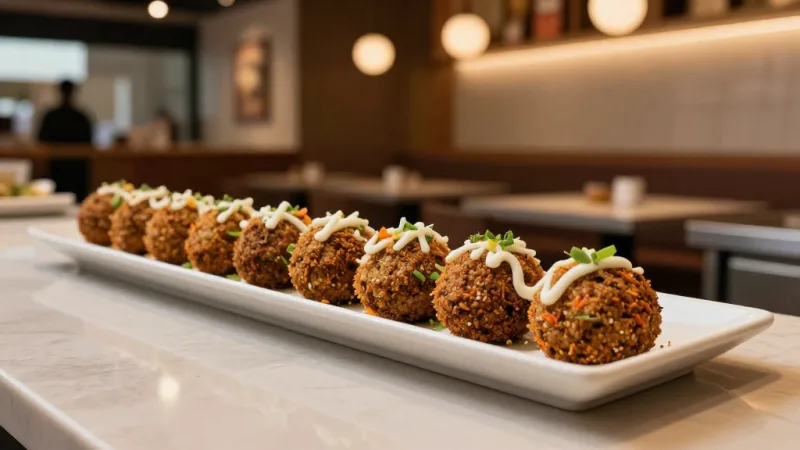
Frequently Asked Questions
Why is falafel and shawarma such a high-margin quick-service model?
The core ingredients are cheap and the perceived value is high. A falafel ball costs roughly 60 to 70 cents in chickpeas, herbs, and oil to produce, yet a falafel plate or wrap built around four or five of them sells for $11 to $13. Shawarma runs on bulk chicken thigh or beef bottom round marinated in spice — low cost per ounce, premium plate price. The catch is that the margin only survives if every component is portioned by tool and the line moves fast enough to hit fast-casual ticket counts. Over-scoop the rice, the protein, and three sauces on every order and you hand the margin back one build at a time.
How do you keep a falafel and shawarma assembly line fast during a rush?
Run it like Chipotle, not like a full-service kitchen. Pre-portion proteins and toppings into the line before service, keep the shawarma spit carving to a steady demand-based pace, hold falafel frying in timed batches so it's hot but never sitting, and put every component in fixed-portion tools so a builder never pauses to judge. Then route orders through a kitchen display and a quick-order POS so the cashier and the line never wait on each other. The bottleneck in a build-your-own concept is almost never the cooking — it's the register and the hand-off, and both are solved with the right POS workflow.
How should a falafel and shawarma shop manage its sauce station?
Treat sauces as portioned, costed inventory rather than free condiments. Tahini, toum, amba, harissa, and tzatziki are flavor signatures, but they're also olive-oil and tahini-heavy and expensive by the ounce. Use squeeze bottles or fixed-portion pumps so every drizzle is the same, set a standard "extra sauce" upcharge in the POS so generosity is priced instead of given away, and track sauce as its own inventory line tied to plate count so you can see when usage drifts ahead of sales. A connected POS-and-inventory system flags that drift before it eats a point off your food cost.
Can a fast-casual Mediterranean shop run loyalty and gift cards without slowing the line?
Yes, as long as loyalty, points, gift cards, and e-gift cards live inside the POS checkout instead of a separate app. Falafel and shawarma draws a frequent, health-conscious lunch crowd — the ideal audience for a points or membership program and for self-order kiosks that capture the customer automatically. With an all-in-one platform like KwickOS, the cashier or the kiosk enrolls a regular, applies points, or sells an e-gift card in a couple of taps on the same payment screen, so retention is captured without adding a second to the transaction.