 Ming Ye
Look at a hummus on your menu. Say it's priced at $10.
Now figure out what's actually in the bowl: chickpeas, tahini, lemon, garlic, olive oil, salt. Pennies. The honest ingredient cost of a generous portion of hummus is well under a dollar.
That's a food cost in the single digits against a $10 menu price — the kind of margin a steakhouse would trade its wine list for. Multiply it across the whole mezze section — baba ganoush, labneh, tabbouleh, dolmas, falafel — and you're looking at the most profitable square footage on any restaurant menu in America.
Here's the thing, though: that margin only exists on paper. The moment a line cook scoops hummus "by feel" and lands closer to a dollar-fifty of product in a bowl you priced off eighty cents, the math quietly inverts. You don't lose money on the dishes that cost a lot. You lose it on the cheap ones you give away too much of — because nobody's measuring the thing that's supposed to be your best earner.
And it gets worse: a Mediterranean menu hides this leak in three places at once. The mezze you over-scoop. The grill protein you over-portion. The family-style platter where "a little extra" happens on six components simultaneously. Each one feels like hospitality. Together they're a number with a comma in it, gone every month, that never shows up on a single report.
This guide breaks down how the best Mediterranean operators close every one of those leaks — the mezze prep flow, the grill-station setup, family-style portioning that protects margin, pita production, and the POS workflow that turns a generous, customization-heavy menu into a fast, consistent, genuinely profitable one.
Mezze Is the Engine: Batch It, Portion It, Track It
Start where the money is. Mezze isn't a section of the menu — it's the financial engine of the whole concept, and it runs on three disciplines.
Batch with a recipe, not a memory. Hummus, baba ganoush, tzatziki, muhammara, toum — these are made in volume, ahead of service, and the single biggest threat to their margin is inconsistency. A batch that's slightly off gets remade or thrown out; a recipe that lives in one cook's head walks out the door when that cook does. Standardize every batch to a documented recipe with exact yields, so a 10-pound batch of hummus is always a 10-pound batch and you know precisely how many portions it should produce.
Portion by tool, never by feel. This is the whole ballgame. A fixed scoop, a portion scale, a pre-weighed ramekin — anything that takes judgment out of the line cook's hands during a rush. The difference between a #16 scoop and "looks about right" is a half-ounce per bowl, and a half-ounce of hummus across 300 orders a day is product you bought and gave away for free, every day, forever.
Track theoretical yield against actual sales. Here's where a connected system earns its keep. When your POS knows you sold 280 hummus plates, it knows exactly how many pounds of chickpeas that should have consumed. The gap between that theoretical number and what you actually went through is your waste, over-portioning, and shrinkage — finally visible. Our POS-integrated inventory guide walks through exactly how that theoretical-vs-actual comparison works.
Multi-location operators feel this most. A growing Mediterranean brand can standardize a mezze prep sheet and recipe yields at one location and push them to every store — the same way Crafty Crab Seafood runs 19 stores on one-click menu and recipe sync, so a portioning standard set once rolls out everywhere instead of drifting kitchen by kitchen.
The Grill Station: A Timing Puzzle, Not Just a Hot Surface
Now the other half of the plate. The grill is where Mediterranean food gets its theater — kebabs, shawarma off the vertical spit, grilled branzino, kofta, lamb chops — and it's where your kitchen most often falls behind. Not because the cooking is hard, but because the timing is.
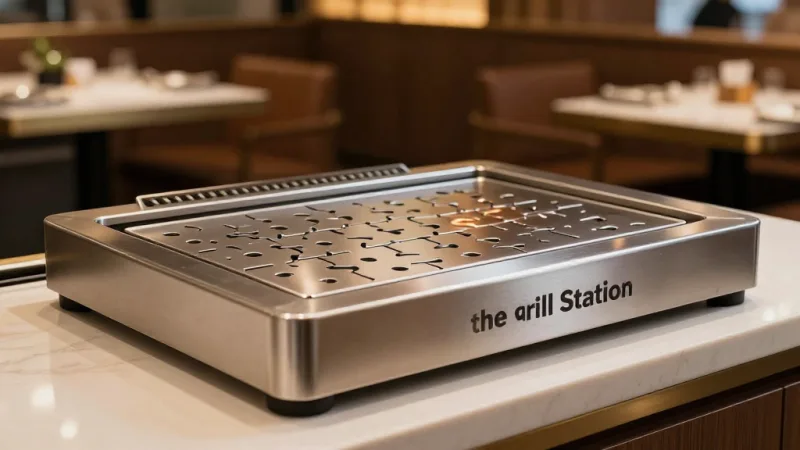
Every item on the grill has a different clock. A chicken kebab and a lamb chop and a piece of fish all need to land on the same plate at the same moment, and a cook working off shouted tickets and memory is constantly either holding finished food under a lamp until it dries out or making the table wait on the one item that started late. The result is the same either way: quality drops and the rush backs up.
The fixes are mechanical:
- Pre-skewer and pre-portion before service. Like a taqueria wins lunch at 10:30, a Mediterranean grill wins dinner at 4:00. Skewers built, proteins weighed and marinated, staged in lowboys in order of cook time. Mid-rush is for cooking, not assembling.
- Stage by cook time. Items that take longest sit closest to where the cook fires first. The goal is that a glance tells the cook what to start now versus in two minutes.
- Route everything through a kitchen display. A KDS that fires items by cook time — starting the lamb before the chicken so they plate together — turns the grill from a guessing game into a sequence. The cook sees a clean, prioritized ticket instead of a wall of shouted modifications.
This is exactly the problem Shogun Japanese Hibachi solved with customized cook-station displays — a grill-forward concept where station-specific screens got the operator proficient in under five minutes. A Mediterranean grill has the same shape of problem, and the same answer: let the display do the communicating, and the cook never has to ask "what was on that one?" (Our speed-of-service guide goes deeper on order-point and handoff timing.)
Family-Style: Where "A Little Extra" Multiplies
Family-style dining is the soul of Mediterranean hospitality and the single most dangerous place on your menu for margin. Here's why: a mixed-grill platter or a grand mezze board isn't one portioning decision — it's six or eight at once. When a cook adds "a little extra" to a single hummus, you lose a few cents. When they do it across every component of a shared platter, the leak multiplies on every plate that leaves the pass.

Run the math. A mezze platter that should cost $4.20 to assemble — at a healthy food cost against its $24 menu price — quietly becomes a $6 platter when six components each get over-scooped by twenty percent. That's $1.80 of giveaway per platter. Sell 60 platters a night and you've handed out over $100 in free food every single night, roughly $40,000 a year, on the dish you thought was your best earner.
The discipline that protects it:
- Standardize every component. Each element of a platter is tool-portioned to a spec, so a mixed-grill platter costs the same to build whether it's the first one of the night or the fortieth, whether the owner is watching or not.
- Cost the platter as a recipe. A POS that knows the component cost of each platter shows you your real margin per platter — not a guess, a number. When the price of tahini or lamb moves, you see the margin compress immediately instead of discovering it at month-end.
- Price off the known cost. Set platter prices from a target food-cost percentage against the documented build cost, then revisit them on a schedule. Pricing a multi-component dish by feel is how operators give away margin on every upgrade and add-on.
Before you finalize a single platter price, run the actual numbers — our free tools library has food-cost and menu-pricing calculators built for exactly this, so the generosity that makes your tables happy doesn't quietly come straight out of your profit.
Pita Production: The Small Decision That Sets Your Tone
Pita is the quiet workhorse of the whole operation — it touches nearly every order, and how you produce it shapes both your food cost and your kitchen's rhythm. The decision tree is short but it matters:
Bake in-house and you get warm, fresh pita that becomes a genuine signature — the smell alone sells mezze — at the cost of labor, oven space, and a prep discipline you have to actually hold. Buy par-baked or finished and you trade that signature for simplicity, lower labor, and predictable cost. Neither is wrong; the mistake is drifting into one without deciding.
Whichever you choose, the operational rules are the same: bake or warm to demand so you're not throwing away stale rounds at close, track pita as its own inventory line tied to covers so you can see when usage drifts out of step with traffic, and stage warm pita within arm's reach at expo so it never becomes the thing that holds up an otherwise-finished order. A connected inventory system flags the week your pita usage spikes ahead of your cover count — the early signal of over-serving or waste, caught before it eats a point off your margin instead of after.
The Register Is the Hidden Bottleneck: POS Workflow
Here's the part most Mediterranean operators underestimate. Your kitchen can be dialed in — mezze portioned, grill sequenced, pita warm — and you can still cap your own throughput at the register, because Mediterranean food is genuinely customization-heavy. A bowl or a wrap is a base, a protein, a half-dozen toppings, a sauce, a spice level, a side swap. If ringing all of that means hunting through screens and free-typing modifications, the cashier becomes the slowest station on the line and the whole operation throttles behind one tablet.
The fix is a POS built for this kind of menu:
- A quick-order grid that puts your highest-volume items — the chicken shawarma plate, the falafel wrap, the grand mezze platter, the combo — one tap away. A handful of items are most of your volume; they should never be more than a tap or two from rung.
- Structured modifier groups — protein, base, toppings, sauce, spice — so a fully customized bowl rings in a few taps, with required-and-optional rules that stop an incomplete or nonsense order from ever reaching the kitchen.
- Automatic price adjustments so the cashier never has to remember that lamb is a premium protein or extra feta is an upcharge — the POS adds it the instant they tap it, protecting speed and margin at the same time.
- Kitchen display routing that splits the ticket to the right station — mezze cold line, grill, expo — so each cook sees only their part of the order, clean and unambiguous.
That last point is how you keep the back of the line fast. Rockin' Rolls Sushi Express cut serving time using exactly this kind of KDS-integrated customization across 49 self-ordering stations; the principle is identical on a Mediterranean line, where one order might split across a cold mezze station and a hot grill. When the display does the routing, nobody stalls waiting to ask what goes where.
Speed Targets: Run on Numbers, Not Vibes
You can't improve a line you don't measure, and the good news is your POS already captures most of what matters. The numbers a Mediterranean operator should watch:
- Order-to-handoff time. From rung to handed-off. A tuned fast-casual Mediterranean line lands in the two-to-four-minute range at peak; if yours is creeping past five, a station is choking — find it.
- Theoretical vs actual food cost on mezze. The single most important number on this menu. Tighten the gap and you've recovered your best margin.
- Average ticket. The lever that add-a-side, add-a-mezze, and "make it a platter for the table?" prompts move — lifting revenue without one extra customer in line. (See our upselling guide for the exact prompts.)
- Covers per labor hour. Time-stamped sales data shows you exactly when to schedule the extra hands for the rush and when to cut for the lull.
And because KwickOS runs a hybrid local-plus-cloud model, an owner can pull these numbers in real time from anywhere — the way T. Jin China Diner monitors 15 stores and 75 terminals remotely, watching every location's dinner rush from one dashboard. You don't have to stand behind the pass to know whether the line is winning.
Where the Margin Compounds: Checkout, Loyalty, and Gift Cards
Here's what separates a Mediterranean spot that grinds for every transaction from one that builds a base of regulars: what happens in the last five seconds, at checkout.
Mediterranean concepts draw a crowd most restaurants envy — health-conscious, habitual, the kind of guest who eats a falafel bowl for lunch twice a week. That frequency is worthless if every visit is anonymous and a goldmine the moment you start capturing it, as long as it never adds time to the handoff. Which means it has to live inside the POS, not a separate app:
- Enroll regulars in loyalty and points at the register. For a repeat-visit concept, a points or membership program — points per dollar, "buy 9 bowls, get the 10th" — is one of the highest-return retention tools you can run. With an all-in-one POS, the cashier enrolls or applies points in a couple of taps on the payment screen, no punch card to lose, no line slowdown.
- Sell gift cards and e-gift cards. Shareable, family-style food makes "want a gift card for the group?" the most natural upsell on the menu. Gift cards are guaranteed future revenue plus a near-certain return visit, and e-gift cards spike around the holidays, graduations, and Ramadan and Eid — a slice never gets fully redeemed, which quietly lifts your margin.
- Save the customer profile. Tie the order to a customer record so you know their usual bowl, can text them a slow-Tuesday offer, and can win them back if they go quiet. Tiger Sugar built minimal-step personalization and electronic receipts with loyalty into a two-kiosk operation — proof you don't need to be big to run a sharp retention loop.
This is where a POS stops being a cash register and becomes a marketing engine. When checkout, loyalty, points, gift cards, e-gift cards, and customer profiles all live in one platform instead of four apps that don't talk to each other, that retention loop runs itself — and the lunch regular you served in three minutes becomes a member who comes back fifty more times this year.
The Platform Underneath: Why It Has to Stay Up
None of this matters if the technology buckles on your busiest shift — and the dinner rush is precisely when cloud-only systems fail. A full dining room, a wall of customized orders, family-style tickets splitting across stations, and one internet hiccup takes the whole POS dark at the worst possible moment.
Architecture quietly decides whether your rush is a triumph or a disaster. KwickOS runs on a hybrid local-plus-cloud model: the POS keeps ringing at 1ms local speed even if the internet drops mid-rush, then syncs when the connection returns. Toast and most cloud-only systems go down when the Wi-Fi does. A few other things that matter specifically for a Mediterranean operation:
- Multi-language built in. Mediterranean kitchens and front-of-house often run multilingual teams. KwickOS ships with English, Chinese, and Spanish, so staff work in the language they're fastest in and tickets print in the line cooks' language — fewer errors, faster ramp-up.
- Processor-agnostic payments. Keep your own processor and negotiate your own rates, saving most restaurants $3,000 to $8,000 a year versus locked-in systems. On a high-volume operation, that processing freedom lands straight in your margin. (See how it stacks up in our platform comparison hub.)
- Fingerprint employee verification. 1:N fingerprint authentication keeps time theft and unauthorized voids in check — exactly what you want when you staff up with extra hands for the rush.
- KwickDriver delivery. A $2 flat fee plus $6.99 per five miles instead of the 15–25% commission the third-party apps take — so delivery bowls and platters stay profitable.
- One unified platform. POS, kitchen display, online ordering, CRM, loyalty, and gift cards in a single system — no patchwork of apps that don't sync.
That's the whole argument. A Mediterranean restaurant doesn't need five vendors and five logins. It needs one platform fast enough to keep the register from being the bottleneck, smart enough to protect mezze and platter margin, and connected enough to turn a three-minute transaction into a lifelong regular. Operators ready to see it running across one location or fifty can start on our restaurant solutions page, and resellers who set these systems up for local operators can learn more on our partner program page.
The Bottom Line
A Mediterranean restaurant has the best margin profile in the business and the easiest one to give away. The mezze that should be your engine leaks a half-ounce at a time. The grill backs up on timing, not skill. The family-style platter multiplies one generous scoop into six. And the register — not the kitchen — quietly caps how many of those high-margin plates you can sell in an hour.
Fix all four the same way: portion by tool, sequence the grill with a kitchen display, cost every platter as a recipe, and ring the customization-heavy menu on a quick-order POS that never becomes the bottleneck. Then close the loop where it compounds — capture every fast, frequent transaction into loyalty, sell a gift card, save the profile — so one served plate becomes a year of repeat visits at full price. On a platform that stays up when the internet doesn't and lets your team work in the language they're fastest in, that's the difference between a generous menu that bleeds and a generous menu that prints.
Stop Giving Away Your Best Margin
KwickOS unifies quick-order POS, kitchen display routing, inventory-connected portioning, loyalty, and gift cards in one platform — with built-in multi-language and a hybrid system that never goes down mid-rush. See how it works.
Get My Free Demo
Frequently Asked Questions
Why is the mezze section the most important part of a Mediterranean menu's profit?
Mezze — hummus, baba ganoush, labneh, tabbouleh, dolmas, falafel — are built almost entirely from low-cost pantry staples like chickpeas, tahini, bulgur, and herbs. A hummus that costs under a dollar in ingredients sells for $9 to $12, and a shared mezze platter that costs $4 to $5 to assemble lists for $22 to $26. That's a food cost in the teens against a menu price, the best margin on the entire menu. The catch is consistency and portioning: because mezze are made in big batches and scooped by hand, a half-ounce of over-portioning per plate quietly erases that margin. The fix is portioning by tool and tracking theoretical batch yield against actual sales through a POS-connected inventory system.
How do you keep a Mediterranean grill station fast during a rush?
Pre-skewer and pre-portion proteins before service, hold marinated items staged in order of cook time, and route every order to a kitchen display so the grill cook sees a clean, prioritized ticket instead of shouted modifications. Kebabs, shawarma, and grilled fish have different cook times, so the grill is a timing puzzle, not just a hot surface. A kitchen display system that fires items by cook time — starting the lamb before the chicken so they plate together — keeps the grill flowing and stops the rest of the order from sitting under a heat lamp going cold.
How should a Mediterranean restaurant price and portion family-style platters?
Build platters from standardized, tool-portioned components so a mixed-grill or mezze platter costs the same to make every single time, then price it off that known cost with a target food-cost percentage rather than a guess. Family-style is where margin leaks the most because "a little extra" on six components at once multiplies fast. Use a POS that knows the recipe and component cost of each platter, so you can see your real margin per platter and adjust pricing the moment ingredient costs move instead of discovering the problem at month-end.
Can a Mediterranean restaurant run loyalty and gift cards without slowing down service?
Yes, as long as loyalty, points, gift cards, and e-gift cards live inside the POS checkout instead of a separate app. Mediterranean concepts draw a health-conscious, repeat-visit crowd that responds well to a points or membership program, and shareable family-style food makes gift cards a natural upsell for groups and celebrations. With an all-in-one platform like KwickOS, the cashier enrolls a regular, applies points, or sells an e-gift card in a couple of taps on the same payment screen, so retention is captured without adding time to the transaction.