 Kelly Ho
It's 5:47 AM. The doors open in 13 minutes. Your display case has 840 donuts arranged across 22 varieties. The coffee is brewed. The register is counted. And in approximately 90 seconds after that first customer walks in, you'll know whether tonight's production run was right — or whether you're about to face the worst problem a donut shop can have.
Not running out. Running out of the wrong thing at the wrong time.
Here's the thing: selling 1,000 donuts before 10 AM isn't actually that hard. Plenty of shops move that volume. The hard part is doing it without wasting 15% of your production, without a line that stretches out the door and costs you drive-thru customers, and without your staff looking like they just survived a hurricane by 10:15.
The difference between a $2,800 morning and an $1,800 morning isn't your recipe. It's your system.
This guide breaks down the entire donut shop morning rush — from the overnight production timeline to display psychology to checkout speed — so every donut you make becomes a donut you sell.
The Overnight Production Timeline That Sets Up a Perfect Morning
Morning rush success is decided the night before. Every donut shop that consistently sells out by 10 AM follows a production timeline that looks something like this:
10:00 PM — Prep and Mise en Place
The overnight baker arrives and begins scaling ingredients for yeast doughs. Fillings are portioned. Glazes are mixed. Fry oil is checked and filtered. This is also when you review your POS sales data from the last 7 days to adjust batch sizes — did maple bars outsell chocolate old-fashioned 3:1 last Saturday? Then you're batching accordingly tonight.
11:00 PM — Yeast Dough Mixing and First Proof
Yeast doughs go into the mixer. First proof runs 60-90 minutes depending on your shop's temperature and humidity. This is the step you cannot rush. Underproofed dough means dense donuts that don't sell.
1:00 AM — Sheeting, Cutting, and Second Proof
Dough is sheeted, cut into rings and filled shapes, and placed on proofing racks. Second proof runs another 45-60 minutes. While yeast doughs proof, the overnight baker switches to cake donut batters — these don't need proofing and can go straight to the fryer.
But it gets worse: if your overnight baker is also responsible for frying, glazing, AND filling, you have a bottleneck that will haunt you every single morning.
2:00 AM — Frying Begins
Cake donuts hit the fryer first (they're ready). Yeast donuts follow as they finish proofing. A skilled fryer running two fryers simultaneously can produce 200-240 donuts per hour. For a 1,000-donut morning, that means frying wraps up around 6:00 AM — cutting it dangerously close to opening.
This is why high-volume shops run two overnight bakers: one on dough/batter and one on frying/finishing. The labor cost adds $120-$160 per shift. The revenue difference between a fully stocked case at 6 AM versus a half-stocked case? According to restaurant industry data, it's 30-40% of your morning sales.
4:00 AM — Glazing, Filling, and Finishing
Donuts cool on racks, then move to the finishing station. Glazed donuts go through the waterfall glazer. Filled donuts get piped. Specialty toppings — sprinkles, bacon crumbles, cereal pieces — go on while the glaze is still tacky. Every variety gets a dedicated tray.
5:30 AM — Display Case Loading
Trays move to the display case in a specific order (more on display strategy below). Coffee urns are topped off. The POS system is unlocked and the opening cash count is verified. Your team does a final walk-through.
Display Strategy: Where You Put Each Donut Changes What Sells
Your display case isn't just storage. It's a sales tool. And most donut shops arrange it wrong.
The instinct is to put your prettiest, most elaborate donuts at eye level. That's backwards. Here's why:
Eye level = your highest-margin items. For most shops, that's filled donuts (cream, custard, jelly) and specialty items. Filled donuts cost $0.18-$0.25 more to produce than glazed rings but sell for $0.75-$1.50 more. That margin difference belongs at eye level where 60% of purchasing decisions happen.
Top shelf = visual wow factor. Decorated donuts, seasonal specials, and anything Instagram-worthy goes up top. Customers notice them, take photos, and often add one to their order. But the top shelf is harder to reach, so keep the volume items lower.
Bottom shelf = your workhorse glazed and cake donuts. These are the items customers already know they want. They'll bend down to grab a dozen glazed. They don't need prime real estate.
And that's not all: the left-to-right flow matters too. Western readers scan left to right. Place your premium items on the left side of the case and your basic items on the right. Customers literally see the expensive stuff first and anchor their expectations there.
How many varieties should you stock? Industry data suggests 18-24 is the sweet spot. Fewer than 15 and customers feel limited. More than 30 and you increase waste, slow production, and create decision paralysis at the counter. Focus on 6-8 top sellers that drive 60-70% of volume. Track this weekly through your POS mix reports — what you think sells best and what actually sells best are often two different donuts.
The Coffee Attachment Rate That Doubles Your Morning Profit
Here's a number that should keep you up at night: the average donut shop coffee attachment rate is 45%. That means more than half your customers walk out without buying a drink.
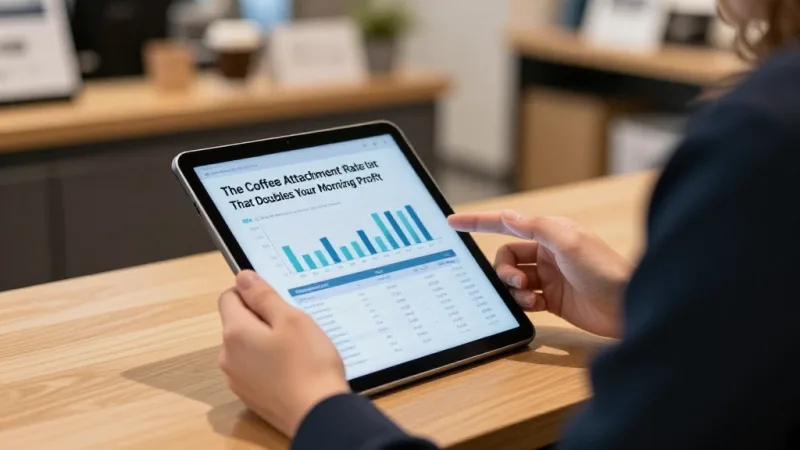
Top-performing shops hit 65-75%. The difference in revenue is staggering.
Let's run the math. If you sell 600 individual donut transactions in a morning (some customers buy multiples), each coffee adds $2.50-$3.50 in revenue at 85-90% margin. Going from 45% attachment to 65% attachment means 120 additional coffees per morning. At $3.00 average, that's $360/day in almost pure profit — over $130,000 per year.
Now here's the kicker: you're not going to get there by putting a coffee pot in the corner and hoping for the best.
Combo pricing is mandatory. "Any donut + medium coffee = $4.99" should be on your menu board, your POS quick-keys, and your drive-thru speaker. Your POS system should automatically prompt the combo when a customer orders a donut without a drink. KwickOS does this with modifier prompts and combo suggestions that appear on-screen — the cashier doesn't have to remember, the system reminds them.
Coffee station placement matters. If your coffee is behind the counter, the customer has to ask for it. If it's self-serve near the register, they grab it while waiting. Self-serve coffee stations increase attachment rates by 15-20 percentage points, according to restaurant industry data.
And don't overlook the upsell from drip to specialty. A $2.50 drip coffee is good. A $4.75 iced latte is better. Train your team to suggest the upgrade — "Would you like to try our iced vanilla latte with that? It pairs perfectly with the apple fritter." That one sentence is worth $2.25 in margin, hundreds of times per week.
Drive-Thru Speed: 90 Seconds or You Lose Them
If your donut shop has a drive-thru window, it likely accounts for 40-55% of your morning revenue. And every second of wait time costs you.
Industry research suggests that when drive-thru wait times exceed 3 minutes, 20% of customers in line will leave. At morning rush prices, each lost customer represents $6-$12 in revenue. Lose 30 customers per morning and you're hemorrhaging $250/day — over $90,000 per year.
The target is under 90 seconds from order to handoff. Here's how to hit it:
- Pre-box popular assortments. Have a dozen glazed, half-dozen mixed, and baker's dozen variety boxes pre-assembled and ready to hand out the window. These "grab and go" boxes eliminate 60-90 seconds of picking time per order.
- Dedicated drive-thru POS station. Your drive-thru cashier needs their own terminal with a simplified menu layout. No scrolling through 6 screens. The top 12 items should be one-tap buttons. KwickOS lets you create station-specific menu layouts so your drive-thru screen looks completely different from your counter screen.
- Pre-brew coffee in thermal carafes. Don't brew individual cups during rush. Batch-brew into thermal dispensers every 20 minutes. One person should own coffee duty from 6-9 AM and nothing else.
- Route drive-thru orders with priority flagging. If your kitchen display system can tag drive-thru orders as priority, your assembler knows which orders to build first. This prevents the "counter order jumped the line" bottleneck.
One thing that makes a massive difference: contactless payment at the window. Tap-to-pay transactions complete in 2-3 seconds versus 8-12 seconds for chip insertion. If your terminal doesn't support NFC, you're adding 10 seconds to every single drive-thru transaction. Over 200 drive-thru orders, that's 33 minutes of accumulated delay — enough to lose a dozen customers. Check our KwickOS vs Toast comparison to see how processor-agnostic systems handle contactless payments with faster terminals.
Variety Management: When to Make More and When to Let It Sell Out
Here's a counterintuitive truth about donut shops: selling out is not always bad.
Selling out of your signature maple bacon bar at 8:30 AM creates urgency. Customers learn to come earlier. They tell friends "you have to get there before 9 or the good ones are gone." That's free marketing you cannot buy.
But selling out of glazed rings at 7:15 AM? That's a disaster. Glazed is your volume driver, your dozen-box anchor, your coffee companion. Running out of glazed during peak rush means turning away your most profitable orders.
The solution is a two-wave production strategy:
Wave 1 (overnight): 80% of projected daily volume. This covers your opening case and the first 2-3 hours of rush. Your POS historical sales data tells you exactly how many of each variety you need. If Tuesday's glazed ring sales have averaged 180 for the last 4 weeks, you produce 145-150 in Wave 1.
Wave 2 (7:00 AM): 20% of projected volume, focused on top sellers only. Your morning baker does a targeted second fry of the 4-5 fastest-moving items. This replenishes the case during peak rush without overproducing specialty items that might not sell.
The key enabler here is real-time inventory visibility. Your POS system should track donut sales by variety in real-time so the morning baker knows exactly what's running low. KwickOS's real-time inventory tracking shows current counts on a kitchen display, eliminating the "walk to the case and count" guessing game. When a variety hits zero, it automatically flags as 86'd across all order channels — counter, drive-thru, and online.
Checkout Speed: The Register Can't Be Your Bottleneck
You just spent 8 hours producing 1,000 perfect donuts. Your display case looks incredible. Coffee is hot. And then everything stalls because your cashier is navigating 4 menu screens to ring up a half-dozen mixed donuts with a coffee and an e-gift card reload.
Checkout should take under 30 seconds for a typical donut order. If it takes longer, your POS is the problem.
What a donut shop POS needs during morning rush:
- One-tap quantity buttons. "Half dozen" and "dozen" should be single buttons, not six individual taps on "glazed ring." The price break should apply automatically.
- Visual menu with photos. New cashiers struggle to tell an apple fritter from a bear claw on a text-only screen. Photo-based POS menus cut training time from 2 days to 2 hours and reduce mis-rings by 40%.
- Smart combo detection. When a customer orders 2 donuts and a coffee, the system should automatically apply the combo price without the cashier remembering to select it.
- Gift card and loyalty in one tap. Morning regulars want to scan their loyalty card, pay with their gift card balance, and get out. That should be one flow, not three separate steps. KwickOS handles gift card payments, e-gift card redemption, and loyalty point accrual in a single transaction — the customer taps their card or scans a QR code and everything processes together.
Speaking of loyalty programs: donut shops are one of the best businesses for points-based loyalty because of high visit frequency. A customer who buys a donut and coffee 4 mornings per week is worth $780-$1,000 per year. Losing that customer to the shop across the street because they have a punch card and you don't is a $1,000 mistake. Digital loyalty programs — "Buy 10, get 1 free" with automatic tracking through your POS — have redemption rates 3x higher than paper punch cards. Your regulars earn points automatically, get a push notification when they're close to a reward, and never lose their card.
Staffing the Rush: Positions, Not People
The biggest staffing mistake donut shops make during morning rush is assigning people instead of positions. "Maria works the counter" is vague. "Maria is on register 1 handling walk-in customers, counter-only, no drive-thru" is a position.
For a 1,000-donut morning, you need 5 positions filled from 6-10 AM:
- Register 1 — Walk-in counter. Takes orders, rings sales, handles payment. Does not leave the register to box donuts unless the line is empty.
- Boxing/Assembly. Picks donuts from the case, boxes orders, bags individual items. This person should be your fastest worker with the best product knowledge.
- Drive-thru. Takes orders via speaker, assembles drive-thru boxes, handles payment at the window. This is a self-contained station — they don't share resources with the counter.
- Coffee/Drinks. Manages all beverage orders, restocks self-serve station, brews fresh batches every 20 minutes. During a lull, they restock napkins and supplies.
- Morning Baker. Handles Wave 2 production, restocks the display case, manages 86'd items, and monitors inventory levels on the KDS.
That's 5 people for 4 hours = 20 labor hours. At $15/hour average, morning rush labor costs $300. Against $2,800 in morning revenue, that's a 10.7% labor cost — well within the target range for quick-service operations.
Fingerprint clock-in ensures the right people are actually there at 5:30 AM. KwickOS's fingerprint 1:N authentication eliminates buddy punching and gives you an exact record of who showed up and when — critical when your $2,800 morning depends on having all 5 positions filled.
Gift Cards and Seasonal Promotions: Morning Revenue Beyond the Rush
Here's an opportunity most donut shops completely miss: gift card sales during morning rush.
Think about it. Your morning customer base is largely regulars. They know your product. They love your product. And at least twice a year — holidays and birthdays — they need a gift for someone. A $25 donut shop gift card is the perfect "I know you'll love this" present.
Place physical gift cards at the register where every customer sees them during checkout. Train your cashier to mention them: "We have gift cards if you ever want to share the addiction." That one line, delivered naturally, can generate $400-$600/week in gift card sales.
E-gift cards expand this even further. A customer can text a $10 e-gift card to a friend at 7 AM while waiting for their own order. The friend comes in the next morning to redeem it. You just acquired a new customer for zero marketing cost.
Seasonal donut promotions drive spikes you can plan for. Pumpkin spice season, Valentine's Day heart-shaped donuts, St. Patrick's Day green-glazed — these limited-time items create urgency and social media buzz. Pair them with a loyalty bonus: "Double points on any seasonal donut this week." Your POS tracks the promotion automatically, and you can measure exactly how many incremental visits it drove.
The Technology Stack That Keeps 1,000 Donuts Moving
A donut shop's morning rush is one of the highest-transaction-per-minute scenarios in food service. You're processing 3-5 transactions per minute at peak, with an average ticket time under 30 seconds. Your technology has to keep up.
Here's what the stack looks like:
- POS terminals (2 minimum): One for walk-in counter, one for drive-thru. Both need 1ms local response time — if your cloud-based POS lags for even 2 seconds per transaction, you lose 6-10 minutes of throughput during a 3-hour rush. KwickOS runs on a hybrid local+cloud architecture: transactions process locally at 1ms, then sync to the cloud. If your internet drops during rush hour, you keep selling. Toast and Square can't do that.
- Kitchen display (1): Shows the morning baker real-time sales velocity by variety. When glazed rings are selling 20% faster than projected, the baker starts Wave 2 early.
- Receipt printer (thermal): Fast, reliable, no ink cartridges to die mid-rush.
- Payment terminal (NFC-capable): Tap-to-pay for speed. Processor-agnostic so you're not locked into Toast's 2.99% + $0.15 on every transaction. On $2,800 in morning card sales, the difference between a negotiated interchange-plus rate and Toast's flat rate is $15-$25 per day — over $5,000/year.
- Digital menu board: Displays current availability, combos, and seasonal items. Updates automatically when items are 86'd. KwickSign integration means your menu board and POS share one source of truth.
Baked Cravings runs a similar high-volume operation with their self-serve kiosk at Lego Land — processing hundreds of transactions daily with minimal staff, using a Pax A35 terminal and KwickOS to keep everything flowing. The same principles apply to a donut drive-thru: fast hardware, fast software, zero friction.
Measuring Your Morning: The 5 Numbers That Matter
After the rush ends and the adrenaline fades, pull these 5 reports from your POS:
- Total morning revenue (6-10 AM). Track this daily. A healthy donut shop should see 55-65% of daily revenue in this window.
- Coffee attachment rate. Divide coffee transactions by total transactions. Target: 65%+.
- Waste percentage. Count unsold donuts at end of day divided by total production. Target: under 10%. Above 15% means you're overproducing.
- Average transaction value. Should be $7-$10 for a donut shop with coffee. If it's under $6, your combos aren't working.
- Drive-thru average speed. Timestamp from order placed to payment complete. Target: under 90 seconds.
These 5 numbers, reviewed daily and trended weekly, tell you everything you need to adjust production, staffing, and marketing. Your POS should surface them automatically in a morning dashboard — not buried in 14 different reports you have to run manually.
T. Jin China Diner's multi-location model proves this approach at scale: with 15 stores and 75 terminals, owner Tom Jin reviews consolidated morning performance data remotely across every location. The same real-time reporting that manages 15 Chinese restaurants works just as powerfully for a donut shop owner checking numbers from their phone at 10:30 AM.
Ready to Sell 1,000 Donuts Every Morning?
KwickOS gives donut shops the speed, inventory tracking, and combo automation that morning rush demands — with processor-agnostic payment that saves thousands per year.
Get Your Free Demo