 Ming Ye
You already own the hardest part of the coffee business: the customer relationship. Every morning, 150 to 300 people walk through your door, wait in line, and hand you $5 for a latte.
Then they leave.
And 63% of them? According to industry research, they would have bought food too — if you had anything worth eating. Instead, they grab a protein bar from the gas station next door, or skip breakfast entirely, or worse — they start going to the competitor down the street who just added avocado toast to their menu.
You're not losing a food sale. You're losing the entire customer.
Here's the thing: adding food to a coffee shop doesn't require a commercial kitchen, a line cook, or a $50,000 renovation. The most profitable coffee shop food programs in the country run on a pastry case, a toaster oven, and a relationship with a local bakery.
This guide shows you exactly how to build a food program that adds $8,400/month to your revenue — with the equipment you can buy this weekend and the vendor partnerships you can set up this week.
The $280/Day Problem Most Coffee Shop Owners Ignore
Let's do the math that changes everything.
Your average coffee transaction: $5.50. Your average customer visit frequency: 4.2 times per week. Your gross margin on espresso drinks: around 78%.
Now, what if every third customer added a $4.50 food item to their order?
| Metric | Coffee Only | Coffee + Food |
|---|---|---|
| Average ticket | $5.50 | $7.20 |
| Daily transactions (200) | $1,100 | $1,440 |
| Monthly revenue | $33,000 | $43,200 |
| Annual revenue | $396,000 | $518,400 |
| Difference | +$122,400/year (+$10,200/month) | |
Even if you conservatively capture just one in four customers, that's $8,400/month in new revenue. And because food margins in coffee shops typically run 60-80%, the vast majority of that drops straight to your bottom line.
But it gets worse: every coffee shop within a mile radius that already serves food is capturing the customers you're losing. They're not better at coffee. They're just giving customers a reason to stay longer and spend more.
The No-Kitchen Food Model: What Actually Works
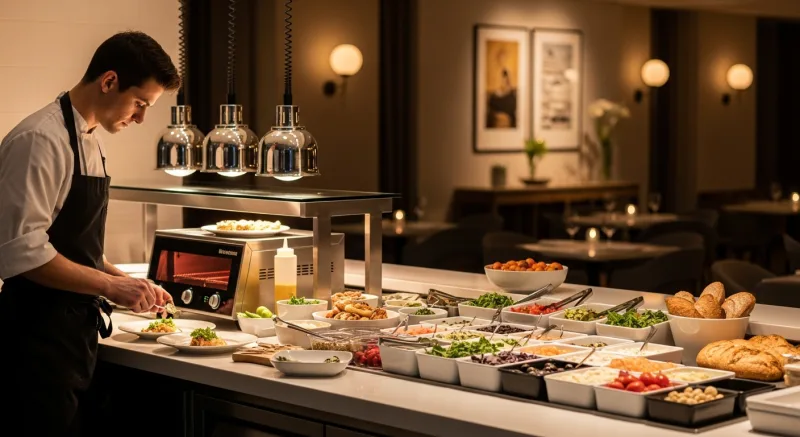
Forget the fantasy of building out a full kitchen. The coffee shops generating the most food revenue per square foot are using what industry operators call the "warm and assemble" model — everything is either pre-made by a vendor, or assembled from prepped ingredients with minimal equipment.
Here's what you need:
Essential Equipment ($1,500-$3,500 Total)
- Refrigerated display case — $800-$2,000. This is your silent salesperson. Customers buy with their eyes. A well-stocked, well-lit display case sells food without your baristas saying a word.
- Commercial panini press or toaster oven — $200-$500. Turns cold sandwiches into warm sandwiches, which sell at a 40% premium and feel like "real food."
- Small prep counter — $150-$400. A clean surface with cutting boards and food-safe containers for assembling toast bars, parfaits, and grab-and-go items.
- Display baskets and risers — $50-$200. Presentation matters. A muffin in a brown bag sells for $3. The same muffin on a wooden riser behind glass sells for $4.50.
Total startup investment: $1,500-$3,500. At $280/day in new food revenue, that investment pays for itself in 5 to 12 days.
And that's not all: your POS system needs to handle these new items seamlessly. This is where most coffee shops stumble — they add food to the menu but don't set up proper modifiers, combo pricing, or menu engineering in their POS. More on that shortly.
5 Food Categories That Print Money (Without a Kitchen)
1. The Pastry Case: Your Vendor-Powered Profit Machine
Partner with a local bakery. This is the simplest, lowest-risk way to add food revenue immediately.
Here's how the economics work:
| Item | Wholesale Cost | Retail Price | Margin |
|---|---|---|---|
| Croissant | $0.85 | $3.50 | 76% |
| Muffin (blueberry) | $0.95 | $3.75 | 75% |
| Scone | $0.90 | $3.95 | 77% |
| Cookie (large) | $0.70 | $3.25 | 78% |
| Banana bread slice | $0.80 | $3.50 | 77% |
The key is finding a bakery that delivers daily — freshness is everything. Start with 3-5 items, track what sells, and expand based on actual data from your POS reports.
Pro tip: negotiate a consignment arrangement for the first month. Many bakeries will agree to take back unsold items while you dial in your order quantities. Once you know your daily demand, switch to wholesale purchase for better margins.
2. The Toast Bar: $0.90 in Ingredients, $7.50 on the Receipt
Avocado toast didn't become a cultural phenomenon by accident. It's the highest-margin food item in the coffee shop universe.
- Avocado toast — $0.90 cost, $7.50 price, 88% margin
- Ricotta honey toast — $0.75 cost, $6.50 price, 88% margin
- PB banana toast — $0.55 cost, $5.50 price, 90% margin
- Smoked salmon toast — $2.10 cost, $9.50 price, 78% margin
All you need is quality bread (sourdough from your bakery partner), a toaster, and prepped toppings stored in food-safe containers. Assembly takes under 90 seconds. No cooking required.
Here's the thing: toast bars work because customers perceive them as "made fresh" even though you're assembling pre-prepped ingredients. That perception of freshness justifies the premium pricing.
3. Grab-and-Go: Revenue That Doesn't Slow Your Line
During morning rush, your baristas can't stop to make food. That's why grab-and-go items are critical — they require zero labor at the point of sale.
- Overnight oats — $1.20 cost, $5.95 price. Prep a batch the night before, portion into jars, refrigerate. Done.
- Yogurt parfaits — $1.40 cost, $6.50 price. Layer yogurt, granola, and fruit in clear cups. Visual appeal drives impulse buys.
- Pre-made wraps/sandwiches — $2.20 cost, $7.95 price. Source from a commissary kitchen or make them during off-peak hours.
- Energy balls/bites — $0.35 cost per unit, $2.50 price. Made in batches, shelf-stable for days.
Grab-and-go items should be displayed at eye level near the register. Industry data shows that food items placed within arm's reach of the checkout point sell 2.3x more than items displayed elsewhere.
4. Seasonal and Limited-Time Items: The FOMO Factor
Limited-time food offerings create urgency and give loyal customers a reason to visit more frequently. A seasonal pumpkin scone in October or a strawberry shortcake cup in June drives social media shares and foot traffic.
Rotate 1-2 seasonal items monthly. Track sales through your POS to identify which seasonal items deserve a permanent spot. The data doesn't lie — and a good POS system makes this analysis automatic.
5. Lunch Pivot: The Afternoon Revenue Most Coffee Shops Miss
After 11 AM, most coffee shop traffic drops by 40-60%. A simple lunch menu — two soup options, three sandwich varieties, and a daily salad — can turn your dead hours into a revenue stream.
Source soups from a local restaurant supplier (typically $2-3/serving wholesale, selling for $6-8). Use the same bread from your toast bar for sandwiches. This isn't about becoming a restaurant — it's about giving people a reason to visit between noon and 2 PM.
Vendor Partnerships: The Foundation of a No-Kitchen Food Program
Your food program is only as good as your vendors. Here's how to build partnerships that actually work:
Finding the right bakery partner:
- Visit 3-5 local bakeries. Buy their products. Taste everything.
- Ask about wholesale pricing, minimum orders, and delivery schedules.
- Request samples of their top sellers — what works in their bakery case might not work in yours.
- Negotiate daily delivery. Stale pastries destroy your food reputation overnight.
- Start with a 2-week trial before committing to any contract.
What to look for in a vendor:
- Delivers before your opening time (non-negotiable)
- Offers wholesale pricing at 30-40% of your retail price
- Has reliable, consistent quality
- Can scale up for holidays and seasonal spikes
- Provides nutritional and allergen information
Many coffee shops also partner with local meal prep companies for grab-and-go items. This is an underutilized strategy — meal prep companies have commercial kitchen capacity and are eager for consistent wholesale accounts.
POS Setup: The Technical Side Most Coffee Shops Get Wrong
Adding food items to your menu is the easy part. Setting up your POS to maximize food revenue is where the real money is made.
Modifier Groups That Drive Upsells
Every food item should have modifier groups configured in your POS. When a barista rings up avocado toast, the screen should automatically prompt:
- Add egg? (+$2.00)
- Add bacon? (+$2.50)
- Upgrade to sourdough? (+$0.75)
- Make it a combo with any drink? (-$1.00 bundle discount)
These modifier prompts consistently add $1.50-$3.00 to every food transaction. At 60 food orders per day, that's $90-$180 in daily upsell revenue — $2,700-$5,400 per month — from a POS configuration that takes 30 minutes to set up.
KwickOS makes this especially straightforward: the POS module lets you create conditional modifier groups that only appear for specific items, set combo pricing rules, and track which modifiers have the highest attachment rate. The system runs on hybrid local+cloud architecture, so modifier prompts appear instantly — 1ms local response time means your baristas never wait for the screen to load, even during morning rush when every second counts.
Combo and Bundle Pricing
Coffee + food combos are one of the most reliable ways to increase average ticket size. The psychology is simple: a $5.50 latte plus a $4.50 pastry feels expensive at $10. But a "Breakfast Combo" at $8.95 feels like a deal — even though you're only discounting $1.05.
Set up 2-3 standard combos in your POS:
- Morning Combo — Any medium+ drink + pastry ($8.95)
- Toast Combo — Any drink + any toast item ($11.95)
- Grab & Go — Any small drink + overnight oats or parfait ($9.50)
Gift Cards and Loyalty: Your Secret Food Revenue Weapon
Here's a pattern that the most successful coffee shops exploit: gift card holders and loyalty members spend 35-40% more on food items than cash-paying customers.
Why? Because gift card balances feel like "free money." And loyalty points create a psychological permission to add items. "I'm earning points anyway, might as well add a muffin."
Set up your loyalty program to accelerate food purchases:
- Double points on food items during your first month of food service (drives trial)
- Free pastry at 50 points as a loyalty reward tier (drives repeat food purchases)
- E-gift card promotions — "Buy a $25 e-gift card, get a free pastry" drives both gift card revenue and food awareness
KwickOS handles all of this natively — loyalty points, membership tiers, e-gift cards, and promotional campaigns all run through the same POS system your baristas already use. No separate apps, no integration headaches. And because KwickOS supports multilingual interfaces in English, Chinese, and Spanish, your team can manage the loyalty program regardless of their primary language.
Display and Merchandising: Sell With Your Eyes
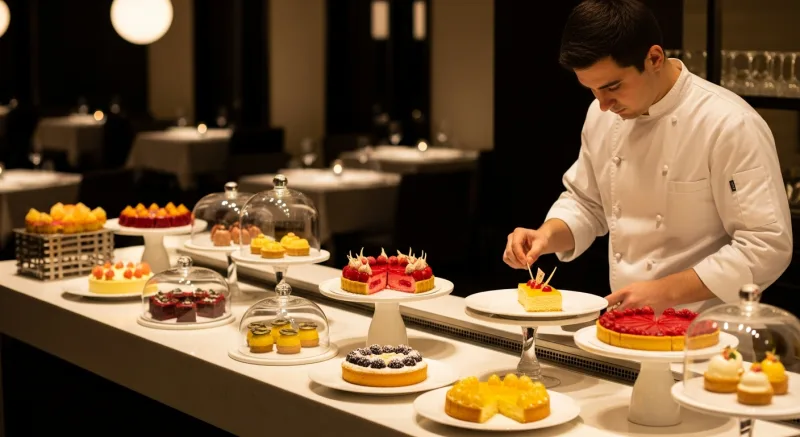
Food merchandising in coffee shops follows one golden rule: if they can see it, they'll buy it.
Placement rules that drive sales:
- Display case at the register — Customers see food while they wait to order. This is prime real estate. Never put your pastry case in a corner or against a back wall.
- Eye-level positioning — Place your highest-margin items (toast bar photos, parfaits) at eye level. Lower shelves are for lower-priority items.
- Full display always — A half-empty case says "we're running out" (bad) and "this isn't popular" (worse). Keep it stocked, even if it means making smaller batches more frequently.
- Menu board coordination — Your digital signage should show food items prominently, especially combo deals. KwickSign can sync with your POS menu in real-time — when an item sells out, the sign updates automatically.
Rockin' Rolls Sushi Express learned this lesson with their 3-store, 49-iPad self-ordering setup: when food photos were displayed prominently on the ordering screens, add-on rates jumped significantly. The same principle applies to coffee shop food displays — make it visual, make it prominent, make it irresistible.
Food Safety Without a Kitchen: What You Need to Know
Health department requirements for coffee shops serving "warm and assemble" food are significantly less demanding than full-service restaurant requirements. But you still need to comply.
Minimum requirements (check your local jurisdiction):
- Food handler's permit for staff who prepare food
- Proper refrigeration at 41°F or below
- Handwashing station near food prep area
- Allergen labeling on all grab-and-go items
- Temperature logging for refrigerated display cases
- Food-safe cutting boards and utensils
Many health departments distinguish between "food preparation" (requires full kitchen license) and "food assembly/warming" (requires only a food handling permit). Warming pre-made sandwiches in a panini press typically falls under assembly, not preparation. Verify this with your local health inspector before investing in equipment.
Pricing Strategy: The Numbers Behind $8,400/Month
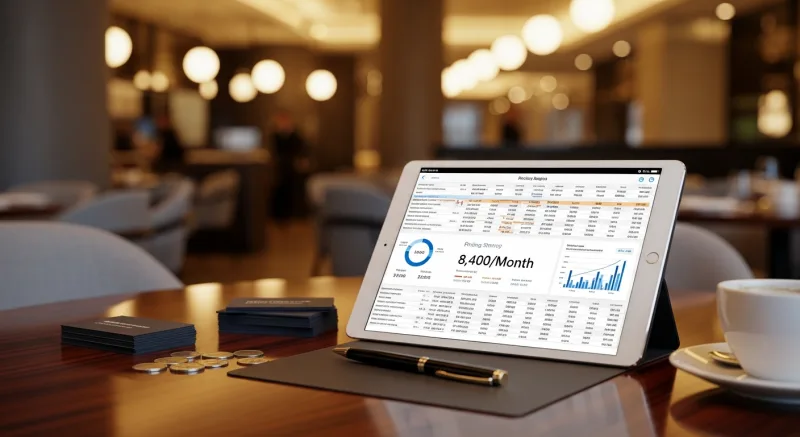
Let's build a realistic daily food revenue model:
| Category | Daily Units | Avg Price | Daily Revenue | Margin |
|---|---|---|---|---|
| Pastries/baked goods | 35 | $3.75 | $131 | 75% |
| Toast bar items | 12 | $7.00 | $84 | 85% |
| Grab-and-go | 15 | $6.00 | $90 | 68% |
| Modifier upsells | 20 | $2.00 | $40 | 80% |
| Combo discount offset | — | — | -$25 | — |
| Total | 82 | $320 | ~76% |
$320/day × 30 days = $9,600/month. Even accounting for slower weekdays and waste, $8,400/month is a realistic, conservative target for a coffee shop serving 200+ customers daily.
Gross profit at 76% margin: $6,384/month. That's $76,608/year in gross profit from a program that costs under $3,500 to launch and requires no additional full-time staff.
The Checkout Flow: Making Every Food Sale Frictionless
Your POS checkout flow determines whether food items add 10 seconds or 60 seconds to each transaction. During morning rush, 60 seconds is the difference between a line of 8 and a line of 15 — and that 15th customer just walked out.
Configure your POS for speed:
- Food items on the first screen — Don't bury food in a submenu. Top-selling pastries and combos should be one tap away.
- Pre-built combos — One button for "Morning Combo" that adds both items and applies the discount. Two taps: drink + combo. Done.
- Quick modifier selection — Toast customizations should be checkboxes, not typed notes. "Avo toast + egg + bacon" in three taps.
- Fingerprint login — With KwickOS's 1:N fingerprint authentication, staff transitions between barista and food prep roles happen in under a second. No shared passwords, no PINs, no fumbling.
The processing side matters too. With KwickOS being processor-agnostic, you can negotiate your own payment processing rates — which matters more than you think when you're adding $100,000+ in food revenue to your annual volume. That extra volume gives you leverage to negotiate lower interchange rates, potentially saving $3,000-$8,000/year compared to locked-in systems like Toast or Square.
Real-World Implementation: Week-by-Week Launch Plan
Week 1: Foundation
- Visit 3 local bakeries, taste products, negotiate terms
- Order display case and panini press
- Get food handler permits for 2-3 key staff members
- Set up food categories and modifiers in your POS
Week 2: Soft Launch
- Start with 5 pastry items from your vendor partner
- Add 2 toast bar options
- Configure combo pricing in POS
- Train staff on food handling and upselling
- Launch a "Free pastry with any e-gift card purchase" promo to drive awareness
Week 3: Expand
- Add grab-and-go items (overnight oats, parfaits)
- Activate loyalty double-points on food items
- Post food photos to social media daily
- Review POS data: what's selling, what's not, which combos have the highest attachment rate
Week 4: Optimize
- Cut underperformers, double down on winners
- Adjust order quantities based on 3 weeks of sales data
- Add 1-2 seasonal specials
- Set up loyalty rewards that specifically drive food repeat purchases
Common Mistakes That Kill Coffee Shop Food Programs
Mistake #1: Too many items, too fast. Start with 8-10 items. You can always add more once you know what sells. A 30-item food menu at launch guarantees waste and overwhelmed staff.
Mistake #2: Ignoring waste tracking. If you're throwing away 20% of your pastries daily, your margins are fiction. Use your POS's inventory tracking to monitor waste rates by item. If something consistently wastes above 10%, reduce order quantity or cut it.
Mistake #3: Not using your digital displays. If you have customer-facing displays or digital menu boards, they should showcase food items — especially combo deals and seasonal specials. Visual cues sell 3x more than verbal suggestions from staff.
Mistake #4: Pricing too low. Coffee shop customers are already paying $6 for a latte. They will pay $4 for a croissant without blinking. Don't price food items like a grocery store. You're selling convenience, ambiance, and the experience of eating something fresh with their favorite drink.
Mistake #5: No food items on your online ordering menu. If you use KwickMenu for online ordering, make sure food items are front and center. Online orders with food items average $3.80 more than drink-only orders.
Scaling Beyond the Basics: When It's Time for More
Once your food program consistently hits $8,000+/month, you'll face a decision: keep it simple or invest in expanding.
Signs it's time to grow:
- Food items sell out before noon regularly
- Customers ask for items you don't carry
- Your food waste rate is below 5%
- Food revenue exceeds 25% of total revenue
At that point, consider adding a commercial toaster oven for hot sandwiches, expanding your prep area, or even exploring a small commercial kitchen buildout. But don't jump ahead. Many coffee shops generate $10,000-$15,000/month in food revenue with nothing more than the warm-and-assemble model described here.
If you're running multiple locations, the advantage multiplies. T. Jin China Diner manages 15 locations and 75 terminals through a single KwickOS dashboard — menu updates, pricing changes, and modifier configurations push to all locations simultaneously. Imagine updating your toast bar pricing across 3 coffee shop locations in one click instead of driving to each store.
Ready to Add $8,400/Month in Food Revenue?
KwickOS gives you the POS tools to launch a food program that actually works — modifier prompts, combo pricing, loyalty integration, and real-time sales data. All from the same system that runs your coffee bar.
Get Your Free Demo