 Kelly Ho
You know the scene. A customer digs through their wallet, pulls out a crumpled card with six smudged stamps, squints at it, shrugs, and says "I think I lost my other one."
That is not a loyalty program. That is a paper waste program.
According to industry research, paper punch cards have a loss and forget rate approaching 80%. Eight out of every ten cards you stamp never come back for the free drink. Meanwhile, your competitor down the street — the one with digital loyalty tied into their POS — is seeing customers return three, four, five times a week because their phone reminds them they are two drinks away from a free latte.
Here's the thing: the coffee shop industry is brutally competitive. There are over 37,000 coffee shops in the United States. Your latte is not that different from the latte three blocks away. What is different is the reason a customer chooses you over them on a Tuesday morning when they are already running late.
That reason, increasingly, is loyalty. Not the emotional kind — the programmatic kind. The kind that sits on their phone, tracks their progress, and sends a push notification saying "One more drink to your free cold brew" at 6:47 AM.
This guide breaks down how to design a coffee shop loyalty program that actually works in 2026 — from digital stamps and tiered rewards to birthday perks, referral bonuses, and the gift card integration strategy most shops completely miss.
Why Paper Punch Cards Are Costing You Money
Let us do the math that most coffee shop owners never do.
Say you run a buy-9-get-1-free punch card program. Your average drink costs $5.50. The free drink costs you about $1.40 in ingredients. On paper, that is a 2.5% loyalty cost on every ten transactions — totally reasonable.
But it gets worse: with an 80% card loss rate, only 20% of customers ever redeem. That sounds like you are saving money, right? Wrong. It means 80% of your customers are getting zero reward for their repeat business. They have no incentive to come back. No progress bar filling up. No psychological commitment to your shop over the one near their office.
You are not saving on rewards. You are losing on retention.
A digital loyalty program flips this equation entirely. Redemption rates jump to 40-60% because the phone never gets lost. But here is the part that matters: visit frequency increases 28-35% among enrolled members, according to restaurant industry data. A customer who came twice a week starts coming three times. A customer who came three times starts coming daily.
At $5.50 per visit, one extra visit per week from 200 loyalty members is $1,100 in additional weekly revenue — $57,200 per year. The cost of those free reward drinks? About $7,800. Net gain: $49,400 in pure incremental revenue.
And that is before we talk about upselling, gift cards, or the data you collect.
Digital Stamps: The Simplest Program That Works
The digital stamp card is the easiest loyalty structure for a coffee shop, and for good reason — customers already understand it. Buy 9, get 1 free. No math required. No "how many points is a latte worth?" confusion.
Here is how to set it up right:
Stamp trigger: One stamp per qualifying purchase (any drink $4 or more). Do not give stamps on bottled water or retail bags of beans — reserve loyalty for your high-margin prepared beverages.
Reward threshold: 9 stamps for 1 free drink (up to $7 value). This gives you a 10% effective discount — generous enough to motivate, tight enough to protect margins. Some shops do 10 stamps, but 9 performs better because the customer feels they are "almost there" faster.
And that's not all: the real power of digital stamps is the data. Every stamp is a recorded transaction tied to a customer profile. You know their name, their drink preferences, their visit frequency, and their average spend. Paper cards give you none of this.
With a POS-integrated system like KwickOS, stamp enrollment happens at checkout — the barista enters the customer's phone number, and the stamp is automatically applied. No app download required. No QR code to scan. The customer's phone number is their loyalty card.
Pro tip: Give 2 stamps on the first visit as a welcome bonus. This leverages the "endowed progress effect" — research shows customers who start closer to the goal are significantly more likely to complete it. A card with 2 out of 9 stamps feels achievable. A card with 0 out of 9 feels like a long road.
Tiered Rewards: For Shops Ready to Level Up
Once your digital stamp program is running and you have 300+ enrolled members, consider adding tiers. Tiered loyalty creates an aspirational dynamic — customers do not just want the free drink, they want the status.
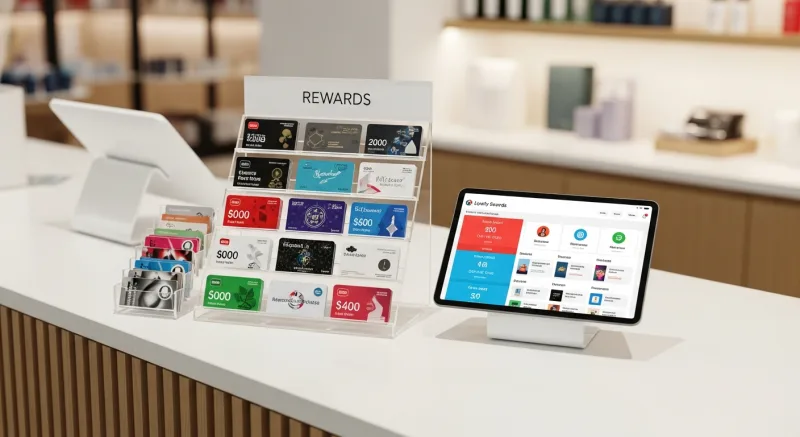
Here is a three-tier structure that works for coffee shops:
| Tier | Requirement | Perks |
|---|---|---|
| Bean | Sign up | Digital stamps, birthday drink, 2 welcome stamps |
| Roast | 25 visits in 90 days | Free size upgrade on every drink, surprise monthly perk, early access to seasonal drinks |
| Barista | 50 visits in 90 days | Free pastry with every drink, double stamps on Mondays, name on the "regulars" board |
Here's the thing: the top tier should feel exclusive but achievable. Fifty visits in 90 days means roughly once every 1.8 days — that is your daily regular. There should only be 5-10% of your loyalty base in the top tier. If more than 15% hit the top, your thresholds are too low.
The "regulars board" is not a joke. Tiger Sugar, a bubble tea brand running KwickOS with 2 stores and 2 self-ordering kiosks, found that visible recognition drives repeat visits more than discounts. When customers see their name on a board, they feel ownership. They bring friends to show it off. That is marketing you cannot buy.
Birthday Drinks and Surprise Perks: The Emotional Layer
Transactional rewards (stamps, points, free drinks) drive frequency. But emotional rewards drive loyalty — the kind where a customer drives past two competitors to get to you.
Birthday drinks are the easiest emotional reward to implement. Collect the customer's birth month at enrollment (not full date — that feels invasive). Send an automated message on the first of their birthday month: "Happy birthday month! Your next drink is on us — any size, any drink, all month long."
Why the full month instead of one day? Because most people do not visit a coffee shop on their exact birthday. A month-long window means they actually redeem it, and every time they think about their birthday drink, they think about your shop.
Cost: about $1.40 per birthday drink. If you have 500 loyalty members, that is $700/year. In return, you get 500 customers who feel personally valued — and who told at least one friend "my coffee shop gives me a free birthday drink."
Surprise perks are even more powerful. Once a month, pick 20 random loyalty members and send them a free pastry or size upgrade — no reason, no occasion, just "Thanks for being a regular. Your next pastry is on us." Behavioral research suggests that unexpected rewards create stronger loyalty responses than expected ones. The surprise triggers a disproportionate emotional response compared to a predictable reward.
KwickOS makes this easy — the CRM module lets you segment loyalty members by visit frequency, last visit date, or total spend, then push a reward to any segment with two clicks.
Referral Bonuses: Turn Regulars into Recruiters
Your best customers already tell their friends about you. A referral bonus just gives them a reason to do it today instead of "sometime."
The structure that works best for coffee shops:
- Referrer gets: 3 bonus stamps (one-third of the way to a free drink)
- New customer gets: Free drink on their first visit + 2 welcome stamps
- Mechanic: Referrer shares a unique link or code via text. New customer gives the code at checkout. POS automatically credits both accounts.
The key insight is that the referrer's reward must be progress-based, not a flat discount. Three bonus stamps feel more valuable than "$2 off" because they accelerate the customer toward a goal they are already working toward. It is the difference between getting cash and getting closer to winning.
Coffee shops running referral programs inside their POS system typically see 15-25 new loyalty enrollments per month from referrals alone. At a lifetime value of $1,400+ per loyal coffee customer (3 visits/week × $5.50 × 5 years), each referral is worth serious money.
Gift Cards and E-Gift Cards: The Loyalty Multiplier Most Shops Miss
Here is an open loop most coffee shop owners never close: gift cards and loyalty should be the same system, not two separate programs.
Think about it. When a customer loads $50 onto a digital gift card or e-gift card, they have made a psychological commitment to your shop. That $50 is going to be spent with you, not your competitor. But if their gift card purchases do not earn loyalty stamps, you are leaving the most powerful double-incentive on the table.
The right setup:
- Every purchase made with a gift card balance earns loyalty stamps
- Loyalty members who load $25+ get a bonus stamp
- E-gift cards can be sent to friends with a "Give the gift of coffee + enroll them in loyalty" flow
- Auto-reload gift cards ($25 auto-top-up when balance drops below $5) earn double stamps on the reload transaction
This creates a flywheel: customer loads gift card → earns stamps → gets closer to free drink → reloads gift card → earns more stamps. The customer is simultaneously prepaying for future visits and earning toward free ones. That is a retention engine that paper cards cannot touch.
With KwickOS, gift card balances, e-gift cards, and loyalty accounts are all linked to the same customer profile. When someone pays with their gift card, their loyalty stamps update automatically at the POS checkout. No manual tracking. No separate systems. One transaction, two loyalty triggers.
Want to see what a gift card program could do for your shop? Our gift card revenue calculator shows the projected breakage, reload rates, and incremental revenue based on your current traffic.
POS Integration: Where Most Loyalty Programs Die
The number one reason coffee shop loyalty programs fail is not bad reward design. It is friction.
If your barista has to open a separate app, scan a code, or enter information into a different system during the morning rush — when the line is eight deep and the espresso machine is screaming — they will not do it. The loyalty enrollment dies at the counter.
But it gets worse: if the customer has to download an app, create an account, and verify their email before earning their first stamp, the enrollment rate drops below 10%. Most people will not install yet another app for a coffee shop they visit twice a week.
This is why POS-integrated loyalty is not optional — it is the entire game. When loyalty lives inside the POS:
- Enrollment takes 10 seconds. Barista asks for a phone number. Types it in. Done. The customer is enrolled, earns their first stamp, and gets a welcome bonus — all within the normal checkout flow.
- Stamp tracking is automatic. Every qualifying transaction triggers a stamp. No scanning, no codes, no "did you remember to stamp me?"
- Redemption is frictionless. When the customer hits 9 stamps, the POS notifies the barista: "This customer has a free drink reward." One tap to apply it.
- Data flows in real time. Visit frequency, average spend, last visit, favorite drink — all visible on the customer's profile at the register.
KwickOS handles all of this natively. The loyalty module is built into the same interface baristas use for every transaction. No separate tablet. No third-party app. No extra monthly fee. And because KwickOS runs on a hybrid local+cloud architecture, loyalty data stays current even if your internet drops — stamps still get recorded, rewards still get applied, and everything syncs when connectivity returns.
This is the same system Rockin' Rolls uses across 3 stores with 49 iPad self-ordering stations. Customers earn loyalty on every order, whether they order at the counter, through a kiosk, or online through KwickMenu.
The Numbers: What a Good Coffee Shop Loyalty Program Looks Like
After working with coffee shops across the country, here are the benchmarks that separate strong loyalty programs from mediocre ones:
| Metric | Weak | Average | Strong |
|---|---|---|---|
| Enrollment rate (% of transactions) | <15% | 25-35% | 45%+ |
| Active member rate (visited in last 30 days) | <30% | 45-55% | 65%+ |
| Redemption rate | <25% | 35-45% | 50-60% |
| Visit frequency lift (members vs non-members) | <10% | 15-25% | 30%+ |
| Average ticket lift (members vs non-members) | <5% | 8-12% | 15%+ |
If your enrollment rate is below 25%, the problem is usually friction — either the enrollment process is too slow, or your baristas are not asking. If your active member rate is below 40%, the problem is usually reward design — the rewards are not compelling enough or take too long to earn.
The KwickOS reporting dashboard tracks all of these metrics in real time, so you can see exactly where your program stands and what needs fixing.
Membership vs. Stamps: The $29/Month Coffee Subscription Option
Some coffee shops are going beyond loyalty programs entirely and offering paid memberships — $29/month for unlimited drip coffee, or $49/month for one specialty drink per day.
This is not right for every shop, but if you have 100+ daily customers, consider adding a membership tier alongside your free loyalty program. We covered the full economics in our coffee shop subscription model guide, but the short version: 340 members at $29/month generates $9,860 in guaranteed monthly revenue before you even open the doors.
The key is that memberships and loyalty should coexist. Members still earn stamps on purchases above their subscription benefit (add a pastry? that earns a stamp). And non-members see the membership option every time they check out, creating a natural upgrade path.
Processor Freedom Funds Your Loyalty Program
Here is a question most coffee shop owners do not ask: where does the money for loyalty rewards come from?
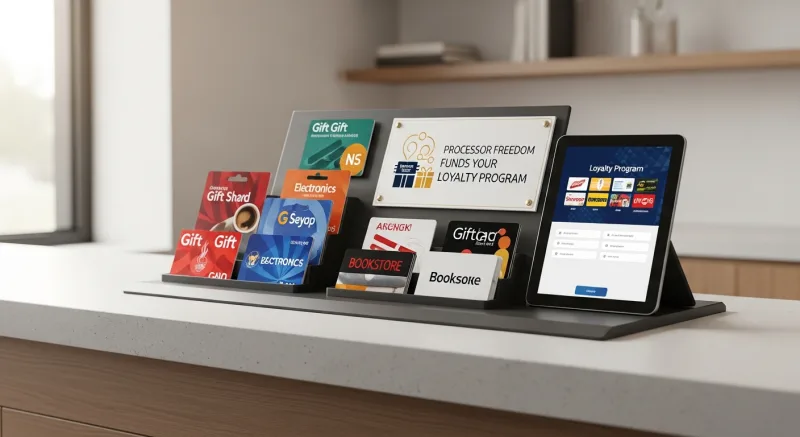
If you are on Toast at 2.99% + $0.15 per transaction, and you process $25,000/month in card sales, you are paying about $10,260/year in processing fees. Switch to a processor-agnostic platform like KwickOS, negotiate an interchange-plus rate, and that drops to about $7,200/year.
The $3,000 you save in processing fees more than covers every free drink, birthday perk, and surprise reward in your loyalty program. You are literally funding customer retention with money that was going to your payment processor.
This is why processor freedom matters even for a small coffee shop. The savings on a single line item — processing fees — pays for the loyalty program that drives 30%+ more visits from your best customers. KwickOS merchants keep the savings because they choose their own processor, saving $3,000 to $8,000 per year depending on volume.
Launch Checklist: Go Live in 7 Days
Ready to ditch the paper cards? Here is your week-by-week launch plan:
Days 1-2: Configure
- Set up digital stamp card in your POS (9 stamps = 1 free drink up to $7)
- Enable phone number enrollment at checkout
- Configure welcome bonus (2 stamps on first visit)
- Link loyalty to gift card and e-gift card accounts
Days 3-4: Train
- Train baristas on the enrollment script: "Want to earn a free coffee? I just need your phone number — takes 10 seconds"
- Role-play the redemption flow so it is fast during rush
- Post small counter sign: "Ask about our new rewards program"
Days 5-7: Launch
- Go live. Enroll every customer who comes through the door
- First-week bonus: 3 stamps (instead of 2) for signing up during launch week
- Post on Instagram/TikTok: "Paper punch cards are dead. Ask your barista about digital rewards"
- Track enrollment rate daily — target 40%+ of transactions in week one
Within 30 days, you should have 200-400 enrolled members depending on your daily volume. Within 90 days, you will start seeing the visit frequency lift in your POS data. That is when the program starts paying for itself — and then some.
Build Your Loyalty Program Today
KwickOS includes built-in loyalty, gift cards, e-gift cards, and CRM — no extra apps, no extra fees. See how coffee shops across 50 states are turning occasional visitors into daily regulars.
Get a Free Demo