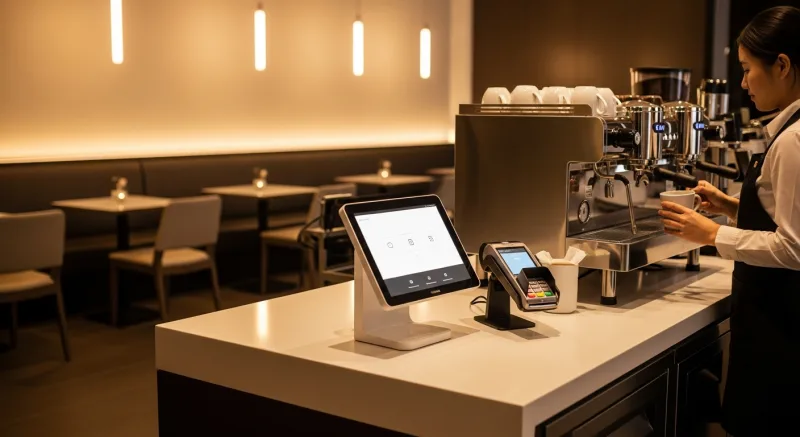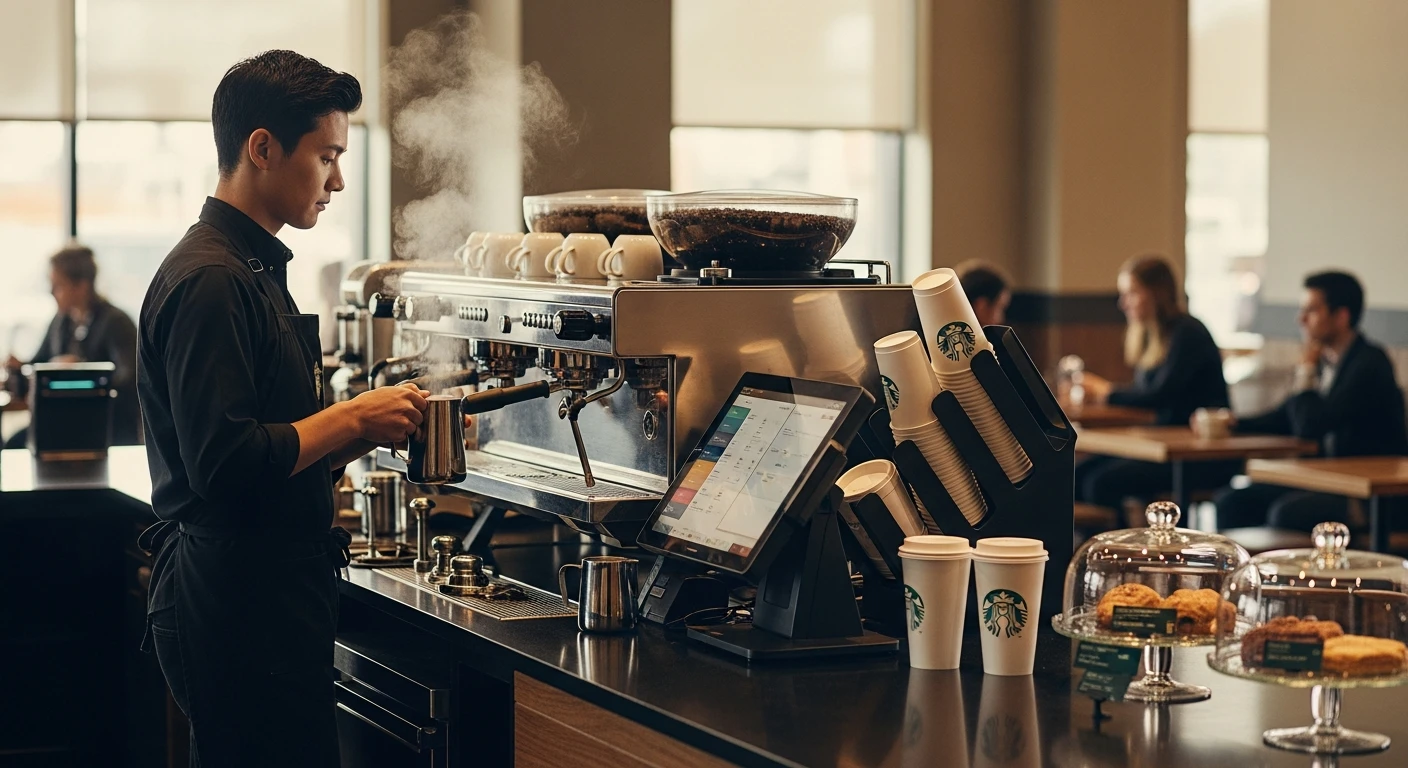
The coffee shop industry is undergoing a technology-driven consolidation. Starbucks, Dutch Bros, and other chains are using integrated technology platforms to systematically outcompete independents on convenience, speed, and loyalty — not on coffee quality. The independent coffee shop serves better coffee in a better atmosphere with better people. But the customer driving to work at 7:15 AM opens the Starbucks app, taps "order ahead," earns stars, and picks up their drink without waiting in line. The independent shop across the street requires the customer to park, wait in line, order at the counter, wait for the drink, and get nothing in return except good coffee. Good coffee is not enough when the alternative is good-enough coffee with zero friction.
An operating system levels this playing field by giving independent coffee shops the same capabilities Starbucks built for $200 million: mobile order-ahead, loyalty with personalized rewards, kitchen display for order routing, digital menu boards, delivery, and a unified platform that ties it all together.
The 7 Capabilities Coffee Shops Need From an OS
1. Mobile Order-Ahead
This is the single most important capability for competing with Starbucks. The ability for a customer to order their drink from their phone, pay, earn loyalty points, and walk in to a ready drink is what drives 31% of Starbucks transactions. KwickMenu provides this capability out of the box — with 500K monthly users already on the platform, your coffee shop's online ordering page exists within an ecosystem that has built-in traffic.
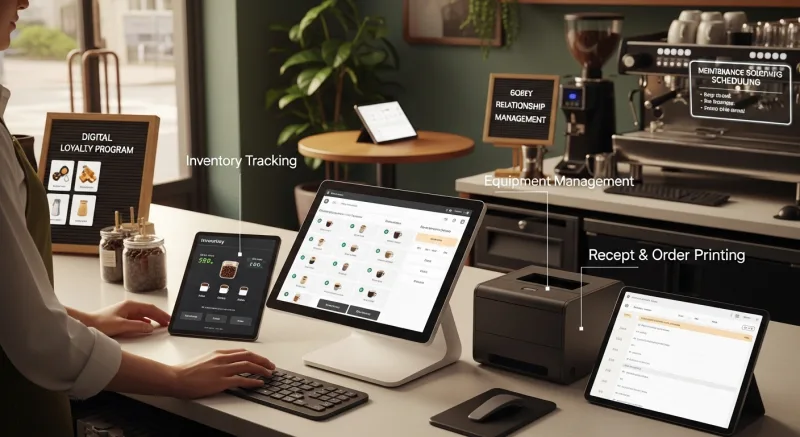
The critical integration point: when a mobile order comes in, it must appear on the barista's KDS immediately, with the customer's name and customization details displayed clearly. The barista makes the drink, marks it complete, and the customer receives a "your drink is ready" notification. This workflow requires the POS, online ordering, and KDS to be the same system — not three systems connected by APIs that introduce delay and failure points.
2. Loyalty That Competes With Starbucks Rewards
Our coffee shop loyalty guide covers program design in detail. In an OS context, the loyalty system is not an add-on — it is woven into every interaction. The barista sees the customer's name, drink history, and point balance when they order in-store. The mobile app shows the same data. The kiosk shows it. The digital signage can even display personalized greetings for loyalty members who walk in (using check-in or geofencing). This level of integration is what Starbucks delivers and what independent shops need.
3. Kitchen Display System for Barista Workflow
A coffee shop KDS is simpler than a restaurant KDS but equally critical. It displays incoming orders (in-store, mobile, and delivery) in a single queue, color-coded by order source and time sensitivity. The barista works through the queue in order, marks drinks complete, and the system updates the customer — whether they are waiting at the counter or tracking their order on their phone.
During morning rush, this KDS-driven workflow replaces the chaos of sticky notes, shouted orders, and lost tickets. Every order is visible, trackable, and attributable to a specific barista for quality and speed metrics.
4. Digital Menu Boards
Coffee shop menus are dynamic: seasonal drinks rotate quarterly, daily specials change, and pricing adjusts for happy hours or promotions. KwickSign displays the current menu on screens throughout the shop, updating in real time when the POS menu changes. Mark the cold brew as sold out, and it disappears from the menu board, the mobile ordering page, and the kiosk simultaneously.
5. Subscription Management
Coffee subscriptions (Daily Drip Club, Latte Lovers, etc.) are the most powerful retention tool against Starbucks. An OS manages subscriptions as part of the core platform: automatic monthly billing, per-visit redemption tracking, usage analytics, and renewal management. When a subscriber orders their daily coffee, the system recognizes them and applies the subscription — no special code, no manual override, no friction.
6. Inventory and Waste Tracking
Coffee shops waste 10-15% of their milk inventory daily through overpouring, expired product, and training baristas. An OS tracks theoretical consumption (based on recipes and sales) against actual consumption (based on inventory counts) and identifies the variance. If 200 lattes were sold (requiring 100 liters of milk) but 120 liters were consumed, the 20-liter variance is flagged immediately — not discovered during the next wholesale order.
7. Delivery at Viable Margins
Coffee delivery is growing (especially iced drinks and food combos) but margins are razor-thin at DoorDash's 25% commission. A $6 iced latte that costs $1.20 to make has $4.80 in margin — $1.50 of which goes to DoorDash. KwickDriver at $2 flat keeps $2.80 more margin per drink. On 20 delivery orders per day, that is $56/day saved — $1,680/month.
Hybrid Cloud: Morning Rush Insurance
Coffee shops live and die on the morning rush. Between 6:30-9:00 AM, a typical shop does 40-50% of its daily revenue. An internet outage during that window is catastrophic for cloud-only systems. Toast and Square both require internet for core functions — payment processing, loyalty lookups, mobile order receipt, and KDS display all depend on connectivity.
KwickOS runs on hybrid local+cloud. Every function operates locally at 1ms latency. Mobile orders queue locally when connectivity drops and process when it returns. Payments process through the local payment terminal. Loyalty lookups happen against the local database. The morning rush proceeds without interruption regardless of internet status.
Processor Freedom: Coffee Shop Math
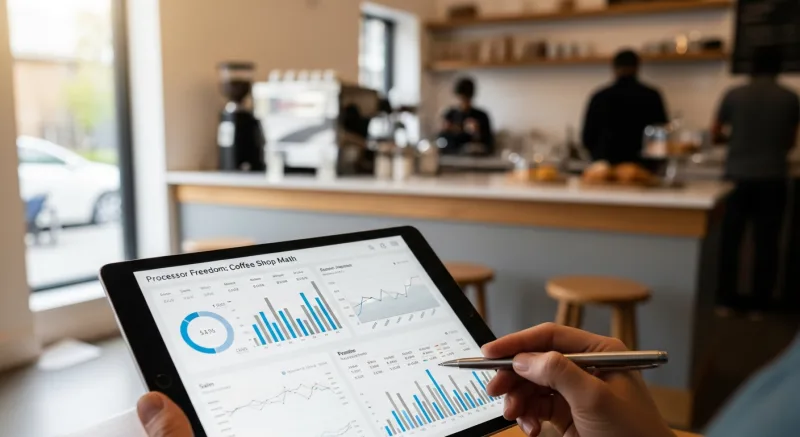
Coffee shops process hundreds of small transactions daily. At $5 average ticket and 300 transactions/day, Toast's 2.99% + $0.15 processing rate costs: ($5 x 2.99%) + $0.15 = $0.30 per transaction x 300 = $90/day = $2,700/month. With KwickOS and a competitive processor at 2.2% + $0.10: ($5 x 2.2%) + $0.10 = $0.21 per transaction x 300 = $63/day = $1,890/month. That is $810/month in processing savings — $9,720/year. For a coffee shop with 5% net margins, that processing savings represents a massive bottom-line impact.
Feature Comparison
| Capability | Starbucks | Toast/Square | KwickOS |
|---|---|---|---|
| Mobile Order-Ahead | Yes | Add-on | KwickMenu (included) |
| Loyalty Program | Yes | $45-75/month | Included |
| Kitchen Display | Yes | $30-50/month | Included |
| Digital Signage | Yes | $25-50/month | KwickSign (included) |
| Fingerprint Auth | No | No | Yes (1:N) |
| Offline Mode | Limited | Limited | Full hybrid |
| Processor Choice | N/A | Locked | Any processor |
Implementation: Coffee Shop OS in 5 Days
Day 1: Installation and menu setup (1-3 hours). Import existing menu, configure modifiers (milk options, sizes, shots, syrups), set up employee accounts with fingerprint enrollment.
Day 2: Staff training (1-2 hours). Baristas learn the POS and KDS workflow. The web-based interface is intuitive — Shogun reported staff proficiency in under 5 minutes.
Day 3: Activate online ordering via KwickMenu. Configure the mobile order-ahead workflow: order → KDS → barista prep → "ready" notification.
Day 4: Launch loyalty program. Configure points, subscriptions, and birthday rewards. Set up digital signage templates.
Day 5: Go fully live with all systems. Monitor the morning rush with all OS capabilities active. Fine-tune any workflow details.
By day 30, measure: mobile order adoption rate (target 15-20%), loyalty enrollment rate (target 50% of transactions), subscription sign-ups (target 20 in the first month), and the combined cost savings from consolidating tech stack + processing savings.
Match Starbucks' Technology Without Their $200M Budget
KwickOS gives independent coffee shops mobile ordering, loyalty, KDS, signage, and delivery in one platform. Compete on convenience and technology, not just coffee quality.
Book Your Free Demo