
 Tom Jin
Pull up your POS reports. Look at last month's customer transactions.
Now sort by total spend, highest first.
You will see something that should make your stomach drop: roughly 20% of your customers generated 80% of your revenue. The other 80% of shoppers? They contributed almost nothing to your bottom line — yet they consumed the same staff attention, the same floor space, the same promotional emails.
Here's the thing: you are treating a $4,200/year customer exactly the same as a $47/year browser. Same checkout experience. Same generic "20% off everything" blast. Same loyalty earning rate.
That is not marketing. That is laziness disguised as fairness.
Customer segmentation fixes this. It uses the transaction data your POS already collects to sort buyers into groups based on how they actually behave — then lets you market to each group differently. The result? Industry research suggests that segmented campaigns generate 3-5x higher revenue per message than one-size-fits-all blasts.
And that's not all: once you see your customers as distinct segments rather than an undifferentiated crowd, every decision in your business gets sharper — from what to stock, to when to schedule staff, to how to spend your next marketing dollar.
Why Most Retailers Fly Blind (And How Much It Costs)
Most independent retailers have no formal segmentation strategy. They know their regulars by face. They have a vague sense of who spends big. But they cannot answer basic questions like:
- How many customers have not returned in 60 days?
- Which customers spend more than $200/visit but only come once a month?
- Who are the customers that buy only during sales — and are they actually profitable?
- Which first-time buyers from last quarter became repeat customers?
Without answers to these questions, you are making critical inventory, staffing, and marketing decisions based on gut instinct. And gut instinct, according to restaurant and retail industry data, leads to approximately 30% of marketing budgets being wasted on the wrong audience.
But it gets worse: while you ignore your best customers, your competitors are actively poaching them. A loyalty program from a competitor that recognizes and rewards high spenders will eventually pull your Champions away — because you never made them feel like Champions in the first place.
RFM Analysis: The Framework That Changes Everything
RFM stands for Recency, Frequency, and Monetary value. It is the simplest, most powerful segmentation framework for retail — and your POS data already contains everything you need to run it.
Here is how it works:
- Recency: How many days since their last purchase? Score 5 (bought this week) to 1 (90+ days ago).
- Frequency: How many transactions in the last 12 months? Score 5 (20+ visits) to 1 (1-2 visits).
- Monetary: What is their total spend in the last 12 months? Score 5 (top 20% of spenders) to 1 (bottom 20%).
Every customer gets a three-digit score. A "5-5-5" is your absolute best customer — recent, frequent, high-spending. A "1-1-1" barely registers. And the magic happens in the patterns between these extremes.
Here's the thing: you do not need a data science degree for this. A POS system with built-in CRM calculates these scores automatically from your transaction history. Every time a customer checks out — whether they tap a card, scan a loyalty membership, or redeem a gift card — their RFM score updates in real time.
The 6 Segments That Matter (And What to Do With Each)
While RFM technically creates 125 possible score combinations, you only need to manage 6 actionable segments:
1. Champions (RFM: 5-5-5 to 4-4-4)
These are your gold. They buy often, spend big, and visited recently. Typically 8-12% of your customer base, generating 35-45% of revenue.
Strategy: Make them feel like royalty. Exclusive early access to new products. VIP-only events. Personal thank-you messages. Birthday surprises that go beyond a generic coupon. They do not need discounts to buy — they need recognition.
At Diva Nail Beauty, Champions receive priority booking, a dedicated stylist preference, and members-only service packages. The result: their top-tier clients average 2.4 visits per month versus the store average of 0.8.
2. Loyal Regulars (RFM: 3-4-3 to 4-3-3)
Consistent visitors with moderate spend. They like you. They keep coming back. But they have not unlocked their full spending potential.
Strategy: Upsell and cross-sell. Product recommendations based on purchase history. "Customers who bought X also loved Y" messaging. Bundle offers that increase average transaction value. Loyalty points that reward bigger baskets.
3. High-Value Occasionals (RFM: 3-2-5 to 4-2-4)
They spend big when they come — they just do not come often enough. These are the customers worth obsessing over because even one additional visit per quarter could mean thousands in extra revenue.
Strategy: Increase visit frequency. Time-sensitive offers ("Back in stock — this week only"). Event invitations. Seasonal reminders tied to their purchase history. If they bought winter gear in November, message them in October: "Your favorites are back — first pick before the crowds."
4. New Customers (RFM: 5-1-varies)
First or second purchase, recent. The most critical segment because their next 30 days determine if they become a repeat buyer or disappear forever.
Strategy: Aggressive onboarding. Welcome email with store highlights. Second-purchase incentive ("$10 off your next visit within 14 days"). Loyalty enrollment at checkout — and here is where your loyalty program earns its keep. Industry data shows that customers enrolled in loyalty on their first visit have 2-3x higher return rates.
E-gift cards are a powerful new-customer acquisition tool here. When an existing customer sends an e-gift card, the recipient enters your ecosystem with a tracked transaction, an email address, and a reason to visit. That is a warm lead you did not pay for.
5. At-Risk (RFM: 1-3-3 to 2-4-4)
Previously loyal customers whose recency score has dropped. They used to come regularly. They stopped. You have a narrow window — typically 30 to 60 days — before they are gone for good.
Strategy: Win-back campaigns. "We miss you" messaging with a specific incentive. Not a generic 10% off — a personalized offer based on their purchase history. "Your favorite [product] is 20% off this weekend — just for you." Urgency and specificity matter here.
6. Lost (RFM: 1-1-varies to 1-2-varies)
No visit in 90+ days. Low frequency. The hardest and most expensive segment to reactivate — but not impossible.
Strategy: Low-cost reactivation attempts. One or two messages maximum. A bold offer ("$25 gift card — no purchase required, expires in 7 days"). If they don't respond, stop spending on them and redirect those marketing dollars to your Champions and New Customers.
Mining Your POS Data: Where the Gold Hides
Your point-of-sale system processes every transaction — every item scanned, every payment method, every time stamp. That data is a goldmine if you know how to extract insights from it.
Here is what to look for beyond basic RFM scores:
Category affinity: Which product categories does each customer gravitate toward? A customer who buys skincare every visit but never cosmetics tells you something. A customer who only buys during clearance events tells you something else entirely.
Day and time patterns: Do your Champions shop Saturday mornings? Do your deal-seekers come Friday evenings during markdowns? Staffing and promotional timing should match segment behavior.
Payment method preferences: Customers who use gift cards and stored value have already committed future spending to your store. They are inherently stickier. Track who loads gift cards for themselves — that is pre-committed revenue and a sign of loyalty.
Basket composition: Average items per transaction varies wildly by segment. Champions might average 4.7 items per visit. Occasional browsers average 1.2. This tells you whether your cross-merchandising is working and for whom.
At T. Jin China Diner, with 15 locations and 75 terminals, centralized customer data reveals segment differences across locations. A Champion at one store might be an unknown at another — unless the POS connects customer profiles across all locations. Multi-location operators need this cross-store visibility to avoid treating a loyal system-wide spender like a first-time visitor.
Targeted Promotions That Actually Work
Once you have segments defined, your promotional strategy transforms from shouting into a megaphone to having individual conversations.
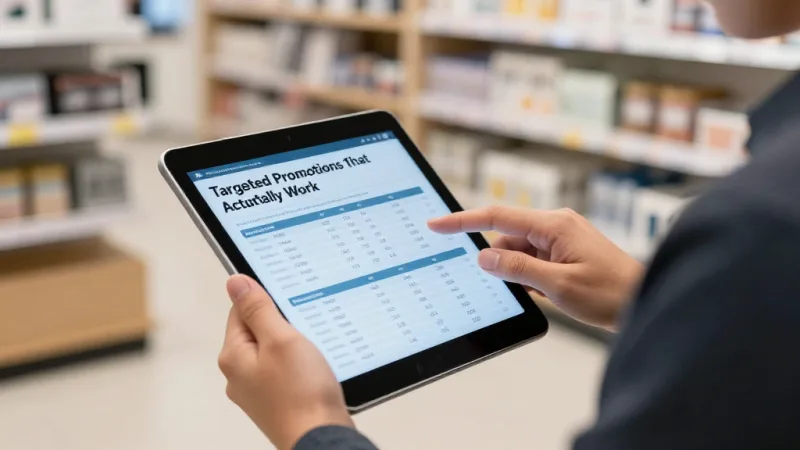
For Champions: Exclusive access, not discounts. "New collection preview — Champions only, 48 hours before public launch." These customers buy at full price. Discounting to them destroys margin for zero incremental volume.
For Loyal Regulars: Points multiplier events. "3x points this weekend on all accessories." This moves them up in spend without requiring a price reduction. Your loyalty points system does the heavy lifting — members earn toward rewards while you maintain full margin.
For At-Risk: The "last chance" framework works. "Your 847 loyalty points expire in 14 days — visit now to redeem." Loss aversion is powerful. They worked for those points. Watching them vanish creates urgency that generic coupons cannot match.
And that's not all: gift cards become a strategic weapon in segmented marketing. For your High-Value Occasionals, a "Spend $150, get a $20 gift card" offer brings them back sooner. For New Customers, "Join loyalty today, receive a $5 e-gift card" drives enrollment. The gift card guarantees a return visit — it is a prepaid commitment to come back.
The Checkout Experience: Where Segmentation Meets Reality
Segmentation is worthless if it stays in a spreadsheet. The real power emerges when your POS recognizes customers at checkout and adjusts the experience accordingly.
Here is what a segment-aware checkout looks like:
- Champion arrives: POS flags VIP status. Staff greets by name. Loyalty balance displays. "Would you like to use your $47 in rewards today?" Personalized product recommendation based on purchase history appears on screen.
- New Customer checks out: POS prompts loyalty enrollment. "Save 10% today by joining our free rewards program — just need your phone number." Captures their data for future segmentation.
- At-Risk customer returns: POS triggers a "welcome back" flag. Staff knows to mention the loyalty balance they have been sitting on. A special offer prints on the receipt to accelerate the next visit.
This is where processor-agnostic POS systems shine. When your POS integrates CRM, loyalty, gift cards, and checkout into a single platform, customer recognition happens automatically. There is no separate system to look up, no manual tagging, no friction between data and action.
KwickOS processes this in 1ms locally — the customer profile, loyalty balance, segment tag, and personalized prompt all appear before the barcode scan is done. Hybrid local+cloud architecture means this happens even if your internet drops. Your best customer does not become invisible because of a WiFi glitch.
Personalized Outreach Without Creeping People Out
There is a line between "they remember me" and "they are watching me." Segmented marketing works when it feels helpful, not surveillance-like.
Good: "Based on your recent purchase of [product], you might love [related product] — 15% off this week for loyalty members."
Bad: "We noticed you visited on Tuesday at 3:47 PM and spent 12 minutes in aisle 3 before buying..."
The rule: reference what they bought, not how they behaved in-store. Purchase history feels like helpful memory. Behavioral tracking feels invasive.
Keep outreach frequency aligned with segment value:
- Champions: 2-3 touches per month (they want to hear from you)
- Loyal Regulars: 2 per month
- Occasional: 1 per month maximum
- At-Risk: 1 win-back sequence, then silence
- Lost: 1 reactivation attempt, then remove
Measuring What Matters: Segmentation KPIs
Once you implement segmentation, track these metrics monthly:
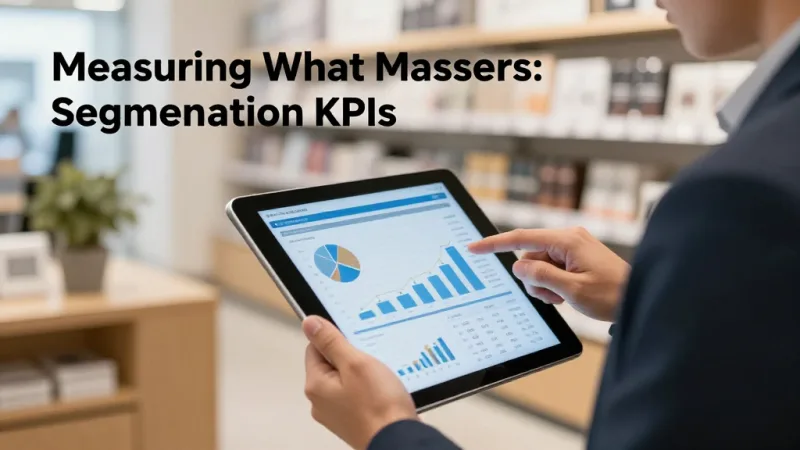
- Segment migration rate: How many customers moved UP a segment this month? If your New-to-Loyal conversion exceeds 25%, your onboarding works.
- Champion retention: What percentage of last quarter's Champions are still Champions? Below 80% means you are losing your best customers.
- Revenue concentration: If your top 10% generates more than 50% of revenue, you are dangerously dependent. Healthy is 35-45%.
- At-Risk recovery rate: What percentage of At-Risk customers returned after your win-back campaign? Industry average is 12-18%. Above 25% is exceptional.
- Gift card cross-segment acquisition: How many gift card recipients became repeat customers? This measures whether your customers are effectively recruiting new buyers for you.
Your POS dashboard should display these without requiring manual exports or spreadsheet gymnastics. At Crafty Crab Seafood, with 19 locations and 152 terminals, segment performance is visible in a single dashboard — broken down by location, by time period, and by promotion type. One-click menu sync means promotional pricing changes for specific segments roll out across all stores simultaneously.
The Gift Card and Loyalty Connection
Customer segmentation and your gift card program are deeply intertwined — and most retailers miss this connection entirely.
Gift card buyers are your hidden marketing team. A customer who purchases gift cards for others is essentially saying "I trust this brand enough to stake my personal reputation on it." That customer belongs in your Champion segment regardless of their personal spend — because they are generating new customers at zero acquisition cost.
Track these gift card metrics by segment:
- Which segment buys the most gift cards? (Usually Champions and Loyal Regulars)
- What percentage of gift card recipients become repeat buyers? (Industry average: 40-55%)
- Do gift card recipients spend above the card value? (Industry data suggests 60-70% do, averaging 20% over the card balance)
Your loyalty and membership program amplifies segmentation further. Points balances create switching costs. Tier status creates aspiration. Exclusive member pricing creates perceived insider access. Together, these mechanisms make your best segments stickier while giving lower segments a clear path upward.
Use your loyalty program ROI calculator to model the impact of segmented rewards — giving Champions 2x points versus standard earners can cost less than a blanket discount while delivering far higher retention.
Implementation: Week-by-Week Roadmap
Week 1: Audit your POS data. How many customers are identifiable (linked to loyalty, email, or phone)? If less than 30% of transactions are linked to a known customer, focus on enrollment first. You cannot segment what you cannot identify.
Week 2: Run your first RFM analysis. Most modern POS systems with CRM can generate this automatically. If yours cannot, export transaction data and score manually using a spreadsheet. Tag your segments.
Week 3: Design one campaign per segment. Start simple: a Champion appreciation message, a New Customer welcome sequence, and an At-Risk win-back offer. Three campaigns, three segments, three distinct messages.
Week 4: Measure and adjust. Which segment responded? What was the revenue per message? Compare segmented results against your last generic blast. The difference will convince you to never send an undifferentiated promotion again.
A processor-agnostic POS like KwickOS lets you execute this entire roadmap within the platform — no third-party email tools, no CSV exports, no integration headaches. CRM, loyalty, gift cards, email, SMS, and checkout all share the same customer record. Change a segment tag and every touchpoint updates automatically.
Know Your Customers. Grow Your Revenue.
KwickOS gives you built-in customer segmentation, loyalty, gift cards, and targeted marketing — all from one platform. No extra software. No integration fees.
Get a Free Demo