
 Tom Jin
Last month, a restaurant owner showed me his tech stack. He was paying $847 per month across six different subscriptions. A POS system. A separate online ordering platform. A standalone loyalty app. A scheduling tool. A digital signage service. And a delivery management dashboard.
Six tools. Six monthly bills. Six logins. And none of them talked to each other.
But it gets worse: three of those tools duplicated features already included in his POS system. He was paying $312 per month for functionality he already owned.
That is $3,744 per year — gone. Not because he made bad decisions, but because nobody ever sat down and mapped out what a restaurant technology budget should actually look like.
Here's the thing: there is no shortage of technology to buy. Every week a new startup launches a "revolutionary" restaurant tool. The hard part is not finding technology. The hard part is knowing what to spend, where to spend it, and what to skip entirely.
After 30 years in IT and 20 years working with restaurant operators, I have seen every mistake in the book. This guide is the technology budget framework I wish someone had given me when I opened my first restaurant.
The 3-5% Rule: How Much Is Enough?
According to restaurant industry data, the average restaurant spends between 3% and 5% of gross revenue on technology. That number has climbed steadily over the past five years as digital ordering, contactless payment, and labor management tools have shifted from "nice to have" to "cannot operate without."
Here is what that looks like in real dollars:
| Annual Revenue | 3% Budget | 5% Budget | Monthly Range |
|---|---|---|---|
| $500,000 | $15,000 | $25,000 | $1,250 - $2,083 |
| $1,000,000 | $30,000 | $50,000 | $2,500 - $4,167 |
| $2,000,000 | $60,000 | $100,000 | $5,000 - $8,333 |
| $5,000,000 | $150,000 | $250,000 | $12,500 - $20,833 |
And that's not all: those numbers include both hardware (one-time purchases) and software (recurring subscriptions). Most restaurant owners only track the monthly subscriptions and forget about hardware depreciation — which means they are underestimating their actual technology spend by 30-40%.
A single POS terminal costs $1,200 to $2,500. A kitchen display system is $800 to $1,500 per screen. Payment terminals run $300 to $600 each. Even if you only buy this equipment once every five years, the annualized cost is $500 to $1,000 per year per station.
The Priority Stack: Where Every Dollar Should Go
Not all technology delivers the same return. Here is the priority order — spend on Tier 1 before touching Tier 2, and Tier 2 before Tier 3.
Tier 1: Non-Negotiable (60% of Budget)
These systems directly touch revenue and operations every single day. Skipping or underinvesting here costs you money immediately.
POS System — $150-$350/month software + $2,000-$6,000 hardware
Your POS is the central nervous system of your restaurant. Every transaction, every order, every report flows through it. This is the last place to cut corners.
But here's the trap most owners fall into: they pick a POS based on the monthly software fee and ignore the processing cost. A system that charges $69/month but locks you into 2.99% + $0.15 per transaction costs you far more than a system at $149/month that lets you choose any processor.
At KwickOS, we have watched operators save $3,000 to $8,000 per year just by switching to a processor-agnostic POS and negotiating interchange-plus rates. That single decision often covers the entire annual cost of the POS software — and then some.
The checkout experience matters too. A modern POS should handle split payments, partial tenders, gift card redemptions, e-gift card sales, and loyalty point lookups — all in one seamless flow. If your cashiers need to switch between screens or apps to complete a transaction, your POS is slowing you down.
Payment Terminals — $300-$600 per unit
EMV chip and contactless (NFC) support is mandatory. Industry data shows that over 68% of customers now prefer tap-to-pay. If your terminal does not support contactless, you are creating friction at the exact moment the customer decides whether to come back.
Kitchen Display System (KDS) — $800-$1,500 per screen + $50-$100/month
Paper ticket printers still work. But a KDS cuts ticket times by 20-40%, eliminates misreads, and gives you data on station performance. Shogun Japanese Hibachi switched to KDS with custom station routing and got new staff up to speed in under 5 minutes — because the screen tells the cook exactly what to make, in order, with timers.
Online Ordering — $0-$200/month (first-party) or 15-30% commission (third-party)
If you are still relying entirely on DoorDash and UberEats, you are handing 15-30% of every delivery order to a middleman. First-party ordering through a platform like KwickMenu costs a fraction — $2 flat fee + $6.99 per delivery with KwickDriver versus 25% commission on every order.
Here's the thing: the math is not even close. A restaurant doing $8,000/month in delivery orders saves roughly $1,600/month by switching from third-party commissions to first-party ordering. That is $19,200 per year — more than most restaurants spend on their entire technology stack.
Tier 2: High-Impact Add-Ons (25% of Budget)
These systems amplify revenue or reduce costs, but you can survive without them in the early stages.
Loyalty and Membership Program — $50-$150/month
According to restaurant industry data, loyalty program members visit 35-40% more often and spend 20% more per visit than non-members. A points-based system that integrates with your POS checkout — where customers earn and redeem without extra steps — is the lowest-friction way to drive repeat business.
Tiger Sugar runs their loyalty program through KwickOS kiosks. Customers earn points on every order, and the kiosk prompts them to redeem at checkout with minimal extra steps. No separate app to download. No card to carry. Just a phone number at the register.
And don't overlook the connection between gift cards and loyalty. When a customer buys a $50 gift card, they are pre-committing to return. When that gift card purchase also earns loyalty points, you have created two reasons for them to come back. The best loyalty programs reward both the buyer and the recipient.
Digital Signage — $30-$80/month software + $400-$1,200 per screen
A printed menu board costs $200 to reprint every time you change a price. A digital menu board costs $0 to update — and you can schedule different menus for breakfast, lunch, and dinner automatically. KwickSign syncs directly with the POS menu database, so a price change in one place updates everywhere: the register, the kiosk, the online menu, and the overhead screens.
Employee Scheduling — $50-$150/month
Manual scheduling costs managers 4-6 hours per week. A scheduling tool with labor forecasting, shift swapping, and overtime alerts cuts that to under an hour — and reduces labor overspend by 3-5% according to industry benchmarks.
Tier 3: Growth Multipliers (15% of Budget)
These are investments that compound over time. Not urgent, but transformative if implemented well.
Self-Ordering Kiosks — $1,800-$4,200 per unit
Kiosk orders average $4-$8 more per ticket than counter orders, according to restaurant industry data. That is because screens do not feel awkward suggesting a large drink or an extra side. Rockin' Rolls Sushi Express runs 49 iPad self-ordering stations across 3 locations. Baked Cravings deployed a self-serve kiosk at Lego Land for 24-hour operation with zero labor cost.
CRM and Marketing Automation — $50-$200/month
Knowing who your customers are, what they order, and when they last visited lets you send targeted messages instead of generic blasts. A birthday offer that arrives the week before someone's birthday converts at 3-5x the rate of a generic coupon, according to marketing industry data.
Advanced Reporting and Analytics — Often included in POS, or $50-$100/month
Real-time dashboards, food cost tracking, and labor-to-revenue ratios. T. Jin China Diner manages 15 locations with 75 terminals through a single dashboard — monitoring sales, labor, and inventory across every store in real time from anywhere.
The Hidden Cost Nobody Talks About: Vendor Lock-In
Here is the most expensive technology mistake a restaurant owner can make — and it will not show up on any invoice.
It is choosing a platform that locks you in.
Toast requires Toast Payments. Square requires Square Payments. Clover routes through Fiserv. When your POS vendor controls your payment processing, you lose the ability to negotiate. You cannot get competing quotes. You cannot switch processors without switching your entire POS system.
But it gets worse: the processing fee difference between a locked system and a processor-agnostic one is typically 0.5% to 0.8% on every transaction. On $40,000/month in card sales, that is $2,400 to $3,840 per year. Over a three-year contract? $7,200 to $11,520 in unnecessary fees.
That is not a technology cost. That is a tax for choosing the wrong vendor.
Crafty Crab Seafood operates 19 locations with 152 terminals on KwickOS. Because the platform is processor-agnostic, they negotiated interchange-plus rates across all 19 stores — saving tens of thousands annually compared to what a locked POS would have cost them.
Use our processing fee calculator to see exactly what processor lock-in is costing your operation.
Budget Template: Single-Location Restaurant ($1.2M Revenue)
Here is a realistic first-year technology budget for a single-location restaurant doing $1.2 million in annual revenue, targeting the 3.5% benchmark ($42,000/year).
| Category | One-Time Hardware | Monthly Software | Annual Total |
|---|---|---|---|
| POS System (2 terminals) | $4,000 | $199 | $6,388 |
| KDS (2 screens) | $2,400 | $79 | $3,348 |
| Payment Terminals (2) | $900 | $0 | $900 |
| Receipt Printers (3) | $750 | $0 | $750 |
| Online Ordering | $0 | $99 | $1,188 |
| Loyalty/Gift Cards | $0 | $59 | $708 |
| Digital Signage (2 screens) | $1,600 | $49 | $2,188 |
| Employee Scheduling | $0 | $79 | $948 |
| Networking (router, switches) | $500 | $0 | $500 |
| Total | $10,150 | $564 | $16,918 |
That is $16,918 — roughly 1.4% of revenue. Well below the 3-5% benchmark because we chose an all-in-one platform instead of piecing together six separate tools. The owner at the start of this article was paying $10,164/year in subscriptions alone. This stack delivers more functionality for 40% less.
And here is the open loop: what if you are a multi-location operator? The savings multiply.
Multi-Location Math: Why Platform Choice Matters More at Scale
When Crafty Crab Seafood scaled from 1 to 19 locations, they did not need 19 separate technology stacks. They needed one platform that scaled. KwickOS gave them centralized menu management (one-click sync across 152 terminals), unified reporting, and negotiated processing rates at volume.
Here is the per-location cost comparison at scale:
| Locations | Separate Vendors (per loc/year) | Unified Platform (per loc/year) | Annual Savings |
|---|---|---|---|
| 3 locations | $16,000 | $11,000 | $15,000 |
| 10 locations | $15,000 | $9,500 | $55,000 |
| 19 locations | $14,000 | $8,200 | $110,200 |
The savings come from three places: volume-negotiated processing rates, eliminated subscription overlap, and reduced IT labor. T. Jin China Diner monitors 15 stores and 75 terminals from a single dashboard — instead of hiring an IT person per location.
The ROI Timeline: When Each Investment Pays Back
Not every technology purchase delivers returns on the same schedule. Understanding the payback period helps you prioritize spending.
| Technology | Typical Cost | Monthly Benefit | Payback Period |
|---|---|---|---|
| Processor-agnostic POS switch | $4,000-$6,000 | $250-$667 (processing savings) | 6-16 months |
| First-party online ordering | $0-$500 setup | $800-$2,000 (saved commissions) | 1 month |
| Self-ordering kiosks | $1,800-$4,200 | $600-$1,200 (higher tickets + labor) | 2-7 months |
| KDS (kitchen displays) | $800-$1,500 | $200-$400 (speed + accuracy) | 2-8 months |
| Loyalty program | $0-$200 setup | $300-$800 (repeat visits) | 1-3 months |
| Digital signage | $1,600-$2,400 | $150-$300 (promo uplift) | 5-16 months |
| Gift card / e-gift card program | $0-$100 setup | $400-$1,500 (prepaid revenue) | 1 month |
Notice the pattern: the fastest paybacks come from revenue recovery (eliminating commission overpayment and processing markup) rather than from revenue generation. Cut waste first, then invest in growth.
5 Budget Mistakes That Cost Restaurants Thousands
After helping 5,000+ businesses deploy technology at KwickOS, these are the five most expensive mistakes I see.
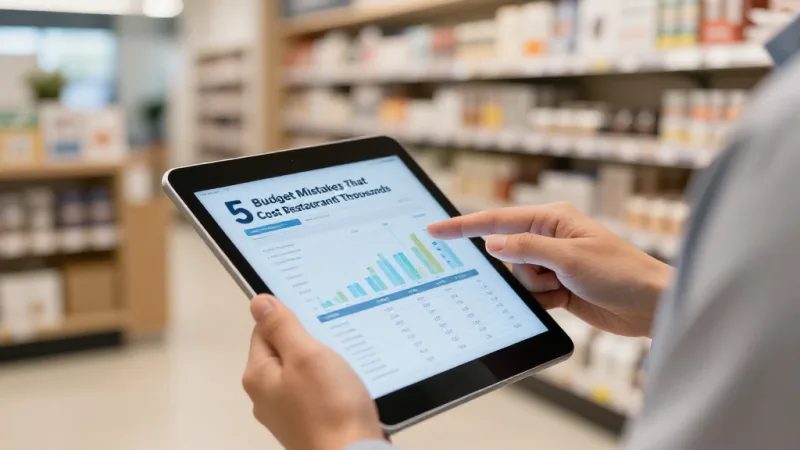
1. Buying best-of-breed instead of best-of-suite. Six separate tools that each do one thing well sounds smart on paper. In practice, you pay for overlapping features, data does not sync, and you spend hours reconciling reports. An all-in-one platform costs less, integrates tighter, and gives you one vendor to call when something breaks.
2. Ignoring processing fees in the total cost of ownership. A POS that charges $69/month but takes 2.99% + $0.15 per swipe costs more than a POS at $199/month with interchange-plus at 2.2%. Run the numbers in our total cost of ownership calculator before signing anything.
3. Leasing hardware. Equipment leases are almost always a bad deal. A $1,200 terminal leased at $49/month for 48 months costs $2,352. You pay nearly double and do not even own it at the end. Buy outright. If cash flow is tight, most vendors offer interest-free payment plans that are still cheaper than leasing.
4. Skipping gift cards and loyalty in Year 1. Operators often view gift card programs and loyalty as "later" investments. But gift cards generate immediate prepaid revenue — every $50 gift card sold is $50 in your bank account today for a meal you have not yet prepared. And industry research suggests that 10-15% of gift card value is never redeemed (called breakage), which goes straight to your bottom line. Diva Nail Beauty launched gift cards and loyalty through KwickOS across 4 stores and saw a 90% efficiency improvement in tracking repeat customers and commissions.
5. Not budgeting for training. Technology is only as good as the people using it. Budget 2-4 hours of paid staff training for any new system. Shogun Japanese Hibachi got new staff proficient on KwickOS in under 5 minutes thanks to intuitive design — but that is the exception, not the rule. Most systems need dedicated training time.
The Vendor Evaluation Checklist
Before signing any technology contract, ask these questions:
- Is the POS processor-agnostic? Can I use any payment processor, or am I locked into the vendor's processing? (Compare KwickOS vs locked POS systems)
- What happens when the internet goes down? KwickOS runs on a hybrid local+cloud architecture — 1ms local latency, full offline capability. Many cloud-only POS systems become paperweights during outages.
- How many separate subscriptions am I paying for? Count every tool: POS, online ordering, loyalty, scheduling, signage, reporting. Then check if one platform covers all of them.
- What does the total cost look like over 3 years? Include hardware, software, processing fees, and any early termination penalties. The cheapest monthly subscription often has the highest total cost.
- Can I add modules later without replacing everything? You should be able to start with POS and add kiosks, signage, and online ordering as you grow — without migrating data or retraining staff.
- Is support available in my language? KwickOS offers 24/7 support in English, Chinese, and Spanish. If your staff speaks multiple languages, your POS should too.
Use our POS comparison worksheet to score vendors side by side.
What to Expect in 2026 and Beyond
Technology budgets are not static. Here are the trends shaping restaurant tech spending right now:
- AI-powered forecasting is moving from enterprise to SMB. Expect labor scheduling and inventory ordering tools that predict demand based on weather, events, and historical patterns.
- Embedded payments — payment processing built directly into POS software — will make processor-agnostic platforms even more important, as vendors compete on transparency rather than captive rates.
- Self-service everything. Kiosks, QR ordering, and mobile checkout will continue replacing counter interactions. Budget for at least one self-service touchpoint within the next 12 months.
- Gift card and loyalty integration is becoming table stakes. Platforms that do not offer integrated gift card sales, e-gift cards, and points-based loyalty will lose market share to those that do.
Explore our full restaurant technology solutions to see what a modern, unified stack looks like.
Build Your Technology Budget the Smart Way
KwickOS gives you POS, KDS, online ordering, gift cards, loyalty, kiosks, signage, and delivery — all in one platform, with any processor you choose. Stop paying for six tools when one does it all.
Get a Free Technology Assessment